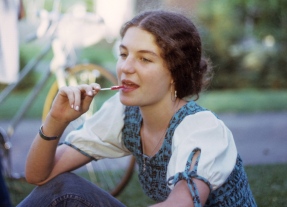
When I decided to become a career woman, I thought I had no role models in my family. My parents (who sometimes considered me the black sheep) would have agreed. Imagine my surprise to find a matriarchal family and three generations of businesswomen women among my Swedish family in Kansas City!
My great-aunt Edith who was a stenographer, secretary, and notary public was a fixture at family gatherings. When I knew her, she was living in California with her two brothers who also were not married. Until their father died, they had lived their whole lives in the family home in Kansas City. I sensed that though my family respected my uncles, they felt sorry for Aunt Edith. It certainly was never suggested to me that instead of getting married and being supported by a husband, I could become a self-supporting working woman like my aunt. Continue reading “Strong Female Role Models among Swedish Immigrant Ancestors in Kansas City by Carol P. Christ”
It has been a marvelous experience for me, these past few years, to be connected with this community Feminism and Religion. Still, sometimes even good things have to come to an end. I’ve decided to discontinue my regular blog contributions. The organizers have graciously allowed me the possibility to do a guest blog in the future; so I may yet contribute.
Here’s the thing: I don’t think folks who read this blog know fully just what goes on—seemingly seamlessly in the background. So before I go, let me expose how this has been for me, to give greater credibility to my first sentence: it has been a marvelous experience.
I was asked to start blogging with FAR while living in another country, another time zone, and inconsistent internet access. Truth be told, inconsistency characterizes my life-work since I travel extensively and cannot predict the regularity of the internet in some of the parts of the world where I might be located. Still I made the commitment to blog twice a month, every first and third week. Continue reading “Good Things Come to an End by amina wadud”
Women’s bodies are the preferred territory in which religious oppression becomes cruelly evident. Misogynist narratives in religions are always addressed to them: decency, honor, virtue, holiness, discretion, and shame are embodied in us, We pay for the absence of these patriarchal principles of control, on our bodies too: imprisonment, slut-shamming, bullying, rape, punishment, mutilation, and death.
Feminism makes sense in this world because women allow their struggles to push the boundaries that have been imposed on us by patriarchy, on our minds, spirits and bodies. The right to decide issues concerning our bodies is not only linked to reproductive rights and planning parenthood, but also to the experience of sexuality on the terms we freely decide and the way we interact with our body and relate to it. Freeing women from the traditions’ narratives of oppression accumulated over hundreds of years and designed to indoctrinate a hatred against our bodies is one of the purposes of feminism, including the work of feminists inside those religious traditions. If I have no right to my body, then I have no right to anything. A God who considers me free and worthy, but allows others to decide how I should embody that worth and that freedom is not a God of justice and equality at all.
“So, when we in the West talk about religion as the cause of this violence, how much are we letting ourselves off the hook, and using religion as a way to ignore our role in the roots of this violence?” Karen Armstrong, author of Fields of Blood This statement was made by scholar of religions Karen Armstrong in an interview in Salon magazine in response to characterizations of Islam as a violent religion by Bill Maher and others. Speaking in the context of the rise of anti-Islamist prejudice in Europe, Armstrong said that Maher’s demonization of “the other” was the kind of talk that could lead us back to the concentration camps.
It has been nearly 2000 years since the Roman emperor Nero kicked his pregnant and sick wife, Poppaea Sabina (hereafter Poppaea), killing her and what was probably the near full term fetus she was carrying. That Poppaea was murdered deliberately should not be doubted, for not long after her death Nero had her son by an earlier marriage, who was then still a minor, killed by being drowned (a fishing ‘accident’).
Given that domestic violence has a history that repeats itself with sickening regularity it is necessary to explain why this particular case should matter now. It is because at the time of her murder Poppaea was, with the sole exception of her murderer, the wealthiest and most powerful person in the world, whose attention was curiously focused not on Italy or Rome but on Judaea and Jerusalem. There is evidence to suggest that had Poppaea not been murdered the history of Judaism and Christianity would have been substantially different than it has been, especially with respect to the role of women. Continue reading “Poppaea Sabina: A Victim of Domestic Violence– But Why Does That Matter Now? by Stuart Dean”
I wish the analysis that accompanies this quote had been mine, but maybe I should be glad that it comes from an insightful young man who goes by the name liamcdg. He argues that the real beef the New York police have with Bill de Blasio is his challenge to their definition of masculinity as dominance, or shall we say white male dominance.
As noted by liamcdg, in the NYPD version of reality, parents should teach children to comply “to comply with New York City police officers even if they think it’s unjust.” In terms of competing definitions of masculinity, the NYPD version is that men in power should be respected simply in virtue of their position, even if they are acting or appearing to act unjustly. In other words we should respect the powerful because they are powerful.
To be empathetic is to be able to put yourself in another person’s place, and in its literal meaning, to feel the feelings of another. In the recent public conversations about race and the police, both Obama and de Blasio have invited white Americans to put themselves in the place of a black man stopped by the police for little or no reason and to ask themselves how they would feel in that situation.
In so doing, liamcdg asserts, Obama and de Blasio were not only trying to explain the feelings of those on the other side of the racial divide, but they were also redefining masculinity. We all know that according to traditional stereotypes, the realm of feeling is the realm of women. And of course we also know that real men don’t cry. Yet what is happening to black men is enough to make anyone who feels their feelings want to cry.
The conflicts between de Blasio and the police and between Obama and a large segment of the older white male voting public may have as much to do with the challenge to white male privilege as it has to do with any particular event or issue. White male privilege involves a complex interconnection of race and sex. It is about the power that comes or is expected to come to one simply by virtue of being born into a white male body.
Forty years ago, inspired by the feminist movement, men began to speak about redefining masculinity. This was easier said than done. It is so easy to accuse men who criticize male power as domination of being “sissies,” “girls,” or “gay.” Even men who might want to discuss the subject may be afraid of being labeled.
I say the fact that the NYPD is turning its back on de Blasio is one measure of how far we have come. I suggest that the NYPD recognizes that a different definition of masculinity and male power is being born right before their eyes. And it is this that they cannot bear to see.
We have been taught that feeling and feeling the feelings of others belongs in the feminine realm. What if it doesn’t? What if in the end male power and female power are much the same? And what if they both begin with empathy?
What if Freud got it wrong? What if males do not have to differentiate themselves from their mothers by becoming “not like” women and girls? What if masculinity and femininity are not polar opposites? What if all any of us has to do is to learn to embody the qualities of those who nurture us?
We are beginning to glimpse a different world. Any thoughts on how to bring the NYPD and other older white males into a new world along with us?
Social justice. Progressive politics. Improper media depictions. What exactly is the F-word (feminism) about?
I have always understood feminism as a project that casts a very wide net, the goals and values of which can keep quite a few people dry under the shade of its umbrella. But more and more, I see a narrowing of who can count as a feminist. There are a few reasons for this constriction. First, the more the F-word becomes a pejorative in contemporary society, the greater the need is to circle the bandwagons and set up camp. Second, when a particular group has elevated levels of in-fighting occurring, it makes sense to start psychologically splitting people into “feminist” and “not feminist.” Or, on a spectrum, “strong feminist” vs. “weak feminist.” Third, there is a pragmatic need for groups to find an optimal tension with society. When social groups are too counter-cultural or revolutionary, they get branded extremist and fanatical, but when they are wishy-washy and lukewarm, they become another extension of the status quo and lose their prophetic fire.
As an atheist, I see all of this occurring in non-believing circles as well. And I’m not really sure how to navigate it. There is also no shortage of men in this social group–from Dawkins to Boghossian–who think of feminism in the negative. All of this has to do with what they think the F-word amounts to. Continue reading “What is the F-word Anyway? by Kile Jones”
I have spoken about the Social Responsibility of the Artist on numerous occasions. This blog approaches similar subject matter, but in relation to using art as a potent tool for change and as a platform for raising awareness of important environmental and ecological issues that all of humanity is currently faced with.
All forms of art have the potential to be tools for healing. I believe that through the creative process the relationship with self and the environment can be transformed. Why? Because when creative work is approached from a place of passion and purpose and art is brought to life with intention, great shifts can occur. Not only for the artist, but also for the viewer. I believe wholeheartedly that I can approach the canvas and paint intentionally to heal the earth and deepen my connection to it, and in doing so inspire others to deepen and honour a connection to the earth creatively.
There are many contemporary artists who are agents of environmental change and who are using their creative gifts and talents to build awareness and provoke thought through their work and process. Many artists, such as myself are working with transformative approaches and processes towards a new vision that is ecological and participates with the living cycles of nature. Many topics are approached such as oceans, climate change, water quality, recycling, water purification, natural disasters, de-forestation, endangered species and more.
Artists today are finding all sorts of inventive ways to call attention to the problems facing our environment, as corporate greed and profit impose destruction on our planet. While each artist works very differently and explores diverse territories, they share awareness about the critical loss of natural resources and a desire to save the planet from human destruction.
“Today the talk of the world is about an endangered Earth. One often wonders how much of the talk is backed with genuine concern and the will to take positive steps. But it should not surprise the world that artists are in the forefront of the discussion on the environment.”
Eco-feminist artist Ann T. Rosenthal and activist artist Steffi Domike have been collaborating on environmental installations for years. Their wall installation, Watermark: Wood, Coal, Oil, Gas (2011) consists of four panels that illustrate an evolutionary timeline of energy resources—wood, coal, oil and natural gas.
Dominique Mazeau is a poet and artist from Santa Fe, New Mexico. She has made an exquisite journal of poems and drawings of cleaning up the Rio Grande River over many years. She has made sculptures from the trash and she teaches school children about the river with her poems and her art.
There are many more Eco-feminist and Environmentalist/Activist artists such as Charla Puryear and Helene Aylon using their art to raise awareness of ecological issues. These few examples alone demonstrate that art, in its myriad of forms, has the capacity to effect positive change on the earth and its environments.
Artists are catalysts for change, and this “change” takes place when we feel deeply for a precious cause. I feel deeply for the state of the earth and feel that it is largely humanity’s spiritual disconnection from the earth and from the earth as sentient that has contributed to the current state of not only the health of the earth body, but also the health of our bodies.
Coming up in October I will be presenting an exhibition ‘Voices for the Earth’ in Bundaberg, QLD Australia. This exhibition will feature the works of select regional artists who are using their art to speak for the earth. It is held in conjunction with RONA-16 an Earth Arts Festival as part of the The Rights of Nature Tribunal that is taking place the same month. Artists of all genres from around Australia are participating in creative activities to raise awareness of the urgency required to make the necessary changes so that ways can be found to make the health of our planet an absolute priority.
I know that more has to be done, and some might see ‘art’ as a hedonist, self absorbed way to attempt to bring about change – but the power of image should NEVER be underestimated.
I am Painting for the eARTh.
This Earth is my sister I love her daily grace Her silent daring And how loved I am. How we admire this strength in each other All that we have lost All that we have found We are stunned by this beauty, And I do not forget What She is to me And what I am to Her.
Jassy Watson, who lives on the sub-tropical coast of Queensland Australia, is a Mother of four, passionate organic gardener, Intuitive/Visionary & Community Artist, Teacher, Intentional Creativity Coach and a student of Ancient History and Religion at Macquarie University, Sydney. She is the Creatress of Earth Circle Studios; a school for the Sacred Creative Arts. Jassy teaches regular painting workshops in person, nationally and internationally, and online based around themes that explore myth, history and our connection to the earth.
When I was a teen in the 1970s, Wonder Woman was everywhere. A feminist cheerfully determined to right the world’s wrongs, especially against women, she boldly sprinted onto the cover of Ms. Magazine’s 1972 inaugural issue. Her tv series spun off toys, t-shirts, action figures, lunch boxes, and more. Now she’s back. Jill Lepore’s new book, The Secret History of Wonder Woman, tells of her bizarre 1940s creation and subsequent history. In 2016, a revamped Wonder Woman will be sword-fighting her way into movie theaters worldwide in Batman v Superman: Dawn of Justice.
Wonder Woman is just one of many currently popular women warriors or superheras, including the X-Men series’ female super-mutants, the Hunger Games’ lead character, the women warriors in the Avatar tv series, and many more, whose power comes from the ability to fight. Even Snow White became a martial arts expert in 2012’s Snow White and the Huntsmen. Like Wonder Woman’s recent regeneration, however, these characters seem grimmer, and more deadly, violent, and dystopian than the earlier Wonder Woman with her optimistic, colorful comic book style, and an innocence that would now seem naive. Continue reading “Great Hera! Wonder Woman and Taking Women’s Power Back from the Mainstream Media by Carolyn Lee Boyd”
I know that you all will be reading this the day after Christmas…so this is my Christmas and/or winter holiday gift to you. I so love the Feminism and Religion (FAR) community—its discourse, intelligence, and its community of like minds. And I appreciate that so many of us offer lessons to each other on how to live—wild. For in some ways the very juxtaposition of the words “feminism” and “religion” posits an out of bounds existence. What does it mean?
I was recently asked how I would teach a class on “women and religion.” Among my first responses was that I would, among other texts, use the book The Feminine Face of God: the Unfolding of the Sacred in Women by Sherry Ruth Anderson and Patricia Hopkins (1992). Although this book was published over two decades ago it still holds, perhaps unfortunately, as true today as then. The text is based on interviews with women regarding the “unfolding of the sacred” in their lives. This book was required as part of my graduate program in the first class I took at Claremont Graduate University (CGU) “Women’s Studies in Religion.” CGU was the first program in the country where you could get your Ph.D. in Religion, with an emphasis in Women’s Studies in Religion, and I believe it is still the only program where you can do so.
My professor for that class, Dr. Karen Torjesen, challenged us to write, if we could, the “theology” in the book—was there one? She challenged us to see if there was a “theo” “logo” word of God in this idea of the “unfolding of the sacred” in women. I took up her challenge—and so one of my first big graduate papers was to unpack this book of interviews and see if I could find a theology in these lives/stories. This is what I found—what is sacred to women—right now (in 1992 and still today)—is the chance to find the sacred. Continue reading “Be Wild this Holiday and Find the Face of God(dess) by Marie Cartier”