Islam Is Out There, Among Women by Vanessa Rivera de la Fuente

Vanessa Rivera de la Fuente. Women and SpiritualityLast week I was touring the capital of my country, Chile, for conferences and workshops on Islam, Gender and Human Rights. One of the issues I address there was the tyranny of stereotypes Muslim women carry with us and the difficulties we women in general face in order to embrace our spirituality,  and to accept ourselves and each other just as we are. It was a nice weekend and a great joy to meet people and make new friends. I learned a lot from colleagues and attendees. One of the happiest moments in my life is talking about Islam outside of religious spaces with non-Muslims – especially with women.

After the event on Queer Spiritualities, I was approached by a young woman who told me:

I attended one of your lectures on women in Islam last year. I came from my town (two hours away) just to listen to you today and thank you. Last year, I left your conference with a lot of motivation for finding my spiritual path, my head free of prejudices and my heart full of joy. I did what you said: To read by myself and reflect in my heart. Today I came to tell you that two weeks ago I CONVERTED TO ISLAM. I AM NOW A MUSLIM. Thank you for introducing Islam in such a beautiful way, thank you for your words that gave me confidence, thank you for your passion and honesty. Thank you. Blessed you always be.

Something similar happened the next day, at the end of the workshop on ¨Muslim Women and Stereotypes.¨ Several of the female attendees approached me to ask: ¨Where can I learn more? Can you recommend books on Islam?¨ And, ¨Is there a Mosque I can visit? – I see you so happy, so free, your smile comes from the heart, I want this joy for me too.¨ ¨I am in my spiritual search, that’s why I came…¨ Continue reading “Islam Is Out There, Among Women by Vanessa Rivera de la Fuente”

What if Divine Feminine and Divine Masculine Are Not Oppositional Categories? by Carol P. Christ

Carol in Crete croppedA friend who is a spiritual teacher speaks often “bringing back the values associated with the Divine Feminine.” For her this has to do with helping women to understand the beauty of our bodies and the importance of ways of being such as giving and caring for others that have been associated with the undervalued so-called “feminine” side of the masculine-feminine polarity. Though she also speaks about the Goddess, I think she prefers the term “the Divine Feminine” because of the implication that men too have their “Divine Masculine.”

This friend has a wonderful husband who is a teacher in his own right and who often ends up spending a lot of his time among powerful women who enjoy talking about the Goddess. In these conversations he sometimes speaks of the need for men to “recover the Divine Masculine” if they are to become whole.

I was reminded of these conversations when a two other friends, in different contexts, recently voiced their concern that Goddess imagery is problematic if it repeats sex role stereotypes. My response to them was that in the West, the feminist association of femaleness with power and value in Goddess symbolism automatically shatters the most important sex role stereotype: the notion that women are less powerful and less valuable than men. But, I said, after that, problems may arise.

I added that (for me) the categories of Divine Feminine and Divine Masculine are problematic because (it seems to me) that at their core these concepts are rooted in the notion that males and females are fundamentally different, and that the so-called “feminine” is relational, loving, giving, while the so-called “masculine” is independent, rational, aggressive, and sometimes violent and warlike. Those who speak of the Divine Feminine and Divine Masculine as oppositional categories usually try to avoid categorizing men and women by stating that “we all have our masculine and feminine sides.” Still it is hard to avoid the implication that men are more masculine and women are more feminine.

Though I agree that men need new images of what it means to be men as much as women need new images of what it means to be women, I hesitate to speak of these as new images of the Divine Feminine and Divine Masculine for two reasons. Although I recognize that others are inspired by images of the Sacred Marriage, for me it has been more important–and more possible–to find power within myself and in a wide variety of relationships, than to find it in a male-female heterosexual couple relationship in which the opposites are “joined.”

More importantly, I find that images of Divine Feminine and Divine Masculine often do justify patriarchal sex-role stereotypes. An internet search for “Divine Masculine” validated this fear. The first (and therefore most popular) website defined the Divine Masculine through six archetypes: God, King, Priest, Warrior, Lover, Sage.

The site’s author seems to want to help men learn new ways to interact with powerful women—as neither dominant over them nor submissive to them. The author writes: “The Divine Masculine represents an archetypal ideal, the best and most inspiring, elevating, and restorative aspects of masculine expression and manifestation in the universe. For those seeking an expanded understanding of the Self, the Divine Masculine is not a distant, detached, jealous and vengeful male deity. The Divine Masculine (along with the Divine Feminine) acts as a shining mirror of the Self, revealing aspects that need compassionate attention and support to become one’s highest potential.”

Following this insight, he redefines the God archetype as “unconditionally loving, inclusive, open, welcoming, heart-centered, spiritually focused, supportive and inspirational.” For him, the King archetype is “benevolent, evenhanded, calm, caring and thoughtfully present.” And the Warrior “finds his place in collaborative projects, being fulfilled and contented with the collaboration and not by ambition or competition.”

While I appreciate the ways in which this man redefines masculinity and male strength in terms that in the past have been associated with “the feminine,” I am concerned that he continues to view the six “archetypes” that include the King and Warrior as universal. He does not explicitly name patriarchy as a system of male dominance enforced through violence as the reason for redefining the meaning of the “archetypes.” I also worry that a good king is still a king, and that a warrior who fights for the good of others is still a warrior. From a feminist perspective, these archetypes are not universal, but rather are the product of patriarchy. Perhaps instead of redefining them, we should discard them.

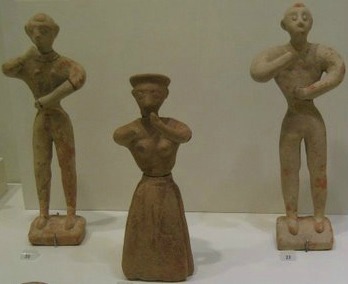
peak shrine figurines 3
Male and female figures from ancient Crete are not strongly differentiated.

New research suggests that in matriarchies, there is no divine masculine per se, because though men have their own important roles, both males and females are encouraged to embody the values associated with mothers and mothering—in other words to be loving, giving, caring, and generous. In this context there is no opposition or sharp contrast between the divine masculine, the divine feminine, and any other divine gender or transgender.

I believe that that we need a multiplicity of images for divine power that express the diversity and differences of our bodies and all bodies in the web of life. We also need new images of how to be strong and powerful, yet loving and caring above all, in male, female, and other bodies.

However, if the “highest” values are the same for both—and all–genders, then perhaps it is time to retire the oppositional binary of Divine Feminine and Divine Masculine and to speak instead of images of divinity in male, female, and other bodies.

Carol leads the life-transforming Goddess Pilgrimage to Crete (facebook and twitter).  Carol’s books include She Who Changes and and Rebirth of the Goddess; with Judith Plaskow, the widely-used anthologies Womanspirit Rising and Weaving the Visions and forthcoming next year, Goddess and God in the World: Conversations in Embodied Theology. Explore Carol’s writing. Photo of Carol by Maureen Murdock.

Where does your conviction come from? By Oxana Poberejnaia

oxanaI sometimes feel a bit awkward about not having read a lot of feminist books and not knowing a lot of feminist theory. However, I draw support from the example of Zen, “the teaching beyond letters.”

zen_logo_by_vargux-d4lwlr5The number and scope of different Buddhist traditions might overwhelm non-Buddhists reading my ramblings or any other writings about Buddhism. Even Buddhists, as those who come to Manchester Buddhist Convention, of which I am a co-organiser, every year discover new Buddhist groups that have been hitherto unknown to them.

All these traditions claim to be an authentic form of Buddhism and those that are concerned with such things, trace direct lineage of teaching coming all the way from the Buddha. As the editor of the volume “Buddhist Scriptures” Donald S Lopez Jr notes (Penguin Classics, 2004), such diversity requires certain means of ensuring that this school’s particular teachings are still in line if not with the letter, then with the spirit of the historic Buddha’s teaching.

Continue reading “Where does your conviction come from? By Oxana Poberejnaia”

The Importance of Rituals (Part 2) by Elise M. Edwards

elise-edwards

In my previous post, I wrote about the importance of rituals. The rituals of the Easter season helped me process some difficult emotions. The way that rituals mark time and demonstrate consistency has been a comfort for me when facing new challenges and settings. But I am quite aware that rituals can become empty.   In one of the comments to that post, a woman named Barbara responded, “There came a time for me when familiar and meaningful ritual no longer made sense. I had changed in understanding of what the ritual symbolized and celebrated. And haven’t found new rituals that make sense for me now…or at least I’m not aware of any.” Barbara’s remarks capture not only the loss from no longer being able to relate to existing rituals after life changes, but also the difficulty in finding or creating new rituals to take their place. I thanked Barbara for her honesty and decided that this post would continue the discussion, focusing more on discovery and creation of new rituals.

As I was preparing that post, I watched an episode of Call the Midwife that prompted me to reflect on the need to create rituals when existing ones just don’t work. Call the Midwife is a BBC-PBS show about nurses and midwives living in a convent in London’s East End at the end of the 1950s and early 1960s. The show is based on the memoirs of Jennifer Worth, and it does a better job than most primetime dramas of showing female characters’ experiences the joys and challenges of their professional lives and personal lives. As it is set in a convent with several characters who are both nuns and midwives, the show also explores the theme of vocation. What does it mean to be called to the religious life? Called to nursing? What does motherhood demand? Continue reading “The Importance of Rituals (Part 2) by Elise M. Edwards”

Restored in Beauty by Carol P. Christ

Carol Christ in LesbosThe path leading to the Klapados Waterfall begins at the edge of an open meadow in the pine and oak woodlands of a mountain in the island of Lesbos. After driving several miles on a very rutted dirt track, we parked under an oak tree, crossed the meadow and scrambled down a winding path. After about 20 minutes, it ended at a stream surrounded by plane trees. From there, we climbed over rocks to reach a pool created by the seasonal waterfall.

waterfall at klapados 1On the day we visited it, the waterfall was only a trickle of cascading drops that moistened its moss-covered path to the pool. The roots of a plane tree growing at the top of cliff followed the path of the water, weaving a web over the rockface all the way down to the pool.

Sitting on a rock at the edge of the pool I realized that the cliffs that embraced it on three sides were the remains of a crater formed twenty million (or so) years ago when a finger of molten lava pushed its way through the earth, exploding in clouds of dust and projectile rocks.

In Lesbos the volcanic activity came not from a single source–for example, from the highest mountain. Rather, like the plane trees in whose shade we rested, the volcano’s trunk with roots in the molten lava of the earth’s core, had many branches from which it erupted at different times. Huge boulders thrown out in the explosions can be seen in the meadows, while the trees in the forest curve their roots around them to reach the soil. The mountain was also shaped by the settling of volcanic dust that crumbles again into tiny fragments when exposed.

As I was thinking of all of this my friend Cristina climbed over the roots of the plane trees that surrounded the pool, removed her clothes, and slipped into the water. Soon I followed her. We sensed that we were in a sacred place, and as we have done rituals together many times before, our ritual emerged spontaneously: it almost seemed as if our minds and bodies were moving as one.

We renewed ourselves in beauty, submerging our bodies under the water three times, while floating in the embrace of the pool, gazing up at the rock formations, admiring trees that looked like dancing women, moss that looked like pubic hair, and blue black damselflies that all together had created a most beautiful place that called to something deep within us on that day.

Later we would sing the English version of the song of the Navajo Beautyway:

klapados waterfall 056


I walk with beauty before me.
I walk with beauty behind me.
I walk with beauty all around me.
As I walk the beauty way.
I walk with beauty above me.
I walk with beauty below me.
I walk with beauty inside me.
As I walk the beauty way.

We are the creative process of life.

We are restored in beauty.

Blessed be!


Carol leads the life-transforming Goddess Pilgrimage to Crete (facebook and twitter).  Carol’s books include She Who Changes and and Rebirth of the Goddess; with Judith Plaskow, the widely-used anthologies Womanspirit Rising and Weaving the Visions and forthcoming next year, Goddess and God in the World: Conversations in Embodied Theology. Explore Carol’s writing.

The Dance of Memory, Part 2: The Wishing Tree Laura Shannon

Laura Shannon square crop

Now is the time of Beltane, the great festival celebrating life and fertility.

Last week, on April 24th, in my post The Dance of Memory I wrote about the centennial of the Armenian Genocide, and invited everyone to join in this worldwide day of remembrance through prayer, meditation, music and dance. Subsequently I received testimony from students and colleagues all over the world about dance events they had organised in response to my call.

Dancing friends from Europe, North America, South America, and Australia told how moved they felt to be part of a larger whole, connected through the wordless beauty of music and dance, and by our compassion and caring for all those affected by genocide. Many, including my sister Leslie, thanked me for my ‘call to include Turkish and other dances in the Armenian commemoration activities’. She wrote from New Zealand, ‘The world needs more of this kind of inclusiveness!’

In Germany, Sybille Kolaric danced Armenian dances and a Turkish dance with her group, saying, “I really liked the idea to combine in the dance circle what is so separated in reality.”

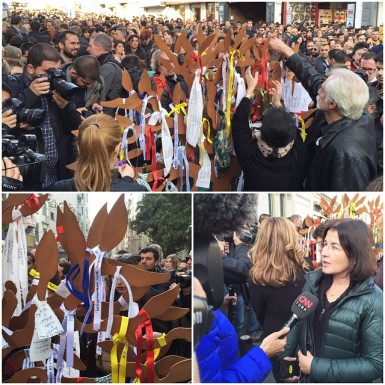
A beautiful coming together of Turks and Armenians took place in Istanbul, where my dear friend and colleague Shakeh Major Tchilingirian went with her family, along with many Armenians from all over the world, for the April 24th commemorative ceremonies. A few days before, Shakeh had been leading Armenian dances with Turkish university students there as a ritual of reconciliation (you can see the film, Circle of Life, about a similar event she led in London). Shakeh wrote that they attended a very emotional service in the Armenian Church, and then went to Taksim Square to tie cloths to the Wishing Tree.

Shakeh wrote from Istanbul, “Last night I read some of the messages on The Wishing Tree, messages remembering ALL victims of atrocities and genocide as well as the displaced. There were thousands, possibly tens of thousands, of people sitting silently in Taksim Square, many Turks and Kurds amongst us. There is a lesson to be learned here: we are all victims of the situation we find ourselves in and the longer these wounds bleed the more difficult it becomes to heal.”

The Wishing Tree in Taksim Square was created by Turkish artist Hale Tenger, specifically to mark the centennial of the Genocide. She invited participants to tie pieces of cloth to its branches in homage to the victims and survivors of the Armenian Genocide. Armenian-American Nancy Kricorian brought with her from New York a strip of fabric from one of her grandmother’s aprons, saying, “My grandmother Mariam Kodjababian Kricorian was a survivor of the 1915 Genocide, and tying this cloth to the Wishing Tree in Istanbul will be a tribute to her life.”
HaleTengerWishingTree


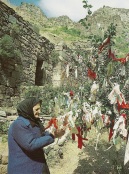
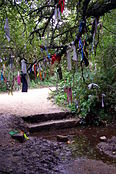
Clouties_near_madron_wellArmenian wishing tree cropCoincidentally, my April 24 post on FAR included a photo of an Armenian grandmother tying an offering of cloth to just such a tree. The ancient folk custom of the wishing tree, where people (usually women) tie cloths with a special prayer for a loved one, can be found today in Armenia, Turkey, and Greece, in Asia and throughout Europe as far as the British Isles and in Asia as well. This ‘clootie tree’ by the ‘clootie well’ (cloth = clootie) in Madron, Cornwall, is almost identical to the Armenian one shown in my previous post.

Carol P. Christ’s comment on my last post described a similar tree on her Greek island of Lesvos which she tells me is near hot baths once sacred in antiquity. She also stated that brides in ancient Greece would leave articles of their unmarried clothing on a tree dedicated to the virgin Goddess Artemis, one of many tree-worshipping rituals which were well-known and widespread in the ancient world.

Women on Carol Christ’s Goddess Pilgrimage to Crete have all participated in such a practice, tying coloured ribbons onto the venerable myrtle tree already covered with ribbons and votive offerings called tamas, at the sacred monastery of Palianí. When I went there with Carol in 2012, my encounter with the tree led to a profound and lasting experience of healing, which Carol remembered in Giving Back to the Mother.
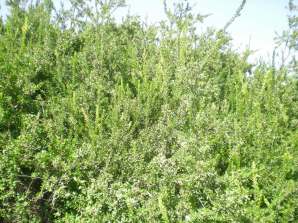
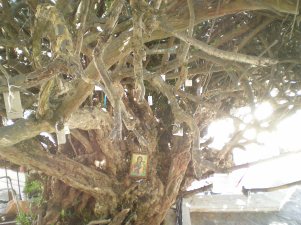
Paliani myrtle DSCN9080Paliani tamas DSCN9079

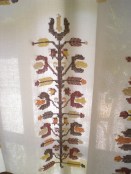
Tree emb Paliani DSCN9092Sisters on Carol’s pilgrimage also get to encircle the 2,000-year-old plane tree at Krasi. Even today village festivals are held under the canopy created by the ancient tree.  We know that tree worship on Crete has roots in Minoan times, as depicted in gold seal rings and other examples of Minoan art, and we know that tree worship is both ancient and widespread.  My life’s work researching the Goddess in traditional Balkan dance has shown that the Tree is often associated with the Goddess, for instance in many Balkan embroideries  This abstract but recognisable version comes from the curtains of the reception room in the Palianí monastery.
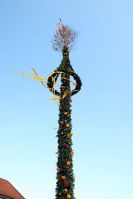
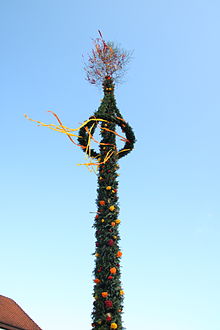
Maibaum_Ostfriesland967The sacred tree remains a living tradition in central, western and northern Europe in the form of the Maypole. I write this from Austria, where virtually every town and village honours May 1st (the ancient celebration of Beltane) with a May Tree, or Maibaum, a tall decorated pole with a wreath at the top. I love how this one from Germany resembles the Goddess.  Can you see her too?

Once-universal practices revering trees, nature, and the Goddess may have changed, but the act of praying for others’ well-being remains common to us all. The longing to keep our loved ones safe transcends all religious, political and ethnic boundaries. Love for others is one of the strongest bridges to common ground, and here is where we find our meeting place once again.

As I read through the messages sent in response to my invitation to dance on April 24th, I feel that each dancing circle is like a votive offering hung on a sacred tree. Each one is a gift of love for humanity, unique, yet part of a shared desire to end suffering, to bring healing, and to ensure the safety and survival of every single being in creation.

Laura Shannon has been researching and teaching traditional women’s ritual dances since 1987. She is considered one of the ‘grandmothers’ of the worldwide Sacred / Circle Dance movement and gives workshops regularly in over twenty countries worldwide. Laura holds an honours degree in Intercultural Studies (1986) and a diploma in Dance Movement Therapy (1990).  She has also dedicated much time to primary research in Balkan and Greek villages, learning songs, dances, rituals and textile patterns which have been passed down for many generations, and which embody an age-old worldview of sustainability, community, and reverence for the earth. Laura’s essay ‘Women’s Ritual Dances: An Ancient Source of Healing in Our Times’,  was published in Dancing on the Earth. Laura lives partly in Greece and partly in the Findhorn ecological community in Scotland.

The Gift of Life by Judith Shaw

judith Shaw photoLife – a precious gift I so often take for granted.  Events of recent weeks have turned that blatant disregard into profound gratitude.

I began keeping bees about three years ago.  My first two years were unsuccessful.  But last year, bees I obtained from my bee mentor, Mike, were strong and vibrant.  They provided me with my first honey harvest, wintered well, and come spring were out and about pollinating the neighborhood.

Continue reading “The Gift of Life by Judith Shaw”

Experiencing Divinity in the World by Carol P. Christ

carol mitzi sarahAs I work on revisions of the new book, Goddess and God in the Worldthat Judith Plaskow and I are writing, I am thinking again about John Cobb’s notion of the “two ultimates” as two different ways of thinking about divinity. Cobb suggested that religions have defined the nature of ultimate reality as personal and as impersonal, as God and as the ground of being. The ground of being is the impersonal ultimate: the metaphysical principles that structure all of life, principles that he described as creativity or the creative process.

Judith describes God as the impersonal creative process and views personal language for divinity as metaphoric or symbolic. I define Goddess as personal, yet also view the impersonal ultimate, the creative process, as sacred. For me, this raises the question of the relationship between Goddess and the creative process.

In Cobb’s view, the two ultimates are co-eternal: the personal God did not “create” the creative process, nor was the personal God “created” by the creative process. Rather, for Cobb, God as the personal ultimate, like all other individuals, participates in the creative process. What then is the creative process? Although the term “creativity” has multiple meanings, in process philosophy it has a specific one.

Whitehead’s description of the creative process is rooted in the insight of modern science that the most basic components of our universe are particles of atoms that defy being categorized as either matter or energy, but seem to move and change, depending on their relationships. It is from the relationships of these tiny individuals that the evolutionary process of our universe began. This insight led Whitehead to recognize that the nature of reality (or being) is not fixed and static (as Western philosophers before him had concluded) but is always moving, changing, or “in process.” Whitehead’s understanding of the creative process is summed up in his much-quoted phrase, “the many become one, and are increased by one.”

The creative moment in the creative process (which is in fact every moment in the life of an individual) is the moment when the individual (whether particle of an atom, cell, animal, human, or divinity) in an act of creative freedom unifies the world (the many) into a new synthesis (the one): this new synthesis adds a new fact to the world (the many is increased by one). This is an abstract description of the creative process in its most basic form. In fact, however, we do not experience the world in the abstract, but in the concrete.

In this moment I (Carol) remember my past (many different Carols situated in many different worlds and some of the books I have read) as I shape this sentence (with my hands on my computer acting in concert with the feelings of my body and the thoughts that are flowing in my mind) and unite myself and my world in a new synthesis (which is this sentence). As I do so, I add a new fact to the world (the many are increased by one), a sentence that may be read by others in the future, therefore influencing their lives.

The reader who reads my words (you) reflects on them in relation to her or his memory (your memories of your past selves in your past) and asks if what I am saying makes sense: in the moment that she or he (you) decides if it does or it doesn’t, a new fact is added to the world (the many are increased by one), an opinion that in turn may be expressed to someone else (the many is again increased by one) who in turn responds to it (the many is increased by one more).

Though this description of the creative process focuses on mental actions, our mental processes are not divorced from our bodies and feelings, and the relations of mind, body and feeling are complex. In some creative moments, feelings are primary, while in others the body leads. This second richer description of the creative process is still an abstraction. We do not generally experience life as a series of moments but as a flow in which one moment is indistinguishable from the others; nonetheless, we can recognize that our lives are made up of a series of moments in which we along with others create the world anew.

Sometimes we take a longer and broader view of the creative process, recognizing patterns and cycles within the world that we share with other than human life. Traditional peoples, for example, often speak of or invoke the creative processes of birth, death, and regeneration that are the basis of life on this earth. This is also an important way of describing the ground of being because it situates human creativity within the creativity of the web of life. In our time we might also speak about the evolution of life. Taking a long view, we experience the sacrality of the web of life.

I experience—feel and sense—the personal ultimate, the presence of Goddess as intelligent love in my body, mind, and spirit and in all bodies, minds, and spirits, as I go about my everyday life. She is always there: feeling the love and joy I feel; supporting and understanding me when things are difficult; inspiring me to share the grace of life with everyone and everything. I also feel the power of the impersonal ultimate, the creative process that supports the creativity or freedom of all individuals who interact with each other in the web of life. For me the two ultimates—Goddess and the web of life—are both real.

Though the two ultimates are separate in the abstract, in the concrete experience of those of us who affirm a personal divinity, they are intertwined because the personal divinity is experienced through the creative process that is the basis of life. Thus, at one and the same time, I experience myself and divinity within me, other individuals and the divinity with in them, the creative process and the divinity within it.

I celebrate the creative process and its fruits, the powers of birth, death, and regeneration and the evolutionary process as a whole, as the ground of all being as well as the Goddess I experience as a personal, intelligent, loving, compassionate presence who cares about me, all other individuals in the world.

Carol leads the life-transforming Goddess Pilgrimage to Crete (facebook and twitter).  Carol’s books include She Who Changes and and Rebirth of the Goddess; with Judith Plaskow, the widely-used anthologies Womanspirit Rising and Weaving the Visions; and forthcoming in 2016, Goddess and God in the World: Conversations in Embodied Theology.

The Dance of Memory: Commemorating the Centennial of the Armenian Genocide

Laura Shannon square crop

Friday, April 24, 2015 marks one hundred years since the start of the Armenian Genocide of 1915.

In my dance workshop last Sunday in Somerset, England, we lit candles to the exquisite voice of the great Armenian soprano Lusine Zakarian, and danced beautiful Armenian dances in a ritual of solidarity with this occasion.

I have been encouraging all my students to dance Armenian dances with their groups this week, most especially on Friday, to align with the commemorations happening around the world. Even if you do not dance, you could simply light a candle and listen to some Armenian music (see my list of recommendations at the end of this post). I feel that every act of compassionate witnessing, however small, helps heal the wounds of history.

Continue reading “The Dance of Memory: Commemorating the Centennial of the Armenian Genocide”

Gay Marriage: “Tell me why I shouldn’t hate you…?” asks the straight Christian to the lesbian by Marie Cartier

MarieCartierforKCETa-thumb-300x448-72405This is the third of a series exploring gay marriage as a game changer within religion and politics. I have explored the topic as political animus and earlier as almost fairy tale come to life. Today I am examining it from a very person view.

Consider a gay woman (myself) being asked by a straight attempting to understand the “right” for gay marriage, “What does it matter if I know you’re ‘gay’ if I’m not attracted to you?”[1]

Then consider that another right of “marriage” –or being known as “gay”—is the right to be admitted into the hospital room of a loved one, who is considered one’s primary partner, or “spouse.” Yes, one wants to say to the questioning woman in the above scenario, the rights for marriage include the crucial family relationships which allow one person to be able to take sick leave to care for a partner, or a partner’s child; being able to make critical medical decisions, and the right to be together in crisis situations (such as a hospital emergency room).[2]

Imagine the gay woman speaking to the straight woman and saying, “Because I am more than someone you might or might not be attracted to. I am my own person with my own life. I want to among other things, get into the hospital room of my partner, my loved one, the one I am actually attracted to.” Continue reading “Gay Marriage: “Tell me why I shouldn’t hate you…?” asks the straight Christian to the lesbian by Marie Cartier”