Why I Failed Feminism 101: Gender, Sexuality, and the Power of Relationships

I forgot, that relationships, like feminism, are not easy, and that it is a conscious and continual effort of renewal to remind yourself everyday why you love the person you love and more importantly, in the case of feminism, why you fight, “the good fight.”

I was once told by my ardent feminist advisor in undergrad to “not put all my proverbial eggs in one man basket” after discussing my relationship with my boyfriend over a cup of coffee.  Thinking my relationship was different and that we were special, I heeded the warning but thought of it no further.  Now, looking back on it three in a half years later, I wish I would have.

Relationships are a powerful tool.  They help to make you feel special.  They help to bring you joy.  They help you discover the reason why a divine presence may have endowed us with the ability to love and most importantly they help you realize and discover things about yourself you may have never taken the time to notice.
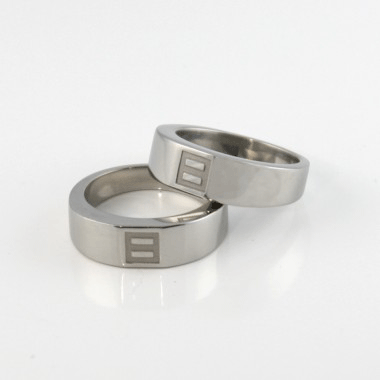
Feminism 101 is more than just the pop culture stereotype of a bunch of women advising the younger generation of girls to be weary of men and the pain they can bring.  Feminism, specifically as what I now call Feminism 101, is the transformative ability to listen to your elders, trust yourself, and ultimately, if you happen to trust in the relationship you have built, knowing deep down that it is built on equality, love, and trust. Continue reading “Why I Failed Feminism 101: Gender, Sexuality, and the Power of Relationships”

Painting the Shulamite By Angela Yarber

Calling the Shulamite holy is my way of affirming female sexuality, the beautiful variety of the body’s shapes and sizes, and including the LGBT community in the canon of saints.

Several years ago, after experiencing the innate maleness and straightness of most traditional icons, I decided to give iconography a folk and feminist twist.  Biblical women, mythological figures, poets, artists, dancers, scholars, literary figures, and personal loved-ones graced my canvases and with a brush-stroke they were canonized.  Miriam, Sappho, Gaia, Jephthah’s daughter, Virginia Woolf, Tiamat, Mary, Baby Suggs, Isadora Duncan, Fatima, the Shulamite, Dorothy Day, Mother Teresa, Mary Daly, Sophia, Sojourner Truth, and many of my friends and colleagues became “Holy Women Icons.”  It is these icons—these holy women—that will be the focus of my monthly articles in Feminism and Religion.

This month, the Shulamite is the center of our attention.  She is a dancer made famous by the erotic love poetry dedicated to her sensuous curves in Song of Songs:

Return, return, the Shulamite.

Return, return, and let us gaze on you.

How will you gaze on Shulamite in the dance of the two camps?

How beautiful are your sandaled feet, O prince’s daughter.

The curves of your (quivering) thighs like jewels crafted by artist hands.

Your vulva a rounded bowl; may it never lack wine.

Your belly a mound of wheat hedged by lotuses.

Your breasts like two fawns…

(Song of Songs 7:1-4 translation mine) Continue reading “Painting the Shulamite By Angela Yarber”

JUDGES 19: A BRIEF PAUSE FROM JUSTICE-WORK TO BE WITH HER IN THE SILENCE BY IVY HELMAN

Elie Wiesel, Holocaust survivor and renowned Jewish thinker, believes that no one can ever truly understand the profundity and tragedy of the Shoah unless one experienced it.  For him, silence is the best way to express the events since words fail to do justice.  The principle of letting silence speak, when words no longer can, when pain is so real it debilitates and when tears flow more freely than thoughts, is not original to the twentieth century.  The Bible contains many events and personal stories in which this is the case.

Judges 19 begins with two characters: a Levite and his concubine.  The concubine has recently run away to her father’s house, when her husband decides to visit her there trying to win her back.  He seems to have only good intentions in mind.  After leaving her father’s house with his wife, the Levite discusses his future plans with his servant who apparently accompanied him on the journey.  He still has not spoken a word to his wife.

The servant and the Levite decide to spend the night in Gibeah, a Benjaminite city.  The three of them sit in the city’s square waiting for someone to take them in but no one arrives until evening.  At dusk, an old man comes by and offers to take care of the needs of the entire party, including the donkeys, as long as they promised not to spend the night in the city square. Continue reading “JUDGES 19: A BRIEF PAUSE FROM JUSTICE-WORK TO BE WITH HER IN THE SILENCE BY IVY HELMAN”

The Sainthood of Hildegard von Bingen by a Feminist-Friendly Pope? by Cynthia Garrity-Bond

While I celebrate the rise in status of Hildegard to official saint and soon to be Doctor of the Church, I cannot help but be suspicious of the Vatican’s motivations.  One only has to take in the last two months behavior of the CDF, sanctioned by Pope Benedict, to see the real intentions of this papacy—the continued subjugation of all women to clerical authority.

The past month or so has been a very busy time for the Congregation for the Doctrine of Faith or CDF and their examination of women. First they (and this includes Pope Benedict XVI) decided American nuns are guilty of the sin of silence by not speaking out on abortion & homosexuality.  Their “radical feminist” ideology of standing with the poor and disenfranchised, while good, is not good enough for the CDF.  The firestorm of solidarity coming from both laity and religious surely caught the Vatican off guard.  Right?  Well, not quite.  This past week the CDF began its investigation of the Girl Scouts for their purported association with the likes of Planned Parenthood and Oxfam.  While both address the needs of the poor, it is the latter and its troubling advocacy for safe sex via condom use that initiated the inquiry. Keep in mine that in 2010 Pope Benedict retracted from his earlier position and bane on condoms, seeing instead their use as a “lesser evil” in the fight against HIV/AIDS.  The CDF angst is that the message of condom use might be too much sex-talk for impressionable young women.  Continue reading “The Sainthood of Hildegard von Bingen by a Feminist-Friendly Pope? by Cynthia Garrity-Bond”

Liberalism as Feminist Religious Tradition: Friend or Foe? By Amy Levin

Come, come, my conservative friend, wipe the dew off your spectacles, and see that the world is movingElizabeth Cady Stanton

Whenever I find myself in conversation with a liberal skeptic who assumes that the existence of a liberal Mormon or Catholic is about as likely as aliens walking the planet, I do two things. First, I show them our blog. Second, I attempt to describe the complicated, long, and constantly evolving relationship between American liberalism, religion, and feminism. The roots of this complex triad are planted in a complicated history whereby, on the one hand, religious liberalism helped women gain equal rights and social justice, while on the other hand, it created divisions among some religious women who felt liberalism threatened their theological beliefs. Of course, the term “liberalism” is fraught with its own contemporary meanings. However, religious feminists throughout history have nevertheless engaged in practices we could place under the rubric of liberalism, including the push toward cosmopolitanism, modernism, and political progressivism. The difficulty was (and still is) maintaining their religious practices and beliefs.

Continue reading “Liberalism as Feminist Religious Tradition: Friend or Foe? By Amy Levin”

Abuse of Power in the Catholic Church: Undoing Almost Fifty Years of Progress – Part I, by Michele Stopera Freyhauf

“Now the Vatican says that nuns are too interested in “the social Gospel” (which is the Gospel), when they should be more interested in Gospel teachings about abortion and contraception (which do not exist).  Nuns were quick to respond to the AIDS crisis, and to the spiritual needs of gay people—which earned them an earlier rebuke from Rome. They were active in the civil rights movement.  They ran soup kitchens.” —  Roman Catholic Women Priests (via Facebook)

I once had a conversation with my New Testament Professor about the issue of women ordination.  He was optimistic and thought there might be a possibility that change was in the air – that was six years ago.  The basis for his statement had to do with language.  Of the journals and articles read, he felt the language used was more inclusive and that once people adjust to this discrete change in gender inclusive language, change for women in the Church can come.

He was right about change coming.  The result was not equality and ordination for women, but an attempt to silence and force these women back into their habits and cloisters. Continue reading “Abuse of Power in the Catholic Church: Undoing Almost Fifty Years of Progress – Part I, by Michele Stopera Freyhauf”

Change My Mind, Move My Heart: Feminist Ethics in Practice by Marie Cartier

As some of you know, this spring I am teaching “Feminist Ethics” at California State University Northridge. I recently posted a blog on this site regarding the students’ project April 4, 2012 The Feminist Toolbox by Marie Cartier. If you read the original blog you know that the students have been asked to find a problem in the public or private world that they will deconstruct and then find a full or partial solution for. For their actual final they must actually *do* their proposed solution.

Students must use the tools described in the earlier blog, in what I call “the Feminist Ethical Toolbox,” or what my students call “Cartier’s Toolbox.” The toolbox contains questions such as “Is everyone affected by the decision (the solution to the problem) at the decision making table?” and “If they are not at the table, are they represented at the table by someone who will speak to their interests?” among others. Continue reading “Change My Mind, Move My Heart: Feminist Ethics in Practice by Marie Cartier”

The Boldness of Grace Ji-Sun Kim by Grace Yia-Hei Kao

“The Grace of Sophia is an openly ‘syncretistic’ work.”

Continue reading “The Boldness of Grace Ji-Sun Kim by Grace Yia-Hei Kao”

At the Intersection of Gender, Religion, and Race by Jameelah X. Medina

Since 9/11, many Muslim women in the USA are in a similar predicament as what African American and Chicana women found themselves in decades ago during the Black Power and Chicano Power Movements. African American and Chicana women stood along side African American and Chicano men to fight against oppression and injustices against them by the power structure and the people in positions of power. In both movements, women’s issues were relegated to the sidelines; they were only visible in the periphery of decision-making. Both African American women and Chicanas decided that they had to stand up for themselves and call it like they saw it—they were being oppressed and marginalized in mainstream society because of their race and ethnicity and also within their racial group because of gender.  Continue reading “At the Intersection of Gender, Religion, and Race by Jameelah X. Medina”

1972: Can We Talk? — Looking for Spaces to Share by Lisa Clayton

“Why do you care what God says?”

““Don’t you want to be liberated?”

“How can you be serious about being a Mormon?”

Those were a few of the questions I fielded the year I, a devout Mormon, worked as an intern at the University of Utah’s new Women’s Resource Center.  As I studied at the “U” in the early 1970’s I encountered second wave feminism and its brand of secularism that challenged the prevailing Mormon-centric environment.

I was introduced to feminism in workshops at the newborn Resource Center, and as an intern I helped plan and put on its inaugural women’s conference.  The women there were excited and exciting.  They were exploring feminist ideas during a very heady time for college women. Continue reading “1972: Can We Talk? — Looking for Spaces to Share by Lisa Clayton”