Make-up the Most of Your Moustache by Natalie Weaver

Natalie Weaver editedMy girlfriend Heidi has a great sense of style. It is theatrical, creative, and always original. I met Heidi when I was eight years old and have had a chance to observe her personal developments and self-presentations grow and change over three decades. Our friendship has always included a strong element of the silly mixed in with the beautiful. We would dress up for high school dances together in classic regalia as easily as we would put floral shower caps and boldly colored wigs on our heads to entertain ourselves as we walked around our neighborhood. Now, Heidi works as an artist model in one of the most theatrically dressed cities in America, becoming the basis for the first city-commissioned sculpture (Kim Bernadas’s Terpsichore) in New Orleans after Katrina. She is slender, tall, and striking with platinum hair and large dark eyes framed by long, elegant lashes, and often adds to her already statuesque appearance by wearing heels and hats. Heidi, moreover, creates hats in her avocational role as a milliner. It is, in short, always a striking surprise when Heidi walks in the door.

Over the weekend, Heidi and I had an opportunity to go to the opera together. Playful as always, Heidi showed up for the event in elegant tuxedo-inspired couture, complete with a handcrafted fascinator and (drum role) a very finely, penciled in moustache. She looked truly stunning, and we enjoyed the night together as a lovely couple. We laughed over the moustache, but more or less would have forgotten about it were it not for the looks people gave us. Some were genuinely appreciative, others merely curious, and yet others, specifically random men, had the great audacity to say something to her, like, “you have a moustache.” It was sufficient to inspire Heidi to try it again the following day as we popped in and out of shops and restaurants on the street, and sure enough, some guys felt obligated to tell her about face.

What does this mean, I have been wondering, and why have I been so unsettled by the commentary she and I have received? On one level, I have been aware that we may be perceived as a same-sex couple. This phenomenon I have been aware of since we were children. Close female friends, who laugh together and sometimes link arms when walking, especially in the USA, seem automatically to evoke in the public imagination a suspicion of lesbianism. I found the suggestions in high school puerile and irritating, but now I find them imposing and reflective of a deep intolerance of inter-women’s shared energy and joy. But, to be fair, Heidi was wearing a fine, little moustache, which, if nothing else, did broadcast androgyny in Heidi if not couple-hood between us. And, yet, here’s were my radar pings even louder. Why not androgyny? What was it to the passers-by and would-be commentators if we were a couple, or if Heidi always blurred gender presentations in her dress?

I have found myself more and more perplexed that any random man (and we only received male feedback) feels entitled to advise openly a strange woman (or, for that matter, a known one, or even more, anyone at all) on how s/he should look. One stranger man at a bar, who was openly critical of her style and verbal about it, even dared ask me why I was so charmed by my friend. When I ignored him altogether, he patronized me with, “Are you ok?” like a date fishing from his girlfriend for an explanation about her sudden moodiness.

Continue reading “Make-up the Most of Your Moustache by Natalie Weaver”

CROSSING THE SEA OF DEATH by Carol P. Christ

carol p. christ photo michael bakasI am washing wet clothes cast off by refugees who crossed the Sea of Death, the new name for the channel only 4 nautical miles wide that separates Turkey and Lesbos. A tiny pink long-sleeved shirt with a boat neck, for a girl, size 3 months. The channel was relatively safe in the spring and summer, even though people were pushed into black rubber dinghies wearing illegal life jackets that would not float. A pair of leggings with feet, grey with pink, orange, brown, white, and blue polka-dots, to be worn over diapers. North winds have made the journey treacherous.

I am not on the front lines, pulling wet children alive and dead from the sea. I think my heart would break. Tiny black stretch pants with nylon sequined bows at the knees, size 2 years. My friends were in the harbor when an overcrowded fishing boat collapsed, throwing 300 people into the sea. Two pairs of children’s underpants, one navy blue, the other turquoise. They pulled babies from the waves and tried to revive them. Small stone-washed blue jeans decorated with rhinestones, for a little girl. They were wet and cold. Their clothing was removed. They were wrapped in blankets. Red knitted leggings with black hearts and white reindeer. Some survived after spitting out the sea’s water. Blue leggings with feet, blue with white and beige stripes, for a boy. The newly donated ambulances do not carry oxygen. Continue reading “CROSSING THE SEA OF DEATH by Carol P. Christ”

Epic Drama and Epic Confusion, Courtesy of Bollywood by Vibha Shetiya

VibaI love Bollywood. The colors, the over-the-top drama, the singing and dancing, the suspension of reality for three hours…I see how it can provide a break from the challenges of everyday life for over 700 million Indians living below the poverty line (and then some). But Bollywood movies also have a frightening side to them. On one hand they transport the viewer to la-la land; on the other, this very fantasy world has the power to set social norms. And yes, it becomes confusing – no kissing, no nudity, yet vulgarity is on full display when camera angles capture the fully dressed heroine’s chest heaving to pulsating music, while she is soaked to the skin in pouring rain, dressed in white, mind you. Sometimes there is no need for the rains. Katrina Kaif’s Chikni Chameli “item” number will attest to this.

But let us move away from the “purely entertaining” angle and return to the idea that Bollywood not only reinforces cultural stereotypes but also has the potential to influence behavior that governs everyday attitudes.

I recently (re)watched Dilwale Dulhaniya Le Jayenge (And the Truelove Will Carry Away the Bride) with an American friend. DDLJ (1995) as it is fondly called is one of India’s all-time beloved movies. So much so that soon after taking office in 2014, the Indian Prime Minister, Narendra Modi declared it a show-case of Indian tradition. I can see how it touches a patriotic chord: the story centers on an Indian family living in Britain, but still “Indian at heart.” Well, the father decides that his daughters born and raised in London are Indian at heart. Of course things go terribly wrong when the older girl, Simran, falls in love with someone dad doesn’t approve of. Raj is Indian, but not a bona fide one in that he has adapted to “the shameless and derelict ways of Westerners.” The family packs their bags and moves back to India where Simran is to be immediately married off to the father’s jigri dost’s (dear friend’s) son, Kuljit. Now as one can imagine, when the film in question is a Bollywood one, this is not drama enough. There’s plenty more to come. But I’ll leave it to you to decide how much drama is drama enough… Continue reading “Epic Drama and Epic Confusion, Courtesy of Bollywood by Vibha Shetiya”

#SheBelieves: How Women’s Soccer is Continuing the Feminist Fight By Anjeanette LeBoeuf

AnjeanetteSoccer is considered the international sport. The success and fervor of soccer across the global has created a form of religious mythos. Many football fanatics have described their love for their club and their attendance to a match, as a ‘religious experience.’ I myself felt like I was on holy ground when I stepped foot onto the grounds of FC Barcelona and Aston Villa FC. And it is on this sacred ground that women are continuing the struggle for equality.

The US Women’s Soccer Team has struggled since its inception in 1985. It has struggled to gain sponsorship, viewership, and even validation that women could play 90 minutes in one of the most physically demanding sports. Continue reading “#SheBelieves: How Women’s Soccer is Continuing the Feminist Fight By Anjeanette LeBoeuf”

Not a Woman of the Cloth- an excerpt from Murder at the Rummage Sale by Elizabeth Cunningham

Elizabeth Cunningham headshot jpegWhen I finished writing The Maeve Chronicles, I returned to a mystery novel, abandoned thirty years earlier. I was finally ready to write about the small town Episcopal Church where I grew up in the 1950s and 60s and to explore the points of view of characters based on my late parents. When I began seeing through my mother’s eyes, the intensity of her suppressed fury took me by storm. Trapped in the role of minister’s wife, Anne Bradley strikes me as an embryonic feminist. In the scene below, Anne is hanging up laundry when she is approached by a pesky parishioner who makes a veiled reference to the death of Anne’s son.

*********

“Hello there, Mrs. Bradley,” Mildred Thomson said, adding some obligatory remarks about the weather. “I was hoping to find Father, I mean *Mr. Bradley in today. Do you know when he might be back?”

Anne did not. In fact, she realized she did not even know where he was. Hospital calls? A diocesan meeting? Surely she would have remembered if he’d gone all the way to New York. He had probably told her, and she had probably not listened. He was not there most of the time, or if he was, he was not available, not to her or the children. He stayed in his study in the parish house where no doubt Mrs. Thomson had hoped to ambush him.

“I’m afraid I don’t, Mrs. Thomson,” said Anne, feeling for her cigarettes in her apron pocket. Hell’s bells. She must have left them in the back hall on the shelf above the washer.

Anne turned back to the clothesline. Three children meant a lot of laundry, though in the summer the load was a little lighter, shorts and short sleeves, not so many filthy elbows and knees. There were always Gerald’s shirts. Short or long-sleeved, they had to be ironed, something she could not even contemplate till the cool of the evening.

“Did you have an appointment with him?” Anne asked, hoping the question did not sound too much like a reproof.

“No, no,” Mrs. Thomson said vaguely. “I just happened by. I suppose I ought to make an appointment. I never did with Father Roberts. He never minded my popping in.”

That was definitely a reproach. Anne felt almost sorry for her husband, almost. But it was part of his job to listen to parishioners maunder on, as much as holding services on Sunday and galvanizing his congregation to do good works in the community.

“Mrs. Bradley, may I ask you a personal question?”

Could she say no, Anne wondered? Or at least, excuse me while I get a cigarette? But Mrs. Thomson took her hesitation for consent.

“Do you ever struggle with your prayer life?”

Anne bit back a bitter laugh. She could hear it in her head, a sound a dog might make, something between a yelp and a snarl.

“I suppose you don’t,” Mrs. Thomson said wistfully.

Continue reading “Not a Woman of the Cloth- an excerpt from Murder at the Rummage Sale by Elizabeth Cunningham”

Finding My Voice By Grace Yia-Hei Kao

In my work with doctoral students, I’ve noticed that what often sets apart “good” graduate students from “good” junior scholars is the ability for the latter to say something important and distinctive. That is, while it may be sufficient during coursework and qualifying exams to master the canon of whatever counts as good scholarship in one’s field, success beyond graduate school will require academic hopefuls to make a bona-fide scholarly contribution to her field of study.

For this reason, I am frequently asked by the graduate students I mentor, particularly those who are women, about the process by which I came to find–or claim–my scholarly voice.

What follows bellow is a version of a talk I gave at the annual conference of the Pacific, Asian, and North American Asian Women in Theology and Ministry (PANAAWTM) in 2014 on this very question.
Continue reading “Finding My Voice By Grace Yia-Hei Kao”

Reform? Progress? By Elise M. Edwards

Elise EdwardsIn my class yesterday (a survey of Christian thought and practices), I was lecturing about monastic life in the Middle Ages. Among other points, I mentioned that medieval religious orders provided settings where women could be educated and assume leadership roles (primarily among other women), thinking of Hildegard of Bingen (1098-1179) who was the Abbess of a monastic community in Rupertsberg. Other women medieval writers who developed influential writings, like Mechtild of Magdeburg (ca. 1210-1282) and Catherine of Siena (1347-80), belonged to tertiaries or third orders, which were monastic community for laypersons. This part of the lesson emphasized that monastic reforms around the 12th century opened religious orders more extensively to women and laity.

Still speaking of medieval reforms, I displayed a picture of Francis of Assisi on the screen at the front of the room. I mentioned that Francis was concerned about the poor and the animals and that he has inspired some contemporary Christians, including the current pope who took Francis as his name. We talked about how both St. Francis and Pope Francis are seen as reformers.

Because earlier in my lesson I’d made a point of speaking of women’s experience, when I spoke about the Pope’s name as a possible sign of renewal or reform, Gina Messina-Dysert’s question “What about the women?” came to mind. In her recent post, she responded to the Pope’s exclusion of many issues that concern women in his address to the US Catholic Bishops. Like Gina, I applaud many of the Pope’s reforms but I am confused about how rarely he is criticized for maintaining the long-held Catholic view that disallows women to be ordained as priests.

Let me provide an example: During the Pope’s visit to the US, one of my students described Pope Francis as “very liberal.” When I interjected that he has not supported the ordination of women, the student laughed and said the pope would be accused of heresy for supporting that! While that may be true, my more immediate concern was that in a classroom of students who are mostly supportive of women in ministry, the Catholic restrictions on the priesthood were seen as a part of the tradition not worth challenging. Why is it that preserving male leadership is excused as a part of the tradition while preserving exclusive marriage practices is something to be challenged? They are interrelated.

As we know from blogs and social media sites, many people who support LGBTQ rights were upset over news stories about the Pope meeting with Kim Davis, the county clerk who was jailed for refusing to issue marriage licenses to same-sex couples. Certainly such a meeting is disturbing to same-sex marriage advocates. But is it surprising? At least one womanist ethicist I know, Eboni Marshall Turman, pointed out in a Facebook discussion that the church has long since been public in its support of male privilege and heteronormativity. My intent is not to single out Catholicism for sexist practices. When recently asked about women’s ordination and leadership in Baptist churches in my own town of Waco Texas, I had to admit that even though ordination of women is permissible and practiced in many of the churches, the number of churches that have called women to the position of senior pastor is shockingly few.

My point is this: When we find teachings in particular religious traditions that justify the exclusion of one group, we should expect to find justifications for excluding other groups, too. In the same discussion I referenced above, Eboni Marshall Turman said, ”Oppressions are compounded and intersectional. If they come for me, it is just a matter of time before they come for you. This is basic theological ethics.”

The experiences of varied groups are not the same; our oppressions and marginalizations also differ. But practices of exclusion are constructed on the same logic that values some persons (the in-group) more than others (the outsiders). Therefore, feminists have a responsibility to advance the well-being and interests of other groups (besides women) who are being marginalized.

Another reason for this advocacy is that many women are included in other marginalized groups. To ignore the intersectionality of oppression is to deny its pervasiveness and the realities of women’s lives. This is why feminists of color are often critical of white feminism. (The recent debate over the photo shoot for the movie Suffragette is a new instance of a persistent critique of white or mainstream feminism. See Rebecca Carroll’s piece on “Suffragette’s Publicity Campaign and the Politics of Erasure”).

To counter the limitations of our own experiences and be consistent in our pursuit of equality, feminists should intentionally cultivate practices of solidarity and coalition-building in our work. I, like everyone else, am often unable to see the inconsistencies in my own practices and teachings without others’ experiences to expand my view. This is one reason I value this Feminism and Religion community. Thank you for the wisdom and practices you offer from your own religious traditions and your own experiences of marginalization. You make me a better feminist through your writings and comments.

Perhaps working together, we can bring about religious reforms that our descendants will recognize in the centuries to come.

Elise M. Edwards, PhD is a Lecturer in Christian Ethics at Baylor University and a graduate of Claremont Graduate University. She is also a registered architect in the State of Florida. Her interdisciplinary work examines issues of civic engagement and how beliefs and commitments are expressed publicly. As a black feminist, she primarily focuses on cultural expressions by, for, and about women and marginalized communities. Follow her on twitter, google+ or academia.edu.

The Reaper by Natalie Weaver

elizabeth-taylorI have begun to call my mother the “Reaper,” which I understand could be to some mums sort of insulting. Images of the Reaper are typically not terribly flattering, you know, with all that sunken skin and stringy black cloth flying around. My mom looks nothing like that, by the way. In fact, she has at all stages of her life borne a striking resemblance to Elizabeth Taylor, causing many a stranger to run up to her over the years, exclaiming, “Oh my goodness, do you know who you look like?” And, let me add, often much to the consternation of those in Mom’s company, such as, well– me, for example– when I was trying to deliver my first baby and the attending nurse ignored me in order to chat with my mom about her resemblances. But, I digress here.

Mom is the Reaper because she is at that point in her life when she rather unabashedly tells it like it is, “reaps truth” as I have come to think of it. Though she may look all violet eyes and white diamonds, she is beyond mincing words.

Is this a feature of aging? I once read that the decreased estrogen and increased testosterone levels in post-menopausal women may contribute to a personality shift where women are more inclined to report on what they are thinking. This may be a factor, but I would find it likelier that many women, menopausal or not, simply get to a point when they have seen/heard/experienced/endured enough that they find little merit in putting up fronts, regardless of hormonal predisposition.

Plus, I am wildly unimpressed by some of the material out there on menopause. It seems like a lot of conflated nonsense that correlates every aspect of female sexual maturation with hormonal imbalance and impending doom. I recently read a book by an “expert” named Dr. Miriam Stoppard – great last name for a menopause specialist, right? – that actually gave medical advice alongside hints about make-up tricks, relationship management tools for your depressed mid-life spouse, and what girdles to wear to help hold up your sagging flesh.

It is interesting that “women who speak their minds” are even an object of contemporary cultural commentary at all. I mean, would there be any talk at all about males who speak their minds? Young girls who speak their minds are cast as feminists, strong-willed, scary to boys, unfeminine, and so on. Of course, the embedded androcentric assumption is that they are doing something contrary to normative female behavior. Older women who “speak their minds” are cast as rude hags and crones, spreading around their venom and disappointment, especially if they swear. This blog on post-divorce dating, kind of says it all:

Continue reading “The Reaper by Natalie Weaver”

From Her Lips by Barbara Ardinger

Barbara Ardinger

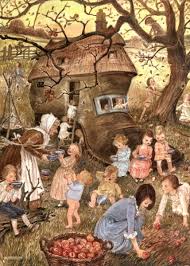
There was an old woman who lived in a shoe,
She had so many children she didn’t know what to do.
She gave them some broth without any bread;
She whipped them all soundly and put them to bed.

Look! Here she comes. Like most old women, she has a lot to say. Let’s listen in:

“Well, that’s what an old nursery rhyme says. But I’m that old woman, and I can tell you for sure that the only thing ‘true’ about that rhyme is that I’m old. I’m older than anyone I know. Oh, I see you there, eavesdropping. That’s okay. You’re welcome here.

Old woman...shoeYou know what? I’ve been called many names by the (mostly) men who make up those rhymes and stories. I’ve been the old witch in the candy house who serves pie to children and then serves the children in the pie. (But did that German guy who wrote that opera about me ever say who eats those pies?) I’ve been the thirteenth old woman at the christening who wasn’t invited and brings a curse that’s as big as the blessings from the first twelve. I’ve been the evil, wicked, mean stepmother.

Continue reading “From Her Lips by Barbara Ardinger”

Re-creating a Gynocentric Cosmology: Situating Myself by Glenys Livingstone

Glenys

I am an inventor, a mythmaker, who has received/taken remnants of her indigenous religious heritage, and newly available parts, and spun and woven new threads, fabrics and stories.[i]

 My method of approach has been informed by my deep personal involvement … my need to “place” myself here – as feminist philosopher Luce Irigaray suggests that woman needs to do.[ii]

 Irigaray said that woman is not situated, “does not situate herself in her place,” that she serves as a thing and is thus nude.[iii] I have intuitively felt the need to “clothe” myself, to find the Place within me, to move from object to sentient subject.[iv]

The way the Cosmos was for a white girl child of Western European descent growing up in country Australia, with Protestant religious teachings, was a place surveyed scrupulously by a vengeful Father God, who was at the same time spoken of as the epitome of Love. What did that do to one’s understanding of Love? How does a woman – or any person – become functional within such a cosmology? Continue reading “Re-creating a Gynocentric Cosmology: Situating Myself by Glenys Livingstone”