From the Archives: Women’s Bodies and the Bible by Janet Maika’i Rudolph

Moderator’s note: This marvelous FAR site has been running for 10 years and has had more than 3,600 posts in that time. There are so many treasures that have been posted in this decade that they tend to get lost in the archives. We are beginning this column so that we can all revisit some of these gems. Today’s blogpost was originally posted May 20, 2019. You can click here to see the original comments.

Trigger Alert:  The bible on its face is quite violent to women.

Amidst the ugliness that is American politics in general and abortion politics specifically, I began to look for guidance to understand what is happening. I ended up pulling out two books that I read long ago. The first is Woe to the Women-The Bible Tells Me So by Annie Laurie Gaylor. Gaylor, in turn, was inspired by the work of Elizabeth Cady Stanton in her The Women’s Bible which was originally published in two parts (1895 and 1898).

I had forgotten how inspired I have been by both books. Together, they motivated me to begin looking at how the bible is a foundational paradigm of our culture. I started researching how translations have been altered from original meanings. I have already written a few blogs about how the representations of Eve have been changed to strip Her of the roots of Her original power. Take a look here and here.

Continue reading “From the Archives: Women’s Bodies and the Bible by Janet Maika’i Rudolph”
Carol P. Christ’s Legacy: ON NOT GETTING WHAT WE WANT AND LEARNING TO BE GRATEFUL FOR WHAT WE HAVE

Moderator’s Note: We here at FAR have been so fortunate to work along side Carol Christ for many years. She died from cancer in July, 2021. To honor her legacy, as well as allow as many people as possible to read her thought-provoking and important blogs, we are pleased to offer this new column to highlight her work. We will be picking out special blogs for reposting. This blog was originally posted March 26, 2012. You can read it long with its original comments here. Carol mentions a book she was writing with Judith Plaskow at the time with the working title: God After Feminism. The book was published in 2016 under the title of Goddess and God in the World: Conversations in Embedded Theology. You can find it here.

Many women’s dreams have not been realized. How do we come to terms with this thealogically?

Although I am as neurotic as the next person, I am also really wonderful—intelligent, emotionally available, beautiful (if I do say so myself), sweet, caring, and bold. I love to dance, swim, and think about the meaning of life. I passionately wanted to find someone with whom to share my life. I did everything I could to make that happen—including years of therapy and even giving up my job and moving half way around the world when I felt I had exhausted the possibilities at home.

For much of my adult life I have asked myself: What is wrong with me? Why can’t I find what everybody else has? Even though I knew that there were a lot of other really great women in my generation in my position and even though I knew that many of my friends were with men I wouldn’t chose to be with, I still asked: What is wrong with me?

Continue reading “Carol P. Christ’s Legacy: ON NOT GETTING WHAT WE WANT AND LEARNING TO BE GRATEFUL FOR WHAT WE HAVE”

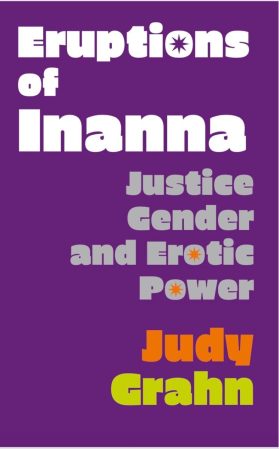
Eruptions of Inanna: Justice, Gender, and Erotic Power by Judy Grahn BOOK REVIEW by Carolyn Lee Boyd

Judy Grahn Eruptions of Inanna

Any new book by Judy Grahn is cause for celebration. For decades, Grahn has been a lyrical and passionate poet, author, mythographer, and cultural theorist whose work  features both goddess wisdom and contemporary culture centering on women and queer people. Nightboat Books has just published her newest book, Eruptions of Inanna: Justice, Gender, and Erotic Power, which offers ancient yet fresh world views with which to approach such issues as injustice, sexuality and gender, climate change, and more just when we need it most. 

In Eruptions of Inanna, she brings what she calls her “poet’s eye” to eight stories featuring the Sumerian goddess Inanna as well as religious practices of those devoted to her. She explores how these have directly influenced our world and, in her words, can continue to “feed our needs and help us take better care of each other and our world.” According to Grahn, Inanna “is a combination of human, creature, erotic and other energetic forces, and civilization. She also inherited very old powers that grew out of women’s rituals” (55).  Her essence engenders sovereignty and self-worth, especially in women and queer people.  She is a goddess of love, espousing passion and the joy of eroticism as integral to both life and society. She practices an expansive justice that creates positive outcomes in response to horrific acts. She creates a civilization of the arts, beautiful and useful crafts, abundance, and a jubilant communal life. She demands respect for nature and ecological sustainability.  

Continue reading “Eruptions of Inanna: Justice, Gender, and Erotic Power by Judy Grahn BOOK REVIEW by Carolyn Lee Boyd”

¡La Vida es la Lucha! – Women in the Colombian Protests by Laura Montoya

*Trigger Warning – Reference and description of distressing violence against women at the hands of police*

Alison Melendez was 17 when she was sexually abused last week by a group of Colombian policemen. She was captured for allegedly being part of the protest groups in Popayán, a city in the south of my country Colombia, South America. The next day Alison was found dead. The official version states that she committed suicide. In the social networks, there is a video of four policemen carrying Alison to the detention center, each holding one of her extremities. One can hear Alison screaming, “Four were necessary to carry me? Four against one woman? Cowards!” The next day – before she was found dead – she posted on Instagram that she was not part of the protests that night. She was walking to a friend’s house when the police showed up. She started recording their actions, they saw her and went mad, so they captured her. When she resisted, four of them took her to the police station. In the post, Alison mentions how they groped her to the soul.” In the video, one can see how her pants came off while they were carrying her, and the policemen did not care. They just kept walking. The last time we see Alison in the video is inside the station. Then cameras were turned off.

*End Trigger Warning*

Alison is one of the 18 cases of sexual violence reported during the protests that started last April 28 in different cities of Colombia. In addition, there are 87 reports of violence and abusive behavior against women protesting. Alison’s case has been more visible, but it is easy to find several videos of police officers beating, harassing, and capturing women in the protests on social media. We have been witnessing this terrible violence full of indignation and impotence, despite protesting is our legitimate right as citizens. 

Continue reading “¡La Vida es la Lucha! – Women in the Colombian Protests by Laura Montoya”

Bridgerton: The Next Wrong Thing in Misogynist Television


Why can’t we have nice things? Because the porn industry has infected media, that’s why.

I have read several of Julia Quinn’s fanciful romance novels. They contain entertaining and sympathetic stories about the economic and social pressures on gentlewomen of early 19th century Britain. The females are creative, courageous, intelligent, and honorable. The males are… well, they are somewhat sexist, of course, but no more sexist than most men I know. The books do a mediocre job of challenging gender roles or stereotypes (especially in their cookie cutter portrayals of male heroes), but they directly challenge overt sexism and misogyny. Quinn calls herself a feminist. Continue reading “Bridgerton: The Next Wrong Thing in Misogynist Television”

The Body is a Nation by Sara Wright

“The body is a nation I have not known.
The pure joy of air: the moment between leaping
from a cliff into the wall of blue below.”*

Oh, the pure joy of being weightless – I leapt to the stars, flung myself with abandon into the deep until the fire started burning and I was forced to surface for air…

I was a stranger to my body, escaping messy feelings by living through my mind. I dressed her, made her behave – learning that I must have control at any cost. I cultivated a winning smile to cover anguish I could not name. Buried all fear. This last one backfired during infancy. I lived pure terror. I had no Voice. It was years before I realized who stole it. Continue reading “The Body is a Nation by Sara Wright”

Masculine: Aggressive/Feminine: Passive: Can We Imagine Alternatives? by Carol P. Christ

Today a couple of friends and I were discussing egalitarian matriarchal values. I stated that in these societies there is no great difference in male and female personalities because both males and females are expected to be as kind and loving and generous as their own mothers. “Oh no I would not want that,” the other woman responded. “I want my man to be masculine–not wishy washy or namby pamby.” This woman soon acknowledged that she did not want her man to be dominant or aggressive. Yet her first reaction was to reject the idea that men might do well to emulate the values of their mothers.
This conversation illustrates the difficulty we have in conceiving alternatives to the way we assign gender roles. Masculine: assertive and aggressive. Feminine: weak and passive.

In fact. being as kind, loving, and generous as mothers in egalitarian matriarchies has nothing to do with these familiar gender binaries. Mothers in egalitarian matriarchies are assertive, but not aggressive, and there is nothing weak or passive about them. Love, kindness, and generosity are not about standing back and letting others walk over you. Instead they are active values that require intelligence, reflection, and strength. Continue reading “Masculine: Aggressive/Feminine: Passive: Can We Imagine Alternatives? by Carol P. Christ”

Coming Out of Quarantine by Angela Yarber

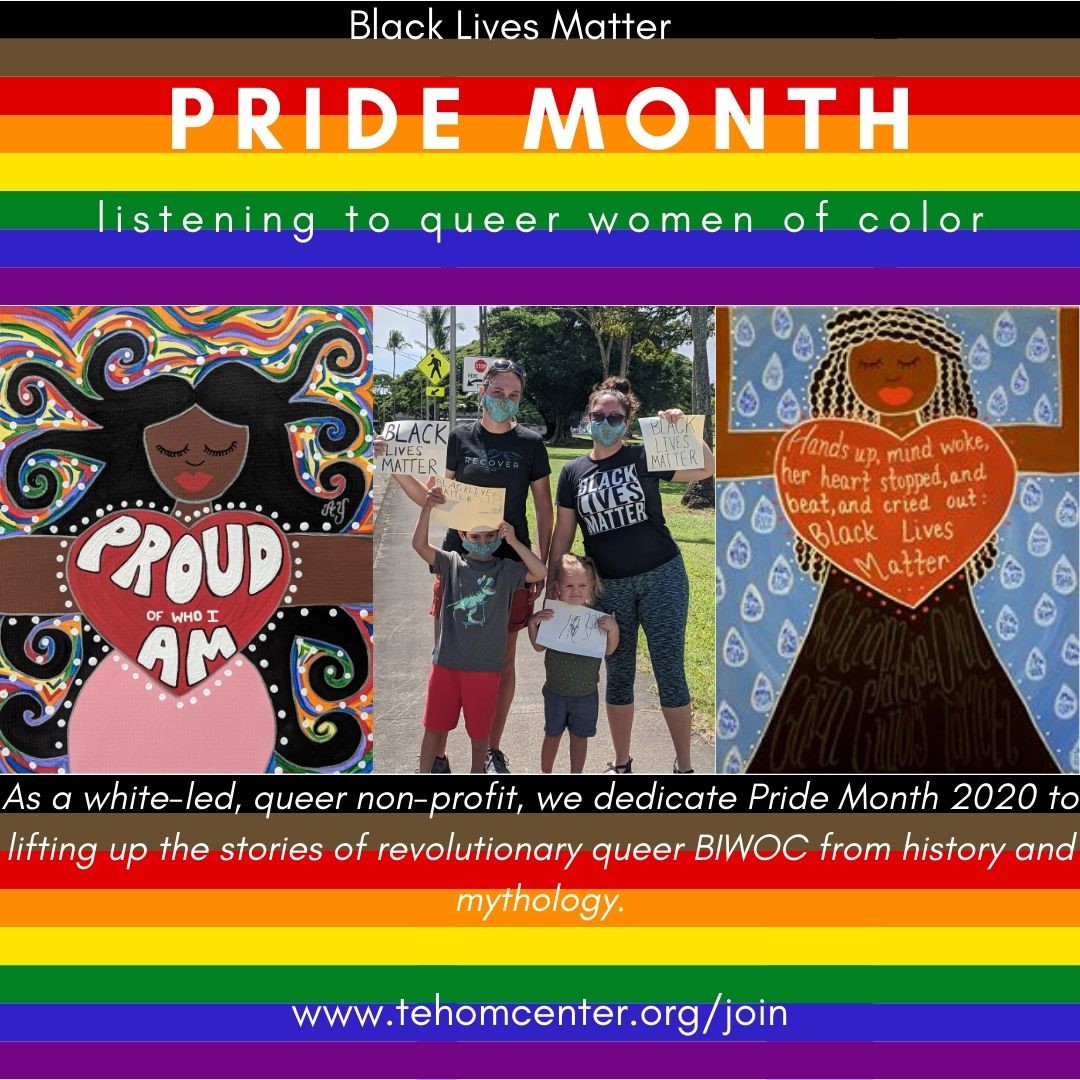
As Pride Month and Black Lives Matter protests co-exist, the spirituality of queer women of color teaches white allies how to listen.

After nearly eighty days of sheltering in place, I feel like I’ve stepped out and found the world on fire. June isn’t supposed to be this way. It’s Pride Month, after all, and I’m queer, eager to dance alongside my favorite drag queens, albeit reticent to embrace capitalism’s commodification of our beloved rainbows.

Most of our annual Pride events have been cancelled due to concerns of social distancing amid a global pandemic. I support these cancellations, though my first family outing since quarantine was a Black Lives Matter protest in Hilo, Hawai’i; we all stood six-plus feet apart, wore masks, and waved our signs beneath the King Kamehameha statue. As my six-year-old was complimented on how he wrote his own sign, I adjusted my three-year-old daughter’s face mask and thought about how queer BIPOC started the Stonewall riots only 51 years ago. I thought about how we queers would have every right to demand our Pride celebrations, storming capitals with glitter bombs, and demanding our civil liberties, not completely dissimilar to the myriad gun clad white dudes demanding haircuts only weeks ago. But we don’t. Continue reading “Coming Out of Quarantine by Angela Yarber”

Sappho’s Poems as an Ethos for Women’s Ritual by Jill Hammer

Photo by: Zac Jaffe

For by my side you put on

many wreaths of roses

and garlands of flowers

around your soft neck


and with precious and royal perfume

you anointed yourself.


On soft beds you satisfied your passion.


And there was no dance

no holy place

from which we were absent.


–Sappho (trans. Julia Dubnoff)


Sappho, the poet from Lesbos (630-570 BCE), was considered one of the greatest poets of her time—one of her epithets was “the tenth Muse.” I discovered the poems of Sappho in my thirties and was utterly captivated.  I had newly embarked on a relationship with a woman and Sappho’s love poetry (though by no means exclusively lesbian) supported the expression of eros between women.  Yet even more than that, Sappho’s poems supported an erotic relationship between self and world—a relationship that included ritual as a form of intimacy.  I’m not a Greek scholar—I experience Sappho’s poems in translation. Yet the translations I read back then were a revelation: a world in which women lived in circle with one another.

Continue reading “Sappho’s Poems as an Ethos for Women’s Ritual by Jill Hammer”

We Won’t Go Back by John Erickson

Bottom line: abortion is healthcare. Nearly a fourth of women in America will have an abortion by age 45. Every day, people across the United States make deeply personal decisions about their pregnancies. Those decisions deserve respect.

Someone once asked me: John, why are you a feminist?  It is always a jarring question because I believe all people should be feminists and we should all fight for gender equality no matter what.  I’ve been drawn to Martin Niemöller’s prolific quote:

First they came for the socialists, and I did not speak out—because I was not a socialist.
Then they came for the trade unionists, and I did not speak out— because I was not a trade unionist.
Then they came for the Jews, and I did not speak out—because I was not a Jew.
Then they came for me—and there was no one left to speak for me.

Right now, it seems like a full on frontal assault against all of us.  No matter what community you’re in, you can draw back to an instance of discrimination you’ve faced both pre-2016 as well as after the election of President Trump. Continue reading “We Won’t Go Back by John Erickson”