

 Many of us are quite familiar with the story of Persephone and Demeter, the Greek myth behind the changing of seasons each year.
“The story basically goes that Zeus arranges a marriage for Hades, the God of the Underworld and the Dead. Zeus gives Persephone to him. Persephone is gathering flowers in a field when she is tempted by the sight of a narcissus. The flower, however, is a trap set by Gaia, acting on the instructions of Zeus, and when Persephone picks the flower the earth opens and the god of the underworld, Hades, also known as Pluto, kidnaps her and rapes her. Only Hecate, a daughter of Rhea, and Helios, the sun god, hear Persephone’s cries.
For nine days, Demeter wanders throughout the world searching for her daughter, carrying blazing torches and neither eating, drinking or washing. No one, god or mortal, comes to aid her.
On the 10th day, Hecate and Helios finally tell her what has happened. Demeter flees Olympus in anger and wanders the earth unrecognized until She comes to Eleusis.” (excerpt from Eleusinian Mysteries, Charles River Editors) Continue reading “Persephone’s Return and the Lesser Eleusinian Mysteries by Deanne Quarrie”
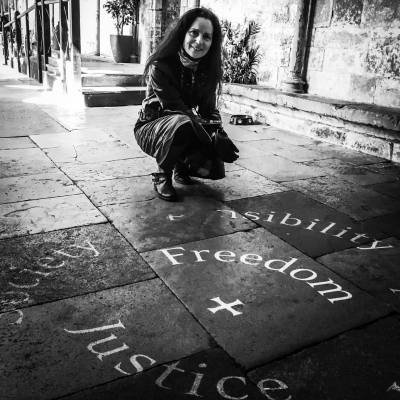
 What is happiness? We all seek it. And yet, it seems so difficult to define. We often find ourselves drawn to options for synthetic happiness — having more things. I am embarrassed to admit that when I am struggling, I distract myself with retail therapy. And now, I don’t even have to leave my bed to do it. A few clicks and a package will show up at my doorstep in two days. However, once it arrives, I usually don’t remember placing the order. It is a transient fix that allows me to avoid feeling. I am guilty.
 “I have set before you life and death . . . Choose life.” (Deut. 30:19)
 I am all for the critical deconstruction of Disney Princesses, especially since now I see more of a commercial push for them as a collection than when I was growing up in the late 80’s. However, I too had a favorite princess growing up, Ariel from The Little Mermaid. I lived next to the ocean and it made sense that she would be the most relatable Disney character to a Puerto Rican 5-year-old at that time; a character like Moana was not yet in site to appeal to this isleña.
 Not too long ago I heard someone deride members of a seminar who were building labyrinths in the olive groves of Greece as “a bunch of tree-huggers.” I bristled! I probably first heard of
  This week’s Torah portion is Vayikra (Leviticus 1:1 – 5:26). Vayikra is essentially one long discourse on animal sacrifice with an occasional grain or oil offering included. This killing of animals, their subsequent burning and the shared eating of their flesh was the predominate way deities were worshipped in ancient Canaan. It was believed that the smell of cooking meat appeased the gods and most importantly stifled their anger. It is no wonder then that the ancient Israelites so integrated within the surrounding culture adopted similar methods of worship.
 I sat in a frigid moot court room at a conference on the morning of March 8, trying to concentrate. Within an hour of the program’s opening keynote, my underarms had become damp with that weird cold sweat that happens when you are at once freezing and yet decidedly overwarm in your wool overcoat. I was distracted, trying to decide whether I was sick, menstruant, nervous, or inappropriately dressed. My coat was long and fitted over my suit coat, and I was vaguely worried about bleeding through or around what had become a misaligned feminine product. Sitting straight in all those stiff layers for several hours felt, I imagined, something like the confinement of a full body corset.
 I’ve been thinking a lot about abuse. Of course, most of us know about the domination, exploitation and need for control meted out by patriarchy, but I wonder if we have actually normalized many abuses? Abuse in the home, in the workplace, in our culture. Perhaps we accepted it unconsciously because so many of us are conditioned by religions that tell us to make noble sacrifice and tolerate suffering silently. I wonder if we’re calling it out when we see it – often and loudly – or if we’ve become conditioned to quietly accept the abuse with little push back.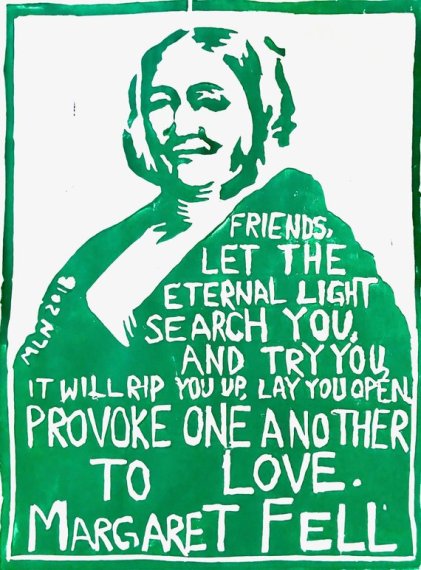
 Feminism and Religion