 My Name Is Isis by Susan Morgaine is the fourth book in the My Name Is series from The Girl God; a series of picture books for children. The series serves as a child’s gentle & colorful introduction to one particular Goddess per book.
In My Name is Isis, Susan Morgaine invites her young readers into a dialogue with the Goddess. For example, when sharing Her role as Great Mother & Protector, Isis asks “Do you have brothers or sisters — or a pet — that you help take care of?” inviting the reader to consider what it means to be nurturing and protective of someone they love. The conversational style is engaging and creates an opportunity for a child to see characteristics of the Divine within themselves.
The cover art and design of this particular book is not my favorite in the My Name is series. I find this one unappealing to children in comparison to the earlier volumes. However, the illustrations inside the book are luminous and include many beautiful examples of women’s bodies that serve to normalizing the sacred nature of diverse feminine forms. Many of the symbols, animals, and features associated with Isis are also depicted, such as Isis as a kite, searching the world for Her missing husband.
Parents should be aware that as a part of exploring Her story, the text does touch on death & the loss of loved ones. It does so gently and encourages children to know that their deceased loved ones live on in their hearts. Sensitive children who struggle with the concepts of death, dying, or grief may need help processing these few pages.
I especially loved the pages about Isis as Teacher and her firm, loving admonishments to “treat your teachers with honor and respect as they show you the things you must learn.” Teachers need a Great Goddess looking out for them and the incredible work they do every day. So, this was a sweet addition to the aspects of the Goddess Susan explores and the lessons she and Isis convey to their audience.
Overall, this truly is a lovely picture book that Pagan/Goddess parents could use to introduce young children to Isis as Great Mother, Teacher, & Healer. Hopefully, Susan Morgaine will write more future volumes in the series, bringing young Pagan children into conversation with more Goddesses. Continue reading “My Name is Isis BOOK REVIEW by Kay Bee”


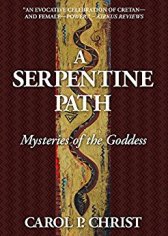
 In the ancient world, snakes represented fertility, creativity, rebirth, wisdom and, even, death. They were often closely connected to female goddesses, priestesses and powerful human females who were the embodiment of such powers. For example, there is the Minoan goddess/priestess holding the two snakes in her outstretched arms. She is closely linked with fertility and domesticity. Similar figurines, with similar associations and dating to approximately 1200 BCE, have also been founded in the land of what once was Canaan, where Israelites also lived. Medusa, in whose hair lived venomous snakes, turned men who looked at her to stone. Ovid’s account of the creation of Medusa credits the Greek goddess Athena with Medusa’s lively hair. Another Greek legend says Perseus, after killing Medusa, gave her head to Athena who incorporated it into her shield. Athena, the goddess of wisdom, is portrayed often with snakes wrapped around her as a belt and/or on the floor next to her.
  The symbol of the Goddess is as old as human history. The most ancient images of the Goddesses from the Paleolithic era are neither pregnant nor holding a child. In Neolithic Old Europe the Goddess was most commonly linked with birds or snakes and only rarely portrayed as mother. Yet we tend to equate the Goddess with the Mother Goddess. I suspect that images of the Virgin Mary with Jesus on her lap and prayers to God as Father have fused in our minds, leading us to think that the Goddess must be a Mother Goddess and primarily a Mother.
 We, Goddess types, are getting ready to celebrate Imbolc, beginning on the evening on February 1st through the following day, until dusk. Many ask, “well, just what is Imbolc?”
 In my dream, two large cats are walking towards me on a sidewalk. They are large cats, not house cats, rather, lions or tigers and they are walking on two legs, standing up, like humans. Wait, their bodies are human, only their heads are feline. As they come closer, they appear to have top hats on their heads. They look like twins. I step aside and they stroll past me.
 I’ll be honest. For me, 2017 royally sucked. Though “feminism” was dubbed the “word of the year” by
 The disdain with which the work of archaeologist
  Feminism and Religion