Time for Change: What Do the Goddesses Say? by Carolyn Lee Boyd

cb2015From our very beginnings, women have danced with time. Our bodies’ moon cycles have always been a human calendar. As the first agriculturists, we partnered with the seasons to feed our families and communities. When we served as midwives and carers for the dead, we ushered our species into and out of their Earthly lives.

Time is also embedded in the stories of goddesses worldwide. Like human gatekeepers of birth and death, goddesses are often the stewards of fate. The Greek Moirai spun the thread of life and cut it at death’s proper time. The Balkan Laima , the ancient Arabian Menat, and the Etruscan Nortia are other among many fate goddesses. Some goddesses oversee change, the physical manifestation of time, including Anna Perenna, goddess of the circle of the year as well as all the seasonal goddesses. Kali, Rhea Kronia, and other Creator/Destroyer goddesses rule over time itself.*

Now, however, time is often a weapon of oppression against women. Women overburdened with an unfair share of daily life’s tasks were never able to create millions of paintings, symphonies, and inventions, make scientific discoveries, or engage in other endeavors at great loss to themselves and the world. After just a few years of maturity, we are cast aside as being “old.” How many lives have been cut short by violence, human-made disease, poverty, and war? For how many centuries have we been told to wait for equality and freedom until another war or crisis is over or we die and go to heaven? Continue reading “Time for Change: What Do the Goddesses Say? by Carolyn Lee Boyd”

Mandalas and Sacred Geometry by Judith Shaw

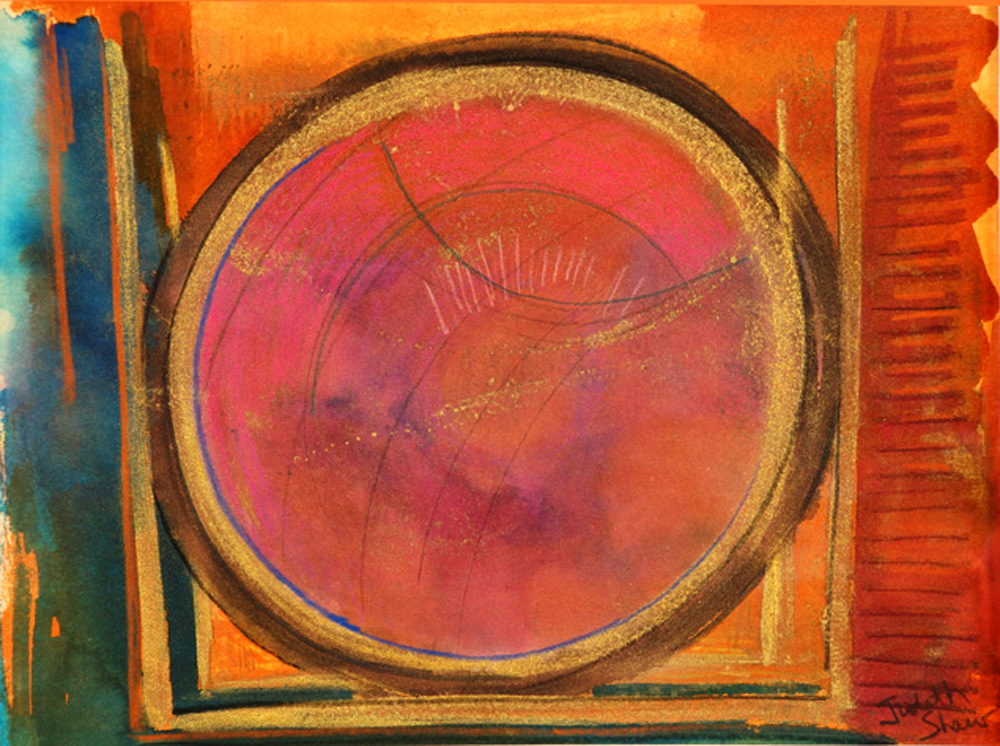
Dawn Mandala painting by Judith Shaw
Dawn Mandala, ink and watercolor on paper, by Judith Shaw

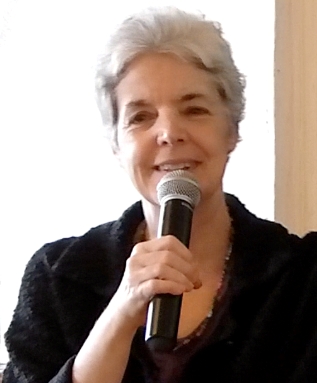
judith Shaw photoCan geometry open our hearts and minds to spirit?   Throughout time people around the world have thought so. Mandalas and Sacred Geometry symbols are found in many cultures both ancient and modern.

Mandala is a Sanskrit word which means “sacred circle.”  In Buddhism, Hinduism and other ancient wisdom traditions of the East, the mandala has been used as a tool to facilitate contemplation and meditation.  Through the process of studying and/or creating a mandala one can reach one’s center, one’s connection to Source. The circle, the first closed shape of Sacred Geometry, thus becomes a doorway to Oneness.

Traditional Hindu mandalas follow a strict form.  Every mandala is created following the precise design of that form.  One sees a further development of other Sacred Geometries within these traditional forms.  First there is the squaring of the circle also known as “The Marriage of Heaven and Earth”, with the circle representing Heaven and the square representing Earth.

Shri Yantra mandalaIn the Hindu tradition, each design within this “Marriage of Heaven and Earth” is called a yantra mandala and functions as a symbol which reveals cosmic truths. Thus yantra mandalas become sacred geometric symbols of a particular Hindu deity.

One of the most famous yantra mandalas is the Shri Yantra, a symbol of Tripurasundari, a supreme Hindu Tantric Goddess.  It depicts a series of precisely interlocking triangles, half pointing downward and half pointing upward.  It forms a state of perfect balance and harmony and represents the union of the female and male principles.  Also known as the Yantra of Creation or the Cosmic Yantra it is the most honored of all the Hindu yantras. The Shri Yantra becomes a door which can lead to the experience of Oneness.

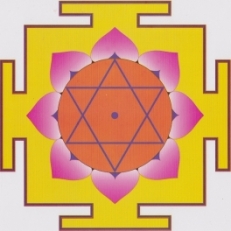
lakshmi yantra mandalaAnother goddess whose divine truths are revealed through the mandala is Lakshmi, Hindu Goddess of fortune, light, luck, and beauty.  Meditating on the Lakshmi Yantra encourages spiritual progress and helps to overcome internal blocks.

Christianity has also used the mandala to represent Divine Oneness and to teach the wisdom of its tradition.  The magnificent rose windows of the Gothic cathedrals are luminous examples of western mandalas.   Complex sacred geometries were used in the architectural designs of the buildings themselves and of the rose windows.

chartres rose windowThe rose windows are a western representation of our human aspiration towards wholeness and balance.  The rose windows operate on various levels; spiritual, emotional and intellectual. The instructional aspect of the rose windows is clearly seen by the subject matter – biblical stories, lives of the saints, astrological calendars, and morality stories to name a few.

In much the same way that the Hindu yantras symbolize the aspects of a particular deity, the rose windows typically show Christ or the Virgin or some other combination in the central rosette of the window.   The gates at the cardinal points of the yantras depict the many paths available to reach the divine.  In a similar fashion, the saints shown in the petals of a rose window can be seen as paths to Christ.

More than likely, mandalas were reintroduced into western thought through the Carl Jung’s pioneering work on the unconscious.  Jung wrote: “I sketched every morning in a notebook a small circular drawing,…which seemed to correspond to my inner situation at the time….Only gradually did I discover what the mandala really is:…the Self, the wholeness of the personality, which if all goes well is harmonious.”

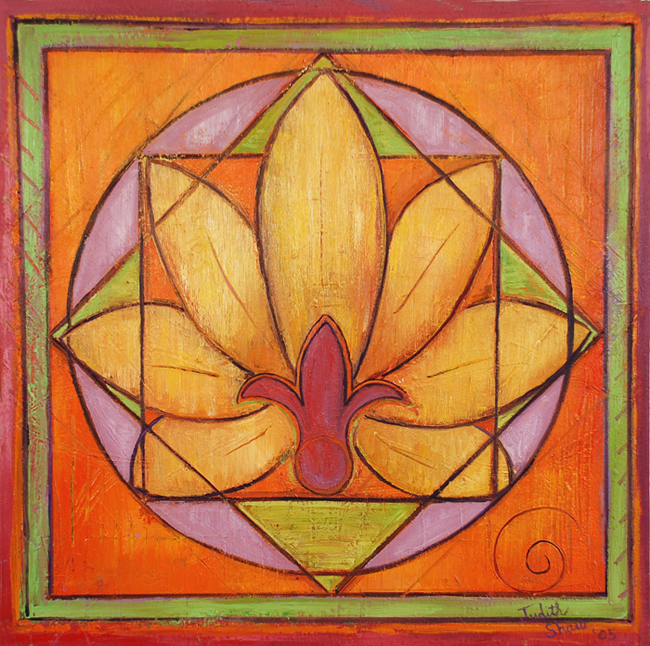
Lotus Mandala 1 , painting by Judith Shaw
Lotus Mandala 1, oil on canvas, by Judith Shaw

Continuing in this tradition, artists and spiritual practitioners today have been exploring a more free-form style of the mandala.  Within the basic foundation of the “squaring of the circle”, the artist then creates a personal, spontaneous design based on the concepts of balance, wholeness and oneness.

A quick google search reveals a multitude of mandala workshops being offered all around the world. Exploration of the mandala through these workshops offers a connection to your true self, an experience of sacred love, an opportunity to improve your life with intention, a deepening of your connection to nature, healing of emotional, mental, or physical pain, and a chance to be truly in the moment.

Lotus Mandala 2, painting by Judith Shaw

Yellow Flower Mandala, painting by Judith ShawCharmed Circle of Goddess Love, painting by Judith ShawThe mandala is a form that I have used in my own art since before I discovered the existence of Sacred Geometry. Even when not directly exploring the mandala, I find that often I want to draw a circle around the main image in my painting – seeking that experience of wholeness in the process of painting.

In future posts I will explore other elements of Sacred Geometry, all of which grow out of the mandala, the sacred circle.

A Lotus Dream, painting by Judith Shaw


Sources:  http://charlesgilchrist.com/SGEO/AboutMan.html,
http://www.isibrno.cz/~gott/mandalas.htm,
http://www.whats-your-sign.com/yantra-mandala.html,
http://dragon_azure.tripod.com/UoA/Med-Arch-Rose-Window.html,
http://www.sacredsymbolhealingart.com/SacredSymbolhealingArt.com/Mandala_Facilitators.html

Judith’s deck of Celtic Goddess Oracle Cards is available now.  Celtic-Goddess-Oracle-cards-by-judith-shawYou can order your deck on Judith’s website. Experience the wisdom of the Celtic Goddesses!

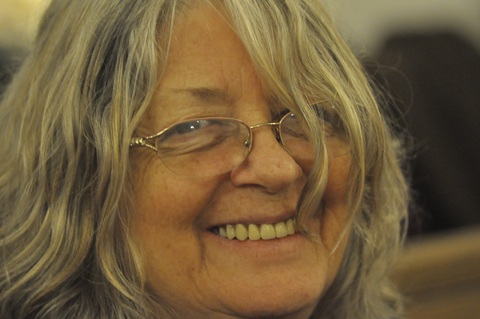
Judith Shaw, a graduate of the San Francisco Art Institute, has been interested in myth, culture and mystical studies all her life.  Not long after graduating from SFAI, while living in Greece, Judith began exploring the Goddess in her artwork.  She continues to be inspired by the Divine Feminine in all of Her manifestations. Originally from New Orleans, Judith now makes her home in New Mexico where she paints and teaches part-time.  She is currently hard at work on a deck of Goddess cards. Her work, which expresses her belief in the interconnectedness of all life, can be seen on her website.

Credhe, Celtic Goddess of Love and Spirit Contact by Judith Shaw

judith Shaw photoCredhe, also known as Creide or Cred is an Irish Faery Queen Goddess of Love and Spirit Contact. She is associated with Danu’s mountains, the Paps of Anu.  These are two gently rounded high hills that were adorned by the ancients with earthen and rock mounds and cairns positioned on top to represent erect nipples.  Her Sidhe was most likely located near the Paps of Anu.  She is also associated with crystals, the color pink and rose oil.

Continue reading “Credhe, Celtic Goddess of Love and Spirit Contact by Judith Shaw”

The Goddess of Willendorf and Does My Uterus Make Me Look Fat? by Molly

editMollyNov 083

 “Loving, knowing, and respecting our bodies is a powerful and invincible act of rebellion in this society.”
~ Inga Muscio

I do not remember the first time I ever saw her, but I do know that I have loved the Goddess of Willendorf sculpture for many years. When someone uses the phrase, “Great Goddess” or “Great Mother,” she’s the figure I see. To me, she honors the female form. I love her full-figure and the fact that she is not “perfect” or beautiful. I love that she is not pregnant* and what I like best is that she is complete unto herself. She is a complete form, not just a headless pregnant belly. She represents a deep, ancient power to me.

In a past post for FAR, I wrote:

I have a strong emotional connection to ancient Paleolithic and Neolithic goddess sculptures. I do not find that I feel as personally connected to later goddess imagery, but very ancient figures call to something deep and powerful within me. I have a sculpture of the Goddess of Willendorf at a central point on my altar. Sometimes I hold her and wonder and muse about who carved the original. I almost feel a thread that reaches out and continues to connect us to that nearly lost past—all the culture and society and how very much we don’t know about early human history. There is such a solid power to these early figures and to me they speak of the numinous, non-personified, Great Goddess weaving her way throughout time and space.

via Echoes of Mesopotamia by Molly Meade |.

Continue reading “The Goddess of Willendorf and Does My Uterus Make Me Look Fat? by Molly”

Caer Ibormeith, Celtic Goddess of Dreams and Prophecy by Judith Shaw

judith Shaw photoCaer Ibormeith, Celtic Goddess of Dreams and Prophecy, is a pan-Celtic goddess who was worshipped in Ireland, Scotland and Wales.  In Scotland and Wales Her name was used to name places such as Caer Edin (Edinburgh). In Ireland Her name identified the homes of Goddesses and Gods, such as Caer Arianrhod, home to the Goddess Arianrhod. Continue reading “Caer Ibormeith, Celtic Goddess of Dreams and Prophecy by Judith Shaw”

Sequana and Blessed Water by Deanne Quarrie

deanne_2011_B_smWater is the daily necessity for earth’s creatures.

When the Continental Celts were looking for a new homeland, they ventured west from the known river valleys of the great landmass we call Eurasia. Just beyond the great mountains, the Alps, they discovered sweet and abundant water, fertile soil, expansive woodlands, and the plentiful fish, game, berries, grasses, fungi and broad-leafed plants necessary to support their tribe.

We know that Celtic spirituality was, in its roots, animistic (spirit was alive in every living thing), non-anthropomorphic (the source of life and death was water, land, plant and animal-life), tribe-specific (in France alone there is evidence of several hundred deities) and a spirituality of place, of the major landforms that defined the world (rivers, springs, forests, animals, heavenly bodies). To the extent that Celtic spirituality was theistic, the creator/sustainer/destroyer of life was typically a goddess. Continue reading “Sequana and Blessed Water by Deanne Quarrie”

Research and the Dissertation: Getting Back to Basics by Michele Stopera Freyhauf

Freyhauf, Durham, Hahn Loeser, John CarrollHistory is written by the victors – this is something that we all know, or at least should know. I apologize in advance for being elementary in my discussion, but I think one thing that scholars tend to do too often is assume our readers or audience has a firm grasp on what we are talking about. With this topic, I am not assuming.

When studying artifacts from past civilizations, an interesting phenomenon of using spolia as a demonstration of conquest is commonplace. If a conquered country’s deity is placed on the bottom of a column, or even turned a different direction, the significance usually means that deity is demoted or inferior – this is found in the Hagia Sophia (especially under the structure). If spolia is found whereby a country adds their deity (even if that deity is their ruler) to another country’s monument, then there is a coexistence or combining of empires with the conquesting ruler in prominent view, even substituting past rulers. This is best demonstrated on the Arch of Constantinople whereby Christian symbols and the likeness of Constantine was incorporated into an arch that once displayed the victories of Marcus Aurelius and Domitian. If you are interested in this topic, please see my article “Hagia Sophia: Political Symbolism in Stones and Spolia” in Popular Archaeology magazine.

Continue reading “Research and the Dissertation: Getting Back to Basics by Michele Stopera Freyhauf”

What is the Cause of Violence? A Response to Karen Armstong by Carol P. Christ

 “So, when we in the West talk about religion as the cause of this violence, how much are we letting ourselves off the hook, and using religion as a way to ignore our role in the roots of this violence?” Karen Armstrong, author of Fields of Blood
carol p. christ photo michael bakasThis statement was made by scholar of religions Karen Armstrong in an interview in Salon magazine in response to characterizations of Islam as a violent religion by Bill Maher and others. Speaking in the context of the rise of anti-Islamist prejudice in Europe, Armstrong said that Maher’s demonization of “the other” was the kind of talk that could lead us back to the concentration camps.

Bill Maher makes blanket statements against religion in general and Islam in particular. Maher clearly does not have a nuanced view of any religion. He is fueling anti-Islamic sentiment when he singles out Islam as a violent religion. If religions are going to be criticized as violent, then we must not limit ourselves to criticizing Islam, but must begin closer to home, by discussing the relation of religion and violence in the Bible, in Christianity, and in Judaism. My rule of thumb is always to begin with Christianity because it is the hegemonic religion of western cultures. Continue reading “What is the Cause of Violence? A Response to Karen Armstong by Carol P. Christ”

Painting for the Earth by Jassy Watson

JassyI have spoken about the Social Responsibility of the Artist on numerous occasions. This blog approaches similar subject matter, but in relation to using art as a potent tool for change and as a platform for raising awareness of important environmental and ecological issues that all of humanity is currently faced with.

All forms of art have the potential to be tools for healing. I believe that through the creative process the relationship with self and the environment can be transformed. Why? Because when creative work is approached from a place of passion and purpose and art is brought to life with intention, great shifts can occur. Not only for the artist, but also for the viewer. I believe wholeheartedly that I can approach the canvas and paint intentionally to heal the earth and deepen my connection to it, and in doing so inspire others to deepen and honour a connection to the earth creatively.

There are many contemporary artists who are agents of environmental change and who are using their creative gifts and talents to build awareness and provoke thought through their work and process. Many artists, such as myself are working with transformative approaches and processes towards a new vision that is ecological and participates with the living cycles of nature. Many topics are approached such as oceans, climate change, water quality, recycling, water purification, natural disasters, de-forestation, endangered species and more.

Artists today are finding all sorts of inventive ways to call attention to the problems facing our environment, as corporate greed and profit impose destruction on our planet. While each artist works very differently and explores diverse territories, they share awareness about the critical loss of natural resources and a desire to save the planet from human destruction.

Take the words of Nigerian painter Jerry Buhari:

“Today the talk of the world is about an endangered Earth. One often wonders how much of the talk is backed with genuine concern and the will to take positive steps. But it should not surprise the world that artists are in the forefront of the discussion on the environment.”

Eco-feminist artist Ann T. Rosenthal and activist artist Steffi Domike have been collaborating on environmental installations for years. Their wall installation, Watermark: Wood, Coal, Oil, Gas (2011) consists of four panels that illustrate an evolutionary timeline of energy resources—wood, coal, oil and natural gas.

shallow-ann-rosenthal-200x300

Dominique Mazeau is a poet and artist from Santa Fe, New Mexico. She has made an exquisite journal of poems and drawings of cleaning up the Rio Grande River over many years. She has made sculptures from the trash and she teaches school children about the river with her poems and her art.

There are many more Eco-feminist and Environmentalist/Activist artists such as Charla Puryear and Helene Aylon using their art to raise awareness of ecological issues. These few examples alone demonstrate that art, in its myriad of forms, has the capacity to effect positive change on the earth and its environments.

Artists are catalysts for change, and this “change” takes place when we feel deeply for a precious cause. I feel deeply for the state of the earth and feel that it is largely humanity’s spiritual disconnection from the earth and from the earth as sentient that has contributed to the current state of not only the health of the earth body, but also the health of our bodies.

Coming up in October I will be presenting an exhibition ‘Voices for the Earth’ in Bundaberg, QLD Australia. This exhibition will feature the works of select regional artists who are using their art to speak for the earth. It is held in conjunction with RONA-16 an Earth Arts Festival as part of the The Rights of Nature Tribunal that is taking place the same month. Artists of all genres from around Australia are participating in creative activities to raise awareness of the urgency required to make the necessary changes so that ways can be found to make the health of our planet an absolute priority.

I know that more has to be done, and some might see ‘art’ as a hedonist, self absorbed way to attempt to bring about change – but the power of image should NEVER be underestimated.

I am Painting for the eARTh.

This Earth is my sister
I love her daily grace
Her silent daring
And how loved I am.
How we admire this strength in each other
All that we have lost
All that we have found
We are stunned by this beauty,
And I do not forget
What She is to me
And what I am to Her.

(from Susan Griffin, Woman and Nature – The Roaring Inside Her, p.219, caps added).

'The Earth is my Sister'
‘The Earth is my Sister’

Jassy Watson, who lives on the sub-tropical coast of Queensland Australia, is a Mother of four, passionate organic gardener, Intuitive/Visionary & Community Artist, Teacher, Intentional Creativity Coach and a student of Ancient History and Religion at Macquarie University, Sydney. She is the Creatress of Earth Circle Studios; a school for the Sacred Creative Arts. Jassy teaches regular painting workshops in person, nationally and internationally, and online based around themes that explore myth, history and our connection to the earth. 

Dancing Daughters of the Living Goddess by Laura Shannon

Laura Shannon

A lifetime of research has convinced me that the women’s ritual dances and costumes of Greece are living remnants of ancient Old European Goddess traditions.  In previous posts on FAR I have written about these dances and embroideries, as well as the Midwives’ day rituals which honour the wise women, and the healing effects the women’s circle dances can have. All of these threads came together again in my most recent trip to Thrace.

Today trisected into Greek, Bulgarian and Turkish parts, Thrace is a wild landscape of mountains, forests, rivers and fertile fields. Less than one hundred years ago Greeks, Slavs, Turks, Pomaks, Gagaouzides and other ethnic groups lived and mingled freely throughout the whole area, and although the traumatic wars of the 20th century precipitated a huge upheaval of refugee movement and new settlement, Thrace is still home to a great variety of different peoples here who have kept their customs alive.

In Greece, Thrace is the most northeasterly region, and Evros is the very topmost bit of it, rising up like a thumb between Turkey and Bulgaria. I started visiting the villages of Evros some years ago and have  been back many times. When friends invited me to celebrate my birthday there recently I jumped at the chance. All the villages we went to are Greek Orthodox, with visible elements in costume and culture – such as the Goddess embroideries – which survive from pre-Christian times.

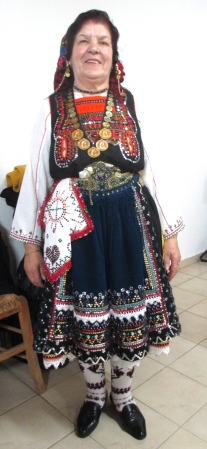
We started off in Pentalofos, my favourite village, with music, dance, song, feasting, and wonderful grandmothers in splendid traditional costumes. In this village they still spin, weave, sew and embroider their festive dress by hand. I have my own costume from Pentalofos like the one Kyria Koula is wearing (on the left), made for me by her, Kyria Loulouda and other women of the village.
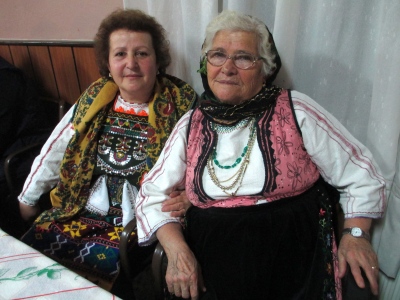
photo 2

The bodice features a triple butterfly design, connected to the ancient labyris / double axe. It is also a symbol of transformation, not least the transformation of individual women – through dance, song and ritual dress – into manifestations of radiant feminine strength and beauty, moving beyond their personal identity and concerns in order to embody a larger power. This phenomenon is represented by the image of a woman with wings, easily discerned in the butterfly design here and in other villages.
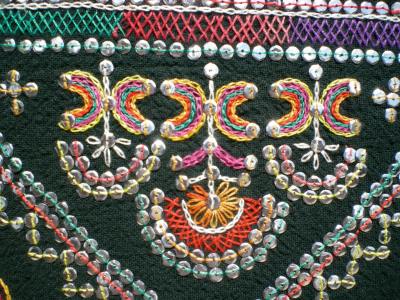
Photo 1

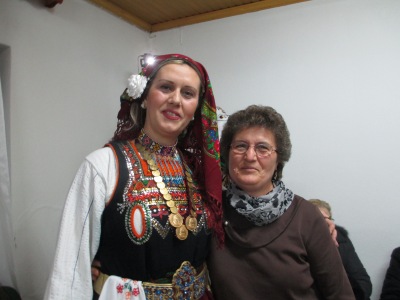
Other villages have their own version of the Thracian women’s costume, as in Doxapara where we went next:
3_IMG_5562

4_IMG_5610
Chryssa, on the left, wears the costume made by her mother, on the right.
5_IMG_5609

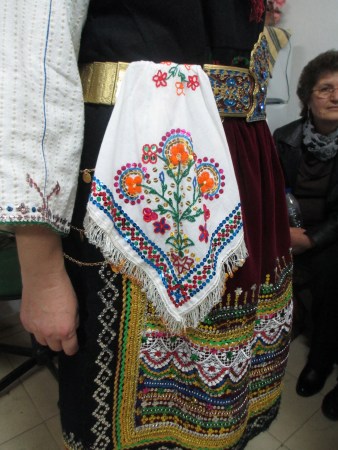
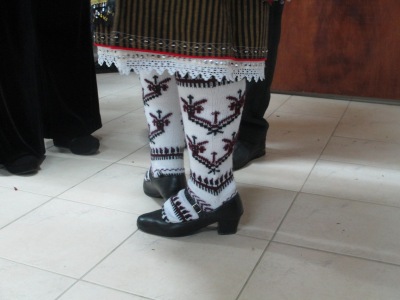
Chryssa’s handkerchief is embroidered with a flamboyant sun-headed Goddess/flower motif.  An ancient V-shaped motif of spiral horns, or perhaps a pair of wings, appears on her sleeve in red. This motif is more discreet, but its central location affirms its importance. Women’s hands – which created all this and much more – were considered holy and worthy of protection. As on the handkerchief, Goddess figures are often depicted with radiant, extra-large or winglike hands.
6_IMG_5567
Knitted socks in Doxapara depict winged Goddess figures in red, black and white.

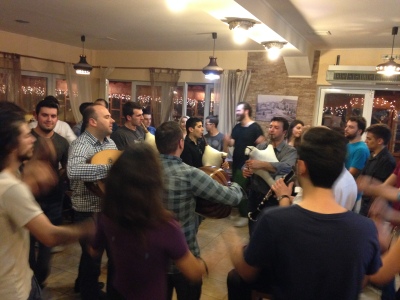
We celebrated my birthday eve in a little taverna in Oinoi, a village of Gagaouzides, Turkish-speaking Greek Christians from Bulgaria. Friends (and friends of friends) needed no persuading to dance up a storm.
7_IMG_1444

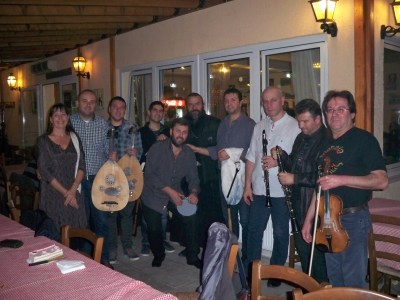
Music was provided by gaidas (bagpipes), laoutos (lutes), clarinets, violin and doumberleki, not to mention everyone singing along. The ‘Happy Birthday’ songs, both English and Greek versions, sounded fantastic with this orchestra.
8_100_0896

9_IMG_1436
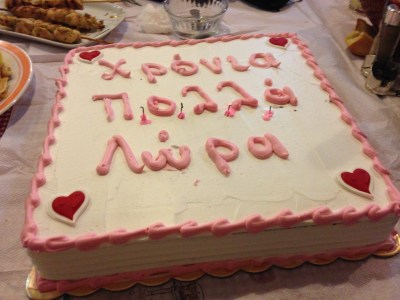
Hospitality is a sacred obligation in Greece, as in many parts of the Balkans, and dancing must be accompanied by feasting. My birthday cake weighed 3 kilos and fed 75 people. ‘Many years, Laura’!

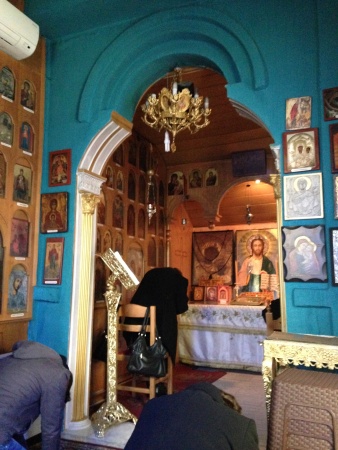
On the morning of my birthday, while everyone else was still asleep, I went to a favourite church in Kleissos, which has a little side chapel filled with 144 icons of the Virgin Mary, whom Greeks call the All-Holy One, the Panayia. As you see, people pray to her very fervently here. The images are copies of famous miraculous icons from other places like Tinos and Kythira. The Panayia of Kleissos is also believed to be a miracle-working icon; I can attest to its power from past experience.
10_IMG_1466

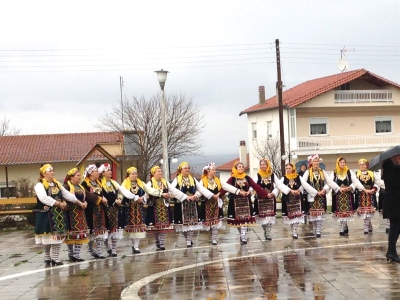
Later we proceeded to Ambelakia, a village I had not visited before.
11_IMG_1576

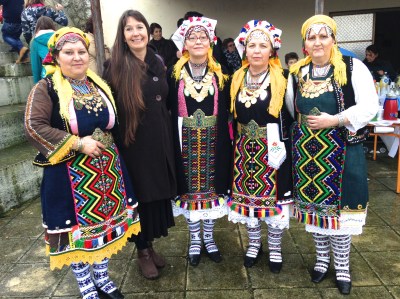
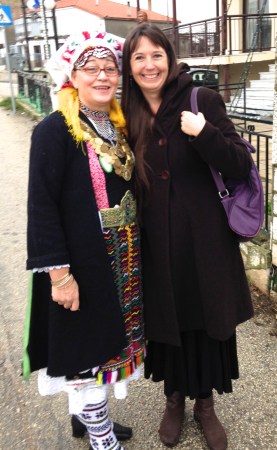
These women are Marides, an ancient Thracian tribe. Their costumes feature many Goddess embroideries and, on their socks, the recurring motif of the wild bee. Priestesses in Thrace and other areas were once known as bees (mélisses).

The women here told me about the ancient festival they keep, called ‘Gynaikokrateía’, Gynocracy or Women’s Rule. It is related to Thracian Midwives’ Day celebrations (described in a previous post) and falls on the same day, January 8th.  On this day, they told me, gender and power roles are reversed and women take over the town hall, village square, cafes and other male-dominated public spaces. They exact toll payments from passing vehicles, which they use to buy wine. The women’s unrestrained merriment and public drunkenness, unthinkable on the other days of the year, is combined with ribald and satirical skits lambasting men’s misbehaviour. This sharp commentary is remembered, laughed over and talked about for months afterwards, thus providing an apparently innocent, yet effective, social deterrent to abuses of power.
12_IMG_1593
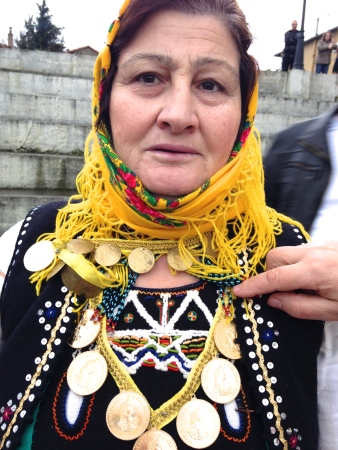
Marides women’s costumes can be ‘read’ as a treasury of ancient women’s wisdom hidden in plain view, an open secret for those with eyes to see. Yellow headscarves with long fringes resemble both sun and rain, life-giving elements of agriculture both originally identified with the Goddess. Woven aprons illustrate flowing life force, womb energy and women’s awesome creative power, with Goddess/Tree of Life figures inside the central rhombs.
13_IMG_1617
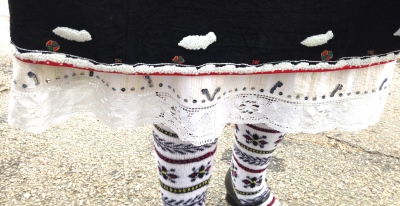
Spiral horns reappear on the hem of the underdress. Sacred symbols on this spot simultaneously pronounce and protect the power of what lies directly above. ‘Doves’ encircle the hem of the black overdress; ‘bees’ adorn the socks.
14_IMG_1614
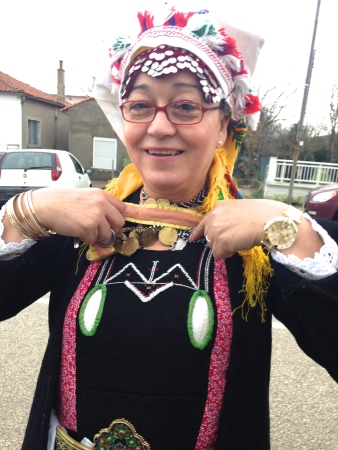
In the central place on the heart of the bodice: the winged Goddess motif, a sign of the dancing priestess and a key Thracian symbol for thousands of years. This powerful image is usually invisible, hidden under scarf fringes, beaded necklaces and garlands of gold coins, but the women revealed it to me because I knew it was there and asked to see it.
15_IMG_1648

16_IMG_1603
As much as I loved meeting them, they loved meeting me – as they would love to meet any woman who can recognise them for what they are and what they wear.
17_IMG_1571
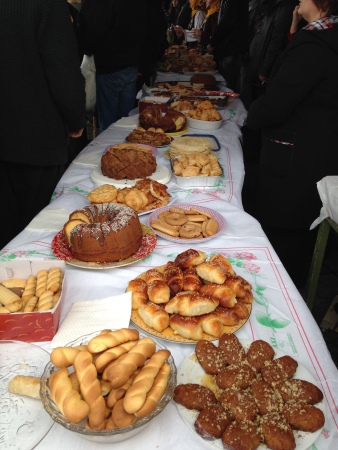
And of course there was another feast.

It was a fabulous birthday. I even danced, managing to overcome lingering injuries from a bicycle accident I had had some months before. Giving myself to the healing energy of women sharing steps together, I felt radiantly joyful and truly alive, as if at a momentary crossroads of space and time, simultaneously fleeting and eternal.

In Thrace, I feel extremely privileged to witness the survival of motifs and ritual customs with roots in Neolithic Old Europe, as well as key values from the Old European worldview articulated by Gimbutas, Carol P Christ, and others: respect for nature, a sense of interdependence, the need for social justice and the importance of community celebration.

We are blessed to live in an age where these and other ancient treasures of women’s wisdom, are now returning, visibly and consciously, to our own culture. Patriarchal domination has not and will not manage to destroy these riches from the past. At this time of the winter Solstice, I wish us all the healing joy, connectedness, and love in abundance which these dances embody, to warm us and guide us all into the rebirth of the year.

Love & blessings,
Laura

Laura Shannon has been researching and teaching traditional women’s ritual dances since 1987. She is considered one of the ‘grandmothers’ of the worldwide Sacred / Circle Dance movement and gives workshops regularly in over twenty countries worldwide. Laura holds an honours degree in Intercultural Studies (1986) and a diploma in Dance Movement Therapy (1990).  She has also dedicated much time to primary research in Balkan and Greek villages, learning songs, dances, rituals and textile patterns which have been passed down for many generations, and which embody an age-old worldview of sustainability, community, and reverence for the earth. Laura’s essay ‘Women’s Ritual Dances: An Ancient Source of Healing in Our Times’,  was published in Dancing on the Earth