When Merlin Stone’s book, When God Was a Woman, was published in 1976, it was a lightning bolt of feminist scholarship that told the world that before there was a Judeo-Christian god there were goddesses, and before there were goddesses, there was the Goddess. If you’re reading this review and you have not read When God Was a Woman, buy the book. Right now. As you sink into Stone’s book, try to imagine what it was like before we knew about Isis or Inanna or Astarte, before we knew that the tree in the Garden of Eden was probably a sacred fig and that the serpent was a symbol or aspect of the Goddess and that people (mostly women) who ate figs or worked with serpents were honored priestesses and prophets. Just imagine! The work of the second wave feminists added to the work of scholars like Merlin Stone and Marija Gimbutas, but it didn’t begin until the second half of the 20th century. Before that? All there was, was God the Father, maker of heaven and earth. Yes, Merlin Stone hurled lightning bolts into our hearts and minds and bookshelves.
Merlin Stone Rememberedis a new book edited by Dr. Carol F. Thomas, Dr. David B. Axelrod, and Stone’s life partner Leonard Schneir, with an introduction by Gloria Orenstein, professor emerita, USC. Orenstein opens the book by putting Stone’s work in context. Before the 60s and 70s, she writes, no one was ever taught anything about the matristic cultures. Yes, a few books had been written. She cites G. Rachel Levy’s The Gate of Horn (published in England in 1948, republished in the U.S. in 1963), Helen Diner’s Mothers and Amazons (1973), and Elizabeth Gould Davis’ The First Sex (1971). These books gave us some of our foundational myths, but, Orenstein writes, “we can see that although there was some writing that had already attempted to reconstruct a history of women …, much more expertise and authority were needed” (p. 8). “Once Merlin Stone provided us with her careful scholarship and a truly feminist (not biased, patriarchal) accounting of ancient Goddess cultures, I and all who found Merlin’s work were finally able to understand our herstory…” (p. 9).
ANJEA is an Australian Aboriginal fertility Goddess. She is an animistic spirit known to the tribesman of the Pennefather River, Queensland, Australia that is located on the Western Cape York Peninsula.
In the 1930s two ancient storerooms in Afghanistan near what is now the Bagram US Air Base were discovered by French archaeologists and unsealed for the first time in about two thousand years. They contained artifacts from all over the ancient world, evidencing just how active trade then was along the complex network of routes known collectively as the Silk Road. Among the artifacts in one of the storerooms was a plaster statuette of Aphrodite (‘Bagram Aphrodite’).
Though it is not known what the motivation originally was for acquiring the Bagram Aphrodite, its presence in Afghanistan arguably evinces an interest in female spirituality–if not in the owner of the storerooms then among some of the people in the market for which she may have been destined. Evidence of such interest among Buddhists is to be found in the Flower Ornament Scripture (FOS), a compendium of sutras dated to approximately the same time (and possibly the same region) as the storeroom containing the Bagram Aphrodite. Female spiritual figures, both mortal and immortal, some portrayed as having official positions, others without any, are prominent in the final chapter of the FOS, so prominent that one scholar suggests Buddhist women of the time in some way influenced its composition (see Douglas Osto, Power, Women and Wealth in Indian Mahayana Buddhism).
Most days I am not certain that anyone really cares about what happens to girls. As a mother of a soon-9-year-old daughter, this burns me.
Because I also have a 12-year-old son, I often end up watching movies I wouldn’t chose on my own. Last Friday, we went to see The Avengers sequel, and I left feeling angry. There were two sheroes shadowed by testosterone; both were highly sexualized. After all the hype over Joss Whedon and his “strong female characters” I began to wonder if the Sheroe we really need is Goddess.
Saturday night we had a lively discussion after dinner with my son’s best friend. I shared my observations on the movie and asked for feedback. They told me the only girl heroes they could think of had “huge boobs.” I asked them why they thought there was not equal amounts of sheroes in movies like this and whether they could think of any movies that were comparable in budget to the Superman, Batman, and Spiderman movies that continue to come out year after year. Continue reading “Does God have Cleavage? The Avengers and Why the Sheroe We Need is Goddess by Trista Hendren”
I was trying not to fidget as I sat on the hard, unforgiving walnut pew. It was a gorgeous summer day out, and I was locked inside breathing stale air and with nothing to look at but the dreary speaker, and, behind him, a life-sized, picture of a sweet-looking man about to be hung from nails driven through his hands. I was visiting my parents, who love to take me to church, and I just wasn’t able to say no.
As I sat I daydreamed about our indigenous European ancestors. They did “church” outdoors, in fragrant, airy forests with wild bluebells, warbling birds, and gentle breezes caressing their skin, ears and eyes. Instead of doing hard time on walnut benches, they got to dance, chant, hold hands and jump through fires.
The path leading to the Klapados Waterfall begins at the edge of an open meadow in the pine and oak woodlands of a mountain in the island of Lesbos. After driving several miles on a very rutted dirt track, we parked under an oak tree, crossed the meadow and scrambled down a winding path. After about 20 minutes, it ended at a stream surrounded by plane trees. From there, we climbed over rocks to reach a pool created by the seasonal waterfall.
On the day we visited it, the waterfall was only a trickle of cascading drops that moistened its moss-covered path to the pool. The roots of a plane tree growing at the top of cliff followed the path of the water, weaving a web over the rockface all the way down to the pool.
Sitting on a rock at the edge of the pool I realized that the cliffs that embraced it on three sides were the remains of a crater formed twenty million (or so) years ago when a finger of molten lava pushed its way through the earth, exploding in clouds of dust and projectile rocks.
In Lesbos the volcanic activity came not from a single source–for example, from the highest mountain. Rather, like the plane trees in whose shade we rested, the volcano’s trunk with roots in the molten lava of the earth’s core, had many branches from which it erupted at different times. Huge boulders thrown out in the explosions can be seen in the meadows, while the trees in the forest curve their roots around them to reach the soil. The mountain was also shaped by the settling of volcanic dust that crumbles again into tiny fragments when exposed.
As I was thinking of all of this my friend Cristina climbed over the roots of the plane trees that surrounded the pool, removed her clothes, and slipped into the water. Soon I followed her. We sensed that we were in a sacred place, and as we have done rituals together many times before, our ritual emerged spontaneously: it almost seemed as if our minds and bodies were moving as one.
We renewed ourselves in beauty, submerging our bodies under the water three times, while floating in the embrace of the pool, gazing up at the rock formations, admiring trees that looked like dancing women, moss that looked like pubic hair, and blue black damselflies that all together had created a most beautiful place that called to something deep within us on that day.
Later we would sing the English version of the song of the Navajo Beautyway:
I walk with beauty before me.
I walk with beauty behind me.
I walk with beauty all around me.
As I walk the beauty way.
I walk with beauty above me.
I walk with beauty below me.
I walk with beauty inside me.
As I walk the beauty way.
This short paper was part of a series of assessment pieces for university where we had to imagine ourselves as people living in a number of ancient cultures. It addresses a very direct question: “Imagine you are in Ancient Greece sometime during the 5th century BCE and a family member is preparing to be initiated into the Mystery Rites at Eleusis. You have come to support them and join in the festival. Briefly describe your experience?”
It is the month of Boedromion (Late September/Early October) and the sixth day of the Eleusinian festivities held annually in the great city of Athens. I travelled some distance to take part in the nine-day festival held in honour of the ‘Greater Mysteries’ for which my niece prepared as an initiate. The city is alive with women, men and children from near and far. Many have come to take part and fulfil the countless functionary roles associated with the festival, along with the great crowd of initiates who have spent the past three days fasting and ritually preparing. Continue reading “Demeter – Mother of Creative Potential”
From our very beginnings, women have danced with time. Our bodies’ moon cycles have always been a human calendar. As the first agriculturists, we partnered with the seasons to feed our families and communities. When we served as midwives and carers for the dead, we ushered our species into and out of their Earthly lives.
Time is also embedded in the stories of goddesses worldwide. Like human gatekeepers of birth and death, goddesses are often the stewards of fate. The Greek Moirai spun the thread of life and cut it at death’s proper time. The Balkan Laima , the ancient Arabian Menat, and the Etruscan Nortia are other among many fate goddesses. Some goddesses oversee change, the physical manifestation of time, including Anna Perenna, goddess of the circle of the year as well as all the seasonal goddesses. Kali, Rhea Kronia, and other Creator/Destroyer goddesses rule over time itself.*
Now, however, time is often a weapon of oppression against women. Women overburdened with an unfair share of daily life’s tasks were never able to create millions of paintings, symphonies, and inventions, make scientific discoveries, or engage in other endeavors at great loss to themselves and the world. After just a few years of maturity, we are cast aside as being “old.” How many lives have been cut short by violence, human-made disease, poverty, and war? For how many centuries have we been told to wait for equality and freedom until another war or crisis is over or we die and go to heaven? Continue reading “Time for Change: What Do the Goddesses Say? by Carolyn Lee Boyd”
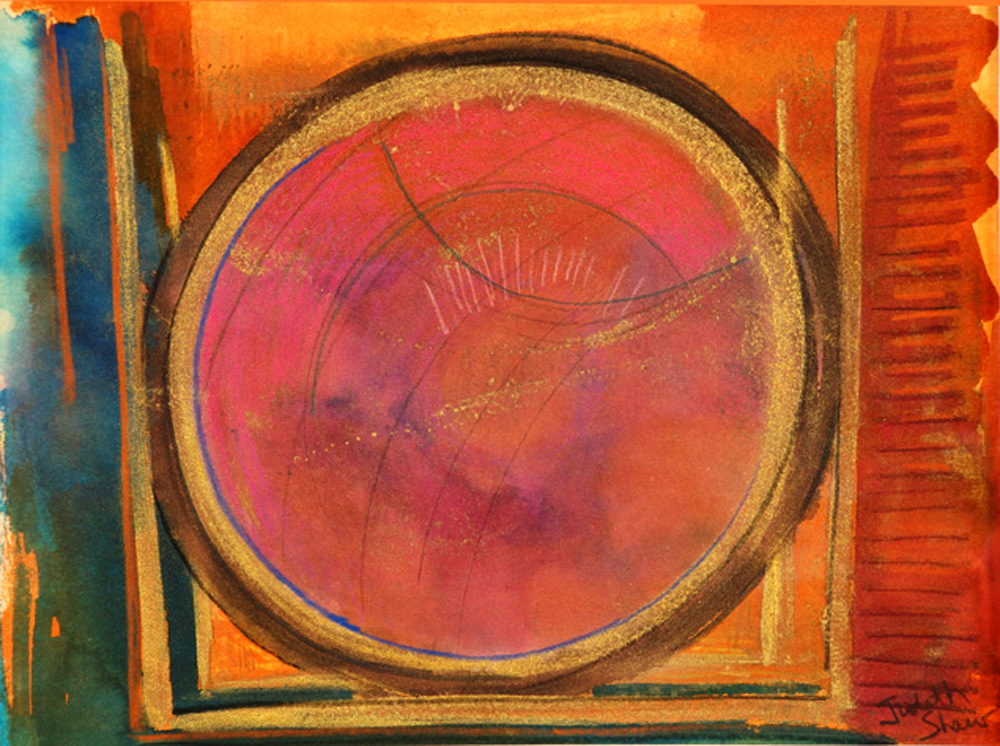
Dawn Mandala, ink and watercolor on paper, by Judith Shaw
Can geometry open our hearts and minds to spirit? Throughout time people around the world have thought so. Mandalas and Sacred Geometry symbols are found in many cultures both ancient and modern.
Mandala is a Sanskrit word which means “sacred circle.” In Buddhism, Hinduism and other ancient wisdom traditions of the East, the mandala has been used as a tool to facilitate contemplation and meditation. Through the process of studying and/or creating a mandala one can reach one’s center, one’s connection to Source. The circle, the first closed shape of Sacred Geometry, thus becomes a doorway to Oneness.
Traditional Hindu mandalas follow a strict form. Every mandala is created following the precise design of that form. One sees a further development of other Sacred Geometries within these traditional forms. First there is the squaring of the circle also known as “The Marriage of Heaven and Earth”, with the circle representing Heaven and the square representing Earth.
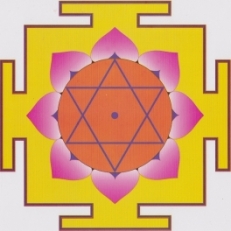
In the Hindu tradition, each design within this “Marriage of Heaven and Earth” is called a yantra mandala and functions as a symbol which reveals cosmic truths. Thus yantra mandalas become sacred geometric symbols of a particular Hindu deity.
One of the most famous yantra mandalas is the Shri Yantra, a symbol of Tripurasundari, a supreme Hindu Tantric Goddess. It depicts a series of precisely interlocking triangles, half pointing downward and half pointing upward. It forms a state of perfect balance and harmony and represents the union of the female and male principles. Also known as the Yantra of Creation or the Cosmic Yantra it is the most honored of all the Hindu yantras. The Shri Yantra becomes a door which can lead to the experience of Oneness.
Another goddess whose divine truths are revealed through the mandala is Lakshmi, Hindu Goddess of fortune, light, luck, and beauty. Meditating on the Lakshmi Yantra encourages spiritual progress and helps to overcome internal blocks.
Christianity has also used the mandala to represent Divine Oneness and to teach the wisdom of its tradition. The magnificent rose windows of the Gothic cathedrals are luminous examples of western mandalas. Complex sacred geometries were used in the architectural designs of the buildings themselves and of the rose windows.
The rose windows are a western representation of our human aspiration towards wholeness and balance. The rose windows operate on various levels; spiritual, emotional and intellectual. The instructional aspect of the rose windows is clearly seen by the subject matter – biblical stories, lives of the saints, astrological calendars, and morality stories to name a few.
In much the same way that the Hindu yantras symbolize the aspects of a particular deity, the rose windows typically show Christ or the Virgin or some other combination in the central rosette of the window. The gates at the cardinal points of the yantras depict the many paths available to reach the divine. In a similar fashion, the saints shown in the petals of a rose window can be seen as paths to Christ.
More than likely, mandalas were reintroduced into western thought through the Carl Jung’s pioneering work on the unconscious. Jung wrote: “I sketched every morning in a notebook a small circular drawing,…which seemed to correspond to my inner situation at the time….Only gradually did I discover what the mandala really is:…the Self, the wholeness of the personality, which if all goes well is harmonious.”
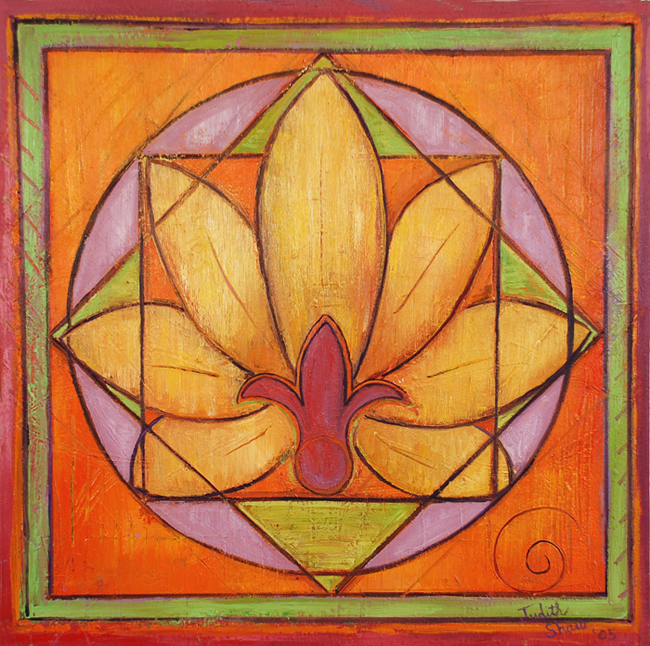
Lotus Mandala 1, oil on canvas, by Judith Shaw
Continuing in this tradition, artists and spiritual practitioners today have been exploring a more free-form style of the mandala. Within the basic foundation of the “squaring of the circle”, the artist then creates a personal, spontaneous design based on the concepts of balance, wholeness and oneness.
A quick google search reveals a multitude of mandala workshops being offered all around the world. Exploration of the mandala through these workshops offers a connection to your true self, an experience of sacred love, an opportunity to improve your life with intention, a deepening of your connection to nature, healing of emotional, mental, or physical pain, and a chance to be truly in the moment.
The mandala is a form that I have used in my own art since before I discovered the existence of Sacred Geometry. Even when not directly exploring the mandala, I find that often I want to draw a circle around the main image in my painting – seeking that experience of wholeness in the process of painting.
In future posts I will explore other elements of Sacred Geometry, all of which grow out of the mandala, the sacred circle.
Judith’s deck of Celtic Goddess Oracle Cards is available now. You can order your deck on Judith’s website. Experience the wisdom of the Celtic Goddesses!
Judith Shaw, a graduate of the San Francisco Art Institute, has been interested in myth, culture and mystical studies all her life. Not long after graduating from SFAI, while living in Greece, Judith began exploring the Goddess in her artwork. She continues to be inspired by the Divine Feminine in all of Her manifestations. Originally from New Orleans, Judith now makes her home in New Mexico where she paints and teaches part-time. She is currently hard at work on a deck of Goddess cards. Her work, which expresses her belief in the interconnectedness of all life, can be seen on her website.
Credhe, also known as Creide or Cred is an Irish Faery Queen Goddess of Love and Spirit Contact. She is associated with Danu’s mountains, the Paps of Anu. These are two gently rounded high hills that were adorned by the ancients with earthen and rock mounds and cairns positioned on top to represent erect nipples. Her Sidhe was most likely located near the Paps of Anu. She is also associated with crystals, the color pink and rose oil.


 When Merlin Stone’s book, When God Was a Woman, was published in 1976, it was a lightning bolt of feminist scholarship that told the world that before there was a Judeo-Christian god there were goddesses, and before there were goddesses, there was the Goddess. If you’re reading this review and you have not read When God Was a Woman, buy the book. Right now. As you sink into Stone’s book, try to imagine what it was like before we knew about Isis or Inanna or Astarte, before we knew that the tree in the Garden of Eden was probably a sacred fig and that the serpent was a symbol or aspect of the Goddess and that people (mostly women) who ate figs or worked with serpents were honored priestesses and prophets. Just imagine! The work of the second wave feminists added to the work of scholars like Merlin Stone and Marija Gimbutas, but it didn’t begin until the second half of the 20th century. Before that? All there was, was God the Father, maker of heaven and earth. Yes, Merlin Stone hurled lightning bolts into our hearts and minds and bookshelves.
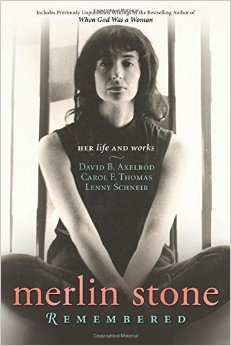 Merlin Stone Remembered is a new book edited by Dr. Carol F. Thomas, Dr. David B. Axelrod, and Stone’s life partner Leonard Schneir, with an introduction by Gloria Orenstein, professor emerita, USC. Orenstein opens the book by putting Stone’s work in context. Before the 60s and 70s, she writes, no one was ever taught anything about the matristic cultures. Yes, a few books had been written. She cites G. Rachel Levy’s The Gate of Horn (published in England in 1948, republished in the U.S. in 1963), Helen Diner’s Mothers and Amazons (1973), and Elizabeth Gould Davis’ The First Sex (1971). These books gave us some of our foundational myths, but, Orenstein writes, “we can see that although there was some writing that had already attempted to reconstruct a history of women …, much more expertise and authority were needed” (p. 8). “Once Merlin Stone provided us with her careful scholarship and a truly feminist (not biased, patriarchal) accounting of ancient Goddess cultures, I and all who found Merlin’s work were finally able to understand our herstory…” (p. 9).

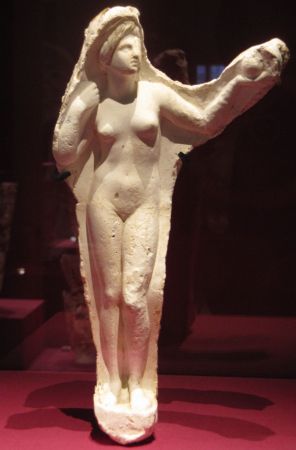 Though it is not known what the motivation originally was for acquiring the Bagram Aphrodite, its presence in Afghanistan arguably evinces an interest in female spirituality–if not in the owner of the storerooms then among some of the people in the market for which she may have been destined. Evidence of such interest among Buddhists is to be found in the
  Most days I am not certain that anyone really cares about what happens to girls. As a mother of a soon-9-year-old daughter, this burns me.
 I was trying not to fidget as I sat on the hard, unforgiving walnut pew. It was a gorgeous summer day out, and I was locked inside breathing stale air and with nothing to look at but the dreary speaker, and, behind him, a life-sized, picture of a sweet-looking man about to be hung from nails driven through his hands. I was visiting my parents, who love to take me to church, and I just wasn’t able to say no.


 From our very beginnings, women have danced with time. Our bodies’ moon cycles have always been a human calendar. As the first agriculturists, we partnered with the seasons to feed our families and communities. When we served as midwives and carers for the dead, we ushered our species into and out of their Earthly lives.