The place and purpose of the Garden of Eden is a topic of endless fascination and interpretation. This blogpost looks at two biblical passages and the word eden itself to see what we can learn about its meanings. At its most basic, Eden is a garden of treasure and delight.
As I’ve written before, the written form of Ancient Hebrew words comes from the hieroglyphic tradition of Egypt. The pictures of the letters form a picture puzzle or rebus. The word roots are generally two or three letters. I use script called Semitic Early for my baseline of study.
A warm summer sun smiles down upon the British coastline, the low tide reflecting jewels which are wash up and dispersed upon fine sand. A welcome breeze dances around a gathering of Goddess devotees encircling a small bonfire. Amongst them stands a banner and statue depicting and imitating Botticelli’s Venus and bouquets of roses. Just before the sun sets, those gathered lovingly collect these assembled artifacts, holding them aloft, and begin to process barefoot towards the sea.
Aphrodite-Venus’s banner and sculpted face shines in the low afternoon sunlight. As the procession slowly steps, weaves, and dances, towards the sea to the beat of a drum, the sun reaches further behind the hills, casting a long shadow upon the beach. The Goddess’s image dances with them, banner swaying and statue bobbing with the dance of its carrier. By the time the procession reaches the sea, the sun has dipped behind the now black silhouette of the hills bathing the beach ahead in dusky oranges and brilliant blues. At the shoreline, a priestess steps forward and turns the Goddess’s statue to face the procession, which has now fanning out into a semi-circle.
Moderator’s note: This marvelous FAR site has been running for 10 years and has had more than 3,600 posts in that time. There are so many treasures that have been posted in this decade that they tend to get lost in the archives. We are beginning this column so that we can all revisit some of these gems. Today’s blogpost was originally posted February 1, 2014. You can visit it here to see the original comments.
Brigid, Goddess of the Fire, greets us on Brigid’s Day, February 1. She is a Celtic sun goddess whose light burns brightly, illuminating the darkness of the land, of a heavy heart, and the dark night of our soul. With her shining light to guide us, we are lifted out of the Underworld darkness where we tend to descend in Winter, to the light of the World above, teeming with life as Spring begins to unfold her wet wings.
Brigid is a beloved goddess throughout the British Isles, particularly Ireland, where she is seen as the Mother of the Land and Her people. As a feminine archetype, she activates our solar, active nature. Much like the sun rising from below the Earth’s horizon, she urges us to come out of hiding and shine our light on the world. This may be done in a quiet manner, such as sitting by the hearthfire and doing needlework, finding inspiration by a walk in nature and writing a poem, moving about the kitchen making soup, getting busy with an art or craft project, or in big ways by taking on new roles as healers, artists, and leaders and calling others to join us.
Moderator’s note: This marvelous FAR site has been running for 10 years and has had more than 3,600 posts in that time. There are so many treasures that have been posted in this decade that they tend to get lost in the archives. We are beginning this column so that we can all revisit some of these gems. Today’s blogpost was originally posted June 30, 2012. You can visit it here to see the original comments.
We are going through a huge cultural shift toward restoring the female to her full radiance. However you want to define that, it is rising now, through us.
That which is Sacred, what should we call it? We’ve been told to name it he, him, his. That it was blasphemy to do otherwise, to say she, even as they desecrated the Divine with comparisons to mortal overlords, those cruel masters, despoliators, persecutors. No. Reconsider. That fearful address to an authoritarian punisher takes us far from true reverence. Rather revere the roots of Being, manifesting in all Nature around us, within us. The profound silence, and the Deep calling to the Deep.
Deeply I go down into myself. My god is Dark and like a webbingmade of a hundred roots that drink in silence. ― Rainer Maria Rilke
Moderator’s Note: We here at FAR have been so fortunate to work along side Carol Christ for many years. She died in July this year from cancer. To honor her legacy as well as allow as many people as possible to read her thought-provoking and important blogs we are pleased to offer this new column to highlight her work. We will be picking out special blogs for reposting. This blog was originally posted December 23, 2013. You can read it long with its original comments here
A link to a video of a Crow Uses Plastic Lid to Sled Down Roof Over and Over Again on a mayonnaise-lid sled appeared on my Facebook timeline a few days ago. {moderator’s note: I believe this is the same video that Carol originally posted. The link has been updated since 2013 } For me this crow expresses the “spirit of the season” as aptly as anything I can think of. She brings a smile to my face on a grey and cold morning. She makes me want to climb up on the rooftop and slide down with her. She reminds me that we humans are not alone–we share the world with a vast multitude of other intelligent creatures. She tells me that there is nothing more sacred than the joy of life.
Moderator’s note: This marvelous FAR site has been running for 10 years and has had more than 3,600 posts in that time. There are so many treasures that have been posted in this decade that they tend to get lost in the archives. We have created this column so that we can all revisit some of these gems. Today’s blogpost was originally posted December 25, 2015. You can visit it here to see the original comments.
Marie bringing in Elen of the Ways photo by Tony Mierzwicki
One of my colleagues at Feminism and Religion recently wrote of Xmas and Feminine Wisdom. My blog, for Christmas Day continues this exploration.
Elen of the Ways is a figure primarily studied by scholar, Carolyn Wise. She wrote two core articles available on the web here and here. Wise writes that in order to “track” and find Elen of the Ways she had to peel back the layers:
…to the earliest track ways, the migratory tracks of the Reindeer and Elk. Elen moves across vast tracts of time, and land, cloaked and masked appropriately for each age.
As the Green Lady, she peers out between the trees in forests …As a British Venus… she is guardian of the underground streams that carry the sacred waters. She is the Guardian of the ancient track ways, the Leys, the Kundalini currents in nature. And as the Horned Goddess, she leads us to the first track ways, the migratory tracks of the reindeer and later, to the path of the red deer through the forests. From here she leads us to the lost Shamanism of the isles of Britain and we can follow her across Scandinavia, Russia, Mongolia, Siberia, India and beyond.
…part goddess, part dream, part saint, a green lady and a water nymph, primordial mother and patroness of deer, and guardian of the Old Straight Tracks and solar alignments. …Elen is as real as the roads named after her, as solid as the ancient paths that carry her presence.
What are these tracks? Part of the story can be explained by understanding that there are ley lines, or energy paths throughout the globe. These paths were “tracked” by shamans, pagans, and regular folk and still exert their influence today in very recognizable ways. People celebrated earlier this week on the Solstice (December 21) at Stonehenge. “One of the most important and well-known features of Stonehenge is its alignment on the midwinter sunset-midsummer sunrise solstitial axis,” a spokesperson said. “The midwinter sun sets between the two upright stones of the great trilithon.” The solsitial axis is part of the ley line network that connects sacred sites such as Newgrange in Ireland, a sacred burial mound which lights up only the morning of Solstice.
At dawn in Newgrange, on the mornings surrounding the solstice a narrow beam of light enters the 62-foot long passage and lights the floor. It moves along the ground, from the window box until it lights the rear chamber. This Neolithic light show lasts 17 minutes….Local expert Michael Fox told National Geographic, “Archaeologists have classified Newgrange as a passage tomb but it is more than that. ‘Ancient temple’ is a more fitting label: a place of astronomical, spiritual, and ceremonial importance.”
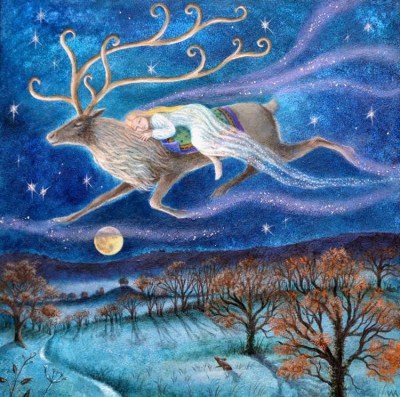
If light that travels around the world lighting up sacred sites and bringing the gift of light to all corners of the world starts to sound like Christmas, let’s extend that thought to understand the connection to flying reindeer. According to Caroline Wise,
…the only kind of female deer to have antlers are Reindeer. Not only does the female reindeer have antlers, but she is stronger than the male and does not shed her antlers in winter. It is an older female reindeer that leads the herds.
So as I like to tell my students, “the McDonald drive through version” of what we’ve heard so far is: Most likely, yes, Rudolph is a girl/female reindeer, keeping her antlers leading a herd of female reindeer keeping their antlers, traveling with Elen (Santa) throughout the sky giving the gift of light—the light of Rudolph’s red nose that keeps the sleigh on track—following the ley lines around the world, and lighting up the sacred sites, turning the sacred wheel towards spring.
Wise continues the thread of Elen and Christmas thus:
…Leys as shamanic flight paths was relevant to Elen in her guises of both Empress and the Reindeer-woman…the Father Christmas story is based on the shamans of the Sámi people. These people (and other reindeer societies) had a symbiotic relationship with the Reindeer. They would follow the herds along their migratory tracks. Their food, clothes, homes, tools, even needles and thread came from the reindeer. ..the Father Christmas story is based on the older, non-Christian Shamans of Lapland. …to aid their shamanic flights, the shamans needed the properties of the Fly Agaric mushroom, the fabulous red and white toadstool of fairy stories. Taking the mushroom can be risky, or at least unpleasant, because of toxins it contains. The Shamans noted that the reindeer ate the mushrooms, which grew around the silver birch trees, and suffered no ill effects.
The shaman lets the substance pass through the reindeer, neutralizing the toxins, and then drinks its urine. The active ingredients are unaffected, and the shaman enters his trance and begins his flight. Above the snow he can see the herds, see the predators, and gains helpful knowledge for the tribe. He gains wisdom of the plants and healing, as the Fly Agaric opens the gateways for him to be able to commune with the spirits of the land, the beasts, and the ancestors. He carries back the gifts of healing, and also news of the herds. When finishing his trance session, the shaman would enter the yurt through the smoke hole, and slide down the central silver birch pole with his bag of healing plants and his paraphernalia – Father Christmas coming down the chimney.
And Christmas trees?…the Fly Agaric is found mainly at the base of the silver birch and pine trees. It can be found beneath conifers, mostly evergreens, such as cedar, and the spruce and firs used for Christmas trees. …Reindeer Shaman spirituality was holistic within its environment, a complete cosmology including the people, the herds, the landscape, the stars…Therefore the trees that the mushrooms grew around were an an important part of the whole.
Moderator’s note: This marvelous FAR site has been running for 10 years and has had more than 3,600 posts in that time. There are so many treasures that have been posted in this decade that they tend to get lost in the archives. We have created this column so that we can all revisit some of these gems. Today’s blogpost was originally posted May 27, 2012. You can visit it here to see the original comments.
In my blog of May 11 about practicing the presence of the Goddess, I explained how Brother Lawrence of the Resurrection inspired me. Many thanks to everyone who read that blog and commented on it. One comment came via email from a friend, who said, “I kept thinking as I read about that expression ‘walking one’s talk.’” But of course. It would be lovely if anyone outside a nunnery or monastery could be as filled with their god or goddess as Brother Lawrence was. Though we try to be as mindful as we can, we obviously don’t always succeed as well as we’d like. But surely it’s better to have a positive intention than a negative one.
So let’s get practical. Instead of filling our heads with what’s been called monkey-chatter, let’s fill ourselves with the Goddess so that our thoughts of Her can go on autopilot. Instead of obsessing over, say, if the Lakers, Packers, or Cardinals are going to win their next whatever-they-play or who’s gonna win this week on Dancing With the Stars, let’s set our minds on the Goddess so our thoughts go to Her when we don’t have to concentrate on some specific, important task at hand.
It’s been wonderful to read so many posts remembering Carol Christ. The FAR community was so important to Carol: as has been pointed out, she not only offered her own posts each Monday, she also read and responded to every post, every day. Through the FAR ‘family’ I feel comforted by connecting with others who knew and loved her and miss her as as I do.
Online Memorial Gathering On December 20, Carol’s birthday, all friends of Carol and friends of FAR are warmly invited to an online Memorial Gathering and ritual in Carol’s honour. Many of Carol’s friends will share cherished memories (please email me if you would like to say a few words) and I will show some photographs from her personal archive. (If you have photos of Carol you would like to share, please email them to me at laura@laurashannon.net.) We’ll also talk about the future of Carol’s Goddess Pilgrimage in Crete. Please register with your email address at this link.
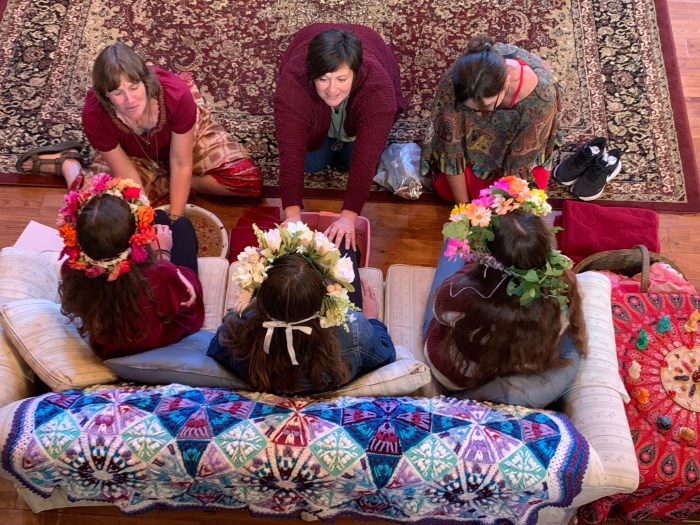
We gathered roses and bright zinnias to crown their heads with flowers, these shining daughters who we’ve cradled and fed and loved with everything we have and everything we are. We knelt before them and sang, our hands gently washing the feet that we once carried inside our own bodies and that now follow their own paths. For a moment, time folded and we could see them as babies in our arms, curly hair and round faces, at the same time seeing the girls in front of us, flowers in their hair, bright eyed and smiling, and so too we see women of the future, tall and strong boned kneeling at the feet of their own girls as the song goes on and on. We tried to tell them what we want them to know, what we want them to carry with them as they go on their ways: You are loved. We are here. You are loved. You are strong. You are magical. We treasure who you are. This love that carried them forth into the very world they walk on, we hope it is enough to embrace them for a lifetime, and so we kneel and sing and anoint and adorn and hold their hands in ours. We are here. You are not alone. You are wise in the ways. You belong. We are not sure if tears can say what we mean to say, but they fall anyway as we try our best to weave our words and wishes and songs and stories, with strength and confidence into a cloak of power that will encircle them with magic, no matter how far away from us they journey.
Once upon a time, the Great Goddess was the spiritual focal point of ancient culture. Her worship included honoring women, living in harmony with the earth, and cherishing the processes of the cycles of nature. Asherah was one of those Goddesses. When the Patriarchs moved in and worked to suppress the old goddess religions, Asherah and her fellow Goddesses were diminished, and in a propaganda coup we might recognize today, defined Her as evil. I imagine that some brave people fought to hold onto the Goddess in Her glory but when they saw they were losing the battle, they encoded Her and Her Sister Goddesses into their cultural mythology. Hidden in this manner, She found Her way into the bible. If we can uncover those codes, we can reclaim Her, others and their Earth-based spirituality.









 Feminism and Religion