Saying Goodbye to May by Sara Wright

Friday night’s dream alarmed me. I had already lost two dogs, and the dream told me that I had lost three. Was my present beloved animal companion at risk?

The weekend passed with increasing heat and dryness and a strange escalating depression that dominated the atmosphere around me. This, with so much astonishing autumn beauty on my doorstep.

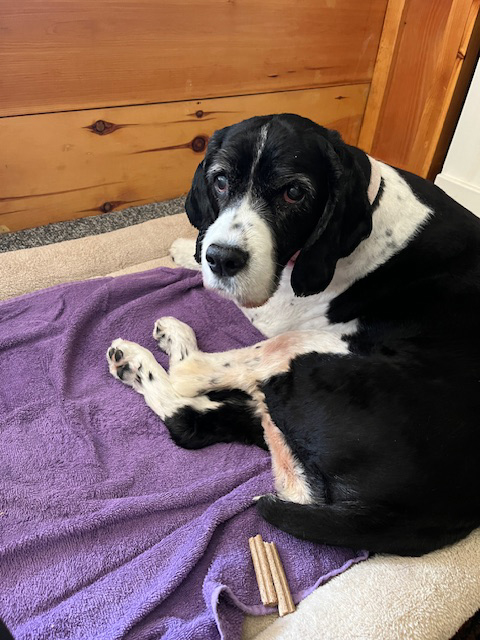
Maybe this mood was why I was having so much trouble completing an essay (The Doorway) that when done would finish a heartbreaking odyssey that began last December 24th when my beloved Hope almost died from heart failure. Eight months later Hope was dead. With Lucy’s death five weeks later, I was left dogless and bereft – except for the help from a couple of friends and May, a 15 -year – old Springer Spaniel who had stolen my heart months before when I first met her.

Instant recognition characterized our first meeting – woman and dog – linked through that mysterious animal thread that was grounded in deep compassion.

Continue reading “Saying Goodbye to May by Sara Wright”

Legacy of Carol P. Christ: What is the Nature of the Hope that Can Trump Despair in the New Year?

This was originally posed on December 20, 2013
carol-christ“All hope abandon, ye who enter here.” These words posted on the gates of hell in Dante’s Inferno have an eerie resonance in our time. 

Marie Cartier recently posted a blog on children and hunger with facts so devastating I could not finish reading it. Earlier in the month Jassy Watson wrote about her deep feelings of grief on hearing Luisah Teish’s “Prayer for Disappearing Species.” Grief, despair, and sadness about the injustices in our world can be overwhelming.

A friend of mine has recently fallen into a deep depression. When I try to talk her out of it, she repeats that they are threatening to cut down the last remaining old growth forest in her home state of Oregon and that she can no longer eat fish because radioactivity released in the Fukishima nuclear plant disaster is reaching the seacoast of Oregon.

When I tell my friend she should not dwell only on these things and that she must remember that the world is still a beautiful place, she responds, “I do not want to give up my feelings. I know I must find a way to acknowledge my sadness and make a place for joy, but I don’t know how to do it.”

I have been in the grip of deep grief about the planet myself, not once but many times. But this happens less frequently than it used to.  When I think about the differences between how I once felt and how I feel now, I think the difference is that I have come to terms with and accepted the likelihood that “the world as we know it” is “going to hell in a handbasket”—as I put it.

I believe that the most likely conclusion of the choices human beings are making on planet earth today is massive environmental destruction leading to great suffering and probable extinction for human and many other species on planet earth. This is what I believe, but I also remind myself that I cannot know for sure. The earth and its species including human beings may have resources of resistance and survival, transformation and adaptation,that I do not know about and cannot imagine.

When I began to accept that the world I know and love (where spring follows winter, where birds sing, and where there is hope that injustice can be rectified) may not exist in the very near future, I had an astonishing insight. The death of the world I know and love will not mean the death of our planet or the end of the evolution of the universe.

Thinking about the disappearance of species and the death of human beings from starvation often feels too much to bear. None of this should be happening. Still, it can be strangely comforting to remind myself that the world I love is not the only possible world. There have been other worlds on this very planet—the time when the first cells were formed, the time of the dinosaurs, and many others. Evolution will continue on planet earth for several billion more years, and when our sun burns out, other suns will most likely still be shining in the universe.

This insight was followed by another. The reason for hope is not the conviction that we will be able to save the world we love. The reason for hope—and the reason to keep trying to save our world—is the deep knowing that it is right to try. Even if we cannot save the world we love for all time, we can savor the gift of life, and we can continue to try to create a world in which the gift of life is shared widely today and tomorrow.

I have written many times that we must learn to love a life that ends in death. I was speaking about accepting that each one of us will surely die. I do not fear death. Overcoming this fear has opened me to a greater and more clear-sighted love for life.

Can we learn to love life while accepting that the world we love may be dying? Can we continue to work to improve the conditions of life for individuals and species knowing that the world as we love it may not survive? Do we have any other choice?

For me the hope that can trump despair in our time begins in gratitude for a life that has been given to us, a life that has come down to us through the generations, and through billions of years of the evolutionary process on our planet.

Let us bless the Source of Life.

Let us bless the Source of Life, and the cycles of birth, death, and regeneration.

Let us turn back from despair.

Let us embrace the gift of life and share it with as many others as possible in the new year.

Carol P. Christ  learned to be grateful for the gift of life in Crete on the Goddess Pilgrimage to Crete she leads through Ariadne Institute.  It is not too early to sign up for the spring or fall pilgrimages for 2014.  Carol can be heard on a WATER Teleconference.  Carol’s books include She Who Changes and Rebirth of the Goddess and the widely-used anthologies Womanspirit Rising and Weaving the Visions. She wishes you great joy in the new year.

We’ve Seen This Playbook Before by Janet Maika’i Rudolph

Wikimedia Commons

ICE has been doing mass round-ups of anyone who looks like “the other.” The people cheered.  “This is my country,” they shouted to the deportees. “Go back where you came from.” The people are flush with excitement thinking this is what we voted for, meanwhile ignoring that they came from someplace too. We know this is a publicity stunt. How? Dr. Phil tagged along on one of round-ups.  Newly minted secretary Kristi Noem also took her role in the spotlight attending one in NYC and saying dehumanizing words I will not repeat here. 

We’ve seen this playbook before. Creating chaos, disorientation and suffering for political points, TV or other publicity ratings. It doesn’t end well – EVER!

The NY Times had a report of how deportees were treated in a dehumanizing manner, being held on a broken plane in the Amazonian heat with no AC, people shackled, children were on board.  There are always people available to treat other people as less than human. “I was just doing my job.”  “I was only following orders.” 

We’ve seen this playbook before.  It doesn’t end well – EVER!

Continue reading “We’ve Seen This Playbook Before by Janet Maika’i Rudolph”

Mourning by Beth Bartlett

Grief is the experiencing . . . Mourning is the process,
when we take the grief we have on the inside and express it outside ourselves –
writing, planting, burying, burning, rising up
ceremony, ritual, community[i]

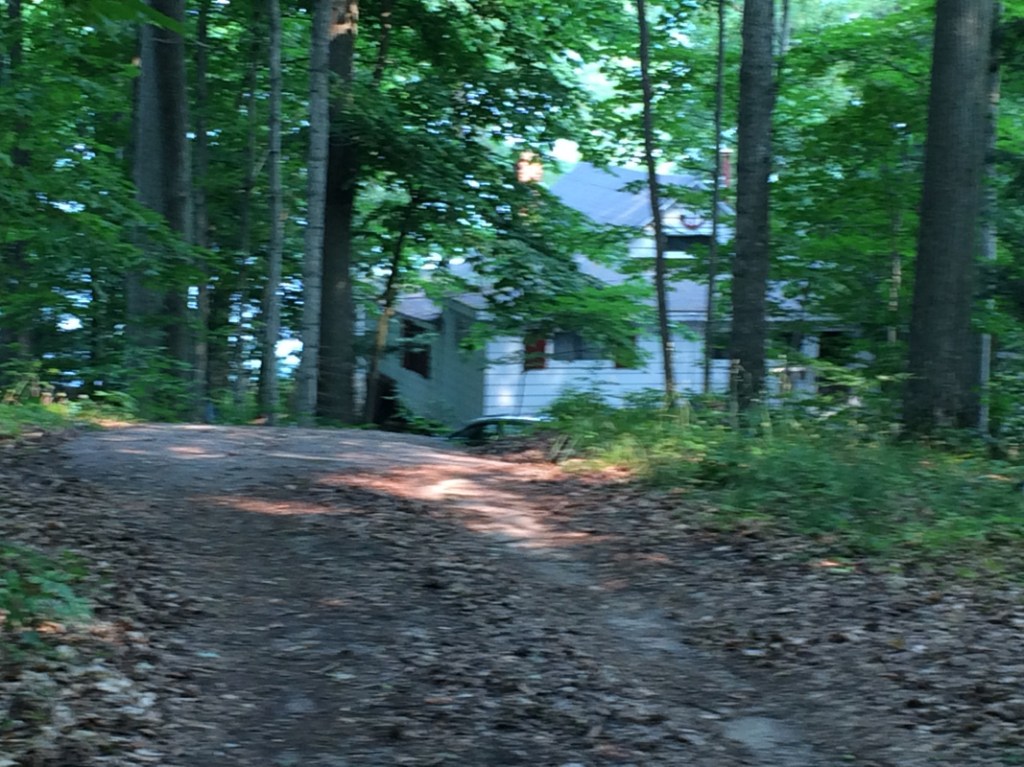
A glimpse of our cottage as I drove away.

“As long as I stayed there, I could keep you with me. . . .” Those words kept repeating in my mind throughout my long drive home from my sister, Jeannie’s, “Celebration of Life” service. I’d stopped midway on my thousand-mile journey at the cabin our family has shared for sixty years.  There I could still feel her presence — on the hillside where we so often sat with our morning cups of tea, or watching the sunset, or chatting away the afternoon; on the dock where we’d lie in the sun or sit late at night and watch the stars come out, or cuddle up in blankets on windy, fall days; in the circle of couches and chairs where we played telephone Pictionary, charades, and CatchPhrase; in the kitchen where we’d cooked and eaten and played card games together; in the bedroom we often shared with a dog between our beds; the road where we’d go for family walks – eight, ten, twelve of us all together, and always two, three, or four dogs; even the driveway where we’d greet and hold each other with great gladness after months of separation, and where we’d hug and say goodbye, and then hug once more because in the back of our minds we’d be wondering if this was the last time.  . . .

Continue reading “Mourning by Beth Bartlett”

BRINGING IN THE KIN-DOM by Esther Nelson

I’ve mentioned before that I’m quite the fan of Jim Rigby, one of the current ministers at St. Andrew’s Presbyterian Church in Austin, Texas. Jim writes a short column four or five times a week and posts them on Facebook.  I, along with many others, follow him there; however, I’ve also begun to join the Sunday morning service at St. Andrew’s via Zoom.

As a preface to the Sunday morning services I’ve attended, Jim gives a short explanation of his use of the word “kin-dom” instead of kingdom, fully acknowledging that the word kin-dom was coined by Ada Maria Isasi-Diaz (1943- 2012), a Cuban-American, Mujerista theologian. (Mujer is the Spanish word for woman.)

Continue reading “BRINGING IN THE KIN-DOM by Esther Nelson”

Gift From the Beyond, part 2 by Sara Wright

Part 1 was posted yesterday

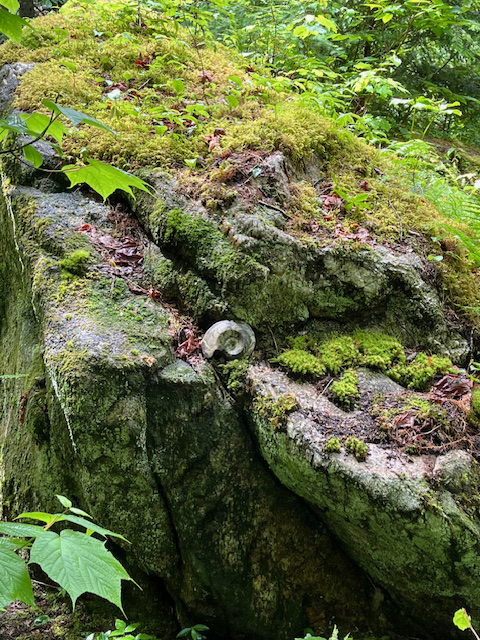
Trillium Rock

My friend Lise sent me some words on the eve of Davey’s birthday (unbeknown to me until the 6th) that reminded me of how often I spoke to him during those months.

The reason I pray to the dead is I trust their timing. They have all the time in the world, after all, and they also see the big picture and the long story. I pray to the dead because, I admit, how little I know, how little I can understand, and how vast the mystery is of the soul.

Let me circle myself with the living who can hold both, with the dead who can hold it all. We are entangled souls…. We are all praying together, with the flowers, the trees, with all that is.” (I substitute talk for pray because that is what I do)

Continue reading “Gift From the Beyond, part 2 by Sara Wright”

Gift From the Beyond, part 1 by Sara Wright

The words came unbidden “go outdoors”. It was dark but I felt my way to the door. I always listen when Nature calls.

Trillime

I had just re -membered that Davey’s birthday was the next day. ‘Happy birthday Beloved’. My little brother would have been 75. I calculated the years with difficulty imagining what it would have been like if he had lived…

Dead at 21 from a self – inflicted gunshot wound, part of me died with my Gemini Twin. I failed him at the end, turning into a parent who was incapable of being emotionally present to listen to a young boy on the verge of adulthood at a time of desperate need. Instead, I parroted my parents’ script, not having developed one of my own…

”You have everything to live for,” I screamed when Davey tried to tell me that he was tired of living.

I no longer blame myself for my inadequacy, but regrets linger on just the same.

It would be eleven years before I was able to begin grieving. Catapulted out of my body at the time of my brother’s death I felt nothing for years as I self- medicated with alcohol and a dreary round of boyfriends while being unable to be emotionally present for my own young children. To feel one must inhabit a body but mine was overflowing with anguish and abandonment. Too dangerous to go there. Isolated and alone, I huddled in my house in silent torment, an absentee mother following the parental script with children of my own.

Continue reading “Gift From the Beyond, part 1 by Sara Wright”

Branwen, Goddess of Grief by Kelle ban Dea

This midwinter has been a time of sadness so far. Two major deaths in the family, and two baby losses, the grief has come thick and fast for me and my kin this season. At a time when we are usually all gathering to celebrate the rebirth of the light in the dark, my spiritual practice is all at sea, leaving me wondering how I can call on Goddess, on Mother of God, at this time.

Then I remember Branwen.

Continue reading “Branwen, Goddess of Grief by Kelle ban Dea”

Who Will Plant and Who Will Harvest by Marie Cartier

A Poem 3/27/23

We see the beginnings of fruit trees.
The first fruit, my Jewish friend says:

            The best of spring—as fruit
            Is what makes luxury, she says.

We could just eat vegetables –but
With fruit we have extra luxury, we have extra—
We have wine. Cheers- we have luxury.

Continue reading “Who Will Plant and Who Will Harvest by Marie Cartier”

Hearing Grief by Xochitl Alvizo

I was writing this blog post on the same day that Rosemary Radford Ruether died, receiving the news during my writing process. The timing of that still has me feeling something I cannot yet express…

One of the most meaningful concepts I learned very early on from my education in feminist theology was “hearing to speech,” from Nelle Morton. I have written about this before, sharing that at times when I have struggled with my academic writing, I try to imagine that I am writing to my peer group, which helps open the path because not only are they a trusted circle of friends that I know loves me deeply, but they are friends who hear me into speech (and in that way, to writing, as well).

Nelle Morton coined this feminist principle of “hearing to speech.” [1] Morton’s new understanding of hearing and speaking came to her while she was with a group of women who gathered to tell their stories. As one woman shared her story – a story which at times reached points of excruciating pain – no one moved or interrupted, everyone seemed to be holding their breath. At the end, when the woman finally finished, she said, “You heard me. You heard me all the way – I have the strange feeling you heard me before I started. You heard me to my own story.”

Continue reading “Hearing Grief by Xochitl Alvizo”