

 Reading the story of the Levite’s pîlegeš – found in the Hebrew Bible, Judges 19:1-20:7 – is unlike any other scholastic endeavor I have undertaken.1 The narrative is of a woman who leaves her husband’s house, only to be retrieved by her husband, gang raped on her way to his home, and dismembered upon arrival. This intense violence then escalates to the abduction and rape of more than 400 virgins and the death of many more (Judges 20-21).
The first time I encountered this narrative was while reading Phyllis Trible’s Texts of Terror as an undergrad student. While at the time I did not fully understand the textual nuances Trible points out, I did understand this story was sacred in a way I could not articulate. It was not until years later that I realized I was not truly listening to the story because I had not read it from the pîlegeš’ perspective and was yet to be affected by the horror of it.
An explanation is needed when one calls a story of violence sacred. To clarify, it is the telling of the story that makes it sacred, not the violence. In much of the world today, violence done to women is taboo.2 Not only are the violent acts ignored, but the victim and her retelling of the acts are also often ignored. Perhaps this is because our society is biased towards the perpetrator. Perhaps it is because our faith communities have self-identified as loving and to acknowledge violence is to acknowledge failure. But perhaps it is mostly because violence is hard to process, especially when the violent act is committed against a loved one, and we prefer not to struggle with the presence of violence all around us. Continue reading “Painting Women from Judges – Part 3: The Sacred Account of the Levite’s Pîlegeš by Melinda Bielas”

 Feeling safe again is often the healing and elusive aspiration of a person like me.


 On a corner adjacent to a cantina, across the street from a home full of barefoot children running through open doorways, and a few houses down from a paleteria y fruteria in San Antonio, Texas, sits a bright white house dressed up in orange trimmings – Casa Coatlicue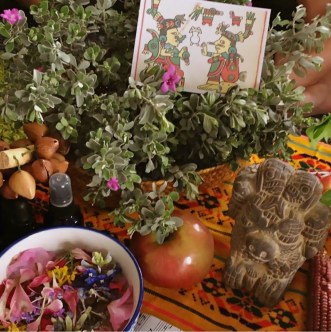
 When I was about eight years old, I dreamed one night that I stood inside the workings of an immense instrument, so big it filled the sky. It was crafted of wood and gold, and although there was no obvious source of light, it was brightly illuminated. I could have confused it for the inner workings of a clock except that I could hear the sweet music it produced resonating throughout its cavernous hollows. It was curious to me that there seemed to be no atmosphere there either to breathe or to carry sound. Within it, I did not perceive any movement. And, there was no actual melody that it produced, which could be sung or repeated. There was only an enveloping harmonic thrumming. The sound was multiplicative and voluminous although not piercing. I understood it in the dream to be cosmic, structural, primordial, and generative. When I awoke, I had the feeling that I had seen something divine. It was not heaven. It was not God. It was more like the instrument of the universe, or the universal instrument, created as a first work among creation
 I sat at the bottom of my stairs exhausted, lost, not knowing what day it was or rather not really caring what day it was. I was the overtired mother, who was still getting the knack of breastfeeding around the clock. Panicking each and every time I heard the baby cry. As soon as I heard his cries, I would think to myself, hurry and grab the boppy, the burb cloth, the iPhone so I could click on the breastfeeding app! Hurry, hurry, hurry….!

 Feminism and Religion