Future of Mifepristone by Winifred Nathan

Today is the one year anniversary of the Dobbs decision.

The alarm grows louder. How far will the antiabortion lobby restrict women’s reproductive health care before they are satisfied? If they successfully secure a complete abortion ban, will they stop? Or will they go on to control women’s dress, education, travel, etc.?

Reportedly, Dobbs v Jackson overturned Roe v Wade so the states could set the legal boundaries of abortion through the democratic process. But on November 18, 2022, the US District Court of Northern Texas delivered Alliance for Hippocratic Medicine et al. v US Fodd and Drug Administration et al., a decision that stops medical abortion in all fifty states by ending FDA approval of mifepristone. The Supreme Court has stayed (paused) the Texas order as the appeal works its way to their docket. Mifepristone continues to be available, but for how long? Will the Supreme Court eventually side with the plaintiffs?

Continue reading “Future of Mifepristone by Winifred Nathan”
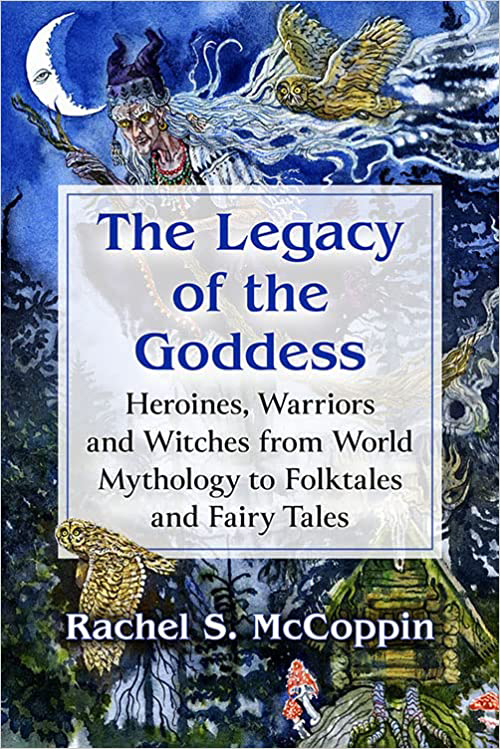
The Legacy of the Goddess: Heroines, Warriors and Witches from World Mythology to Folktales and Fairy Tales by Rachel McCoppin

Part 2, Part 1 was posted yesterday

Chapter 4, “Monstrous Females and Ghost Women,” “traces the many female characters within folktales and fairy tales who appear as monstrous, materializing in the forms of giantesses, succubi, mermaids, rusalki, etc. Just as in many ancient myths, even though these monstrous women appear in folktales and fairy tales as hindrances to the quest of the hero, they ultimately serve to educate male heroes about the true meaning of their quest, which again often aligns with concepts associated with mythic goddesses. The many ghost women who appear in folktales and fairy tales around the world are also discussed in this chapter, as they often serve as agents to teach male heroes about how they, particularly as females, have been wronged by males or by patriarchal systems, and thus have been thwarted from completing their own heroic quests” (McCoppin, p. 9).

Though most myths around the world display male heroes partaking on heroic quests, and seldom focus on heroines who participate in their own heroic journeys, this is not at all the case with folktales and fairy tales, as hundreds of folktales and fairy tales portray strong, independent female heroines who indeed partake on their own heroic quests. Therefore, the second half of Legacy of the Goddess focuses on the formidable heroines found in many folktales and fairy tales from around the globe.

Continue reading “The Legacy of the Goddess: Heroines, Warriors and Witches from World Mythology to Folktales and Fairy Tales by Rachel McCoppin”

The Legacy of the Goddess: Heroines, Warriors and Witches from World Mythology to Folktales and Fairy Tales by Rachel McCoppin

This is part 1 of a two part posing. Part 2 will be posted tomorrow.

In this blog post, I would like to take the opportunity to discuss my new book, entitled: The Legacy of the Goddess: Heroines, Warriors and Witches from World Mythology to Folktales and Fairy Tales. This book argues that hundreds of folktales and fairy tales from around the world have preserved elements related to goddess worship from the sacred myths of many ancient civilizations.

Powerful goddesses were worshipped in most global cultures for centuries, until, in many regions, episodes of diffusion, conquest, colonialism, etc. caused the worship of these goddesses to be revised, lessened, or in some cases eliminated. To “preserve at least part of the reverence of goddesses, as well as the memory of the powerful religious and social roles women once held as representatives of goddesses”, hundreds of folktales and fairy tales were created, “told, and retold, most often by women storytellers” to impart goddess ideology (McCoppin, 2023, p. 5). Thus, many folktales and fairy tales portray myriad examples of powerful female characters who portray important messages connected to the goddesses and sacred women of ancient mythology.

Continue reading “The Legacy of the Goddess: Heroines, Warriors and Witches from World Mythology to Folktales and Fairy Tales by Rachel McCoppin”

The Gift of Breathable Air – Fire and Air – Before the Turning by Sara Wright

In the last two hours the air has finally cleared – clouds, light drizzle (the blessing of even a few drops of rain) and sweetly scented air allows my nose to pick up the intoxicating fragrance of the lemon lilies on my porch – For the last 40 hours we have been breathing dead air – or death air as I call it. Headaches for me, and sneezing coughing dogs force me to keep the windows closed, the porch door shut, and unless it is necessary, we stay inside.

 All of us are so sensitive to atmospheric changes…

This time the pollution comes from Canadian wildfires – nine million acres of forests are still burning. When I emailed a friend about the air in Montreal she quipped how the air had cleared and the US had exaggerated the problem (not one word about the fate of the trees – this well-known feminist woman considers herself an environmentalist). I wondered just how accurate her assessment was because here in Maine the air was not breathable, and the blue skies were only softened by haze. I didn’t need the clean air index to tell me that we were all breathing poison. Just the thought of more burning forests ANYWHERE chills me leaving me in a state of profound despair.

Continue reading “The Gift of Breathable Air – Fire and Air – Before the Turning by Sara Wright”

Bathsheba: From Survivor of Sexual Abuse to Queen Mother by Linda Cooper Costelloe

Bathsheba by Artemisia Gentileschi, wikimedia commons, public domain

The image we have of Bathsheba is that of a scheming temptress. That’s the way she’s been portrayed in media, such as the 1951 movie, David and Bathsheba, and Leonard Cohen’s song, Hallelujah. She deliberately bathed on a rooftop in sight of King David. She caught his eye and he was helpless to withstand her charms. The Bible does not support that image of Bathsheba, however. It says that Bathsheba was used and abused by David, and God was displeased.

The Bible says that David was on his rooftop. It does not say where Bathsheba was, only that she was bathing to purify herself after her period (2 Samuel 11:2-4). She was probably in an inner courtyard. In their book, Flawed Families of the Bible. How God’s Grace Works Through Imperfect Relationships, David E. Garland and Diana R. Garland write: “The laws required ritual washing at the conclusion of her menstrual period. A woman would be highly unlikely to conduct such a cleansing from her menstrual period as a come-on. If she were in public view, she would have washed without disrobing. There is no reason even to assume that she was naked. Public nudity was not acceptable in this ancient Jewish culture but instead was considered shameful. There is no foundation for assuming she was some kind of exhibitionist.”i

Continue reading “Bathsheba: From Survivor of Sexual Abuse to Queen Mother by Linda Cooper Costelloe”

A Poem for Enheduanna by Nan Lundeen

Cuneiform Tablet from Nippur, Sumeria
(Modern Iraq) 2300 – 2100 BCE
Mary Harrsch from Springfield, Oregon, USA,
CC BY 2.0 <https://creativecommons.org/licenses/by/2.0&gt;,
via Wikimedia Commons

In beautiful synchronicity, I received an invitation to submit a poem to an anthology in the voice of a female-identified persona around the same time I first learned of Enheduanna. The first named author and poet was mentioned in my New Moon Womyn’s Circle. When I looked her up, I was flabbergasted. I am a poet, a feminist, and a long-time student of Women’s Spirituality, and yet the world’s first author—a high priestess who worshipped a female supreme deity, was unknown to me.

I learned that Enheduanna was a brilliant poet who wrote with majestic metaphors, who shared her emotions, and who grappled with concepts of the divine as a female supreme deity in and with nature, and with whom she experienced a personal relationship. She lived and wrote around 2300 B.C.E. Scholars say they do not have the specific dates of her birth and death, but they do know that she served as high priestess for 40 years at the city of Ur in what is now Iraq.

Continue reading “A Poem for Enheduanna by Nan Lundeen”

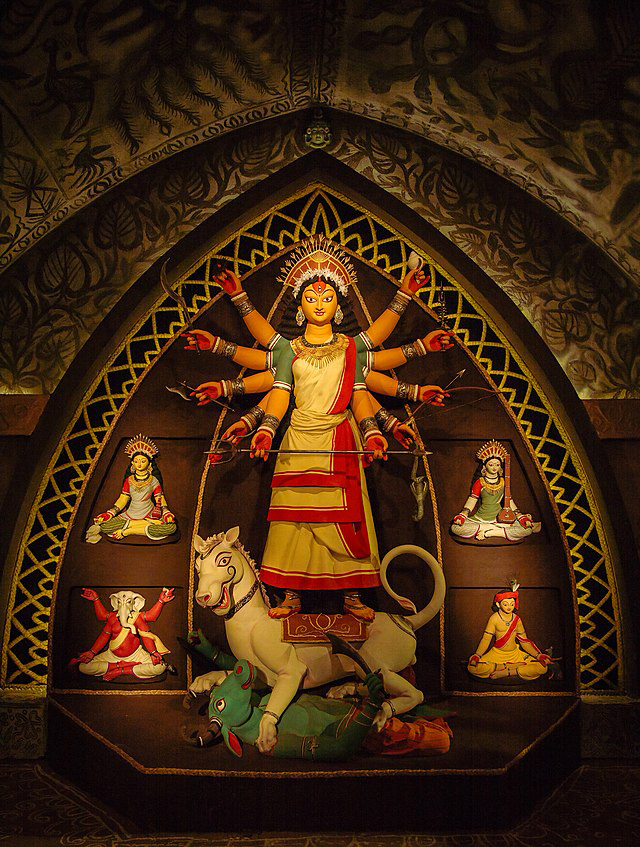
Durga Rising: Feminism as Fierce Compassion By Beth Bartlett

In her FAR post earlier this year,[i] “Why Feminism Needs the Fierce Goddesses,” Susan Foster argues that a “flagging” feminist movement needs the revitalizing energy of the “fierce goddesses” of ancient times to challenge the patriarchal forces that seem to be on the rise as increasingly we find women’s lives and freedoms constrained. She writes, “the dark goddesses of ancient times have been submerged in our psyches, but they serve as a repository of fierce energy, of female rage against injustice.”  She continues, “It’s important and healthy for us as women to reclaim our anger, using it to protect ourselves and fight for our rights in systems that are oppressive.”

Reading this, I immediately thought of Beverly Wildung Harrison’s, “The Power of Anger in the Work of Love,” and China Galland’s, The Bond Between Women: A Journey to Fierce Compassion. Anger as the work of love; fierce compassion.  In this time of mass shootings, insurrection, the ongoing assault on women, LGBTQ, and BIPOC peoples, when rage seems so easily fueled by hate, envy, and greed, it is the rage based in love and compassion that is most needed.  This is the rage of the fierce dark goddesses who are moved to act against injustice, the rage of the feminism I love. With its source in love and compassion, it is a rage that rebels in the best sense of the word – that at once refuses injustice and affirms dignity and respect, that speaks truth to power, that is grounded in solidarity and friendship, and values the immanence of the earth, the water, the body, and the divine spark in all beings.[ii] 

Continue reading “Durga Rising: Feminism as Fierce Compassion By Beth Bartlett”

Coming Home:  The Goddess Rises…(part 2) by Sara Wright

Part 1 was posted last week, you can read it here.

I have been conversing with plants most of my life sensing the reciprocal nature of green beings and treating them as equals, so I was delighted by the bean’s behavior, although not surprised (western science has finally caught up with Indigenous knowledge as new studies indicate that plants listen/ and respond – see Gagliano, Simard). My magic bean is thriving, and every morning I make a promise to Scarlet Runner that the day will come when s/he will finally be free to climb to the stars… Relationships like this one sustain me.

 Opening the door to mist ‘Mary’s Garden’ is entering another magic realm. Ferns I never planted are unfurling. Two hemlock seedling have emerald bristles on the tips of their needles, Partridgeberry is spreading, twin flowers are appearing, unknown seeds are sprouting, fungi come and go, lichens abound, some cascading from pieces of old wood. One old piece of pine bark supports the tiniest fungal trumpets. This terrarium is a source of endless enchantment and comfort on the coldest winter day.

Continue reading “Coming Home:  The Goddess Rises…(part 2) by Sara Wright”

My Powers are Growing:  Are Yours? by Caryn MacGrandle

When I first found the Goddess and Women’s Spirituality almost a decade ago, my change and growth was painful.  I hosted Women’s Circles, and often, they veered a tad towards venting but with self-realization and a determination to do better. 

I did.  And I watched the others in the Circles do so as well.

Powerful stuff.  And it made me a believer in the strength of coming together while retaining our individual will and paths.

I am a different person today for all those Circles.  They changed me in ways that no amount of counseling, journaling or pharmaceuticals ever could.

Community.  Support. 

Continue reading “My Powers are Growing:  Are Yours? by Caryn MacGrandle”

Hear Me! Redux by Winifred Nathan

She Said; He Said 
And How 
She won! He lost!

On May 9, 2023, in New York Supreme Court, “she said,” won. E. Jean Carroll was awarded a judgment of five million dollars in compensatory damages in her defamation and sexual abuse case against former President Donald Trump. YES, she won! He lost!  

How did this happen?

The starting point is looking to a New York state change in its law regarding sexual assault. The assault took place in early 1969. Like many women, Ms. Carroll didn’t seek immediate legal help. She waited until 2019 to file a suit. Her explanation: at her trial, she opined, “I was born in 1943. Women like me were taught and trained to keep our chins up and not to complain.”

In November 2019, E. Jean Carroll did bring her first lawsuit against Donald Trump, which grew from his remarks when she accused him of sexual abuse. The suit was, however, limited to defamation. (Applicable statutes of limitation precluded any potential criminal action for sexual assault.) The Justice Department appealed the case. 

Continue reading “Hear Me! Redux by Winifred Nathan”