

In prisons in Canada and around the world, a large percentage of criminalized people, who are more often than not, victimized people, Indigenous people make up significant percentages. In a recent *talk I gave, accompanying Indigenous Elder and Artist Philip Cote, we addressed what happens when colonial narratives and patriarchal narratives collide. The result is that our worldviews are shattered. When our worldviews, which are our foundational way of meaning-making, are dismissed, denied, and in the case of
cultural genocide: decimated, our heart health fails. Our bodies, our minds, our souls become disconnected become dissociated. Become imprisoned. Imprisoned in the figurative sense and eventually over time, in the literal sense.
Category: Indigenous Spirituality
Solstice Stories : Fire and Ice by Sara Wright
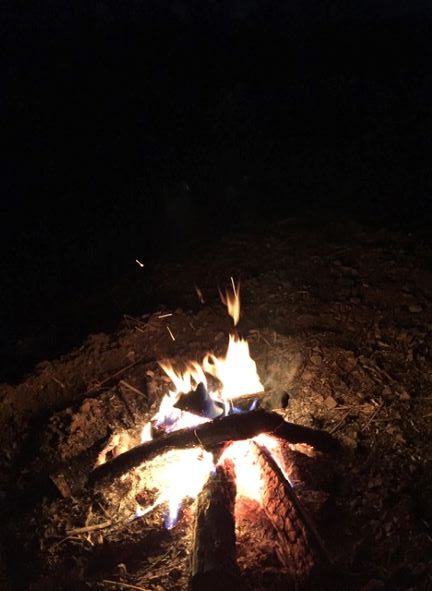
The winter solstice is almost upon us just as the first heavy snow buries the forest and house under 28 inches of snow. I never look forward to this shift into the cold, ice, and snow, although I do wrap myself in peaceful silence, sitting by the fire dreaming as twilight turns to night. My Norfolk Island pine and tipped balsam wreath shimmer with tiny stars. The scent of balsam soothes my senses and purifies the air. This month above all others is my time to honor the trees… I am keenly aware that Bone Woman and Old Man Winter are rising with the moon, whipped up by Northwest winds.
My scientist and naturalist friend, a member of one of the seven Indigenous Sioux tribes agrees with me that winter solstice is a dangerous time, one of the reasons in the old European way that everyone is masked while acting out winter solstice stories. These tales may vary in content but all have the same root. Shadow is on the move. Masks protect the people, the risk of exposure to danger is minimized in this way.
Continue reading “Solstice Stories : Fire and Ice by Sara Wright”From the Archives: We are Mauna Kea: The Continual Protest for Maintaining Sacred Land by Anjeanette LeBoeuf

Moderator’s Note: The blog was originally posted November 21, 2015. The movement for the sacred land is still relevant and active.
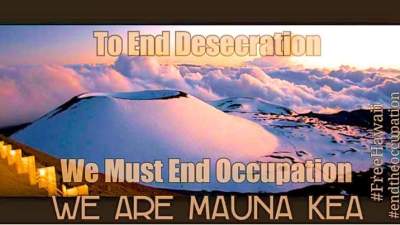
It seems like there is a perpetual debate over acquiring land for progress and growth versus the protection of land that has ties to religion, customs, and cultures. The history of America is littered with stories and events that deal with acquisition of land. The sake of growth, expansion, and progress takes precedence in the history of America. Our country’s geography is a road map of acquired land and the pushing aside sacrality.
Our country has treated sacred land in a variety of ways. Religious sites have found their way, at times, to the front lines of protest and change. Religions across the globe carry some sort of Mother Earth element. Hinduism has the goddess Pṛthivī, the Greeks worshiped Gaia and Hestia, and the Hopis called her Tuuwaqatsi. Papahānaumoku is Mother Earth to Hawaiians. She is the life-giving force and the ancestor to all human beings. Honoring the earth becomes honoring our mother.
Mirror Reflections by Sara Wright

The Old Woman still lives in the Forest as she once did in fairy tales. She can present her dark side to those who are uninitiated (mirror mirror on the wall…) but she also offers gifts to those that visit her wild untrammeled places… After a week spent in a forest where a river snakes her way through thousands of acres and beavers act as transformers I wrote this poem because even with the astonishing autumn crimson, orange, and gold I was drawn repeatedly to the mirror reflections of trees, leaves, clouds and sky in the still pools. When I untangled the why I wrote this poem realizing that what caught me was the importance of having an accurate reflection from another, person, or aspect of nature in which to see the world and self as whole. Accurate reflections are intimately tied to relationships of all kinds.
Mirror Reflections
Relationship needs honest
Reflection – S/he knows a
Broken mirror won’t do.
Water is made of magic
above and below
Sky blue, slate gray,
piercing orange
flames fly through
thin air –shafts of light
slice wavy ripples
embrace the river’s flow,
Sand hill cranes
and geese soar overhead…
Fourth of July: A Time to Mourn by Sara Wright

I awakened to dove gray skies and the sweet scent of falling rain. Soaking in the greening of a fully leafed out forest and the stillness of early dawn felt like a gift because these quiet moments are precious and precarious on the weekend Americans celebrate ‘Independence Day’.
As a person with mixed heritage (Passamaquoddy) I am not one of those people. Indigenous peoples of the Americas have nothing to embrace on this weekend. We are still invisible; we are still discriminated against. We are still outsiders.
Along with the emphasis on Black Lives Matter I often wonder why Red people are not included in the current cultural outrage. These are the people who were deliberately poisoned with smallpox, and also murdered and herded onto reservations by the colonists who took over this once wild and untrammeled country, systematically destroying its beauty by slaughtering the trees and animals that once grew into stately giants or roamed free. Why would Indigenous peoples or any other minority celebrate an Independence Day that occurred at their expense?
Continue reading “Fourth of July: A Time to Mourn by Sara Wright”Of Women and Wildflowers by Sara Wright

Women and plants have been in relationship since the dawn of humankind. Women were the Seed keepers. Women created agriculture. Women learned what herbs to use for healing. Women noticed wildflowers, loved them, grew them and painted them, created poems about them. Some women and plants still share a deep bond, and as an herbalist I am one of these women. My relationship with wildflowers stretches back to the first word I ever spoke – “cups” for the wild buttercups I loved and gathered as a toddler.
Recently, I joined a wildflower identification site online because wild flowers are so dear to my heart. Every spring I am drawn into the forest glades to meet my diminutive friends that burst unbidden, unfurling from moisture laden rotting leaves. So many are fragrant!
With the summer solstice on the horizon and abnormally high temperatures, we are living a withering drought, and my intrepid little wildflowers are fading, their annual cycle completed earlier than usual. Even in a good year this wildflower season is never long enough for me.
Continue reading “Of Women and Wildflowers by Sara Wright”Crane Song: Finding my way Home through Image, Myth, and Nature – Part 2 by Sara Wright
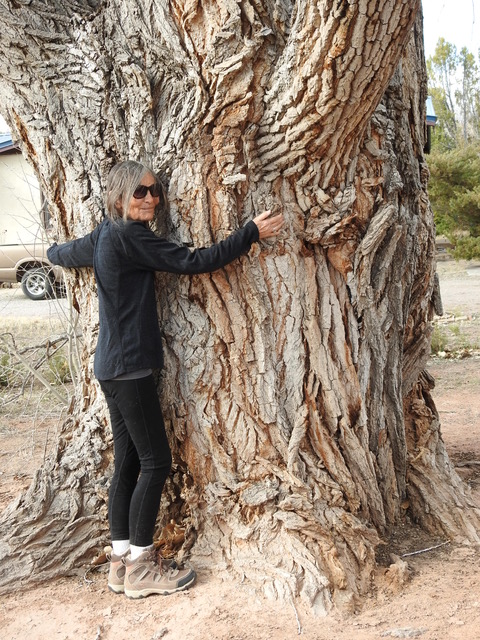
Recently, I returned from the Southwest where I was introduced to the ceremonies of the Pueblo peoples, ceremonies that reflected my own spiritual practice reinforcing its authenticity. This interlude also allowed me to be part of a people who had never lost access to their roots. They had never given up their ceremonies or surrendered their way of life.
I returned to Maine with a much stronger sense of my Indigenous cultural identity than I had when I left. I hadn’t realized until I went to the Southwest how much this identity had been eroded by local people. Living in western Maine had brought me in contact with the frightening bias people have towards Indians; some are openly despised. Continue reading “Crane Song: Finding my way Home through Image, Myth, and Nature – Part 2 by Sara Wright”
Crane Song: Finding my Way Home through Image, Myth, and Nature – Part 1 by Sara Wright

The last gift I received from my very distant parents was a print of a Native American Medicine Wheel by Ojibway artist Joe Geshick. I received this present on my birthday in 1993.
When I opened the cardboard tube I was astonished by the image. A Medicine Wheel? As far as I knew neither of my parents had any idea that I had picked up the thread of my Native heritage and was studying Indigenous mythology. What could have motivated them to send me such an image? I was stunned by the seemingly bizarre synchronicity. Continue reading “Crane Song: Finding my Way Home through Image, Myth, and Nature – Part 1 by Sara Wright”
Navajo Night Chant – Part 2 by Sara Wright
The original Night Chant involved four teams who danced twelve times each with half-hour intervals in between-a total of ten hours. The dance movements involve two lines facing each other. Each of the six male dancers takes his female partner, dances with her to the end of the line, drops her there, and moves back to his own side. The chant itself is performed without variation and has a hypnotic effect on the listeners. The only relief is provided by the rainmaker-clown named Tonenili, who sprinkles water around and engages in other playful antics.
The medicine men who supervise the Night Chant insist that everything-each dot and line in every sand painting, each verse in every song, each feather on each mask-be arranged in exactly the same way each time the curing ceremony is performed or it will not bring about the desired result. There are probably as many active Night Chant medicine men today as at any time in Navajo history, due to the general increase in the Navajo population, the popularity of the ceremony, and the central role it plays in Navajo life and health. Continue reading “Navajo Night Chant – Part 2 by Sara Wright”
Navajo Night Chant – Part 1 by Sara Wright
 With the Winter Moon waxing on nights when stars are falling from the sky and the winter solstice passage, I am much aware of the healing and dwelling place that I inhabit that also characterizes these dark months of the year.
Unfortunately, even those who acknowledge our seasonal turnings rarely honor the dark as sacred. At the winter solstice the emphasis is still on light.
As Carol Christ writes so succinctly we manage to celebrate light at both solstices – at its apex and as its return. Continue reading ” Navajo Night Chant – Part 1 by Sara Wright”
 Feminism and Religion