Archives from the FAR founders: Systemic Violence and the Killing of Michael Brown by Xochitl Alvizo

 This piece was originally posted on August 14, 2014, over ten years ago; add immigrants and Latine where it reads young black men, boys, or women, and it is as if I wrote it for today.

The current U.S. regime gives us more and more to rage and grieve over every single day. It is indeed important to grieve and to give ourselves the time to really feel what is going on under our watch so that we can then move into action with more resolve and efficacy. I invite you then to read, grieve, and then take action. Every day, do at least one thing – make a call to the president, your governor, senators, and representatives; engage in mutual aid; show up to a protest – and choose not to be a bystander. Oppression is systemic, indeed, but it is also a people, it is us.  The system is people and we are the system. 

~~~~~~~~~

Oppression is systemic. Injustice is systemic. It pervades the whole – it seeps into everyday actions and becomes habits and patterns that function as default. As a result, the actions that fall within these patterns hardly need justifying. If anything, the questioning of them is what is put on the defensive. And those who stand against injustice must usually do so in the face of militarized policing, before vast forces that serve to preserve the status quo.

Continue reading “Archives from the FAR founders: Systemic Violence and the Killing of Michael Brown by Xochitl Alvizo”

Legacy of Carol P Christ: WAR, WAR, WHAT ARE WE FIGHTING FOR?

This was originally posted Sept 16, 2013. It is sadly pertinent today

“They used chemical weapons, we must do something to stop them.”  A justification widely used in support of President Obama’s decision to launch a military strike against Syria.

We fought the Civil War to end slavery and racism. We fought the Second World War to end fascism. Did we end racism? Did we end fascism? Howard Zinn

At the time of the Revolutionary War, “a not inconsiderable Quaker element was on principle opposed to war, as itself a greater evil than any it might seek to right.”

Michelle Obama is against military intervention in Syria. Does the President dismiss Michelle’s dissent as “womanish”?

Continue reading “Legacy of Carol P Christ: WAR, WAR, WHAT ARE WE FIGHTING FOR?”

Legacy of Carol P. Christ: RAPE CULTURE IN THE MILITARY AND “TURNING BOYS INTO MEN”

This was originally posted on June 17, 2013

Rape is not something that “just happens” in the military. It is an inevitable product of military training. Unless and until we understand this and change the way soldiers are trained, we will never be able to stop rape in the US military or any other military system.

Propaganda-Poster-Masculinity

The right to rape women of the enemy has been considered one of the “prerogatives” of warriors since the beginning of warfare.  Could “military training” which “turns boys into men” by calling them “girls” or “women” or “gay” in order to break down their self-esteem and remold their “character” as soldiers be one of the reasons rape is such a pervasive problem in the military? Are “boys” being taught that the only way to “prove” their “manhood” is to replace “identification” with women—their mothers, sisters, girlfriends, wives—with a new “identity” as a “dominant male” who “dominates” women and weaker men?  I fear that if we fail to address the “core issue” of “military training,” we will never get to the root of the rape culture that pervades the military.

Continue reading “Legacy of Carol P. Christ: RAPE CULTURE IN THE MILITARY AND “TURNING BOYS INTO MEN””

Archives from the FAR Founders: The Tale of Two Breast: From Religious Symbol to Secular Object by Cynthia Garrity Bond

This was originally posted on June 15, 2012

I am less concerned with the legitimacy or morality of public breast-feeding . . . rather I am asking what contributes to this strange binary of, on the one hand, social acceptability of near-porn-like images of breast used in advertising, i.e. Victoria Secret, while on the other hand, internal conflicts some feel when viewing a baby/child feeding at the breast?

Beyond the “war on women” initiated by the Republican party on women’s reproductive rights, the issue of women’s breast, or more specifically, the nursing breast, has been making itself know in the media.  The recent Time magazine cover of Jamie Lynne Grumet breast-feeding her three-year-old son produced a flood of  controversy centering on “attachment parenting,” which promotes, among other things, breast-feeding beyond infancy. Parent magazine recently profiled two military mothers breastfeeding in public while in uniform.  For some, this perceived breach in social decorum is akin to urinating and defecating openly while wearing your uniform.  Responding to the outcry, Air Force spokesperson Captain Rose Richeson states, “Airmen (sic) should be mindful of their dress and appearance and present a professional image at all times while in uniform.” In other words, it is suggested nursing military mothers pump and bottle-feed their babies when wearing their uniform in public spaces.  And finally, Hadley Barrows of Minnesota was asked to leave the library by a security guard because her nursing in public was a form of “indecent exposure.”  In this post I am less concerned with the legitimacy or morality of public nursing (although I have no issue with it), instead I am asking what contributes to this strange binary of, on the one hand, social acceptability of near-porn-like images of breast used in advertising, i.e. Victoria Secret, while on the other hand, internal conflicts some feel when viewing a baby/child feeding at the breast? Drawing from the work of Margaret Miles and her text, A Complex Delight: The Secularization of the Breast, 1350-1750, social attitudes and the public display of women’s breast can best be understood when the breast is viewed as a coded symbol that informs, through artistic representation, complex patterns of discourse.

Continue reading “Archives from the FAR Founders: The Tale of Two Breast: From Religious Symbol to Secular Object by Cynthia Garrity Bond”

From the Archives: “I Missed a Day Again: Reflections on Hanukkah.”

Author’s note: This post was orginally published December 13th 2015. Nonetheless, I still find this post relevant and my hope is that you, dear reader, do as well. Chag semeach!

When I first started back on my journey to reclaim Judaism, I distinctly remember the first Hanukkah I lit candles. Not only was I bringing light into the literal darkness of night, I was also kindling the divine spark within myself. Each night I walked through a meditation I had created using the letters of the word Hanukkah, since there were eight letters and eight nights. I remember some of the words I had assigned to the nights: Holiness, Attentiveness, Night, Understand, Knowledge and Keep. I can’t remember the rest, but I do remember feeling the calm of the candlelight and the deepness of the meditation. I also remember that at some point, either I missed a night of lighting or I repeated one night twice because the days were officially over, and I still hadn’t lit all eight candles.

Continue reading “From the Archives: “I Missed a Day Again: Reflections on Hanukkah.””

Myanmar’s Dangerous Military Coup by Anjeanette LeBoeuf

On February 1st, a successful military coup took place in South Asia. The national military of Myanmar arrested top non-military officials and seized all power. While this February coup happened in South Asia, it could have happened on our very shores. Myanmar’s successful military coup d’état took place almost a month after the unsuccessful January 6th attack on the US Capitol.

Continue reading “Myanmar’s Dangerous Military Coup by Anjeanette LeBoeuf”

The Trees and We Breathe Bombs Long Gone by Elisabeth Schilling

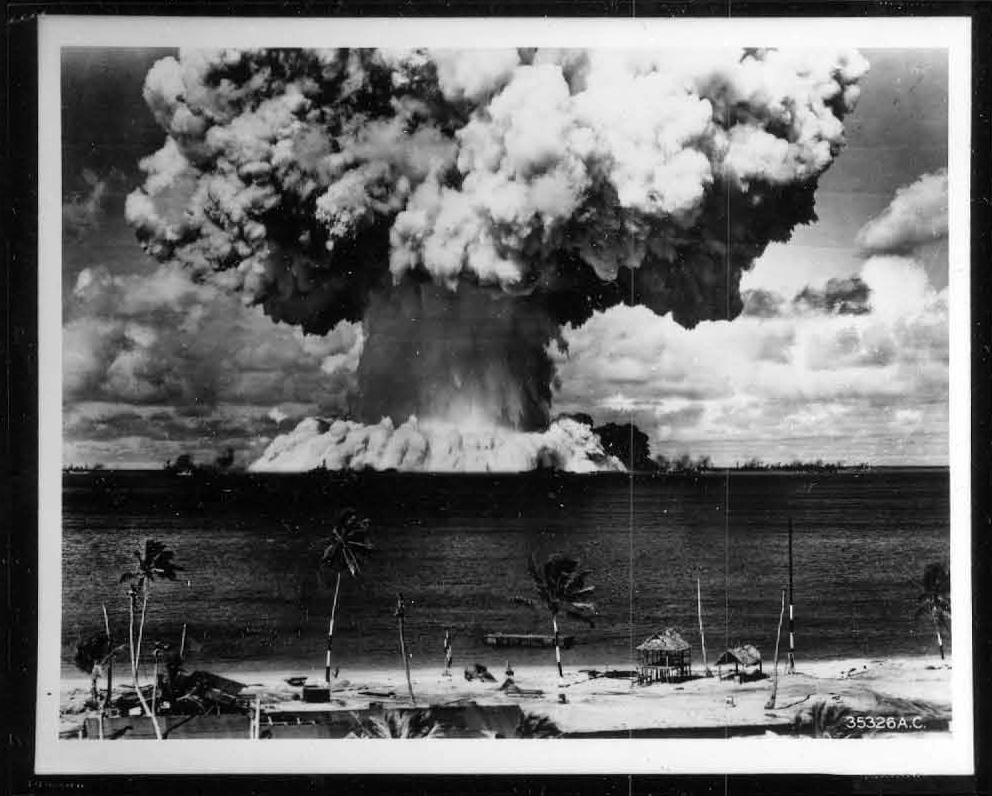
bikini atoll bombI wish that in our pursuit of finding cures for illnesses we would do more as a collective species to prevent the causes, sometimes environmental ones. Why do we vote for people to make decisions that represent us but that we would never in a million years agree to? Bombs and the consequences of them raise questions of health and power. In the Yoga Sutras, 2.30, we read that “Yama consists of non-violence, non-lying, non-stealing, appropriate use of vital energy, and non-possessiveness.” The yamas are our social restraints. They are a negation of behaviors we might usually partake in.

Ahimsā, or non-violence, is listed first. It is the first element of the first limb of yoga; it is the basis for every other ethical aspect of our lives. Bombs are an example of a common and frequent behavior of violence that make the land, water, and sky increasingly uninhabitable. According to Micah Zenko of the Council on Foreign Relations, in 2016 alone, the U.S. is estimated to have dropped 26,172 bombs. Zenko says that this estimate is “undoubtedly low.” (1) This is one year and the bombs from one nation. (2) What is the environmental impact of all of the bombs dropped from every nation since the beginning of bombing history?

When a bomb is detonated, there is not only harm to the immediate life in that vicinity but life in the future and far away. According to the International Campaign to Abolish Weapons (ICAN) website, “the International Physicians for the Prevention of Nuclear War has estimated that roughly 2.4 million people will eventually die as a result of the atmospheric nuclear tests conducted between 1945 and 1980, which were equal in force to 29,000 Hiroshima bombs.” (5)

According to a statistic updated March 2016 on the Ploughshares Fund website, nine countries in the world have a total of 14,900 nuclear weapons, the U.S. and Russia holding 93% of them. (3) They have been used twice, both times by the United States, in war, but additionally they have been used in tests over 2,000 times in more than 60 locations over the globe, according to ICAN. (4) There are already unavoidable consequences to the earth and humans because of this irresponsible behavior that is ongoing.  These tests occur in the atmosphere, under the earth, and under water. (6) Continue reading “The Trees and We Breathe Bombs Long Gone by Elisabeth Schilling”

What Could ‘Masculinity’ Mean in 2017? by Meghana Bahar

PART II of II – see PART I here

Last year, the leader of the (un)Free World was elected by ‘right choice’, much to the collective dismay of liberal leftists, a huge proportion of people of colour, progressive educationists, environmental conservationists, human rights defenders, religious reformists, and a large fragment of the developing world in the south of the globe. Today, Donald Trump has brought the world to the brink of World War III. ­­­Amidst accusations of undeclared tax returns and unabashed grabbing of female genitalia, the term ‘toxic masculinity’ is thrown about in a variety of media platforms. Many critiques lament how “inflammatory” the term is, one that is not quite “hopeful” for men, whilst the criticisms by media oligarchs reflect a hatred towards femininity.

Entitlement, sexism and narcissism can no longer be virtues of a millennial masculinity – we have lost so much already to corporate greed, warlords and racist bigots. Traditional, armorial masculinity is breaking our homes and our planet. At the ecological scale, the lungs of the earth mother are clogged. Wisdom-keepers decry the daily rape and plunder of their lands. The planet’s heart valves bleed toxins that can no longer sustain flora, fauna, fungi. Continue reading “What Could ‘Masculinity’ Mean in 2017? by Meghana Bahar”

What Could ‘Masculinity’ Mean in 2017? by Meghana Bahar

There have been so many times
I have seen a man wanting to weep
but instead,
Beat his heart until it was unconscious.

— ‘Masculine’, Nayyirah Waheed


PART I of II

There have been many times when I have wondered whether the world has reached a peak in a broken kind of masculinity.

The notion that there is only one kind of masculinity deserving pedestalisation, or even just one kind of masculinity, has long been discarded in the enclaves I have access to as a grassroots activist and scholar. These are not secret societies that are password-protected. They are protected, of course, by communities that uphold principles of freedom, dignity, equality and justice. But anyone is welcome.

It remains to be seen whether everyone will come.

Six years ago, news broke out that sixty-six teenaged boys had been sent to a government-authorised “anti-gay” boot camp in the state of Terengganu, a rather conservative Islamic province in eastern Malaysia. Their offence? They were considered ‘effeminate’ by their custodian-teachers. The boys were sent to a week-long counselling camp to ‘correct’ their behaviour. Continue reading “What Could ‘Masculinity’ Mean in 2017? by Meghana Bahar”

Dear Gloria: The Feminist Candidate I Can Believe In Must Be Unbossed and Unbought by Carol P. Christ

Carol Molivos by Andrea Sarris 2In the past week, founder of Ms. Magazine Gloria Steinem, whom I have always greatly admired, stated that young women are supporting Bernie Sanders because his campaign is where the boys are. She has since recanted the comment, but I suspect she still believes that feminists ought to be supporting Hillary. I have written Gloria an open letter.

Dear Gloria,

Like you, I am no longer a young woman. Like you, I am a lifelong feminist activist. But, unlike you, I am not supporting Hillary Clinton. I am supporting Bernie Sanders because of–not in spite of–my feminist principles. I came into the feminist movement through the antiwar, antipoverty, and civil rights movements. My feminism cannot be reduced to the single issue of women’s rights. I believe that feminism can and must be intersectional and inclusive of issues of class and race. For me it must also include an analysis of the relationship between patriarchy and war, which I have discussed in a series of blogs on Feminism and Religion that I hope you will read.

I believe the future of the United States (and the world) requires us to dismantle the system in which the 1% owns more of the world’s resources than the rest of us combined. As you and I both know, poor women of color are at the bottom of this system, both in the United States and worldwide. As you and I both know, there are reasons to seriously doubt if democracy can function in a political system in which the 1% can buy candidates and fund voter suppression. Continue reading “Dear Gloria: The Feminist Candidate I Can Believe In Must Be Unbossed and Unbought by Carol P. Christ”