Sedna, Inuit Mother of the Sea by Judith Shaw


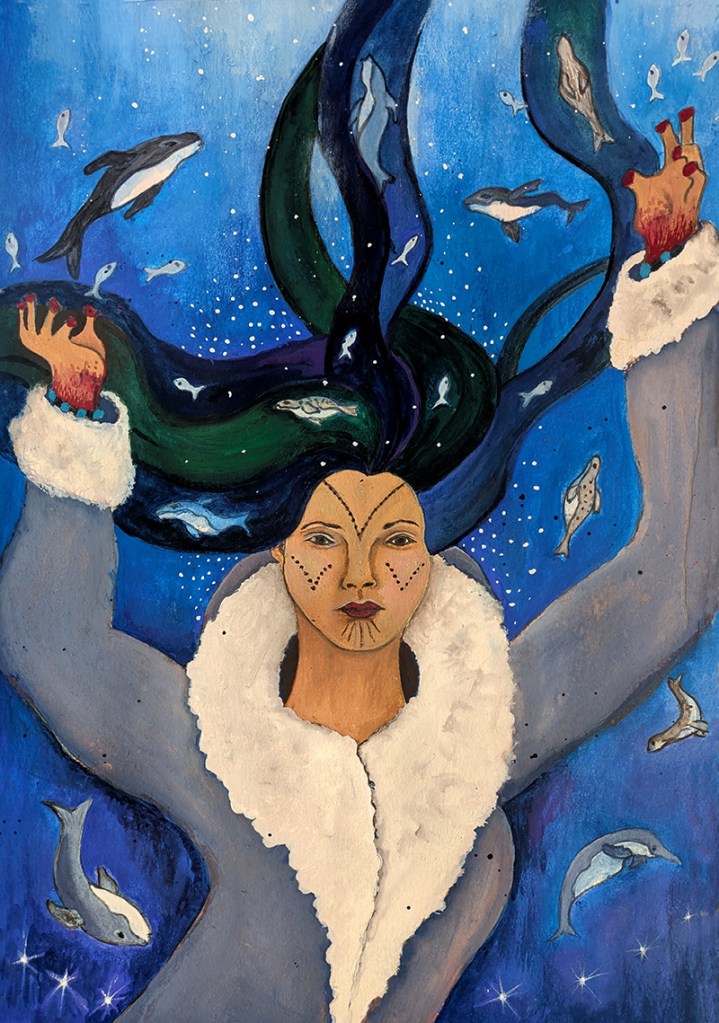
During the depths of winter, the tension between sacrifice and the joy of rebirth peaks. From Pagan celebrations of the Winter Solstice to Christian festivities marking Christ’s birth, this darkest time of year in the Northern Hemisphere is recognized as a moment when darkness nurtures light, promising the arrival of spring. It’s the perfect time to explore the story of the Inuit Sea Goddess, Sedna, whose tale encompasses sacrifice, transformation, and metamorphosis.

Sedan, Mother of the Sea, gouache on paper, by Judith Shaw
Continue reading “Sedna, Inuit Mother of the Sea by Judith Shaw”

I Was Called by Mama Dove by Judith Shaw

As we move into the Winter Holidays, when calls for peace are found everywhere, my reflections keep returning to the wisdom of the little dove.

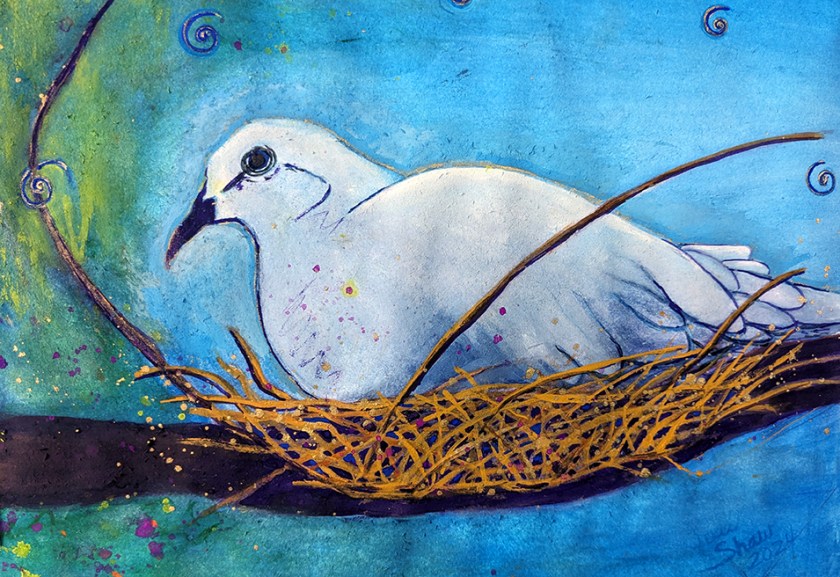
Unlike most of my animal paintings, which start with research into their myths, Mama Dove was different. This painting came about through direct experience in the natural world. In the summer of 2024, a dove nested in the deteriorating lattice roof of my pergola, allowing me to observe her closely as she sat on her eggs. This amazing experience revealed her nurturing strength, and inspired me to create this painting.

mama_dove_painting_Judith_Shaw
Mama Dove, gouache on paper by Judith Shaw
Continue reading “I Was Called by Mama Dove by Judith Shaw”

Legacy of Carol P. Christ: Was Ariadne the Most Graceful Bull-leaper of All? Deconstructing and Re-visioning Greek Mythology

carol-christ

This post was originally published on March 3rd, 2014.

Sometimes we think of Greek myth as a pre-patriarchal or less patriarchal alternative to the stories of the Bible. After all, Goddesses appear in Greek myths while they are nearly absent from the Bible. Right?

So far so good, but when we look more closely we can see that Greek myth enshrines patriarchal ideology just as surely as the Bible does.  We are so dazzled by the stories told by the Greeks that we designate them “the origin” of culture. We also have been taught that Greek myths contain “eternal archetypes” of the psyche. I hope the brief “deconstruction” of the myth of Ariadne which follows will begin to “deconstruct” these views as well.
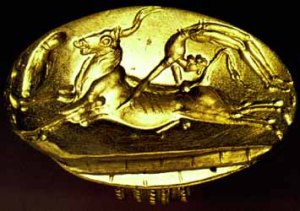
bull leaping ring before 2000 bc phourniAriadne is a pre-Greek word. The “ne” ending is not found in Greek. As the name is attributed to a princess in Greek myth, we might speculate that Ariadne could have been one of the names of the Goddess in ancient Crete. But in Greek myth Ariadne is cast in a drama in which she is a decidedly unattractive heroine.

In the story told by the Greeks, Ariadne falls in love with Theseus, a handsome young man who was sent with 11 other Greek young people to be fed to a monster (who is half man, half bull) known as the Minotuar. The Minotuar is Ariadne’s half brother (see below). Because of her “love” for Theseus, Ariadne helps him to murder her brother.  She then flees with Theseus on his boat.

However, this “love story” does not have a “happy ending” as Theseus abandons Ariadne on a nearby island–long before he arrives home in Athens. Theseus is ever after celebrated as a hero who killed a monster, while Ariadne is just another cast-off female.  Whose story is this? Continue reading “Legacy of Carol P. Christ: Was Ariadne the Most Graceful Bull-leaper of All? Deconstructing and Re-visioning Greek Mythology”

The Beast at Our Door: Fenrir Wolf and ICE by Janet Maika’i Rudolph

Binding of the norse mythological wolf, Fenrir. From Guerber, H. A. (Hélène Adeline) (1909). Myths of the Norsemen from the Eddas and Sagas. London : Harrap. This illustration is on page 92. Digitized by the Internet Archive Wikimedia Commons

When I was a shamanic trainee, our group spent a lot of time and focus on the “beast within” This concept has had many expressions in different circumstances – the shadow side (Jung), the dark side (Star Wars), letting loose the “dogs of war” (William Shakespeare), reptilian instincts (psychology). 

Mythology has many stories about this phenomenon. In our group, we studied the stories as a way to learn what we must do in our own lives to tame the beast so we had this energy available to use the energy without letting the crueler destructive aspects of the beast run rampant. Here are two of the stories as we discussed them.

Fenrir Wolf

Fenrir Wolf is a deity from the Norse tradition who was known and feared as a great monster. Tyr was the only God in Asgard brave enough to tend to Fenrir. For a long time, Tyr fed and cared for him. Eventually, though, Fenrir grew too large to handle and began running throughout the land called Midgard, killing both gods and people. Odin called a council to discuss how Fenrir could be slain. 

Continue reading “The Beast at Our Door: Fenrir Wolf and ICE by Janet Maika’i Rudolph”

Samhain and the Goddess by Judith Shaw

The wheel of the year is turning us once again toward the dark half of the year. Here in the United States, the bright, shining days of youth and achievement receive the most attention. Death and darkness are rarely honored and often feared.

But the ancient Celts had a completely different view of their place in the world. With a strong belief in reincarnation, the Celts saw death as simply a point of transition in a very long series of lives. People honored the darkness of both night and winter as starting points. In the Celtic worldview a day began at sunset, not sunrise, and the New Year began on Samhain, October 31—the midpoint between Fall Equinox and Winter Solstice.

Samhain, one of the four great fire festivals of Celtic tradition, might have begun long before the Celts arrived in Ireland under the influence of an ancient goddess, Tlachtga (tclak ta). She was most likely from the time of the Fir Bolgs, (fair bolak) the Bronze Age inhabitants of Ireland from the East, and later incorporated into the Celtic pantheon.

Tlachtga--celtic-goddess-painting-by-judith-shaw
Tlachtga, Celtic Goddess of Sun & Lightning, gouache on paper
Continue reading “Samhain and the Goddess by Judith Shaw”

Merrows: The Enchanting Mermaids of Celtic Mythology by Judith Shaw

Mermaids have captivated our imaginations worldwide for thousands of years. Across cultures, mermaids are depicted in differing ways—as a dangerous seductresses like the Greek sirens, or as one who could grant immortality like the Japanese ningyo.  

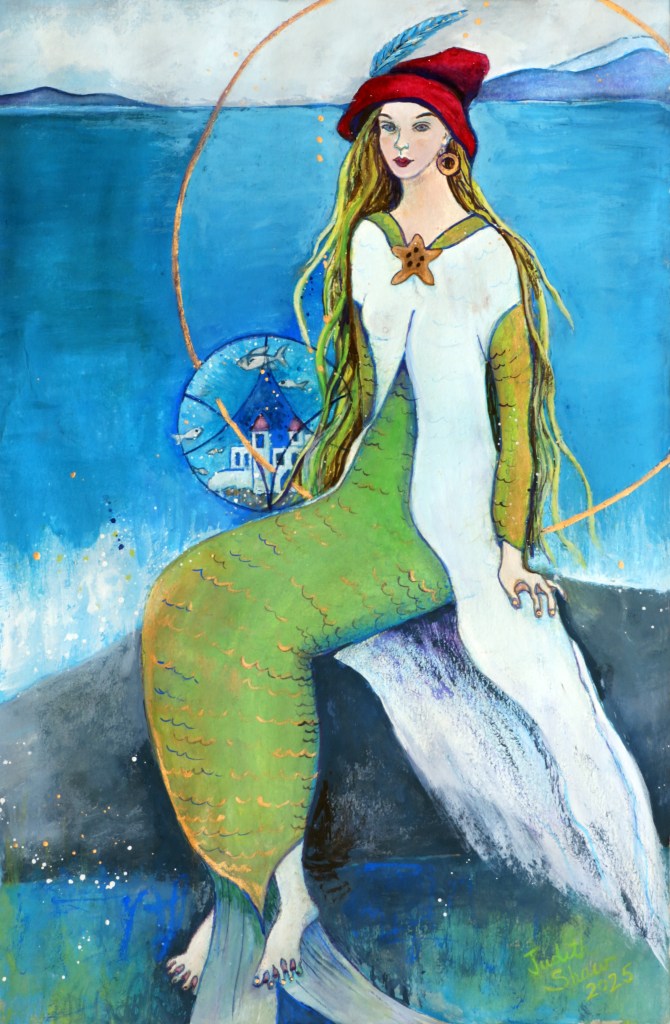
Celtic Ireland, with its abundance of fairies and magical beings has its own kind of mermaid, the Merrow. This term derives from the Gaelic word, “murúch,” which translates as “sea maiden.”

A Merrow‘s Longing by Judith Shaw, gouache on paper, 12″x18″
Continue reading “Merrows: The Enchanting Mermaids of Celtic Mythology by Judith Shaw”

The Cauldron of Life: Destruction and Creation in Celtic Myth, Part 2 by Judith Shaw

Branwen’s Story

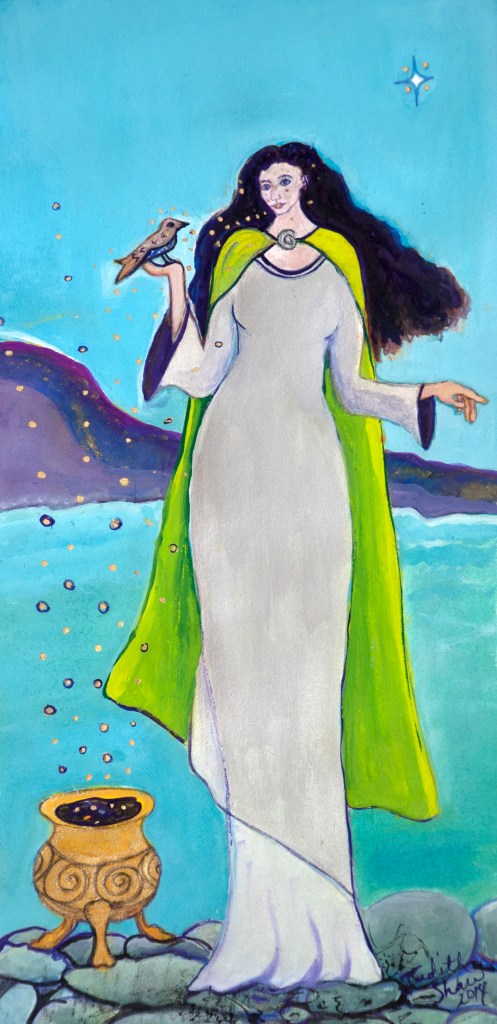
Branwen, sister of King Bran the Blessed, was cherished for her gentleness, compassion, and beauty. As the mother of the future king in the tradition of the Old Tribes of the British Isles, she embodies Sovereignty. She is the source of all life, ruling over both the spirit and the land.

Branwen, Celtic Goddess painting my Judith Shaw
Branwen: Celtic Goddess of Love and Compassion by Judith Shaw

We first meet Branwen when the Irish King Matholuch arrives, his fleet signaling peace with a great shield pointing outwards. He asks for Branwen’s hand in marriage—a significant event, as no woman of the old tribes had ever left her people for a foreigner, much less she who would give birth to the next king. Nonetheless, Matholuch is welcomed ashore, and Branwen is summoned.

Continue reading “The Cauldron of Life: Destruction and Creation in Celtic Myth, Part 2 by Judith Shaw”

The Cauldron of Life: Destruction and Creation in Celtic Myth, Part 1 by Judith Shaw

With each passing day, the world spirals deeper into chaos under the weight of the most unsuitable and morally bankrupt president the United States has ever elected. In nearly every aspect of life—from politics to economics to technology to the environment—the world as we knew it is gone. We find ourselves caught between chaos and creation. We are in liminal times.

Badb, Dark Goddess by Judith Shaw
Badb: Fate Weaver by Judith Shaw
Continue reading “The Cauldron of Life: Destruction and Creation in Celtic Myth, Part 1 by Judith Shaw”

Healing Soul Loss Through Movement

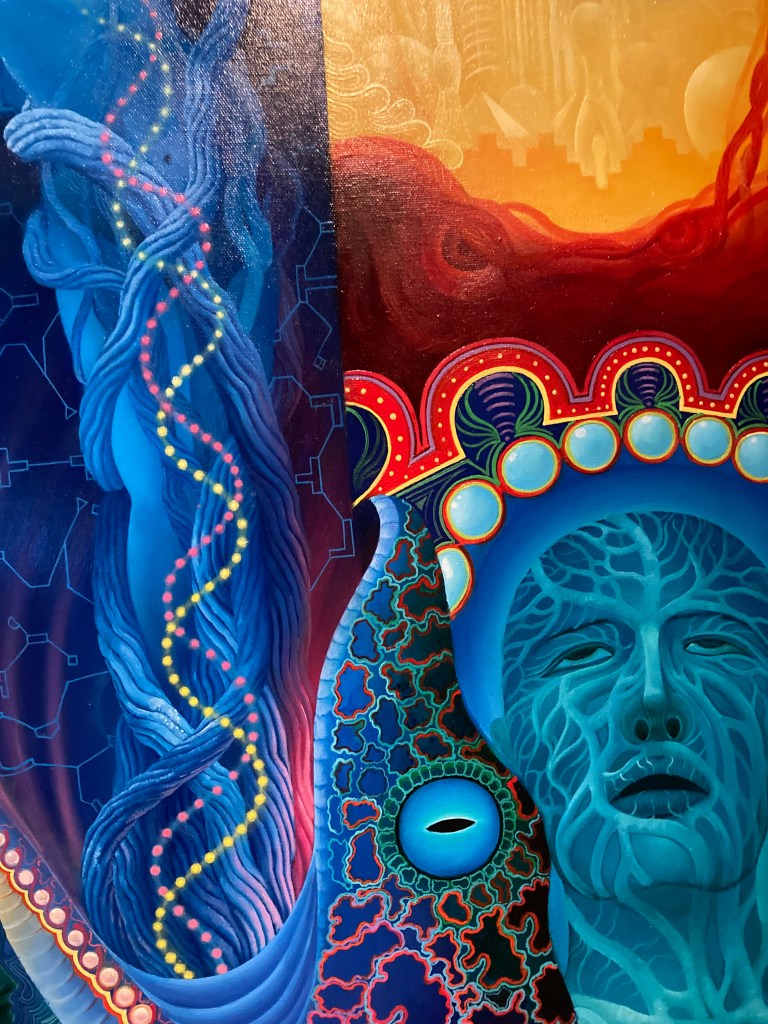
We tend to imagine soul loss as something rare and dramatic, or reserved for those with deep trauma. But in shamanic paradigms across cultures, soul loss is a normal part of being human. The concept refers to moments when a vital piece of our essence disconnects, often as a survival mechanism. In psychology this is called dissociation. This can happen through shock, illness, relational rupture or subtle decisions we make to fit in, stay safe or succeed. A piece of us leaves in order to preserve the rest.

[Image credits: Detail from Anderson Debernardi’s painting “Iniciacion Shamanica”, seen at Exhibition Visions Chamaniques. Arts de l’Ayahuasca en Amazonie Péruvienne, ‎⁨Musée du Quai Branly, 2024. Photo by Eline Kieft.]

Continue reading “Healing Soul Loss Through Movement”

Dancing the Stories That Heal

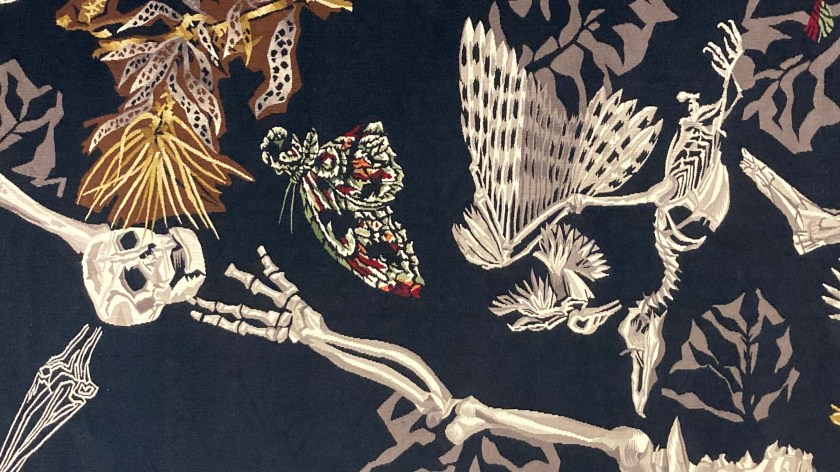
After a near-death experience in 2019, I found myself immersed in myth and movement—sitting with Clarissa Pinkola Estés, dancing archetypes through Movement Medicine, and weaving stories like the Handless Maiden and the Red Shoes into my everyday life. This post shares some of the journey of how myths became embodied allies and an invitation for you too, to remember what lives in your bones.

Tapestry: Le Grand Charniers (1959) by Jean Lurçat, Musée Jean-Lurçat, Angers, photographed in 2024. Image © Eline Kieft.
Continue reading “Dancing the Stories That Heal”