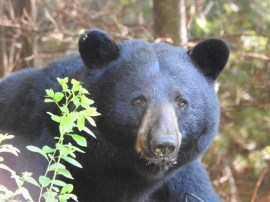
On the path
through the pines
I see clumps of
moss scattered,
an old tree trunk
is raked as if
with claws;
clumps of downed bark
food for the earth.
My heart soars.
Wild hope pours
through me like honey.

Exploring the F-word in religion at the intersection of scholarship, activism, and community.

On the path
through the pines
I see clumps of
moss scattered,
an old tree trunk
is raked as if
with claws;
clumps of downed bark
food for the earth.
My heart soars.
Wild hope pours
through me like honey.
 I have a vivid childhood memory of being sick with the stomach flu and standing in the doorway of my parents’ bedroom looking for my mother. Her care for sick children was tender and thorough. She would bring us ginger ale and toast with jelly. When she had time, she read us stories. I can remember her steering me, heavy with fever, back to a bed that she had magically smoothed and cooled. But that day my mother lay in her own bed in an old nightgown, not stirring. She had the flu, too, and could not get up to care for the rest of us. It was a shocking and sobering moment.
As I grew older, I transferred my need for comfort, reliability, and continuity from my mother to the earth, the sure turning of the seasons, beloved trees, waters, and rocks. As a young mother, I looked forward to sharing my own childhood joys with my children, among them jumping into autumn leaf piles. The first time my children leaped into a leaf pile, they came up covered with the ticks that have now made my region the epicenter of Lyme and other tick-borne diseases. Nor was I able to share with my children the joy of drinking water straight from a stream. Continue reading “Child of the Earth by Elizabeth Cunningham”
In was in October that my last grandmother died, my last living grandparent. As the leaves turn to red and gold once more, I wake thinking of her each morning. I wake thinking of my maternal grandmother too, who died seven years ago, in springtime as the iris bloomed. I dream of my husband’s grandfather, he stands shoulder to shoulder with my oldest son, white hair and smile flashing as he compares their heights and laughs.
We’ve just returned from a two week long trip to Florida and have arrived back in Missouri to a life in full swing, books to write, projects to plan, new products to develop for our shop, old requests waiting for our attention. But, the leaves will only be this color for a moment. The air will only be this sweet and pleasant for a moment. The sun will only glint across the cedar branches in this way that brings my soul to life right now, the colors of the day so sharp and vivid, clear and bright to my eyes, that it is almost like stepping into another reality. We have only this moment to join hands and slip off into the woods beneath the early morning sun, stepping past pools of slowly dripping water, over sharp and uncertain stones, soft green moss, and carpets of fallen leaves. It is only this moment in which we will hear the hawk’s cry ring out across the trees. Only now in which we will turn over leaves and discover shining mushrooms, gleaming in the October sun.
I stepped into the woods holding memories of my grandmothers next to my heart. The leaves were lit gold from within and below, forming an 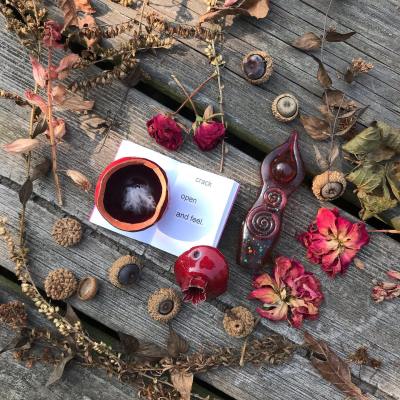 enchanted tunnel into the trees near where we have built our new work studio. As I moved into the clearing, I heard two crows raise an alarm call. I stood silently and looked, curious about the source of their alarm. They called again sharply, once, twice, and right in front of me a quiet brown deer, previously unseen, lifted its white tail and leaped gracefully away through the trees. It took a breath, a beat of time, for me to realize that it was me, my own small form standing relatively motionless among the trees watching the morning sun illuminate the yellow leaves, that was the cause of the raised alarm, this communication between species, sharing the same ground.
We set off along a stony gully that bisects the land of my parents, pausing by a series of small pools and gazing through the backs of dogwood leaves turning to rich red with veins of green still lightly tracing through their round centers. Suddenly, the scent of cedar filled the air and I crouched beneath the tree to see the ground beneath it littered with small snippets of evergreen, strewn across a thick blanket of brown oak leaves and yellow maple, glowing in a stained glass impersonation in the perfect touch of the sun upon their surfaces. My breath made a fog in the air and I looked up into the tree to see that it, too, was breathing in this cool morning, steam lifting off its trunk and rising into its thin fingered branches. There are small blue juniper berries brightly laid against the wet green moss beneath the tree and I turn to see the peachy-rose globes of persimmons hanging on thin branches against the sky. I have the sensation that they are watching me there, kneeling on the wet ground, caught between rays of sunlight and enchantment.
We continued picking our way carefully across the lichen-laden gray stones until we came to fallen tree, carpeted with a beautiful array of fungus. Small brown knobs that look like new potatoes spring from what was once the top of the trunk and a panoply of beautifully spiraled whorls of turkey tail mushrooms form small cups which hold last night’s raindrops.
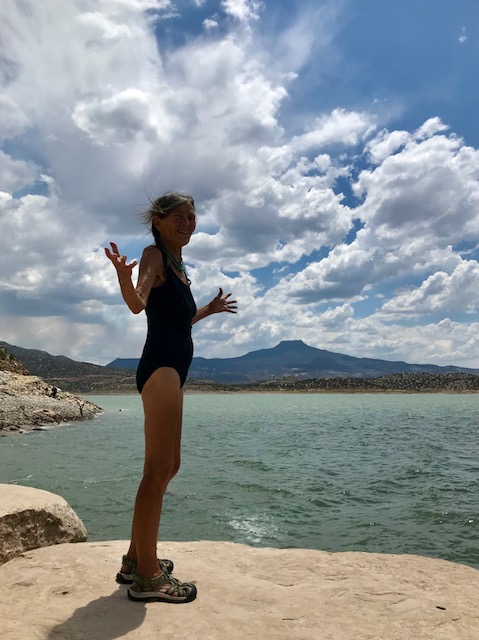
As we descended into the gully, the view opened up before us, slabs of stone forming a naturally terraced series of platforms dropping lower and lower into the round stone pools. The trees are yellow here, sun gleaming on the leaves, forming a temple bower of golden branches. I felt full of delight and joy, so pleased that we had chosen to lay aside the to-dos and come on this ramble together. I asked my husband to take a picture of me in the trees and stones telling him with a smile that this is the only moment in which the leaves will be this color and in which I will be this fabulous.
Being in the world, noticing what blooms and breathes and flows around us, is the fullest expression of my spirituality to me. Seeing what 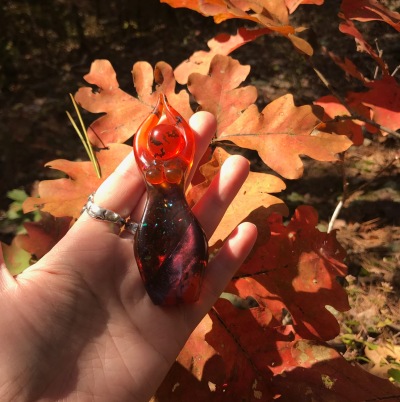 emerges, what fades, what rises and falls, this is a living magic. Honoring the passage of time, the turn of the wheel, the cycles of the land, the earth as an ensouled presence, and my own footsteps on her an act of devotion, these are the cornerstones of feminist spirituality for me. Look. Learn. Listen. Feel. Care. Act. Goddess worship and the symbol of the Goddess plays an important role in re-conceptualizing and restructuring the role of women, the value of nature, and the social order. In her book Ecofeminist Philosophy, Karen Warren writes: “Many spiritual ecofeminists invoke the notion of ‘the Goddess’ to capture the sacredness of both nonhuman nature and the human body…the symbol of the Goddess ‘aids the process of naming and reclaiming the female body and its cycles and processes.” Rather than something to dominate and control, the earth becomes the body of the Goddess and is acknowledged as both literal and spiritual home and is something inseparably linked to personal well-being—planetary health and personal health become synonymous—and both are treated with reverence and respect.
I have wondered if I try too hard to make my life be magical, to make it meaningful and then I realize, if you look for evidence that the world is made of magic, for evidence that your life is magical, that you will find it everywhere. This isn’t wrong. This is beautiful and powerful and real. Yes, my life is magical. So is yours. The whole world is magical. We need only step right up to it and look, to see that we are surrounded by magic, woven right into the threads of it.
The stones were slippery with water and moss as we skirted our way carefully to the bottom of the gully, where a wide, curving, bowl-shaped basin has been formed of rock and rain and time. Gazing at it, tranquil and still, gently rippled rocks forming the sides and leaves filling its bowl, I said aloud: “When I die, you can leave me curled up here and I’ll be happy.” For a crisp moment I could clearly see my own bones lying nestled, smoothed and ivory, across this bed of leaves and sunbeams.
Something bright red caught my eye then, looking at first like the domed half of a large cherry tomato partially covered by brown leaves and I squatted down to discover a burst of crimson mushrooms grouped together and bright against the decaying foliage.
Mark didn’t answer me, but he laid his hand across my hip and together we scrambled like mountain goats past the crimson mushrooms and up the steep slope, the oak leaves giving way to a carpet of pine needles as we climbed, the now bare stems of lowbush blueberries catching on our socks and pants. At the top of the hill, we sat on the stones, chests heaving, breath fast from our ascent, smiling silently as we looked at the sunshine through the pines.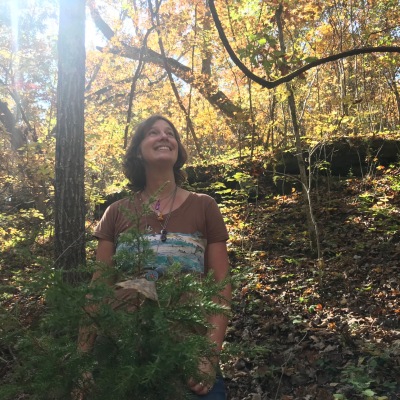
Molly Remer’s newest book of poems, Sunlight on Cedar, was published in March. Molly has been gathering the women to circle, sing, celebrate, and share since 2008. She plans and facilitates women’s circles, seasonal retreats and rituals, mother-daughter circles, family ceremonies, and red tent circles in rural Missouri. She is a priestess who holds MSW, M.Div, and D.Min degrees and wrote her dissertation about contemporary priestessing in the U.S. Molly and her husband Mark co-create Story Goddesses, original goddess sculptures, ceremony kits, mini goddesses, and more at Brigid’s Grove. Molly is the author of Womanrunes, Earthprayer, the Goddess Devotional, She Lives Her Poems, and The Red Tent Resource Kit and she writes about thealogy, nature, practical priestessing, and the goddess at Patreon, Brigid’s Grove, Feminism and Religion, and Sage Woman Magazine.
 I am a naturalist and ethologist who has studied many animals and birds in their natural habitat; my 15 year study of Maine’s black bears is perhaps the best example of the work I do. I am a dedicated animal advocate and telepathic communication is part of many if not all of my interactions with both tame and wild animals.
I am also an eco-feminist who believes that women have always had a more intimate connection to the natural world, that if developed, will lead to telepathic communication.
A couple of months ago I wrote a story about the telepathic relationship between my dove, Lily B and me. I put it on my blog and every day there after I noted that a number of people read it. At first I didn’t pay much attention but after awhile I couldn’t dismiss the odd sensation that this story was traveling from country to country in a very peculiar way. One day I counted 11 countries whose bloggers just read one article, the story about Lily B. Bloggers continue to read about my dove on a daily basis. This morning, for example, someone from Egypt read it. Continue reading “Telepathy, Women, and Birds by Sara Wright”

My recent move from Northern England to the Silver Coast of Portugal has been a radical change on so many levels. Not only am I coming to grips with a different climate and culture and immersed in learning a very challenging new language, I have embraced a completely different lifestyle.
For the first time ever, I can keep my beloved Welsh mare and matriarch, Ms. Boo, at home, along with her companion, the dashing Zinco, a very handsome but sometimes aloof Lusitano gelding. My pet name for him is Mr. Darcy.

I could have taken the easy route and put Boo on a livery yard that did all the care for me, but I wanted to give Boo a lifestyle with daily year round turn out in a big field and none of my local livery yards offered this, though I talked to some very kind and helpful people at these establishments. It’s just a different approach to horse care in Portugal, which prioritizes stabling horses and using their energy for training exercises and riding.
My life now literally revolves around horse care and feeding. As soon as it’s daylight, I’m out bringing them their morning feed before I even have my human breakfast or coffee. I bring them their evening feed some time before sunset. So my writing, intensive Portuguese classes, or whatever else I’m doing is necessarily book-ended by horse care. My “productivity” can suffer as a result. If you have animals or children or other care-taking duties, the care-taking always has to come first. My change in lifestyle prompted me to question precisely why our culture privileges such a narrow view of productivity in terms of working for and selling ourselves to the corporate world rather than caring for the land and beings all around us.
I addition, I poo-pick the field twice daily, a very time-consuming task. I was in a bit of a quandary whether all this meticulous poo-picking was actually necessary. Many UK-based sites insists it is an obligatory part of horse welfare to control both flies and the spreading of parasites. However, my Portuguese farmer neighbor and my farrier both hinted that I could just leave the stuff on the ground and it might actually be better for the soil if I did.
I actually don’t mind poo-picking. It’s good exercise and very meditative, especially in early morning when the sun is rising above the mist and the dew is sparkling on each blade of grass. The other morning I saw a magnificent full moon setting majestically over the Atlantic Ocean on the far Western horizon. It’s so serene and peaceful, just listening to the birds and the horses munching their hay. I feel like I’m entering a slower, more authentic world where time is measured not by smart phones bleeping at you but by the deep cycles of nature, the sun and the moon, and the distant chiming of village church bells.

I think if certain world leaders got up early to poo pick, they would spend far less time spreading verbal horse sh*t on Twitter.
In many ways this feels like a homecoming, a return to my roots. On both sides of my family, my grandparents were farmers and many of my first cousins and their children are still farmers. Although I’m not an actual farmer, keeping horses at home has made me an accidental small holder.
Alas, the consequence of my poo-picking habit is an ever-growing mountain of a muck heap. What to do with all this manure is a perplexing problem if you don’t have a manure spreader and other fields to spread it on. I offered it to the farmer next door, only to receive a lecture on his view that chicken poo, sheep poo, goat poo, and cow poo are all superior to horse manure! A hierarchy of poo! (It was this gentleman who hinted that I was better off just leaving the stuff where the horses dumped it.)
Nonetheless I have a most imposing muck heap that will only get bigger unless some action is taken. I posted that I had free horse manure to collect on some local gardening sites. So far two people have taken me up on it. Both people took as much manure as they could possibly squeeze into their cars–it hardly made a dent on my manure pile! But from them I learned some valuable tips on composting and have been inspired to dig out the mature stuff at the bottom of the pile to put on my roses and hydrangeas. Hint: if you ever have insomnia, spending a day carting wheelbarrows full of horse manure all around your garden will insure you sleep like a rock.
It’s something sad if horse manure is just viewed as an unwanted waste product instead of being recognized as part of the deep ecology of animal-keeping and gardening. Manure is compost in the making.
In the meantime, my “manure friends” who have collected the stuff for their gardens have gifted me with organic produce and homemade fig jam. I still have a lot to learn but this new life is teaching me so much. Living in harmony with nature isn’t just posting pictures of pretty flowers on Instagram. It’s getting actual dirt under your fingernails.

Mary Sharratt is on a mission to write women back into history. Her acclaimed novel Illuminations, drawn from the dramatic life of Hildegard von Bingen, is published by Mariner. Her new novel Revelations, about the globe-trotting mystic and rabble-rouser, Margery Kempe, will be published in April 2021. Visit her website.
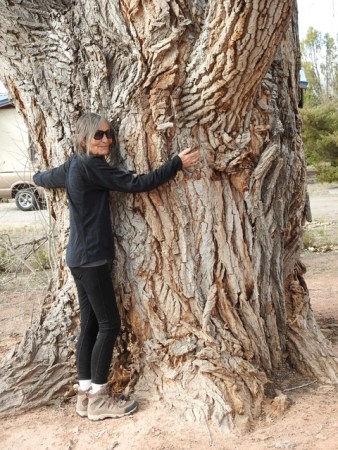
I am gazing out the window; an almost bare leafed apple tree’s sap has begun its descent for the winter months. Trees participate in a great round; breathing slows as the tree becomes drowsy. Soon the merciful cold will put her and others of her kind to sleep, not to awaken until life each tree’s life – blood thickens to rise and soar into the highest branches with a warming sun. Only tree roots stay awake throughout the winter searching for nutrients, exchanging carbon and carbohydrates, water, meeting new friends and avoiding foes, their root tips branching, fusing, glowing – solving problems far more complex than those of humans…
Last night a full white ‘falling leaf moon’ slid unobstructed through apple branches casting shadowy silver arms around our bed. My dogs were restless. I could see the rounded luminous pearl embedded in an ebony sky shining through all the deciduous trees that were dressed in scarlet splendor just a week ago. Last night those trees were bare. Continue reading “Passionflower Autumn by Sara Wright”
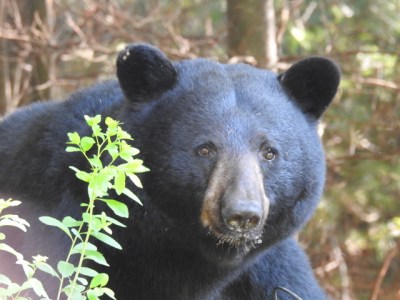
When we meet
our deep
brown eyes
mirror a
mutual need
for light
to penetrate
human darkness.
Your eyes are
wary and fearful;
Mine hunger
for your touch.
I cry out softly
“Don’t be afraid…
I love you”.
We share
a haunted skin –
hunted down
by Difference.
You are slaughtered
by men with guns.
I am knifed by wounding
man words,
– boy threats,
a ‘gift’ of a still warm
grouse – her neck twisted
and broken – dropped
at my door.
There are so many ways
to kill an animal.
You have shiny black fur
and my skin is light
but our senses scream
as one
in torment –
our bodies feel
the earth moving
under our feet.
We have no place
left to go –
no hope of peace.
What’s left?
Courage
to endure.
Working notes:
Some nights I walk down to the field, the one I call “field of dreams” to gaze up at the constellation of the Great Bear who circumnavigates the sky. In the Northern Hemisphere the Great Bear was probably the first image and manifestation of the Goddess. As a bear She denned in the fall, gave birth in dead winter, was reborn in the spring, feasted during the summer, and re –entered the cave of night in the fall, participating in an endless round of becoming. This year I feel the loss of Her Presence keenly. It has been a year of endurance; one in which hope has been absent. A year permeated by fear, drought, heat, stagnancy, unbearable waiting for house repairs to begin. It is almost October; un – dealt with house repairs loom as parched leaves drift to the ground and rains never come… I am losing perspective and I know it.
Wild bears have been for the most part absent from my life. For the first time ever. The absence of day bears mirrors the apparent loss of the Great Mother in me. I am drowning in doubt, depression, and uncertainty.
Of course, hunting pressure has reduced the number of bears to almost zero and those that still haunt what’s left of these broken forests have little food or protection. Even though I offer sanctuary, treats and friendship bears have been too wary, visiting only under the cover of night. I almost never see them.
The exception was Coal, a timid 300lb adult female that barely allowed me to get a few glimpses of her during the month of June…Although Coal knows me she is no longer interested in friendship. That she has survived long enough to reach adulthood and is of breeding age (she bred last year but lost her cubs to god knows what horror) guarantees that she has had too many threatening encounters with men to trust any human, including me – a woman who loves her.
Because we are in the midst of the three month black bear slaughter I think about Coal every day hoping that somehow she has managed to escape the hunters raging gun, wild dogs that ‘hound’ her, the ugly steel traps illegal in every state but this one…I look at her picture wondering if there is some way to reach her, to protect her – to help her survive. But I suspect that I am as powerless to help her, as I am to help myself.

Sara is a naturalist, ethologist ( a person who studies animals in their natural habitats) (former) Jungian Pattern Analyst, and a writer. She publishes her work regularly in a number of different venues and is presently living in Maine.
I breathe in
the scent of
moist wooded bogs,
crystal lake waters,
baskets of dew
heavy and sweet
soaking heat
through every pore…
note withered leaves
shriveled mosses
and still
the rains do
not come.
The Earth is on Fire.
Stagnant pools
shrunken trunks,
the lack of fruiting bodies
falling leaves
a crisped ground
beneath my feet
remind me
that grief must be
felt with as much
awareness as possible
to create the
necessary bridge…
My weeping pine
keeps me mindful –
The Earth is on Fire.
Two thousand year old Redwoods
succumb to flaming
heartwood…
Yet some will live on.
Trees know that
There is nothing they
can do to stop
this holocaust
besides witnessing,
accepting their dying,
leaning into
the Grief of the Earth,
as she yields
to the power of
‘What Is.’
Working notes: From the personal to the collective
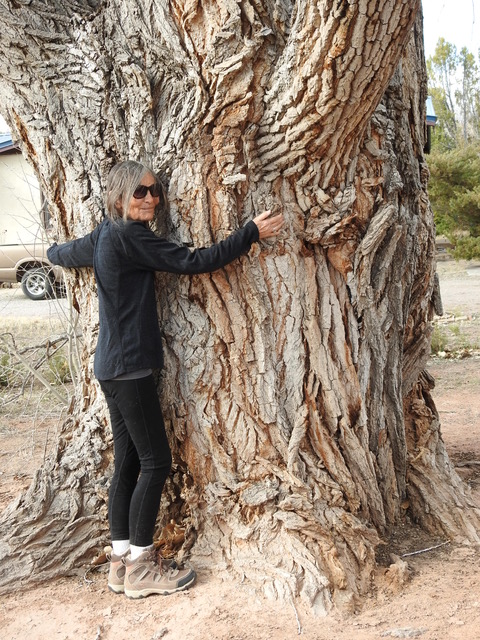
A few days ago I had to take down a pine tree that I loved. Although I did not do the actual cutting I did make the decision to end the tree’s life, so I am the one responsible. My young friend made the cut, felling the tree in just the right direction; his father who was assisting felt a fierce wind hit his face as the tree slammed into the ground just beside him. Indoors, I shuddered involuntarily even as relief flowed through me like a river. It was over.
This tree cutting was witnessed by “tree people” – three humans who truly love trees. Afterwards, Marcus came to me. “Are you all right?” I choked back an avalanche of tears. Not (at that moment) for the tree, but for me because, like the tree, I too had just been witnessed by this boy’s sensitivity – For the first time in my 75 years I was not alone with my tree grief. No other words passed between us but the depth of our feelings united us with each other and that tree. Not a shred of separation. Amazing, and yet so comprehensible.
I felt sorrow over the loss of the tree; but also, strangely, accepting. The next morning I wrote the following:
Treefall
Last night I poured water at the base of the tree as a blessing, gathered herbs to place against her trunk. I lay my hands on rough bark as I spoke … reminiscing about the bear fur I first found scattered around her pine-rooted floor. I told the tree how much I loved the sound of her needles rustling, the intoxicating scent of those that fell to the ground, the “candles” s/he bore in late spring, the masses of pine cones that appeared shortly thereafter. How kindly s/he blocked the heat of the summer sun from the house; how much I loved her. I told her too that I hoped that she would not feel too much pain. I listened then for a response and sensed a stillness; this tree knew what was coming and accepted her dying. There was no answer forthcoming regarding pain… (I called this marked tree a female but all white pines are monoecious meaning that each tree produces male and female cones).
That was as far as I got.
An email came in from Marcus a few minutes later that addressed my question: did he feel that trees experienced pain?
What follows is his response.
“In my experience, I have found that trees certainly do feel pain. The difficulty is in understanding it because the pain the trees feel is only knowable at a visceral level in our bodies. The pain in my body is the tree‘s pain. The tough part is that because that pain is in my body, it gets mixed up with my own feelings of loss, which makes it immensely challenging to sort through. However, a few weeks ago when I had to cut down an apple tree that was being destroyed by tent caterpillars the separation of this pain was discernible. Once the tree was gone there was an immense release of pain in my body. But even so I still carried the sadness of the tree’s loss…I spent so much time getting to know that apple tree that I could feel it drowning in its own sap because it could no longer photosynthesize. Yesterday was different. I could feel the tree and the split but couldn’t communicate with it as well…I was so nervous and stuck in my own place (we all were nervous because the tree was 167 feet tall). But what I know for certain is that trees accept death much easier than we do… the dying hurts physically but the trees are never scared of death or regretful at what is being left behind. They are much more in touch with the fluidity of their spirituality and with the cyclic nature of life. They understand that death is not an endpoint… Dead trees that have stumps continue to live as they transfer what I think of as their essence, meaning soul, spirit, consciousness to whatever comes next. It is only when the underground network for transference is ripped away that a tree really dies.”
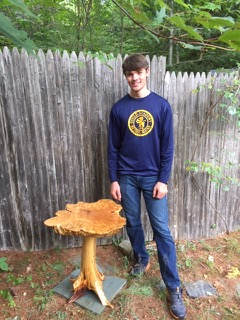
I should add that Marcus is a nature mystic, though he doesn’t yet know it. A scholarship to Dartmouth left him feeling as if he didn’t belong and after a year he dropped out. Now he cares for his family’s forest, cuts trees when needed, creates magnificent art from dead trees and trains for the Olympics. He is 21 years old.
It stuns me that someone who is 50 years younger than I am could be such a powerful teacher, friend, and the first person I have ever known that feels the way I do about trees and can communicate these ideas/feelings on such an embodied level. I adore him.
The following day I learned firsthand about the terrible fires that are ravaging Colorado after talking with a woman who cannot even leave her own house (I have deliberately been avoiding the news).
That night I had a catastrophic dream rife with cultural holocaust elements.
When I awakened that morning I was so sluggish I could barely move. I dragged myself outside and stood quietly by the tree soaking in her dying scent. Pinenes. Tears were seeping into the heartwood from the still living cambium. I thought of the billions of burning, slaughtered trees. I felt helpless and quite stupid. Profoundly depressed, I knew enough to stay with the grief as I moved through the day; the trees had taught me well. My body felt like lead. I fell asleep in the early afternoon.
The next morning I awakened refreshed; the collective grief had receded because I felt it and didn’t try to hurry it or twist my experience into some bizarre form blurring its painful edges with new age ‘gratitude,’ for example. I paved my own way to peace and illumination on a personal level by being with others who truly loved trees and allowed themselves to feel their grief as I did – with them and also alone.
It also interests me that as a ‘tree woman’ that I was still called to feel catastrophic tree grief on a collective level just after my personal loss. By avoiding the news (because of Trump) I was also lacking in awareness and knowledge. Our Earth is on Fire, trees are dying by the billions, and these beings need to be witnessed, especially by those who are capable of standing it (so many are not and I think this is part of the problem). Blind acceptance of the death of billions of trees seems out of place in this context. Resignation is not an endpoint. The trees will guide me into whatever comes next. Of this, I am certain.
Sara is a naturalist, ethologist ( a person who studies animals in their natural habitats) (former) Jungian Pattern Analyst, and a writer. She publishes her work regularly in a number of different venues and is presently living in Maine.

When I begin my class discussion about defining nature, I often start with a wooden chair or table. I point to it and ask the students, “Is this chair natural?” I pause.
They have already been introduced to the idea that humans are embodied and embedded beings, and therefore dependent on and interconnected to nature. I remind them of those ideas. Then, I ask again, “Is this chair natural?” I continue, “Humans are part of nature and humans made the chair, so would that mean the chair is natural? The chair is made from wood, a natural material. Does that make it natural? I could just as easily sit on a rock or a stump if those were here. They are natural, right?” The discussion begins.
At some point in the discussion, we pause to define what nature is according to the ecofeminists we read for class that day. Mary Mellor, in Feminism and Ecology: An Introduction, defines nature as “the non-human natural world,” (8). It is probably the simplest definition out there. I quite like its simplicity.
Continue reading “What is Natural? The Wooden Chair Discussion by Ivy Helman”
 I am a fairly private person; but I do like nice hugs. I grew up in a home that involved so much intentional love and affection that I came to see it as a normal part of any loving relationship. I’m pretty sure I startle my friends sometimes by saying such affectionate things; but they endure, and many of them claim to appreciate a nice hug, too.
I know there are plenty of people who have experienced unhealthy or abusive touch; in fact, I’m one of them. I also know that the way to heal those wounds is usually through healthy touch, in relationships of trust.
Continue reading “Sacrificial Gathering in the Long Covid Desert by Tallessyn Zawn Grenfell-Lee” Feminism and Religion