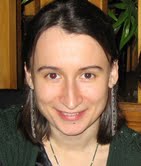
In the medieval European philosophy, woman’s body was seen as a vessel filled with sins, while man was regarded as a more spiritual being. This is one of the reasons why the concept of body is reassessed in feminist studies and why body is elevated in neo-paganism and Goddess spirituality. My fear is that nowadays body can be treated as an instrument for social advancement.
OLYMPUS DIGITAL CAMERA
We still live in a society that is deeply hostile to women’s bodies. Alla Demidova, an actress I respect for her talent and her critical mind, did a programme of Christmas-related poetry. I could not listen to more than five minutes of it.
The poems have been all written by men. I am not saying that men do not have the right to write about birth. I am saying that our prevalent image of Christmas should not be based on male view alone. In this sense I much better like the Carol from “The Vicar of Dibley” (one of my favourite British comedy series, about a female Vicar), which describes the movement of baby Jesus through Mary’s birth canal.
Many years ago, in the group of women I work with, we all had a marvelous epiphany. It was spontaneous combustion that fueled our collective desire to learn about the “Nine Maidens.” It was as though some unknown force was driving all of us to seek out and to know.
I would like to share what we collected:
“… My poetry, from the cauldron it was uttered. From the breath of nine maidens it was kindled….”
“… ygkynneir or peir pan leferit. O anadylnawmorwyngochyneuit.”
(Preiddeu Annwn or The Spoils of Annwyn from ‘Llyfr Taliesin’ 9th to 12th c. CE.)
Anadyl = breath
Naw= nine
Morwen= maiden
These lines are from the poem, the Spoils of Annwyn, where Arthur and seven knights raid the rotating island fortress of Caer Sidi in the Otherworld for possession of the Cauldron of the Head. Continue reading “The Nine Maidens by Deanne Quarrie”
Arduinna, Gaulish Goddess of Forests and Hunting is one of the many Celtic Goddesses who is associated with a particular region or body of water. She was worshipped in the heavily forested regions of the Ardennes, located in what is current day Belgium and Luxembourg with small portions found in France and Germany. She was also associated with the Forest of Arden in England. Her name has its roots in the Gaulish word “arduo” meaning “height”.
Candlemas / Imbolc, the midway point between the winter solstice and spring equinox brings with it (in the northern hemisphere) the first signs of awakening spring. Here in Canterbury, southeast England, where I am living this year, the birds are already starting to sing for mates and build their nests. In Celtic pre-Christian religion, Imbolc is associated with the Goddess Brigid / Bride (and the Christian Saint Brigid), but today I suggest we pay a visit to Brigid’s Slavic sister, the Goddess Mokosh / Mokoš, who is also powerfully associated with emerging fertility in the woman, the land and the year.
As well as fertility, Mokosh and Brigid bless and protect women’s crafts and women’s work, and share attributes of healing, motherhood and midwifery. They are both Goddesses of Fate and of destiny: spinning the thread of creation, giving life and cutting the thread, like the Three Fates of Greek tradition. Both have a special connection with sheep, wool, and weaving, and of course with textiles: Brighde is honoured through the tying of cloths or ‘clooties’ at sacred wells, while a favourite offering to Mokosh was a hank of spun wool dropped into a well. In the Slavic lands, Mokosh is a key figure on embroidered ritual cloths.
Mokosh, like Brigid, is associated with wells, springs and moisture; the name Mokosh comes from the root ‘mol’ meaning ‘moisture’, and is connected with the Slavic words mokry and moknut (‘wet’ and ‘to get wet’) . Mokosh brings the water of life and protects the life-giving waters on which human and animal existence depend. In this way Mokosh gives life to plants and animals, and is often portrayed with them. She is an important Slavic Mother Goddess, embodying fertility, femininity, prosperity, protection, health, good luck, abundance, and a successful future.
Mokosh is also a warrior goddess, in her fierce aspect as a goddess of protection. One of her epithets is ‘She who strikes with her wings’. The fact that she is a winged Goddess indicates her power and that which she grants to her priestesses and devotees, to travel between the worlds in trance, dream, and vision, for blessing and for healing on behalf of the community and all who are in need. Mokosh is also connected to butterflies, symbols of transformation, and bees, symbols of priestesses in antiquity. The beautiful Slavic embroideries shown here depict some of her typical manifestations as a tree/flower/goddess figure with branches/arms/wings/wheat ears, sometimes all at once.
Slavic Goddess Embroidery
Mokosh is a Slavic sister in the same lineage of water-loving fertility deities who were so important in ancient Greece, the Nymphs and Muses. Mokosh features centrally on women’s aprons, directly over the life-giving place of the womb, on sacred cloths for the icon corner in the home, or on cloth and clothing tied to birch or willow trees in Russia and the Ukraine. All over Europe, these elements of the Goddess and the divine fertile feminine can be found, disguised but discernible, in embroideries, dances, songs, fairy tales, ritual breads and other seasonal customs.
In the Christian era Mokosh continued to be worshipped in the form of the Virgin Mary, and more specifically was transformed into St. Petka / Paraskeva / Paraskevi, ‘Saint Friday’, which links her with the Norse Goddess Freya. Friday is the holy day of both Brigid and Mokosh.
Late winter/early spring, the time of Imbolc, is one of her sacred seasons. Whether you call her Brigid or Mokosh, or by another name or none, now is an opportune time to ask her help and invoke her presence. By lighting a sacred flame, tying a cloth to a tree in a fertile place, honouring the waters of Earth which give life to all, spinning and weaving threads of creation and creativity – literally or metaphorically – we too can connect once again with the source of all, and open ourselves to receiving Her blessings.
We may not be able to see what this year will bring, but we do know that the waters of the earth, the birds, bees and animals, the food sources which nourish all life, and the women of the human family, all need blessing and protection. Brigid and Mokosh can help with this. Reconnecting with these and other Goddesses also helps reawaken the Old European worldview as articulated by Marija Gimbutas, Carol P. Christ, and others: cooperation and community, respect for nature and shared resources, an understanding of our mutual interdependence, the value of craft and creative expression, and the need for social justice to protect what is precious.
As the spring returns, may we all both receive and give abundant blessings of new life and rebirth on every level.
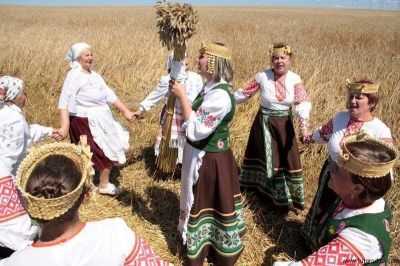
Russian women in ceremony
*****
I will be teaching dances from Greece and Eastern Europe which honour Mokosh and the nymphs and muses at my workshops this year in Greece, Austria, Germany, Morocco and the UK. For details of these dance events, please visit www.laurashannon.net
I thank Sylwia Geelhaar, who researched Mokosh for us in my most recent 2-year training group in Women’s Ritual Dances in Lebensgarten, Germany, and gathered together many of the images shared here.
Further reading: Barber, Elizabeth Wayland (2013). The dancing goddesses. W. W. Norton & Co.
Gimbutas, Marija (1989). The language of the goddess. San Francisco: Harper & Row.
Kelly, Mary B. (1989). Goddess embroideries of Eastern Europe. McLean, New York: StudioBooks.
Rigoglioso, Marguerite (2010). Virgin mother goddesses of antiquity. New York: Palgrave Macmillan.
Shannon, Laura (2011). ‘Women’s Ritual Dances: an Ancient Source of Healing in Our Time.’ In: J. Leseho and S. McMaster, eds., Dancing on the Earth: Women’s Stories of Healing Through Dance. Forres: Findhorn Press.
*****
Laura Shannon has been researching and teaching traditional women’s ritual dances since 1987. She is considered one of the ‘grandmothers’ of the worldwide Sacred / Circle Dance movement and gives workshops regularly in over twenty countries worldwide. Laura holds an honours degree in Intercultural Studies (1986) and a diploma in Dance Movement Therapy (1990). She has also dedicated much time to primary research in Balkan and Greek villages, learning songs, dances, rituals and textile patterns which have been passed down for many generations, and which embody an age-old worldview of sustainability, community, and reverence for the earth. Laura’s essay ‘Women’s Ritual Dances: An Ancient Source of Healing in Our Times’, was published in Dancing on the Earth. Laura lives partly in Greece and partly in the Findhorn ecological community in Scotland.
The Year 2015 is coming to a close. It is a time of endings and a time of beginnings. That is the wonderful thing about our cycles. We all have the opportunity to end and begin – over and over. Each day, each month and each year. We all scurry about making resolutions for the new year only to see them fail almost immediately.
This is where a good basic magical practice can lend a hand with our resolutions. In every magical act we must first know what it is we wish to manifest. I am not talking some empty wish here but a real look at what we want – really want – for the new year to bring.
I have recently been looking at the Goddess Ananke. Ananke and Her consort Khronos, were primal energies emerging from chaos, producing the world egg and then wrapping themselves around it causing it to burst. Out of that egg came the world and all that it contains. Just imagine, the world being formed by two energies – those of Inevitability or Necessity and by Time. How simple and yet how complex.
The story of Ananke and Khronos is large. Those ancients who held onto this story were not speaking of small things. This is the creation of a Universe. And yet, in the theory of “as above – so below”, we can look and see Ananke and Khronos at work in our lives all the time.
Time and Inevitability – perhaps everything can be broken down into these two principles. With Time and Inevitability, we are born, we age and we die. A life is led, perhaps filled with love, perhaps many things. As children we play and learn and eventually become adults. We marry. We have children. Some step into careers and choose not to procreate, rather putting their energies into work and other kinds of relationships, still creating, just not procreating. Also, it is possible that some of those lives will follow a darker path into poverty, criminality, envy and greed. It is hard to know at birth, the path that will be followed by a child. And yet there is a certain amount of inevitability that when a child is born into a life containing a dark poverty of spirit, that the child may not thrive in healthy wholesome ways in adulthood. Continue reading “Ananke’s Promise by Deanne Quarrie”
Dahut Ahes, Breton goddess of Love and Sensuality is a Celtic Goddess whose origins are obscured by patriarchal tales which cast Her as wanton and depraved. By weaving together the tales as they are today with an understanding of the life-affirming nature of the old pagan ways Dahut emerges as more than a glittering goddess of beauty; She is revealed as an ancient goddess in a long line of goddesses who holds the rebirth of the old ways in Her loving arms.
As war and the fruits of war, including hatred and the desire for vengeance, threaten our human community, I take this opportunity republish a vision of a Society of Peace. If we cannot imagine a Society of Peace, we will never be able to create one. Can you imagine that:
As a child, you would not have to fight with your sisters or brothers for your father’s or your mother’s attention. You would not have one mother but many as you would be raised in a large extended family. Both girls and boys would be equally loved and cherished by their mothers and grandmothers and by their uncles and great-uncles. Both girls and boys would know that they would always have a place in the maternal clan. As a boy or a girl you would never have to “separate from” or “reject” your mother in order to “prove yourself as an individual” or in order to “grow up.” You could grow up without severing the bond with the ones who first loved you and first cared for you.
You would be raised in a large family with sisters and brothers and cousins, all of whom you would consider your siblings. You would never feel lonely. You would not be taught to compete with your siblings. You would never be hit by or hit others, because violent behaviors would not be considered appropriate in families.Continue reading “Can You Imagine a Society of Peace? by Carol P. Christ”
In the Roman Catholic calendar, today is All Saints Day, tomorrow, All Souls Day. The following slightly edited paragraphs are from my book Pagan Every Day (RedWheel/Weiser, 2006), which is obviously not just about Pagan topics. (I couldn’t find goddesses for every day of the year, so I widened my view.)
November 1: All Saints Day
During the persecutions of Diocletian (245–313), the number of martyrs became so great that separate days could not be assigned to honor them. They were given common memorial days. All Saints’ Day, the Catholic Encyclopedia informs us, was instituted in the fourth century when dioceses began to divide up and exchange the relics of martyr-saints. At first, only martyrs and St. John the Baptist were recognized, but in 609 Pope Boniface IV consecrated the Pantheon to the Blessed Virgin and all martyr-saints. The vigil for All Saints’ is Hallows Eve, which was also first celebrated in the fourth century. By the 13th century, All Saints’ Day was solemnly celebrated to honor “all saints known and unknown” and to remedy any deficiencies by the faithful in remembering the saints on their proper days. In other words, it became a sacerdotal catch-up day. If a saint was neglected on his assigned day, he could be honored today.


 In the medieval European philosophy, woman’s body was seen as a vessel filled with sins, while man was regarded as a more spiritual being. This is one of the reasons why the concept of body is reassessed in feminist studies and why body is elevated in neo-paganism and Goddess spirituality. My fear is that nowadays body can be treated as an instrument for social advancement.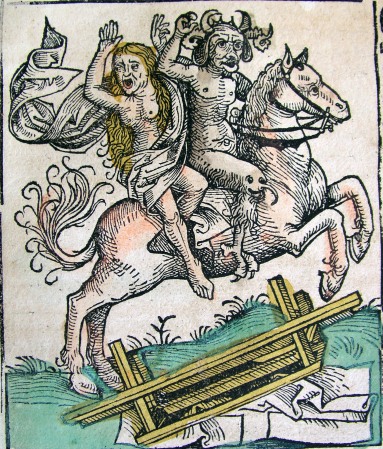
 Arduinna, Gaulish Goddess of Forests and Hunting is one of the many Celtic Goddesses who is associated with a particular region or body of water. She was worshipped in the heavily forested regions of the Ardennes, located in what is current day Belgium and Luxembourg with small portions found in France and Germany. She was also associated with the Forest of Arden in England. Her name has its roots in the Gaulish word “arduo” meaning “height”.
 Candlemas / Imbolc, the midway point between the winter solstice and spring equinox brings with it (in the northern hemisphere) the first signs of awakening spring. Here in Canterbury, southeast England, where I am living this year, the birds are already starting to sing for mates and build their nests. In Celtic pre-Christian religion, Imbolc is associated with the Goddess Brigid / Bride (and the Christian Saint Brigid), but today I suggest we pay a visit to Brigid’s Slavic sister, the Goddess Mokosh / Mokoš, who is also powerfully associated with emerging fertility in the woman, the land and the year.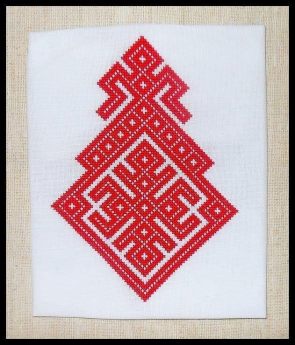
 The Year 2015 is coming to a close. It is a time of endings and a time of beginnings. That is the wonderful thing about our cycles. We all have the opportunity to end and begin – over and over. Each day, each month and each year. We all scurry about making resolutions for the new year only to see them fail almost immediately.
 As war and the fruits of war, including hatred and the desire for vengeance, threaten our human community, I take this opportunity
 Feminism and Religion