Ananke’s Promise by Deanne Quarrie

Deanne Quarrie, D.Min.I have recently been looking at the Goddess Ananke. Ananke and Her consort Khronos, were primal energies emerging from chaos, producing the world egg and then wrapping themselves around it causing it to burst. Out of that egg came the world and all that it contains. Just imagine, the world being formed by two energies – those of Inevitability or Necessity and by Time. How simple and yet how complex.

The story of Ananke and Khronos is large. Those ancients who held onto this story were not speaking of small things. This is the creation of a Universe. And yet, in the theory of “as above – so below”, we can look and see Ananke and Khronos at work in our lives all the time.

Time and Inevitability – perhaps everything can be broken down into these two principles. With Time and Inevitability, we are born, we age and we die. A life is led, perhaps filled with love, perhaps many things. As children we play and learn and eventually become adults. We marry. We have children. Some step into careers and choose not to procreate, rather putting their energies into work and other kinds of relationships, still creating, just not procreating. Also, it is possible that some of those lives will follow a darker path into poverty, criminality, envy and greed. It is hard to know at birth, the path that will be followed by a child. And yet there is a certain amount of inevitability that when a child is born into a life containing a dark poverty of spirit, that the child may not thrive in healthy wholesome ways in adulthood. Continue reading “Ananke’s Promise by Deanne Quarrie”

Dahut, the Once and Future Goddess by Judith Shaw

judith Shaw photoDahut Ahes, Breton goddess of Love and Sensuality is a Celtic Goddess whose origins are obscured by patriarchal tales which cast Her as wanton and depraved.  By weaving together the tales as they are today with an understanding of the life-affirming nature of the old pagan ways Dahut emerges as more than a glittering goddess of beauty; She is revealed as an ancient goddess in a long line of goddesses who holds the rebirth of the old ways in Her loving arms.

Continue reading “Dahut, the Once and Future Goddess by Judith Shaw”

Can You Imagine a Society of Peace? by Carol P. Christ

Carol Molivos by Andrea Sarris 2As war and the fruits of war, including hatred and the desire for vengeance, threaten our human community, I take this opportunity republish a vision of a Society of Peace. If we cannot imagine a Society of Peace, we will never be able to create one. Can you imagine that:

As a child, you would not have to fight with your sisters or brothers for your father’s or your mother’s attention. You would not have one mother but many as you would be raised in a large extended family. Both girls and boys would be equally loved and cherished by their mothers and grandmothers and by their uncles and great-uncles. Both girls and boys would know that they would always have a place in the maternal clan. As a boy or a girl you would never have to “separate from” or “reject” your mother in order to “prove yourself as an individual” or in order to “grow up.” You could grow up without severing the bond with the ones who first loved you and first cared for you.

You would be raised in a large family with sisters and brothers and cousins, all of whom you would consider your siblings. You would never feel lonely. You would not be taught to compete with your siblings. You would never be hit by or hit others, because violent behaviors would not be considered appropriate in families. Continue reading “Can You Imagine a Society of Peace? by Carol P. Christ”

All Saints Day and All Souls Day by Barbara Ardinger

In the Roman Catholic calendar, today is All Saints Day, tomorrow, All Souls Day. The following slightly edited paragraphs are from my book Pagan Every Day (RedWheel/Weiser, 2006), which is obviously not just about Pagan topics. (I couldn’t find goddesses for every day of the year, so I widened my view.)

November 1: All Saints Day

All Saints Day

During the persecutions of Diocletian (245–313), the number of martyrs became so great that separate days could not be assigned to honor them. They were given common memorial days. All Saints’ Day, the Catholic Encyclopedia informs us, was instituted in the fourth century when dioceses began to divide up and exchange the relics of martyr-saints. At first, only martyrs and St. John the Baptist were recognized, but in 609 Pope Boniface IV consecrated the Pantheon to the Blessed Virgin and all martyr-saints. The vigil for All Saints’ is Hallows Eve, which was also first celebrated in the fourth century. By the 13th century, All Saints’ Day was solemnly celebrated to honor “all saints known and unknown” and to remedy any deficiencies by the faithful in remembering the saints on their proper days. In other words, it became a sacerdotal catch-up day. If a saint was neglected on his assigned day, he could be honored today.

Continue reading “All Saints Day and All Souls Day by Barbara Ardinger”

Ghosts by Lauren Raine

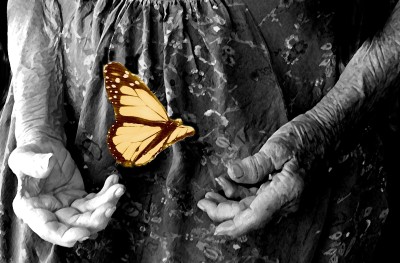
Florence's Hands by Lauren Raine
Florence’s Hands by Lauren Raine


GHOSTS

Where do the dead go?

The dead that are not corpses, cosmetically renewed

and boxed, their faces familiar and serene.

Or brought to an essence, pale ashes in elegant canisters.


I ask for the other dead

those ghosts that wander unshriven among our sleep,

haunting the borderlands of our lives.


Continue reading “Ghosts by Lauren Raine”

Chlíodhna , Celtic Goddess of Beauty, the Sea and the Afterlife by Judith Shaw

judith Shaw photoHaving spent the past year and a half immersed in the study of Celtic Goddesses, I am intrigued by the sharing of many of their attributes, symbols, and associations – shape-shifting, magical birds, and apple orchards in the Otherworld to name just a few. One other common thread found in so many Celtic Goddesses is the existence of many contradictory folk tales about them.  Their stories, like the otherworldly mists of the Celtic countryside, which materialize suddenly, obscure reality and then melt away again, exist on the frontier of myth and reality.

Chlíodhna (pronounced Kleena), Celtic Goddess of Beauty, the Sea and the Afterlife, is such a Goddess.

Continue reading “Chlíodhna , Celtic Goddess of Beauty, the Sea and the Afterlife by Judith Shaw”

Why Is Pizza Round? The Black Goddess of Rome by Stuart Dean

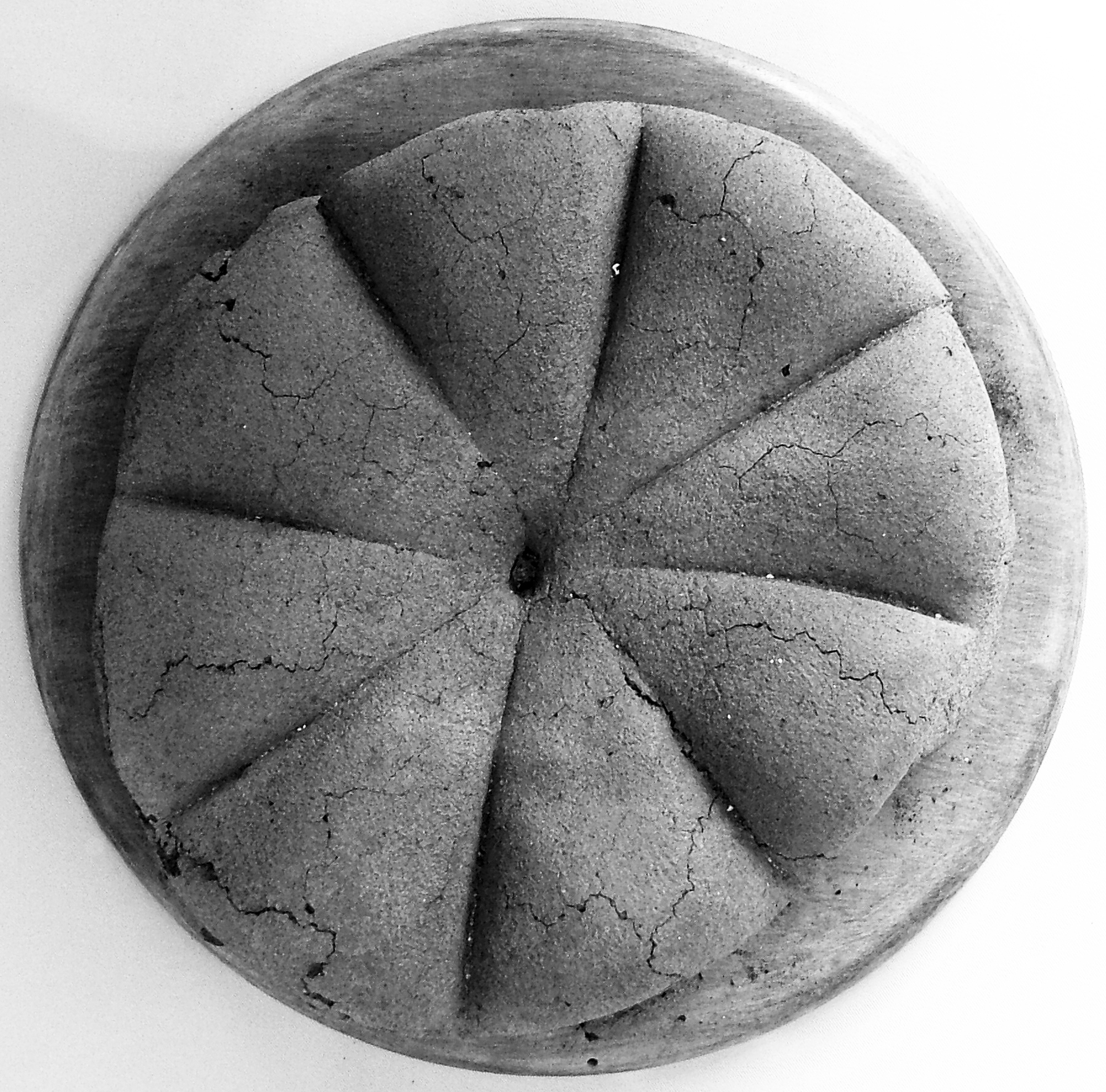
The remains of an ancient Roman bread pie from Pompeii, carbonized in the eruption of Vesuvius in 79 CE
The remains of an ancient Roman bread pie from Pompeii,
carbonized in the eruption of Vesuvius in 79 CE

The poem Moretum (discussed in my last post) narrates the preparation of a meal that can be characterized in modern English as ‘pizza.’  Round flatbread is baked; to go on it, a cheese spread is mixed.  The details of the narration are such as to create a recipe of its ingredients and related cooking instructions.  

The most important ingredient, however, is not an ‘ingredient’ as such, but a shape.  The bread, the cheese, and the cheese spread are all round.  That by itself might not seem remarkable, but the Latin terminology (words from which ‘orbit’ and ‘globe’ derive) is identical to then contemporary astrological terminology.  The bread is even scored into quadrants, symbolizing, among other things, the four elements and the quadrants of an astrological observer’s circle. 

The ancient audience of Moretum would have recognized in all this the world view of the Italian poet from southern Campania, Parmenides.  Though the only poem he is known to have composed is in Greek, the combination of the fact that he likely wrote it while in Italy and that it had over the centuries since its composition become one of the most influential philosophical works of pre-Christian antiquity meant Parmenides had special importance to Romans.  It is not surprising Moretum has the same meter and many of the poetic images as are found in the poem of Parmenides. Continue reading “Why Is Pizza Round? The Black Goddess of Rome by Stuart Dean”

The Great Dragon, Níðhöggr by Deanne Quarrie

Deanne Quarrie, D.Min.I am a student of the Northern European/Old Icelandic worldview known as Seidr. What I find particularly fascinating in my studies are not the deities but rather the creatures living on the World Tree, along with the Primordial Giants who predated the gods. One such creature is Níðhöggr, the “Derision Striker.” Níðhöggr is a great dragon who lives at the base of Yggdrasil, the World Tree. She gnaws on the roots of the tree, stimulating new growth. Her home stretches from icy Niflheim, near what is called the “Roaring Kettle”, the sacred well of all the rivers of Niflheim, all the way to Dead Man’s Shore in Helheim where she devours the piled corpses.
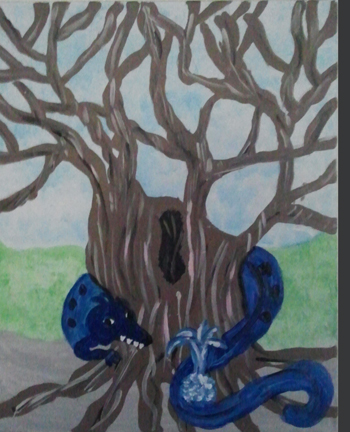
NíðhöggrNíðhöggr embodies the principle of rot, which is that all things must decay to make room for those things that are new. It is Níðhöggr’s job to clean up the mess! She is involved in acts of undoing. She reminds us of the impermanence of life and that eventually, all that is must become undone. It is important to know this so that we can be prepared for unexpected or difficult changes in our lives.

Níðhöggr is there to devour nasty things in one’s self, both physical and emotional. She is there to take away anything that no longer serves us, as long as we are willing to give it to her. She also is there to help anyone working to clean up the environment, especially from our own pollution.

Many fear Nidhogg because of the job she must do but without this part of the life cycle there would be no cycle at all. We make every effort to hide things that are unpleasant. We flush our human waste into our water supply instead of simply giving back to the Earth where we can restore it and use it as nourishment for new life. Menstrual blood is hidden away as if somehow shameful. We hide all that is ugly or that which makes us uncomfortable. And so it is too, with creatures and characters in mythology. Somehow in our dualistic world, the lines between good and bad, negative and positive are clearly drawn. So often those things we suppress, hide and call negative are actually, what save our lives. They are the things in our basic natural spirit that propel us forward into becoming better human beings.

Níðhöggr also serves us as a moral agent, reminding us that our own cruelty, especially harmful acts that undermine another’s sense of self. Bullying behavior is a good example. She reminds us that our actions always have consequences to the energy of the whole, not just our own lives.

Her work is much like that of the vulture, a bird so ugly it is beautiful. I have always thought of vultures as the great recyclers, returning what is lifeless and no longer useful back to the Earth to make ready for new growth.

She is truly all about roots, and keeping them clean. As that, she reminds us that real strength is found in one’s roots.

In her story, at the end of days, Níðhöggr chews through a root and upends the World Tree. Clearly if this were the root upon which all else depended, the mighty tree would fall. Perhaps this would represent our own failure to clean up after ourselves, both in our own lives as well as here in this place we call home, the Earth.

Deanne Quarrie. D. Min. is a Priestess of the Goddess. She is the author of five books. She is the founder of the Apple Branch where she teaches courses in Feminist Dianic Witchcraft, Northern European Witchcraft and Druidic Shamanism. She mentors those who wish to serve others in their communities. She is also an Adjunct Professor at Ocean Seminary College and is the founder of Global Goddess, a worldwide organization open to all women who honor some form of the divine feminine.

E Pluribus Unum and The Unrecognized Black Goddess of Rome by Stuart Dean

Stuart WordPress photoE pluribus unum (‘EPU’), which first began to be used by the U.S. in the 18th century, comes from a poem entitled Moretum that until well into the 19th century was generally attributed to Vergil.  During those centuries Latin would have been studied from what was the equivalent of today’s elementary school through at least high school.  Because Vergil is to the study of Latin what Shakespeare is to the study of English, Moretum would have been read by anyone lucky enough to receive formal education in those centuries–mostly boys–including the white sons of slave owners.

Those boys, however, would have been motivated not just to read, but to memorize Moretum.  That is because Moretum, through a variety of clues, encourages allegorical interpretations, one of which is that it celebrates the sexual intercourse of a single white farmer and his sole companion, his black female slave.  Such an interpretation requires ignoring the clues that the author thinks of such sex as rape (as anyone other than a male slave owner would); those clues lead me to think the author may have been a woman.

Illustration of Moertum (1558 Edition of Vergil's works)

Illustration of Moretum from a 1558 edition of the works of Vergil available here.

Continue reading “E Pluribus Unum and The Unrecognized Black Goddess of Rome by Stuart Dean”

Rosmerta, the Great Provider – a Celtic Goddess of Abundance by Judith Shaw

judith Shaw photoAs we near August 2, known to the ancient Celts as Lughnasadh or Lammas, examples of abundance are everywhere.  Gardens and farms are in full bloom with some crops ready for harvest and others very near.  Lambs born in spring are now reaching maturity. Days are still long and we are full of energy. It is a perfect time to remember the Celtic Goddess, Rosmerta.

Rosmerta,  a goddess loved by both Celtic and Roman Gauls was known as ”The Great Provider”. She is a goddess of fertility and wealth. She was worshipped in South-western Britain, Gaul, and along the Rhone and the Rhine rivers.

Continue reading “Rosmerta, the Great Provider – a Celtic Goddess of Abundance by Judith Shaw”