Echoes of Mesopotamia by Molly

IMG_0522

Echoes of Mesopotamia
small figures from ancient places
ancient times
and ancient faces
ancient words
and ancient wisdom
still flowing in my veins

Clay in my hands
clay in her hands
running on the rivers of time
spiraling in the mysteries of being
spinning in the eddies and ripples of eternity…

I have a strong emotional connection to ancient Paleolithic and Neolithic goddess sculptures. I do not find that I feel as personally connected to later goddess imagery, but very ancient figures call to something deep and powerful within me. I have a sculpture of the Goddess of Willendorf at a central point on my altar. Sometimes I hold her and wonder and muse about who carved the original. I almost feel a thread that reaches out and continues to connect us to that nearly lost past—all the culture and society and how very much we don’t know about early human history. There is such a solid power to these early figures and to me they speak of the numinous, non-personified, Great Goddess weaving her way throughout time and space. Continue reading “Echoes of Mesopotamia by Molly”

The Great Commandment for Women: Love and Care for Yourself as You Love and Care for Others by Carol P. Christ

carol-christA rabbi known as Jesus of Nazareth taught that you should  “love God with all your heart and your neighbor as yourself.”  Charles Hartshorne, philosopher of relationship and a twentieth century advocate of the “two great commandments,” added that it should be understood that this means that God wants you to love yourself too.

I quote Hartshorne’s midrash on the great teaching often because, sadly, too many women—and some men too–have been taught to love their neighbors at the expense of themselves, to care for others, but not to care as much for themselves.  Continue reading “The Great Commandment for Women: Love and Care for Yourself as You Love and Care for Others by Carol P. Christ”

Brigid, Archetype of Inspiration and Activation by Stephanie Anderson Ladd

Stephanie AL_London_photoBrigid, Goddess of the Fire, greets us on Brigid’s Day, February 1. She is a Celtic sun goddess whose light burns brightly, illuminating the darkness of the land, of a heavy heart, and the dark night of our soul. With her shining light to guide us, we are lifted out of the Underworld darkness where we tend to descend in Winter, to the light of the World above, teeming with life as Spring begins to unfold her wet wings.

Brigid is a beloved goddess throughout the British Isles, particularly Ireland, where she is seen as the Mother of the Land and Her people. As a feminine archetype, she activates our solar, active nature. Much like the sun rising from below the Earth’s horizon, she urges us to come out of hiding and shine our light on the world. This may be done in a quiet manner, such as sitting by the hearthfire and doing needlework, finding inspiration by a walk in nature and writing a poem, moving about the kitchen making soup, getting busy with an art or craft project, or in big ways by taking on new roles as healers, artists, and leaders and calling others to join us. Continue reading “Brigid, Archetype of Inspiration and Activation by Stephanie Anderson Ladd”

Etain, The Shining One – Celtic Sun Goddess/Goddess of Transformation by Judith Shaw

gugg jude72Etain (pronounce Ay-deen), a Celtic Goddess called “Shining One”, was originally a Sun Goddess before becoming a Moon Goddess and one of the White Ladies of the Fae.  Her story, which lasts over one thousand years, reveals Her place as a Goddess of Love, Transformation and Rebirth.  Elements sacred to Etain are the sun, dawn, the sea, rain, water, butterflies, apple blossoms, and swans. She is associated with healing and the transmigration of souls.

Etain shows us that we can overcome even life’s most difficult circumstances. She teaches us that though beauty, wealth and position might fade away we can regain our shining light. She lights our way on the path of transformation, guiding us toward balance, wholeness and rebirth. Continue reading “Etain, The Shining One – Celtic Sun Goddess/Goddess of Transformation by Judith Shaw”

Why I Need the Goddess by Judith Shaw

judith shaw photoI have been drawn to the Goddess for a variety of reasons.  Initially, as a young woman, She spoke to me of my own power, self-worth, self-determination and my/every woman’s inherent beauty. She lent Her hand to my emerging sense of independence from male domination.

Over the years my experience of Goddess deepened.  At times I feel Her as manifest in me and as a symbol of my own power.  At other times She is who I pray to for both personal and community help.

Continue reading “Why I Need the Goddess by Judith Shaw”

Who Are the Pagans? by Barbara Ardinger

Barbara ArdingerIt has occurred to me that it’s possible that some of the bloggers and readers of this site may not know very much about pagans, so here’s a little New Year’s lesson. The first thing to know is that pagans are almost by definition rebels. That means any generalization anyone may make will almost certainly have a thousand exceptions. You may have heard what Will Rogers wrote in 1932: “I am not a member of any organized political party. I am a Democrat.” Well, the same goes for pagans: many of us joke that we don’t belong to an organized religion. “Pagan,” by the way, is the generic term. Witches, Wiccans, and eclectics (among others, see below) are specific terms. Many of us belong to what are called traditions, which are somewhat analogous to the Protestant denominations. Some traditions are said to go back to the Middle Ages (or further back), but this is generally nonsense. Paganism as it is practiced today is a modern religion looking for (and—voilà! finding!) roots in the ancient and classical pantheons or in Old Europe, where archaeology shows us that the Goddess was worshipped thousands of years before Abraham met his god, ca. 2000 BCE (see Marija Gimbutas’ text for more information on this). Continue reading “Who Are the Pagans? by Barbara Ardinger”

The Pagan Wheel of the Year by Deanne Quarrie

Deanne QuarrieBarbara Ardinger (one blogger here – watch for her “twist” on this in January!) and I were discussing that an explanation of the pagan year and our Sabbats might be in order. Sometimes when we are immersed in our own spiritual practice, we forget that those who read what we have written may not have a clear understanding of what forms the basis of the holy days we speak of in our articles. These holidays are called Sabbats. The word sabbat is of obscure etymology but was understood in the Middle Ages to mean a gathering of witches and heretics.  The word comes from the Hebrew Shabbath meaning a day of rest.  Christians use the word Sabbath for Sunday, their traditional day of worship. It is interesting to note this was not a term originally coined by pagans, themselves.  It has been borrowed or adopted for use today.

Pagans see the journey traveled in a year or a lifetime as kind of wheel.  It is based on the earth’s journey around the sun. One rotation equals one year. We call it the Wheel of the Year. Since the origins of most of the traditions practiced by pagans in this country come from the Northern Hemisphere, the turning of the wheel is based on the Earth’s travel around the sun and the impact that is felt in the Northern Hemisphere. It would be exactly the opposite for those in the Southern Hemisphere. Continue reading “The Pagan Wheel of the Year by Deanne Quarrie”

Of Birds, Angels, and Tidings of Great Joy by Carol P. Christ

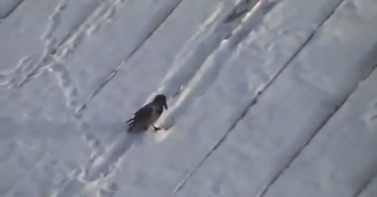
carol p. christ 2002 colorA link to a video of a European Hooded Crow sliding down a snow-covered rooftop on a mayonnaise-lid sled appeared on my Facebook timeline a few days ago. For me this crow expresses the “spirit of the season” as aptly as anything I can think of.  She brings a smile to my face on a grey and cold morning.  She makes me want to climb up on the rooftop and slide down with her.  She reminds me that we humans are not alone–we share the world with a vast multitude of other intelligent creatures.  She tells me that there is nothing more sacred than the joy of life.

crow

The ancient Cretans believed that the capacity to enjoy life was not limited to human beings–they believed that animals  enjoy life as much as we do, and they expressed this sensibility in their art.  They also celebrated birds because their  arrival in spring announces the beginning of the growing season. This early pot in the shape of a bird or duck opening its mouth to–as we kids used to say–“drink the rain” cannot help but evoke a smile. Continue reading “Of Birds, Angels, and Tidings of Great Joy by Carol P. Christ”

Winter Solstice – When Darkness Nurtures Light by Judith Shaw

Judith Shaw photoIn the Northern Hemisphere Winter Solstice, usually December 21,  heralds both the time of deepest darkness and the beginning of the return to light.  It is a liminal day offering a transformation from darkness to light.

In the mid-latitudes in the ten days after the winter solstice the hours of sunlight increase by only a few seconds up to a minute or so.  The world slows down allowing a time to relish the quiet of long nights and the inspiration of winter dreams.

Continue reading “Winter Solstice – When Darkness Nurtures Light by Judith Shaw”

Ancestor Connection Revisited: Anna M. Christ of Little Germany, Brooklyn by Carol P. Christ

carol-christThese days I can’t get my 2x great-grandmother Anna Maria Christ off my mind.  She may be the independent female ancestor I have been looking for all these years.

My father’s father was transferred from New York to San Francisco during the depression. When I moved to New York City, I felt powerfully connected to its diverse immigrant culture, but I never thought of trying to figure out where and when my ancestors lived there.

Recently I found my Scottish and Irish 2x great-grandparents, James Inglis, the seaman, and Annie Corliss, mother of 9, living in the tenements on Cherry Street near the port of New York.  These were my father’s ancestors on his mother’s side.  I felt inspired by a photograph of Annie to take her Irish spirit of triumph over adversity into my soul.

Because it has become fashionable to be interested in things Irish, I began my ancestor research there.  In fact, I am more German (3/8) than I am Irish (3/16).  As I have delved into my German ancestry, I realized that being German became a cause for shame in both the First and Second World Wars.  German language newspapers were banned, Germans were interned, people hated Germans, and many Germans changed their names.

As a child I learned to create mock battles against “krauts,” Continue reading “Ancestor Connection Revisited: Anna M. Christ of Little Germany, Brooklyn by Carol P. Christ”