It has occurred to me that it’s possible that some of the bloggers and readers of this site may not know very much about pagans, so here’s a little New Year’s lesson. The first thing to know is that pagans are almost by definition rebels. That means any generalization anyone may make will almost certainly have a thousand exceptions. You may have heard what Will Rogers wrote in 1932: “I am not a member of any organized political party. I am a Democrat.” Well, the same goes for pagans: many of us joke that we don’t belong to an organized religion. “Pagan,” by the way, is the generic term. Witches, Wiccans, and eclectics (among others, see below) are specific terms. Many of us belong to what are called traditions, which are somewhat analogous to the Protestant denominations. Some traditions are said to go back to the Middle Ages (or further back), but this is generally nonsense. Paganism as it is practiced today is a modern religion looking for (and—voilà! finding!) roots in the ancient and classical pantheons or in Old Europe, where archaeology shows us that the Goddess was worshipped thousands of years before Abraham met his god, ca. 2000 BCE (see Marija Gimbutas’ text for more information on this). Continue reading “Who Are the Pagans? by Barbara Ardinger”
Category: Paganism
The Pagan Wheel of the Year by Deanne Quarrie
Barbara Ardinger (one blogger here – watch for her “twist” on this in January!) and I were discussing that an explanation of the pagan year and our Sabbats might be in order. Sometimes when we are immersed in our own spiritual practice, we forget that those who read what we have written may not have a clear understanding of what forms the basis of the holy days we speak of in our articles. These holidays are called Sabbats. The word sabbat is of obscure etymology but was understood in the Middle Ages to mean a gathering of witches and heretics. The word comes from the Hebrew Shabbath meaning a day of rest. Christians use the word Sabbath for Sunday, their traditional day of worship. It is interesting to note this was not a term originally coined by pagans, themselves. It has been borrowed or adopted for use today.
Pagans see the journey traveled in a year or a lifetime as kind of wheel. It is based on the earth’s journey around the sun. One rotation equals one year. We call it the Wheel of the Year. Since the origins of most of the traditions practiced by pagans in this country come from the Northern Hemisphere, the turning of the wheel is based on the Earth’s travel around the sun and the impact that is felt in the Northern Hemisphere. It would be exactly the opposite for those in the Southern Hemisphere. Continue reading “The Pagan Wheel of the Year by Deanne Quarrie”
Of Birds, Angels, and Tidings of Great Joy by Carol P. Christ
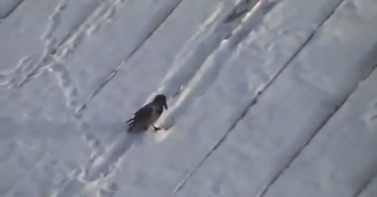
A link to a video of a European Hooded Crow sliding down a snow-covered rooftop on a mayonnaise-lid sled appeared on my Facebook timeline a few days ago. For me this crow expresses the “spirit of the season” as aptly as anything I can think of. She brings a smile to my face on a grey and cold morning. She makes me want to climb up on the rooftop and slide down with her. She reminds me that we humans are not alone–we share the world with a vast multitude of other intelligent creatures. She tells me that there is nothing more sacred than the joy of life.
The ancient Cretans believed that the capacity to enjoy life was not limited to human beings–they believed that animals enjoy life as much as we do, and they expressed this sensibility in their art. They also celebrated birds because their arrival in spring announces the beginning of the growing season. This early pot in the shape of a bird or duck opening its mouth to–as we kids used to say–“drink the rain” cannot help but evoke a smile. Continue reading “Of Birds, Angels, and Tidings of Great Joy by Carol P. Christ”
Winter Solstice – When Darkness Nurtures Light by Judith Shaw
In the Northern Hemisphere Winter Solstice, usually December 21, heralds both the time of deepest darkness and the beginning of the return to light. It is a liminal day offering a transformation from darkness to light.
In the mid-latitudes in the ten days after the winter solstice the hours of sunlight increase by only a few seconds up to a minute or so. The world slows down allowing a time to relish the quiet of long nights and the inspiration of winter dreams.
Continue reading “Winter Solstice – When Darkness Nurtures Light by Judith Shaw”
Ancestor Connection Revisited: Anna M. Christ of Little Germany, Brooklyn by Carol P. Christ
These days I can’t get my 2x great-grandmother Anna Maria Christ off my mind. She may be the independent female ancestor I have been looking for all these years.
My father’s father was transferred from New York to San Francisco during the depression. When I moved to New York City, I felt powerfully connected to its diverse immigrant culture, but I never thought of trying to figure out where and when my ancestors lived there.
Recently I found my Scottish and Irish 2x great-grandparents, James Inglis, the seaman, and Annie Corliss, mother of 9, living in the tenements on Cherry Street near the port of New York. These were my father’s ancestors on his mother’s side. I felt inspired by a photograph of Annie to take her Irish spirit of triumph over adversity into my soul.
Because it has become fashionable to be interested in things Irish, I began my ancestor research there. In fact, I am more German (3/8) than I am Irish (3/16). As I have delved into my German ancestry, I realized that being German became a cause for shame in both the First and Second World Wars. German language newspapers were banned, Germans were interned, people hated Germans, and many Germans changed their names.
As a child I learned to create mock battles against “krauts,” Continue reading “Ancestor Connection Revisited: Anna M. Christ of Little Germany, Brooklyn by Carol P. Christ”
Dreaming the dream on . . . by Kaalii Cargill
I am author, writing fiction and non-fiction. My short stories have been published in various magazines and I have won an international writing prize. When my work was first published, I wanted to write a best-seller and earn enough from my books to retire from my ‘day job’ and write full time. I know the formula: open fast and strong, pick up the reader and carry her along until the last page, action, action, action…
Instead I found myself writing about balance, about land in need of healing and about the people called to defend the balance. My stories are as much about meaning and value as about action, and the same themes cycle though: cooperation vs. domination, defending the Earth, being an integral part of the world around us, cooperation with the rest of Nature. Continue reading “Dreaming the dream on . . . by Kaalii Cargill”
Fand – Goddess of the Sea – a Shapeshifter for Samhain by Judith Shaw
Fand is a Celtic Sea Goddess whom some scholars believe originated as a Manx sea deity (the original inhabitants of the Isle of Man). With time She became the most loved of Ireland’s fairy queens, called “Queen of the Fairies. Fand, meaning “Pearl of Beauty” or “Tear” was stunningly beautiful. Though she was married to the Celtic Irish Sea God, Manannan Mac Lir, She, like other faery queens, fell in love with and then enchanted a mortal man, linking our world with Her Otherworld. Being the Goddess/Faery Queen she was, Fand fell in love not with any common man but with Cuchulainn, the greatest Irish hero.
Continue reading “Fand – Goddess of the Sea – a Shapeshifter for Samhain by Judith Shaw”
Entering Winter, the Season of Darkness by Barbara Ardinger
Halloween used to be spelled “-e’en,” with the apostrophe replacing the V in “eve.” The N was probably added so the word ends in a consonant and we don’t have “hallow-wheee.” But people get lazy, and since the late 20th century, both the V and “eve” have disappeared. This holy day is the true beginning of winter. In pre-Christian Europe, it was celebrated by the wild Celts, who called October 31 Samhain (pronounced approximately SOW-un). Today it’s a major sabbat, or holy day, celebrated by most modern pagans. Although religious fundamentalists keep trying to convince us that Halloween is an evil pagan festival (emphasis on the evilness of pagans) and pressuring retailers not to sell little collectable witches, the name of this day is in fact Christian: it’s Hallowed (or Holy) Evening, or the Eve of Holy Days. In the olden days and still today in, for example, the Jewish calendar, a holy day begins when the moon rises on the evening before. October 31 precedes All Saints Day (November 1) and All Souls Day (November 2). Like Christmas Eve, it’s a holy (but seldom silent) night.
All Saints Day, the Catholic Encyclopedia informs us, was instituted in the fourth century when dioceses began to divide up and exchange the relics of martyr-saints. At first, only martyrs and St. John the Baptist were recognized, but in 609 Pope Boniface IV consecrated the Pantheon in Rome to the Blessed Virgin and all martyr-saints. The theological basis for All Souls Day is the doctrine that “souls that have not been perfectly cleansed from venial sin are debarred from the Beatific Vision.” With prayers, the living can help the dead pass through purgatory. To commemorate “the faithful departed,” the Catholic Encyclopedia further tells us, the priest recites the Office of the Dead and celebrates a Requiem Mass. The vigil for All Saints, or Hallows Eve, was also first celebrated in the fourth century. The Mexican version of this holiday is Día de los Muertos, which is also celebrated on November 1 and 2. That’s when we see the wonderful costumed skeleton figures and the sugar skulls. Like similar festivals in cultures around the globe, this is a celebration of family and ancestors.
Continue reading “Entering Winter, the Season of Darkness by Barbara Ardinger”

Feeding the Dead by Deanne Quarrie
Most people really love this time of year and I share much of that. Living in South Central Texas we actually only have two seasons, with a perhaps two to three weeks in between what we laughingly call spring and fall. Because the winters are not harsh here, the step into spring feels different from those whose winters are frozen for months on end. We do experience some relief when our temperatures finally drop a bit in October. Even then those drops are only teasers. When we do finally get a briskness in the air in the wee, early morning hours of dawn but when the sun rises overhead, any memory of that coolness is forgotten. This morning at 5:30 am, when I woke, it was 54 degrees. I stepped outside to smell and feel the air, so clean and cool. And yet, now it is 85 degrees and rising, it once more feels like summer. We don’t have the sudden frosts that turn our trees to vibrant reds, yellows and browns. Yes, the leaves eventually turn and fall to the ground, but we have no heavy freeze and so our colors are pale compared to those in the North and colder climates.
Many Texans think the emotional feel for our two seasons is backwards, believing that summer, with its blazing sun, is the time to withdraw. Then in winter, when the weather is mostly mild, that’s the time to come out to play. This is a reversal of pagan thinking about the seasons in North America. Continue reading “Feeding the Dead by Deanne Quarrie”
WOMEN ARTISTS AND RITUALISTS IN THE GREAT CAVES: THE BEGINNING OF THE END OF INDOLENT ASSUMPTIONS by Carol P. Christ
In an earlier blog, I suggested that women might have blown red ocher around their hands to leave their marks in prehistoric caves.
At the time I thought this was a rather bold suggestion.
Had I been asked why I thought the images were made by women, I might have said that people have understood caves to be the womb of the Great Mother, the Source of All Life, from time immemorial. I might have added that those who performed rituals in the caves cannot have been performing simple “hunting magic,” but must also have been thanking the Source of Life for making life possible for them and for the great beasts they hunted. Still I am not certain that I imagined women as the artists in the Paleolithic caves.
In recent days the news wires have been carrying a story titled “First Cave Artists May Have Been Women, New Study Suggests.” According to retired anthropological archaeologist Dean Snow, the handprints made by Paleolithic ancestors 40,000-20,000 years ago may have been made primarily by women. Snow spent a decade gathering and analyzing photographs of the handprints left in caves. The scientific fact that women’s first and ring fingers are generally of the same length, while men’s ring fingers are generally longer their index fingers, led him to the conclusion that ¾ of the handprints in the caves were made by women! If women were painting their hands on the caves in larger numbers than men, then isn’t likely that they were also painting the images of the great beasts on the walls of the caves? Continue reading “WOMEN ARTISTS AND RITUALISTS IN THE GREAT CAVES: THE BEGINNING OF THE END OF INDOLENT ASSUMPTIONS by Carol P. Christ”