Being Scared: Fear and Authenticity by Ivy Helman

meblogMy partner is a lawyer who works with asylum seekers and other immigrants here in the Czech Republic (ČR). She’s amazing at her job and I’m constantly in awe of her passion and commitment along with her righteous anger at systematic injustices. In fact just last week, her workplace, together with a consortium of other immigration organizations in the ČR, helped organize a demonstration in the center of Prague to protest the Czech Republic’s refusal to admit Syrian children and their families into the country. She invited me to attend the event with her. I went.

It was my first time attending a public demonstration in Europe. It was moving to see many of her co-workers there and inspiring to listen to the passionate speeches against xenophobia, Islamophobia, racism, the plight of the Roma people as well as the need to come together and welcome diversity. In addition, there were signs in Czech, German and English saying “No One is Illegal,” “End Xenophobia,” “Do Syrian Children Have to Wait for their (Nicholas) Winton?” “I want to have a Syrian Friend!” and “Refugees Welcome!” I wanted to hold each one of those signs! Continue reading “Being Scared: Fear and Authenticity by Ivy Helman”

The Difficult Issue of the Origins of the Buddhist Nuns’ Order by Oxana Poberejnaia

oxanaThe origins of the Buddhist Nuns ‘ Order are a contentious issue in Theravada Buddhism. Paradoxically, it is also the issue that is not discussed a lot. Which is surprising, as in current Buddhism there is a gaping hole where a Theravada Bhikkhuni (Nuns) community should be. The prevailing view is that the nuns’ full ordination line was irrevocably lost long in the past and cannot be restored.

There are separate attempts here and there to bring Theravada Nuns’ Order back, including Ajahn Brahm’s ordaining a group of nuns in Dhammasara Monastery in Australia in 2009. This resulted in severe criticism by some Theravada religious leaders and expulsion of Ajahn Brahm and the monastery he leads from the organisation of the Sangha of Wat Nong Pah Pong.

AniPemaChodronMahayana Nuns receive full ordination, as it is considered that historically the Order did not lose continuity since the Buddha’s times. However, for both Theravada and Mahayana something called “The Eight Garudhammas” – the eight heavy rules – remain a painful issue. These are the rules that the historical Buddha is supposed to have given the first nuns to whom he gave ordination. These eight rules were the condition on which the Buddha would even allow women to become Bhikkhuni.

Continue reading “The Difficult Issue of the Origins of the Buddhist Nuns’ Order by Oxana Poberejnaia”

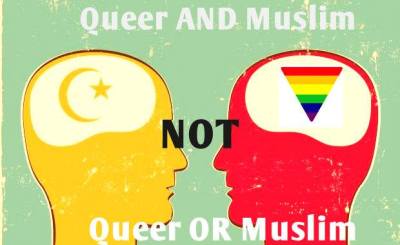
Queer in Islam and a Theology of Dissent by Vanessa Rivera de la Fuente

Vanessa Rivera de la Fuente. Queer and IslamMost of the time, when we talk about being “Queer in Islam,” we identify the term with a hermeneutics developed by or on behalf of LGTBQI Muslims in order to allow their inclusion in religious spaces and recognize their agency in matters of faith.

Is not my intention to appropriate the voice of LGTBQI Muslims in this issue, just to share my reflections about a topic that deserves a larger and deeper treatment. Continue reading “Queer in Islam and a Theology of Dissent by Vanessa Rivera de la Fuente”

Education, Anti-Semitism, a Counter Narrative and a Different World by Ivy Helman

meblogIt’s pretty common knowledge that education changes lives. It opens doors, improves health, promotes gender equality, decreases poverty, promotes civic involvement and has many other benefits. This is true for basic literacy campaigns as well as sex education, access to school for girls and institutions of higher education. Yet, what is taught in addition to how it is taught matters a great deal.

In a few days, I’ll begin a new semester teaching “The Jewish Experience in Central Europe” for Anglo-American University in Prague. As a scholar, a Jew and a feminist who recently moved to Prague (in the heart of Central Europe), this course hits home.   It is also timely given rising anti-Semitism in Europe. Coincidentally, this is also the first time I’m teaching a course solely on Jewish history. Continue reading “Education, Anti-Semitism, a Counter Narrative and a Different World by Ivy Helman”

Mother of All Buddhas by Oxana Poberejnaia

oxanaQueen Maya, the Mother of the Buddha of our age, who before his Enlightenment was known as Siddhartha Gautama, died shortly after his birth. So the future Buddha was raised by his aunt and stepmother. It is said that the womb of the Buddha’s Mother needed to remain unsullied by further pregnancies. This is similar to the belief that Mary Mother of Christ did not bear any more children after Jesus, which is held by some Christian traditions.

280px-Dream_Queen_Maya_BM_OA_1932.7-9.1In addition, the Buddha’s conception and birth were both miraculous, according to the legend and some Mahayana texts (such as the 44th chapter of the Gandavyuha Sutra). The Buddha was conceived when a white elephant entered Queen Maya’s right side, or, in the Sutra, light entered the Queen’s body. The Buddha was born from his Mother’s right side. The light was emanating from every pore of the body of the Bodhisattva Buddha, while he resided in the Tusita (joyous) heaven before descending to earth. This light reminds us of the golden rain form that Zeus took to reach Danaë in her cell to conceive Perseus, and links these two Indo-European patriarchal discourses. Continue reading “Mother of All Buddhas by Oxana Poberejnaia”

What is the Cause of Violence? A Response to Karen Armstong by Carol P. Christ

 “So, when we in the West talk about religion as the cause of this violence, how much are we letting ourselves off the hook, and using religion as a way to ignore our role in the roots of this violence?” Karen Armstrong, author of Fields of Blood
carol p. christ photo michael bakasThis statement was made by scholar of religions Karen Armstrong in an interview in Salon magazine in response to characterizations of Islam as a violent religion by Bill Maher and others. Speaking in the context of the rise of anti-Islamist prejudice in Europe, Armstrong said that Maher’s demonization of “the other” was the kind of talk that could lead us back to the concentration camps.

Bill Maher makes blanket statements against religion in general and Islam in particular. Maher clearly does not have a nuanced view of any religion. He is fueling anti-Islamic sentiment when he singles out Islam as a violent religion. If religions are going to be criticized as violent, then we must not limit ourselves to criticizing Islam, but must begin closer to home, by discussing the relation of religion and violence in the Bible, in Christianity, and in Judaism. My rule of thumb is always to begin with Christianity because it is the hegemonic religion of western cultures. Continue reading “What is the Cause of Violence? A Response to Karen Armstong by Carol P. Christ”

Stories for (Re)creation in the New Year by Natalie Weaver

Natalie Weaver editedTwo New Years’ Eves ago, I came to the realization that I did not need to watch the television countdown to ring in midnight and begin the New Year.  I had always watched the show with my family as a child, and even while it made me feel curiously bad, I still somehow felt like it was an obligatory component of the day, right up there with kisses, well wishes, blowers, horns, and sparkling wine.  Since we seldom went to an actual New Year’s party, it was a way of connecting with the world.  I gave it up, though, when I ultimately deemed the musical guests and hosts to be unviewable.
I was not looking to make a new tradition per se that year when I decided to light a hunk of myrrh in the fireplace.  The myrrh had come to me as a gift in a Three Kings Christmas set.  It made a pretty decent blaze because I had placed it atop a bed of shallow candle wax from an old votive candle.  Let me say, while it smelled lovely and burned a long time, I do not recommend doing this – the fire became alarmingly vigorous for a little while.  Anyway, I spread a cloth on the floor and set out some food, calling my family together to sit in a circle by the hearth.  We dimmed the lights, and by fire I read the Epic of Gilgamesh (with some tasteful PG 13 edits) from 11:00 pm until 1:00 am.  I had been reading great epics to the kids, and it seemed somehow appropriate to return to Babylon that year.  We did not mark the New Year at a precise moment but rather sailed into it on the tides of an ancient tale.  It was a revelation to us all, mostly because we were reclaiming that night from the media usurpers who had defined it for us for most of our lives.

This year, we intended to do something similar until we ended up throwing an impromptu party for some friends and their children.  I knew they would all have limited interest in my second annual fire reading, so we just fed them and eventually counted down the final moments of 2014 on my watch.  But, after they left, we returned to the myth, this time reading the Babylonian Epic of Creation.  We hit the mark, as the story itself was ritually performed at each New Year.  It carried us deep into the first day of 2015 and was also a great revelation. Continue reading “Stories for (Re)creation in the New Year by Natalie Weaver”

Reading “Women” by Laury Silvers

My friends make my life difficult. They make me see what I could not see before. Kecia Ali, Aisha Geissinger, Karen Ruffle and Kathleen Self taught me how to read for gender in the classical texts I use for my academic work. It’s a way of doing close readings by paying attention to the way gender shows up in the text. Aisha sat with me one afternoon and walked me through my own sources pointing out references to gender in the sources. She showed me how the sources I was reading used gender to express social norms. She kept asking me, “What work is gender doing in the text?”

Don’t laugh you been-reading-gender-forever-and-a-day people! Okay laugh. I was a bit slow to pick up this gender thing at first, but I caught up okay. Now I cannot unsee it. I see it everywhere. For instance, I was heading to the stairs at work after a long day and was brain tired. I saw this sign at the stairs:

I nearly kept walking past the stairs thinking for a second that it meant they were for people that society designates as having “male” bodies only. I actually thought that. Then I started laughing at myself. I took a picture and posted it on social media with a story complaining how my friends have absolutely ruined me! Continue reading “Reading “Women” by Laury Silvers”

Writing: Changing the World and Ourselves. By Ivy Helman

I still remember the first tim20140903_180423e I read Mary Daly’s Gyn/Ecology. It awoke something within me. Her use of language, the power of her writing and the ease with which she created new words taught me so much about the world around me and about the way the language, and subsequently its use in writing, shapes lives, choices, abilities and destinies. She also taught me about myself.

I was hooked, but not just on Mary Daly. Shortly after I finished her book, I moved onto other feminists writing about religion like Katie Cannon, Judith Plaskow, Alice Walker, Carol Christ, Rita Gross, Gloria Anzaldua, Audre Lorde, Adrienne Rich, Margaret Farley and Starhawk to name just a few. All of them, in fact every feminist I’ve ever read, has shown me the way in which words have power and how words speak truth to power. Ever since, I’ve wanted to be the kind of writer whose words carry a power that not only affects people but also inspires a more just, more equal, more compassionate and more humane world. In other words, I wanted to be a writer activist.

Yet, I’ve always carried around with me a sneaky suspicion that people don’t consider writers true activists. If you aren’t holding a sign, screaming or participating in some sort of public demonstration or civil disobedience, then you have no right to call yourself an activist. Is that really true? Continue reading “Writing: Changing the World and Ourselves. By Ivy Helman”

The Season of Pilgrimage by amina wadud

amina - featureThis weekend those of us not performing the ritual pilgrimage, or Hajj, will enjoy the Festival of the Sacrifice of Eid al-Adha. Celebrated on the 10th day of the 12th lunar calendar month, it tends to creep up without warning, since we operate on the solar Gregorian calendar. The next day I jump a plane to Southeast Asia so my attention is already diverted.

The sacrifice here refers to Prophet Abraham’s botched contract with God over his first son. Muslims stick with the sheer biology that it was his first son, Ishma’il rather than Sarah’s first biological son, Isaac as recognized in Christianity and Judaism. It’s political, I won’t go there.

Instead I want to focus on this veneration of things masculine across all three Abrahamic faiths with the attention surrounding this particular patriarch. For example, I recall an Eid sermon which dwelt at length on Abraham circumcising himself in full adulthood without anesthesia. All I could think was, WHO should care about that? This particular manhood seems to excel over any reminder of his humanity, or of his devotion to monotheism in a community steeped in Idol worship. Continue reading “The Season of Pilgrimage by amina wadud”