On Noach and its Ecofeminist Potential.

The Torah portion for November 2, 2024 is Noach.  The portion includes the stories of Noah’s ark and the tower of Babel and ends with Abraham and Sarai settling in the land of Canaan.  In my feminist analysis of Noach, I will focus on the ecofeminist potential of divine acknowledgements and how the divine is portrayed.

As ecofeminists at the intersection with religion, one task we have is to interpret those sacred texts which have something to say about nature and animals.  Within Judaism, there are numerous such texts, and parshah Noah is one of them.  Afterall, most of Noach revolves around a great flood in which the deity destroys the earth and most of its inhabitants, animal and human.  

The divine destruction of the material realm is problematic.  The deity blames the divine decision to destroy creation on the rampant corruption of the flesh: human and animal alike (6:13).  In feminist thinking, linking material existence to corruption is unsettling since patriarchy often disavows material existence by linking it to evil.  In addition, in Noach, an aspect of the material world, water, is used in bringing about that destruction.  However, water is also ironically what all flesh depends on for life.    

Continue reading “On Noach and its Ecofeminist Potential.”

Censored Angel: Anthony Comstock’s Nemesis. A Novel by Joan Koster

“I would lay down my life for the cause of sex reform, but I don’t want to be swept away. A useless sacrifice.” Ida C. Craddock, Letter to Edward Bond Foote, June 6, 1898

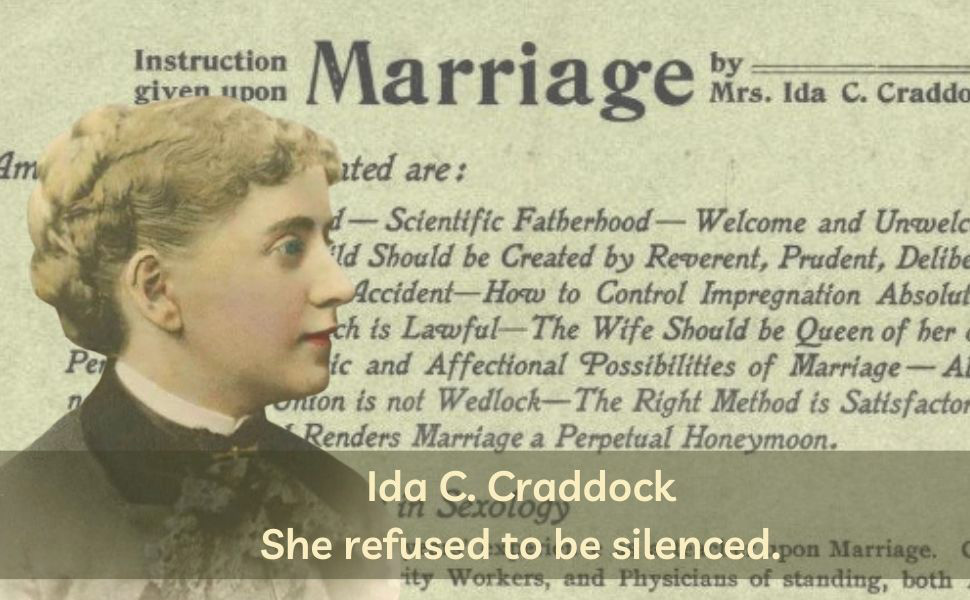
In 1882, Ida C. Craddock applied to the all-male undergraduate school of University of Pennsylvania. With the highest results on the entrance tests, the faculty voted to admit her. But her admission was rejected by the Board of Trustees, who said the university was not suitably prepared for a female. (U of P only became co-ed in 1974)

With her aspirations blocked, Ida left home determined to leave her mark on women’s lives by studying and writing about Female Sex Worship in early cultures. At the time, little information was available to women about sexual relations. To do her research, Ida resorted to having male friends take books forbidden to females, such as the Karma Sutra, out of the library for her.

An unmarried woman, she turned to spirituality and the practice of yoga, a newly introduced practice to the American public at the time, as a way to learn about sex. In her journals, she describes her interaction with angels from the borderlands, and in particular, her sexual experiences with Soph, her angel husband through what was likely tantric sex.

Continue reading “Censored Angel: Anthony Comstock’s Nemesis. A Novel by Joan Koster”

The Purpose of Women by Beth Bartlett

Thomas Aquinas, Wikimedia Commons

12th century theologian Thomas Aquinas didn’t think much of women.  He’d known less than a handful during his lifetime – his mother, who sent him off to a Benedictine monastery when he was five, as was the custom at the time, and later abducted and imprisoned him, with the help of her other sons, seeking to “rescue” him from his choice of becoming a Dominican priest; his two sisters who were sent to him while imprisoned to dissuade him from his choice; and the prostitute his brothers sent into his prison cell to try to tempt him to sin and break his vows – unsuccessfully. So perhaps it is no wonder that Question 92 of his Summa Theologica asks, “Should woman have been made in the original creation?” Though more likely his question was prompted by the milieu of misogyny in which he was raised and lived, having been educated in the theological tradition of Augustine who believed women to be the “lesser” sex and necessarily subject to men, and highly schooled in and known for reviving the thought of Aristotle, who said of women, “a woman is a misbegotten man.”[i]

Continue reading “The Purpose of Women by Beth Bartlett”

Legacy of Carol P. Christ: Neo-Orthodoxy: The Apotheosis* of Power as Power Over

Recently I have been thinking about Neo-Orthodoxy, the leading  Protestant theological movement of the twentieth century, as a deification of male power as power over.  In the language of the schoolyard, this translates as “mine is bigger than yours.”  Or more precisely:  “God’s is bigger than yours.” 

Neo-Orthodoxy dominated Protestant theology in Europe and America in the mid-twentieth century and structured my theological education at Yale in the late 1960s and early 1970s.  Yale may have been “the bastion” of Neo-Orthodoxy, but Neo-Orthodox perspectives reigned in all the Protestant seminaries and were even celebrated in the media.  Neo-Orthodoxy may have some commonalities with fundamentalism but it was by no means an anti-intellectualist approach to theology.

Continue reading “Legacy of Carol P. Christ: Neo-Orthodoxy: The Apotheosis* of Power as Power Over”

On Persephone and the Racetrack: My Experience at Lake Pergusa.

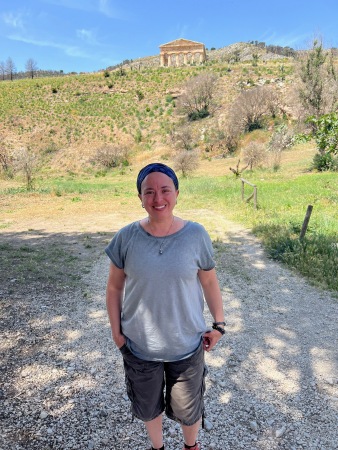
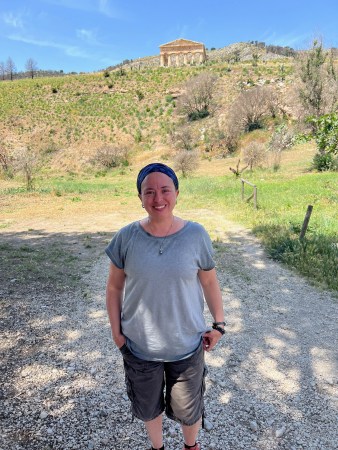
At the Segesta temple.

This May, I visited Sicily to present at the European Academy of Religion’s Annual Meeting. There I saw various historic, religious sites: parts of the city of Siracusa; the Valley of the Temples in Agrigento; mikvot in Palermo; various churches including the Cathedral in Palermo and the Church of St. Cataldo; the Segesta temple; and lake Pergusa where Hades emerges from the land to abduct Persephone. In this blog, I will focus on this lake. As an ecofeminist focusing on religion, this place gave me mixed feelings.

Continue reading “On Persephone and the Racetrack: My Experience at Lake Pergusa.”

To Childless Cat Ladies by Janet Maika’i Rudolph

I feel you. In a patriarchy where women’s reproductive abilities determine our worth, to be childless is a curse. We can thank VP candidate JD Vance for revealing this truth in all its ugly fullness. He is a walking billboard for patriarchy. Bottom line: Patriarchy is all about women’s bodies, our reproductive abilities and men’s desire to control them. We saw this in the Dobbs decision where it was declared that women have no constitutional right to the basics of healthcare, in Texas where it’s pretty much illegal to have a poor pregnancy outcome, and in Ohio where raped children are expected to give birth to their abuser’s child. Its endless 

But it is JD who made it plainer than plain what this is all about. Besides childless cat ladies being an old trope, just think of the judgement involved. Who is JD to decide on anyone’s family constellation? Or their pets? He also made disparaging remarks about the “childless left,” who have no “physical commitment to the future of this country.” That is a statement that only a person who totally lacks empathy can make. He is making a sweeping generalization that people without children don’t care about the future. This statement is more confession than truth. He reveals that until he had children, he had no care about the future of our world. It’s beyond egocentric. If only his kids are the center of his “caring,” that shuts out most of the world’s other children.

Continue reading “To Childless Cat Ladies by Janet Maika’i Rudolph”

The Stories We Tell by Xochitl Alvizo

I often read multiple books at the same time that seemingly have nothing to do with one another. Currently I’m in the middle of these three:

  • How the Word is Passed: A Reckoning with the History of Slavery Across America by Clint Smith;
  • Emergent Strategy: Shaping Change, Changing Worlds by Adrienne Maree Brown; and
  • Determined: A Science of Life Without Free Will by Robert M. Sapolsky.

And I also just completed these two:

  • Jesus and John Wayne: How White Evangelicals Corrupted a Faith and Fractured a Nation by Kistin Kobes Du Mez; and
  • Slow Productivity: The Lost Art of Accomplishment without Burnout by Cal Newport.

And although these books are of different genres and very different topics, the importance of our imagination comes up as a point of connection in four out of the five books. As I’m also in the midst of thinking and writing about church for my current book project, the role of our human imagination across the many parts of our lives, both individual and social, feels timely.

Continue reading “The Stories We Tell by Xochitl Alvizo”

Legacy of Carol P. Christ: RAPE CULTURE IN THE MILITARY AND “TURNING BOYS INTO MEN”

This was originally posted on June 17, 2013

Rape is not something that “just happens” in the military. It is an inevitable product of military training. Unless and until we understand this and change the way soldiers are trained, we will never be able to stop rape in the US military or any other military system.

Propaganda-Poster-Masculinity

The right to rape women of the enemy has been considered one of the “prerogatives” of warriors since the beginning of warfare.  Could “military training” which “turns boys into men” by calling them “girls” or “women” or “gay” in order to break down their self-esteem and remold their “character” as soldiers be one of the reasons rape is such a pervasive problem in the military? Are “boys” being taught that the only way to “prove” their “manhood” is to replace “identification” with women—their mothers, sisters, girlfriends, wives—with a new “identity” as a “dominant male” who “dominates” women and weaker men?  I fear that if we fail to address the “core issue” of “military training,” we will never get to the root of the rape culture that pervades the military.

Continue reading “Legacy of Carol P. Christ: RAPE CULTURE IN THE MILITARY AND “TURNING BOYS INTO MEN””

Naso: An Invitation for Feminist Imagining.

This week’s Torah portion is Naso (Numbers 4:21-7:89).  The portion discusses who, among the Israelites, carries the components of the Miskan (Tenting of Meeting) while wandering through the desert.  It also entails a census of the tribe of Levi, describes various offerings that were brought to the Tent of Meeting in general and for its twelve days of dedication, decrees keeping the ill and ‘contaminated’ out of Israelite settlements, details the Nazirite vow, gives us the priestly blessing, and proscribes the process through which women are acquitted or found guilty of affairs.  There are many components of this parshah that offer food for thought when it comes to a feminist analysis, but for today, I am going to focus on where there is equality between men and women within the text and where there isn’t.  

Continue reading “Naso: An Invitation for Feminist Imagining.”

Processing my experiences of patriarchy has changed my faith for the better by Liz Cooledge Jenkins

As my first book, Nice Churchy Patriarchy, approaches six months of being out there in the world, I find myself reflecting on the journey. The process of unpacking all the ways patriarchy shows up in faith communities—and, in particular, the ways patriarchy has impacted my experience of church—has been a long one, and a winding one. It is no easy path.

How could a person travel this road and have their faith remain unscathed? Or perhaps a better question is this: How could one’s faith remain unchanged? And is this even a desirable goal?

After spending eleven years in “complementarian” (that is, explicitly patriarchal) evangelical church spaces and then two years in evangelical spaces that were egalitarian in theory but still had a long way to go to reach full gender equity—and, especially, after spending four years intentionally reflecting on these experiences and writing about them—I certainly see questions about gender roles and women in leadership differently. But it’s not only that. I see everything differently.

Continue reading “Processing my experiences of patriarchy has changed my faith for the better by Liz Cooledge Jenkins”