Keyvermestn by Janet Madden

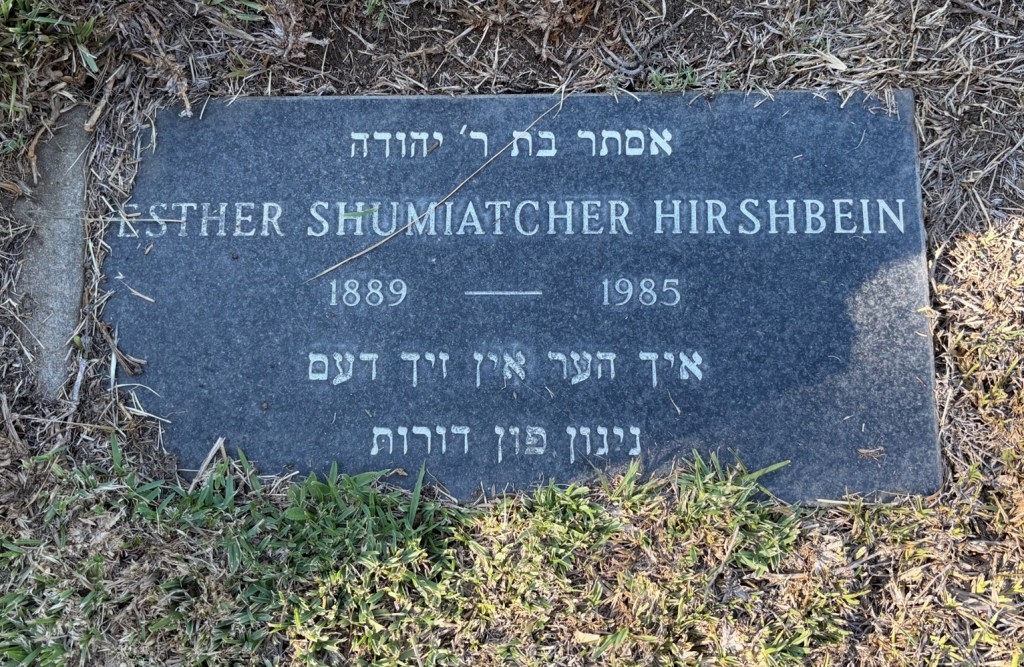
in memory of Esther Shumiatcher-Hirschbein

1.
On a sunny Elul afternoon
I kneel at your grave
a sprig of rue in my pocket.
I recite a tkhine for visiting the graveyard
and imagine that you know this ritual–
stretching string to calculate
the space your body inhabits.
The unspooling wick rests gentle
on rough-cut grass, touching
the edges of mortality,
its twists separating and connecting worlds:
the dead and the living
the past and the now
mine and yours,
a woman I never met,
a writer dead these 40 years.

Continue reading “Keyvermestn by Janet Madden”

From the Archives: Sacred Water by Molly Remer

This was originally posted on August 9, 2017

“Drinking the water, I thought how earth and sky are generous with their gifts and how good it is to receive them. Most of us are taught, somehow, about giving and accepting human gifts, but not about opening ourselves and our bodies to welcome the sun, the land, the visions of sky and dreaming, not about standing in the rain ecstatic with what is offered.”

–Linda Hogan in Sisters of the Earth

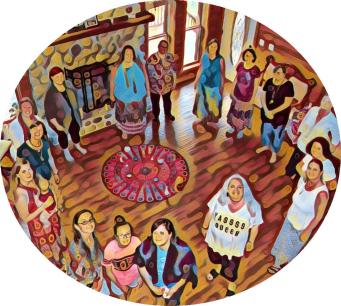
The women have gathered in a large open living room, under high ceilings and banisters draped with goddess tapestries, their faces are turned towards me, waiting expectantly. We are here for our first overnight Red Tent Retreat, our women’s circle’s second only overnight ceremony in ten years. We are preparing to go on a pilgrimage. I tell them a synopsis version of Inanna’s descent into the underworld, her passage through seven gates and the requirement that at each gate she lie down something of herself, to give up or sacrifice something she holds dear, until she arrives naked and shaking in the depths of the underworld, with nothing left to offer, but her life.

Continue reading “From the Archives: Sacred Water by Molly Remer”

Dancing for Rain: Life-Giving Gift from Heaven to Earth by Laura Shannon 

Since ancient times people have danced for rain, the life-giving gift from heaven to earth. Rain rituals were seen as important work and were usually performed by women, traditional bringers of life and fertility. Both bearing and raising children, and cultivating the land to nourish the community, are activities dependent on, and psychically equated to, rainfall. Women’s ability to bring rain when necessary was a key belief of indigenous European culture and is found in many places today. Many women’s dances, songs and rituals in Eastern Europe and the Near East express this connection, and women’s folk costumes often feature long fringes representing water. 

Continue reading “Dancing for Rain: Life-Giving Gift from Heaven to Earth by Laura Shannon “

From the Archives: The Hunger Games, Holy Week, and Re-imaging Ritual by Xochitl Alvizo

This was originally posted on April 3, 2012 and serves as a nice follow up to my recent posts, and to the Christian holy days being celebrated this week.

Being passive spectators of violence and injustice, even if mournfully so, is not just a thing of Panem, it is our everyday reality.

In The Hunger Games Suzanne Collins takes the reality of an unjust society and gives it an imaginative makeover. In Panem, most people are kept at such extreme levels of hunger that even when they do eat they cannot fill the hollowness that has settled in their stomachs, while others are deciding on the next cosmetic alteration they will undertake – whiskers, jewel implants, or green-tone skin color? The disparate conditions between the rich and the poor, the few and the many are absurdly and starkly portrayed but done so in a way that we can still recognize our world in theirs. And at the center of this world is the state imposed ritual of punishment and control, the yearly Hunger Games – a nationally televised competition that all the people of Panem are required to watch. The 12 districts watch mournfully as two kids from each of their districts compete to the death, and the wealthy watch gleefully, for the games are the height of their excesses and entertainment. The yearly Games conclude when one kid, the lone ‘victor’, is left standing. All while the nation watches.

Continue reading “From the Archives: The Hunger Games, Holy Week, and Re-imaging Ritual by Xochitl Alvizo”

FRAME THE CHAOS by Esther Nelson

No matter how much we may want absolute control over our own lives and destiny, most of us realize that’s just not possible. Life itself is chaotic—both on a global and individual level. War, famine, drought, earthquakes, tsunamis, pandemics, poverty, sickness, ignorance, disability, divorce, and ultimately death comes calling for everybody living on planet Earth—a planet which will no doubt  eventually die as well. 

How do we maneuver through such dire straits?  Can we make sense of and find meaning in our day-to-day chaotic existence both as members of individual families/communities and as global citizens? Perhaps so, however, it’s impossible to tackle the tumult all at once. Hence, the title of this essay—“Frame the Chaos.”

Thanks to my former colleague Dr. Cliff Edwards for this phrase, gleaned from his reading of Gilles Deleuze, French philosopher (1925-1995). “Chaos is defined not so much by its disorder as by the infinite speed with which every form taking shape in it vanishes.  It is a void that is not nothingness but a virtual, containing all possible.”

Continue reading “FRAME THE CHAOS by Esther Nelson”