The Harlot Shall Be Burned with Fire: Biblical Literalism in The Girl with the Dragon Tattoo by Sarah Sentilles

(spoiler alert)

Against my better judgment, this past weekend I went to see The Girl with the Dragon Tattoo, directed by David Fincher who’s best known for Fight Club and The Social Network. I didn’t like the book; it unsettled me that a novel filled with sexual violence against women—a novel that seems to take pleasure in the violence, to offer it up for readers to consume—became such a sensation. But I’m a sucker for a trailer and a good soundtrack, and I was curious, so I bought a ticket.

The plot revolves around a missing girl and the serial killer believed to have murdered her who uses the Bible like a handbook. He takes passages from Leviticus—21:9 for example: The daughter of any priest, if she profanes herself by playing the harlot, she profanes her father. She shall be burned with fire—and enacts them on women’s bodies. On Jewish women’s bodies.

Please click here to continue reading this article at Religion Dispatches.

Sarah Sentilles is a scholar of religion, an award-winning speaker, and the author of three books including A Church of Her Own: What Happens When a Woman Takes the Pulpit (Harcourt, 2008) and Breaking Up with God (HarperOne, 2011). She earned a bachelor’s degree from Yale and a master’s of divinity and a doctorate in theology from Harvard, where she was awarded the Billings Preaching Prize and was the managing editor of the Journal of Feminist Studies in Religion. At the core of her scholarship, writing, and activism is a commitment to investigating the roles religious language, images, and practices play in oppression, violence, social transformation, and justice movements. She is currently at work on a novel and an edited volume that investigates the intersections of torture and Christianity.


January 11th is National Human Trafficking Awareness Day

This information was originally distributed by WATER:

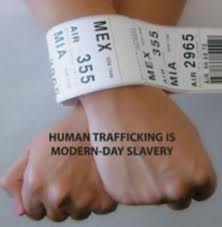
January 11th is National Human Trafficking Awareness Day. Human trafficking, referred to as modern-day slavery, is the fastest growing and second most profitable criminal industry in the world. More than 27 million women, men, and children have become victims of human trafficking for labor and sexual exploitation. Trafficking can and does occur in all parts of the world, including the U.S. Large sporting events like the Super Bowl attract human trafficking, especially for sexual exploitation of women. Read Mary E. Hunt’s new article on human trafficking entitled “Women and Children First.”

Stories of Trafficking
Excerpted from www.polarisproject.org

Amanda learned that her cousin was with a pimp who was advertising her for commercial sex on various websites.

A teacher became concerned about one of her students, a 14 year-old girl, and spoke with classmates who directed the teacher to multiple postings advertising the young girl for commercial sex on backpage.com. Continue reading “January 11th is National Human Trafficking Awareness Day”

Well-Behaved Women Seldom Make History, But Obedient Ones are Rewarded in Heaven: An Examination of the Re-Invention of the Bengali Tradition of Sati By Michele Stopera Freyhauf

Well-Behaved Women Seldom Make History is a book authored by Laurel Thatcher Ulrich.  This has become a well-known phrase used by most feminists to imply a meaning of disobedience or stance against the patriarchal structure of society.  Often in error, the credit of the invention of this phrase is attributed Eleanor Roosevelt and Marilyn Monroe.  Their image, and especially the image of Monroe, will often appear with the slogan on merchandise as a means of marketing and raising revenue.  Ironically, reinvention or reuse is prevalent in history when it comes to tradition or ritual for the same reason – monetary gain.  This practice is common and the benefit of reinventing or reinterpreting an old tradition is an automatic connection to the past giving continuity, which, according to Eric Hobsbaum, instills strong “binding social practice,” (p. 10) including loyalty and duty in the members of the group.  This is especially effective in manipulating the poor and uneducated who usually display strict obedience and blind acceptance of tradition. The Bengali reinvented tradition of satî is an example of this. Continue reading “Well-Behaved Women Seldom Make History, But Obedient Ones are Rewarded in Heaven: An Examination of the Re-Invention of the Bengali Tradition of Sati By Michele Stopera Freyhauf”

Football as a Ritual Re-enacting Male Domination Through Force and Violence By Carol P. Christ

Carol P. Christ is a founding mother in the study of women and religion, feminist theology, women’s spirituality, and the Goddess movement.  She teaches in the Women’s Spirituality program at CIIS and through Ariadne Institute offers Goddess Pilgrimages to Crete. Her books include She Who Changes and Rebirth of the Goddess and the widely used anthologies Womanspirit Rising and Weaving the Visions.

The other day when Paula McGee asked on this blog how Penn State students could rally in support of Sandusky, I was also reading a student paper quoting Rianne Eisler’s opinion that peace and environmental justice cannot be achieved in dominator cultures. Xochitl Alvizo commented that we should not be surprised by the reactions of the students as we live in a “rape” culture.  I would add that we must examine the culture of male domination through force that is “football,” one of the “sacred cows” of American patriarchy, just as we need to examine the culture of hierarchical male domination of the Vatican in the context of child-rape by priests.  Continue reading “Football as a Ritual Re-enacting Male Domination Through Force and Violence By Carol P. Christ”

Can the Students at Penn State Read? Did They Read What I Read? By Paula McGee

The following is a guest post written by Paula McGee, dynamic preacher, writer, and inspirational speaker.  She earned a Master of Divinity from the Interdenominational Theological Center and a Master of Arts in Religion from Vanderbilt University. She is currently a Ph.D. candidate in Women’s Studies in Religion at Claremont Graduate University.  Her personal mission is “to inspire others to recognize, accept, and fulfill their call to greatness.”

“As the graduate assistant put the sneakers in his locker, he looked into the shower. He saw a naked boy, Victim 2, whose age he estimated to be ten years old, with his hands against the wall, being subjected to anal intercourse by a naked Sandusky.”

Can the students at Penn State read? I saw thousands of students rioting in the streets after the Board of Trustees announced the termination of football coaching legend Joe Paterno and President Graham Spanier. I wondered if the students had read page 6 of the 23 page Grand Jury report. The report provides detailed information on 8 victims. So I can’t imagine any student that would question the university’s decision to fire Joe Paterno, if they had read any portion of the report from the Grand Jury’s investigation. The details on page six have caused the most controversy. In 2002, a 28 year old graduate assistant walks in on Jerry Sandusky raping a ten year old boy. Sandusky is now telling people that he only showered with boys.  Continue reading “Can the Students at Penn State Read? Did They Read What I Read? By Paula McGee”

Confronting Sexual Harassment Ten Years Later: Speaking Out, Empowerment, and Refusing to Accept Defeat By Gina Messina-Dysert

Much of my research and activism thus far has centered on rape culture*, sexual violence, and spiritual wounding.  This being said, I have given little consideration, and have shared even less, of my own experience of sexual harassment perpetrated by a professor at the end of my undergraduate career.  Although I had called myself an advocate for women who had been victimized by various forms of violence, sexual included, I was unable to advocate for myself when confronted with my experience.  What’s more, although I have called for a speaking out of one’s experience of sexual violence in order to challenge the rape culture and begin the healing process, I have not been able to do this myself.

My professor sexually harassed me during my final semester of college in the very last course I needed to graduate.  The first time he approached me he asked me to stay after class.  Initially I was nervous thinking I had done something wrong; however I was surprised when he began to ask me personal questions.  I was engaged at the time and Dr. X commented how lucky my now husband was.  He then reached out, hugged me, and stroked my hair.   I didn’t move, I was scared and wondered what was happening. After a few moments, I forced myself out of his arms and with my head down, unable to look him in the eye, I said I had to leave and darted out the door. My initial reaction was to downplay his inappropriate behavior and I convinced myself that I must have misinterpreted the situation.  Continue reading “Confronting Sexual Harassment Ten Years Later: Speaking Out, Empowerment, and Refusing to Accept Defeat By Gina Messina-Dysert”

Finding my Voice through the Vagina Monologues By Anonymous

This post is written in conjunction with the Feminist Ethics Course Dialogue project sponsored by Claremont School of Theology in the Claremont Lincoln University Consortium,  Claremont Graduate University, and directed by Grace Yia-Hei Kao.

“Are you going to the Vagina Monologues try-outs tonight?” my friend asked me last year after class.

“I hadn’t planned on it,” I replied cautiously. Truth be told, the word ‘vagina’ made me uncomfortable. There were yearly productions of the Vagina Monologues at my undergraduate institution, but I never went. I thought it was a time when women gathered and performed monologues they had written, and I thought it demeaning to have these monologues named metonymically. I did not want to be associated with the Monologues: I was in favor of women’s equality, but I did not want to claim my sexuality in so visceral a manner. In my mind, the ‘Vagina’ of Vagina Monologues just referred to the actresses, not the content.

How wrong I was.  Continue reading “Finding my Voice through the Vagina Monologues By Anonymous”

The Scars Were Not Me: Gilligan and Self-Care By Drew Baker

This post is written in conjunction with the Feminist Ethics Course Dialogue project sponsored by Claremont School of Theology in the Claremont Lincoln University Consortium,  Claremont Graduate University, and directed by Grace Yia-Hei Kao.

Drew Baker is a feminist Buddhist-Christian PhD student in Religion, Ethics and Society at Claremont School of Theology. His work engages the interconnections between trauma theory, religious ethics and ghost narratives.

[DISCLAIMER: Sexual violence is contained in the post below]

When I was a freshman in college, I drastically misread Carol Gilligan’s In a Different Voice. I read her book then, and (wrongly) saw a mirror of my own ideals. Selfless care above all else. I see a more complicated and beautiful portrait in her book today. Something changed.

I was raised Buddhist. Like many Buddhists, I learned about the doctrine of no-self and the moral value of compassion. I came to wed the concepts in my mind. Selfless care. There were no virtues in the world beyond the mantra: ‘love others no matter the cost to the self.’

Kenosis can be quite pragmatically valuable to cultivate as a spiritual discipline for those with power. As a white straight man, honestly, there were few instances in my life growing up that should have called this personal virtue into question. Continue reading “The Scars Were Not Me: Gilligan and Self-Care By Drew Baker”