How many objects have I clung to, how many pasts have I tried to preserve–beginning, of course, with the first loss, of Egypt where I’d been born and where my family had flourished? How many habits, feelings, fears, and beliefs continue to constrain me? The new year approaches, and my resolution today is simple: to let go. Again and again and again. As often as it takes.
During the summer of 2005, I was living alone on Venus Street, in New Orleans’ Gentilly Terrace neighborhood, in a small Craftsman cottage I’d purchased two years earlier after breaking up with my longtime partner. I loved the house: modest yet gracious, it had a dining room with French doors that opened onto a screened porch, gleaming wood floors, cove ceilings, numerous multi-paned windows, a large bedroom, and a comfortable study looking out on royal palm trees where a flock of green parrots nested. I liked to think it resembled the home my parents had left behind in Cairo, Egypt when they emigrated to the U.S. in 1951.
For the first time ever, I’d carefully chosen and purchased furniture specially for the new space: a wide, heavy, round wooden dining table; a velvet camelback sofa; a coffee table, lamps, curtains, and a hooked rug. This was my “dream home,” the room of my own I’d always longed for, and I dwelt there in deep contentment–gardening, reading, writing, entertaining. Continue reading “Letting Go by Joyce Zonana”
For those of us living in Southern California, it has been a tense week to say the least: flames ravaging up and down the coast, homes lost, thousands displaced, freeway and school closures, smoke thick in the air, and ash raining from the sky.
Whether or not one is directly impacted by the wildfires here in Ventura and Los Angeles County, you can’t walk through the grocery store, turn on the radio, or get a cup of coffee without engaging the fear and concern, or hearing about the devastation left behind. We are sharing a trauma, howbeit differently, and with different levels of need.
I have been lucky during the fires. I live just south of Ventura. My work is on the Getty side of the 405: it was threatened, but not in flames. I spent the week checking in with family and friends, offering my home, and breathing the toxic air. I also made dinner, picked my brother up from the airport, attended a baby shower, and graded papers. … This is a strange juxtaposition, and like many Californians, I have had a hard time processing what’s going on.
On Sunday afternoon, surrounded by the unnatural darkness of an ash filled sky while traveling down the 101 freeway, I wrote the following. This is my effort to make sense. And I offer it to you all here, in case this helps you make sense too. Continue reading “Just South of Ventura by Sara Frykenberg”
My “me too” went out for all to see way before Facebook existed, way before there were hash tags and internet pages for unveiling our secrets to the world. In all the years that have passed since I first spoke publicly and published about my experiences with sexual violence, there has been a steady stream of people (mostly, but not all, women) who have come to me with their #metoo.
Survivors tend to hold lots of secrets—they become heavier with time and the more the secrets stay secret, the more power they have to distort and rupture and isolate. I held mine for many years and I planned on never telling anyone. But, those memories began to disrupt my life more and more—and finally they had to come out. That was the only way I could ever be free, that is the only way I could truly be alive.
Personal faith often has a huge impact on the lives of survivors of violence. This impact, unfortunately, as can be seen in the other posts as well as in the comments on those posts, is not always a positive one. In her book, Redeeming Memories: A Theology of Healing and Transformation, Flora A. Keshgegian envisions communities of faith as communities of remembrance. A community of remembrance does not ignore or suppress the negative experiences of its members but strives to enable us to embrace personal identity, form our faith, and to nurture hope in order to heal and transform after such experiences.
One question that my dissertation set out to answer was how we might begin the difficult work of moving our communities of faith in this direction. Sadly, the biggest difficulty seems to be the lack of awareness, or the downright denial, that domestic violence is an issue for the average faith community. So many congregation members assume that if their pastor is not talking about an issue then it must not be a problem in their particular community.
In my last post here on Feminism and Religion I unpacked the three primary understandings of atonement theology as well as some of the feminist critiques of those understandings. In this post I’d like to focus a bit more on how the relationship between power and violence influences how Christian women view the atonement.
In her book, On Violence, Hannah Arendt puts forth a new analysis of the relationship between power and violence. Arendt’s analysis, though primarily focused around concepts of the potential for worldwide destruction and war following major global occurrences such as the Second World War and the struggles for civil and women’s rights within the United States context, supplies an interesting framework with which to consider this relationship as it relates to domestic violence. Continue reading “A Middle: Understanding the Relationship between Violence and Power by Katie M. Deaver”
During my last months in Cape Town I have been facilitating a series of workshops on Rape, Gender Justice and Culture of Consent. I am blissful for the opportunity to teach and learn with a group of people with whom we have navigated in the approach of Rape and Sexual Assault in their different perspectives, from the socio-political to the intimate tenets.
This has been an exciting journey of healing and soul blooming. I have realized the critical role that Cape Town has played in pushing me towards empowerment and thriving, enhancing my taking back ownership of my body and all the experiences happening through it.
This journey started few years ago when I decided to come out of the closet as a rape survivor. I wrote about it on Feminism and Religion. This was the first step of my breakthrough. Little by little I became confident and shameless about saying: “Yes, I was raped”.
‘Rather than being a bleeding image of female disempowerment, Medusa may be read as…one of the most ancient European symbols of women’s spiritual abilities… [and] an empowering image of feminine potential.’
–Patricia Monaghan, O Mother Sun! (1994:244)
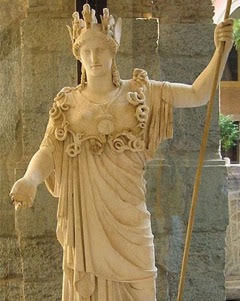
The name Medusa means ‘sovereign female wisdom,’ ‘guardian / protrectress,’ ‘the one who knows’ or ‘the one who rules.’ It derives from the same Indo-European root as the Sanskrit Medha and the Greek Metis, meaning ‘wisdom’ and ‘intelligence.’ (1) Metis, ‘the clever one’, is Athena’s mother. Corretti identifies Athena, Metis, and Medusa as aspects of an ancient triple Goddess corresponding respectively to the new, full, and dark phases of the moon. (2) All three are Goddesses of wisdom, protection, and healing.
Athena with Gorgoneion in her heart. 5th C BCE.
Athena and Medusa are particularly linked: indeed, one may have been an aspect of the other, ‘two indissociable aspects of the same sacred power.’ (3) Their many common elements include snakes, wings, a formidable appearance, fierce eyes and powerful gaze. The serpent, like the Goddess, has been cast as an embodiment of evil in patriarchal retellings; yet as Merlin Stone points out, serpents were ‘generally linked to wisdom and prophetic counsel’, associated with ‘the female deity’ and ‘entwined about accounts of oracular revelation…throughout the Near and Middle East.’ (4) According to Ovid, the poisonous vipers of the Sahara ‘arose from spilt drops of Medusa’s blood.’ (5) Although this is presented as a further sign of Medusa’s horrifying character, the original Berber inhabitants of North Africa – where Herodotus reports that the Medusa myth began – viewed snakes as bringers of luck and portents of joy. (6)
Despite Medusa’s fearsome appearance, she herself does not personify evil or demonic forces. According to Miriam Robbins Dexter, Medusa is a manifestation of the Neolithic serpent/bird Goddess of life, death, and regeneration. (7) Jane Harrison explains that the ancient Goddess wore the Gorgon mask to warn the uninitiated away from her rites (8), most likely mysteries of the great cosmic cycles of heaven and earth. Patricia Monaghan sees the snakelike rays streaming out from Medusa’s countenance as a sign of a solar Goddess (9), while Joan Marler, citing her connection with Hecate, identifies Medusa more with the moon than the sun (10); either way, Medusa is a heavenly deity ruling over the powers of the cosmos and the rhythms of time. Continue reading “Medusa and Athena: Ancient Allies in Healing Women’s Trauma by Laura Shannon”
Since many of the comments on my last post expressed interest in my dissertation topic I will use my next couple of posts to talk a little bit more about my work and research in that area. When we talk about theories of the atonement we are trying to describe a narrative structure of what took place within the Christian cross event. Generally speaking, Christians believe that atonement serves at the reconciliation between God and humanity and that this reconciliation is realized through the person of Jesus Christ. The three primary theories that try to explain this event are Substitutionary/Satisfaction, Moral Influence, and Christus Victor.
The Substitutionary/Satisfaction theory of atonement suggests that Christ takes on the guilt and punishment that humanity deserves because of our sinfulness and so becomes our substitute, paying the debt we owe for our sins. Because of humanity’s sinfulness we deserve death, but instead of giving us what we deserve God instead offers God’s son as a sacrifice to pay our debt, to atone for our sinfulness, and to save us from the eternal punishment of death.
The Moral Influence theory of the atonement focuses primarily on the life and ministry of Christ rather than on his suffering and death. This theory is centered on the belief that God loves God’s creation so much that God would hold back nothing from us, God would even give God’s own Son in order to save us and remain in relationship with us. As a result this theory encourages Christians to live as Christ lived and focuses on imitating his life and ministry in order to bring about justice in our own world.
There have been so many times
I have seen a man wanting to weep
but instead,
Beat his heart until it was unconscious.
— ‘Masculine’, Nayyirah Waheed
PART I of II
There have been many times when I have wondered whether the world has reached a peak in a broken kind of masculinity.
The notion that there is only one kind of masculinity deserving pedestalisation, or even just one kind of masculinity, has long been discarded in the enclaves I have access to as a grassroots activist and scholar. These are not secret societies that are password-protected. They are protected, of course, by communities that uphold principles of freedom, dignity, equality and justice. But anyone is welcome.
Last weekend was a special one for me. After many years of study and dedication I graduated with my Ph.D. and am now, officially, Dr. Katie Deaver. The weekend was filled with celebrations to mark the completion of a milestone that I have spent years working toward. The amazing outpourings of love, support, and care that I have experienced throughout the last few days is quite humbling. The happiness and pure joy of my family, friends, professors, mentors, and multiple church communities have left me in awe. As I reflect on this love and support it helps to heal the wounds and scars that have accumulated throughout the process of earning this degree.
The undertaking of a Ph.D. program is significantly more difficult than anyone tells you. This difficultly lies not necessarily in the course work or the dedication to constant reading, writing, and learning but rather in the personal growth and vocational affirmation that takes place within the process. My dissertation explored the primary understandings of the doctrine of atonement and addressed how this doctrine can, and has, been used in ways that perpetuate, and in some cases even encourage, domestic violence.
My own fascination with the topic of atonement and its links to domestic violence was brought about at the suggestion of one of my undergraduate professors at Luther College, Dr. Jim Martin-Schramm. From the moment that Dr. Martin-Schramm explained the links between theologies of the cross and domestic violence I knew that I had found my new passion. Writing a dissertation on the topics of domestic violence, theology and women of faith was an extremely personal, and intimate experience for me. This topic forced me to accept my own lived experience. To claim myself… out loud… as a survivor of domestic violence. As a result the writing of my dissertation was particularly personal, and painful, as well as extremely life giving.


 During the summer of 2005, I was living alone on Venus Street, in New Orleans’ Gentilly Terrace neighborhood, in a small Craftsman cottage I’d purchased two years earlier after breaking up with my longtime partner. I loved the house: modest yet gracious, it had a dining room with French doors that opened onto a screened porch, gleaming wood floors, cove ceilings, numerous multi-paned windows, a large bedroom, and a comfortable study looking out on royal palm trees where a flock of green parrots nested. I liked to think it resembled the home my parents had left behind in Cairo, Egypt when they emigrated to the U.S. in 1951.
 For those of us living in Southern California, it has been a tense week to say the least: flames ravaging up and down the coast, homes lost, thousands displaced, freeway and school closures, smoke thick in the air, and ash raining from the sky.

 In
In 


 Feminism and Religion