Take time 
to nourish
your caring.
It is needed.
Last month it was raining heavily on a Saturday morning and I spent time coloring letters to fairies with my younger children and baking a cake. Before I knew it, the day had slipped away into the rain and I didn’t get to make my daily visit to the woods behind my house as I like to do in the morning. While the things I did instead were fun and loving, I found myself telling my husband, once again, that I am feeling burned out in my life in general and like I’ve lost my caring. I sometimes worry that I don’t care anymore, that I’ve used up my care, my inspiration, my passion, that I’ve fueled magic for others for so long, that my own has evaporated and I’m finished, extinguished. I listed off the things I need to refuel my soul and restore my care so that I can be there for others, for our work. My list was simple and short and my husband pointed out that I get the things on it almost every day:
- Go to the woods.
- Write and journal.
- Walk and discover things.
- Create/draw/take pictures.
- Read.
I need to nourish my care, I tell him, because I can’t stop caring.
Caring is what holds life together.
What do you need to nourish your caring?
This year, I have found myself struggling with recurrent episodes of feeling like I don’t care. I feel careworn, care-overloaded, care-burned out, care used-up. Sometimes I even feel like I actually can’t care anymore, like all my care is used up, spent, extinguished, exhausted. I have also found myself feeling a little sad and wistful remembering how much I used to care, about everything, but at times I also feel liberated by owning the “don’t care” sensation. Sometimes it sets me free. The world is stained, strained, and brittle from so much lack of care from so many people. We must keep caring, we must care, even when it is a strain. I suppose the secret may be not to care too much about things that don’t require our care, not to overload ourselves with cares that are not our own, or that don’t actually require our attention and are, frankly, quite fine without us and our meddling.
After the month’s Pink Tent ritual with my local circle, a friend tells me that she has been  going to yoga class and every time she lies on the floor at the end of class, she thinks of me. I consider this a compliment. If I could be known as a lay-down revolutionary, that would please me. At least two years ago, I put on my list of “100 Things to Do this Year,” to lie on the floor for at least three minutes every day. I have kept this up more or less every day since then, even setting my phone timer for three minutes at the end of my personal yoga practice each morning, so I know I’m actually giving this to myself. I wonder what might change for many of us if we allowed ourselves three minutes a day to lie on the floor? Ten minutes? Fifteen minutes? One hour? Another friend tells me she needs a time out to refill herself until she is overflowing, instead of just refilling her cup a tiny bit and then draining it over and over again. I feel this too. I have the sensation that I been coasting on my reserve tank for at least a year and my reserves are now becoming depleted too. It takes more than three minutes to fill the tank, so that it carries sustained and lasting energy to fuel my soul.
In the woods the next day, I sit with my eyes closed in the sunshine, basking in the warmth. I hear the sound of birds from each side of me, ping-ponging off of one another into the sparkling green air. I listen to them until my mind softens and I am no longer tormenting myself with questions of how to be better, be more, fix it all. I am very still on the rock and when I open my eyes, I see a vulture coasting towards me. It swoops very low, skimming the treetops, possibly checking to see if I am actually breathing there on the stone, it circles once, twice, three times, above my head, at each pass coming very low, low enough that I can see its red head turn from side to side, looking at me.
Hey, buddy, I say. Yes, I’m still breathing!
My floor-lying friend has spent the night at my parents lodge and I go to visit her and to paint with my mom, my daughter, and my friend and her family. My head is throbbing with the headache I often get following an intense ritual and I don’t feel very present, but we paint anyway, the colors swirling and mixing and the freeform nature of the pour painting meaning there are no mistakes, only magic. When we finish, I help her load a weaving loom into her car and we speak briefly about group dynamics and ritual etiquette, and priestessing energetics. As we speak, I look up to see nine vultures this time, circling in the wide sky above the large open field surrounding the lodge building. They dance in the air and they whisper, It is okay to let go. It is okay to soar. It is okay to be free. It is okay to clean things out and away. That is how you can keep caring.
Recipe for Rebuilding a Soul:
1 weary heart
2 open arms
1 large flat rock
As many tall pine trees
as you can find
1 empty book
Many pens
Lots of water
2 scoops of sunlight
An infinity of starshine.
Mix together patiently and wait in the shadows. Let rise in the sun. Let rise with the moon. Check for delight. If still soggy and deflated, expose on a hillside or soak in the ocean. Sprinkle with laughter.
Submerge beneath a stream of inspiration.
Drizzle with dreams and a generous helping of time.
Steep with incredible slowness.
Dust with flowers and need well.
Let become exquisitely tender and soft.
When fully risen, warmed throughout, and glowing with strength and satisfaction, enjoy with a tall glass of moonlight, a side of magic, and a handful of enchantment.
Create regularly for best results.
Additional audio poem: Careworn Soul
This essay is excerpted from my book in progress, The Magic of Place: Rebuilding the Soul Where and How You Are.
Molly Remer has been gathering the women to circle, sing, celebrate, and 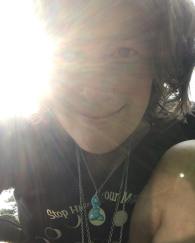 share since 2008. She plans and facilitates women’s circles, seasonal retreats and rituals, mother-daughter circles, family ceremonies, and red tent circles in rural Missouri. She is a priestess who holds MSW, M.Div, and D.Min degrees and wrote her dissertation about contemporary priestessing in the U.S. Molly and her husband Mark co-create Story Goddesses, original goddess sculptures, ceremony kits, mini goddesses, and jewelry at Brigid’s Grove. Molly is the author of Womanrunes, Earthprayer, She Lives Her Poems, and The Red Tent Resource Kit and she writes about thealogy, nature, practical priestessing, and the goddess at Patreon and at Brigid’s Grove.


 It’s about every three years when we at Feminism and Religions put out a solicitation for a new intern to join our team. Back in 2013 we had the great privilege of having Kate Brunner join us. She came on as an intern and stayed to become one of our permanent co-weavers who help run the day-to-day behind-the-scenes of this collaborative project. She reorganized the structure and rhythm of how we run things and made it easier for us to bring in the next person. Enter Katie M. Deaver at the end of 2016. She is the superhero who so smoothly swooped in as Kate stepped back to attend grad school. Katie shared all the values and ethos of FAR – it was the most organic match we could have hoped for. Truly FAR couldn’t have survived without each of them.
 The awakening occurred at 1:27am with the pterodactyl-cry only uttered by toddlers. It continued around 2am when said pterodactyl joined weary moms in bed. Stinging tears splattered pillows with a swift headbutt to my nose, later accompanied by footied talons jabbing my ribcage as this tiny person became the human crossbar of a giant “H,” vertical moms arching precariously on either edge of the overstuffed bed. 5:30am came all too soon as both children arose, crows louder than any rooster, tired moms stretching their aching backs. Navigating this whole feminist parenting thing is complicated, y’all. As an artist, author, activist, and academic, I thought I had a handle on my identity and vocation; now I feel like motherhood is the only moniker defining my exhausted reality.
 Are Women’s Bodies too Magical for Professionalism?
 I sat in a frigid moot court room at a conference on the morning of March 8, trying to concentrate. Within an hour of the program’s opening keynote, my underarms had become damp with that weird cold sweat that happens when you are at once freezing and yet decidedly overwarm in your wool overcoat. I was distracted, trying to decide whether I was sick, menstruant, nervous, or inappropriately dressed. My coat was long and fitted over my suit coat, and I was vaguely worried about bleeding through or around what had become a misaligned feminine product. Sitting straight in all those stiff layers for several hours felt, I imagined, something like the confinement of a full body corset.
 The Torah parshah for this week is Tetzaveh (Exodus 27:20 – 30:10). Mostly it describes the priesthood, both of Aaron and his sons. It details how they should be consecrated, what they should wear, the difference between the garb of the high priest and the others, institutes the daily burnt offerings of rams, and provides instructions for the construction of an altar for locally-sourced incense.
  On June 8, Cleveland watched the Cavaliers lose the NBA championship. Outside of Cleveland, according to the commentators I heard, no one really expected our guys to pull it off. But, here in Cleveland, we felt otherwise. Up until the final four minutes of the fourth quarter, when the Herculean LeBron took the bench, we were still thinking something magical could happen. When he stopped, the game ended. We lost. And, the city, once again, had to recast its disappointment, redirect its energies, and rediscover the eschatological hope that is the core of Cleveland’s athletic grit: “there’s always next year!”
 Recently I traveled in India with my husband who did doctoral research there 48 years ago. I had no goals of my own other than to be open. Back only a short while, I am still pondering the journey. Here are glimpses of the women I saw, often only from a distance, with gratitude for so much kindness.
 Feminism and Religion