The Grandfathers, part 1 by Sara Wright

Moderator’s Note: Sara wrote this in 2019. This is its first publication and has grown all the more pertinent now.

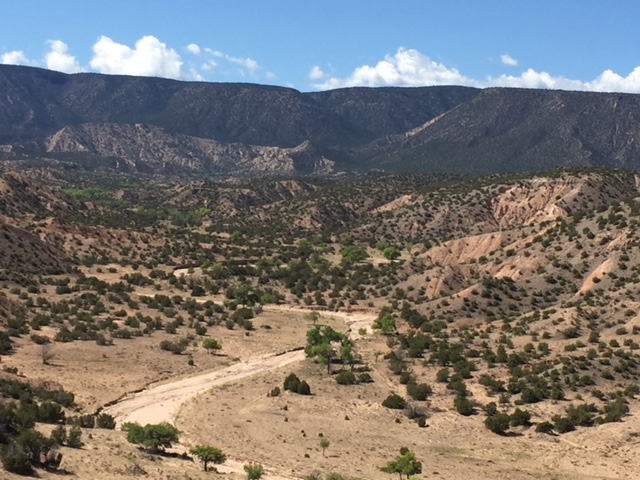
Sapawe is an ancestral Tewa Pueblo located outside of El Rito. Until this weekend I had never been to the ruin. I didn’t know, for example, that it was the largest ruin in New Mexico, and perhaps the entire Southwest or that during the period it was built and occupied (1300- 1500’s) that ten thousand people lived there. Estimates suggest that there were at least 1,800 ground rooms and twenty – three kivas. Walking around the huge compound is something I have yet to do. It was too hot for me to do more than take in the astonishing view or traverse a small part of the plateau, briefly. I did note that there were artifacts and planned to come back another time – soon.

Early yesterday morning I met with four other people to see the shrine that was located outside the pueblo. This was the place that secret ceremonies were held on behalf of all the people in the pueblo. On the surface all that could be seen was a large raised stone circle, but there was a sense of presencethere that felt both powerful and peaceful probably because few people knew about this shrine and the  natural power of place had not had a chance to dissipate. After having explored a couple of other Tewa ruins, I learned that it was very important to allow place to speak in its own time, and to allow that to happen I had to return again and again with an open heart, eyes that could see beyond the obvious, and an active inner ear … The land speaks to those that can listen.

Continue reading “The Grandfathers, part 1 by Sara Wright”

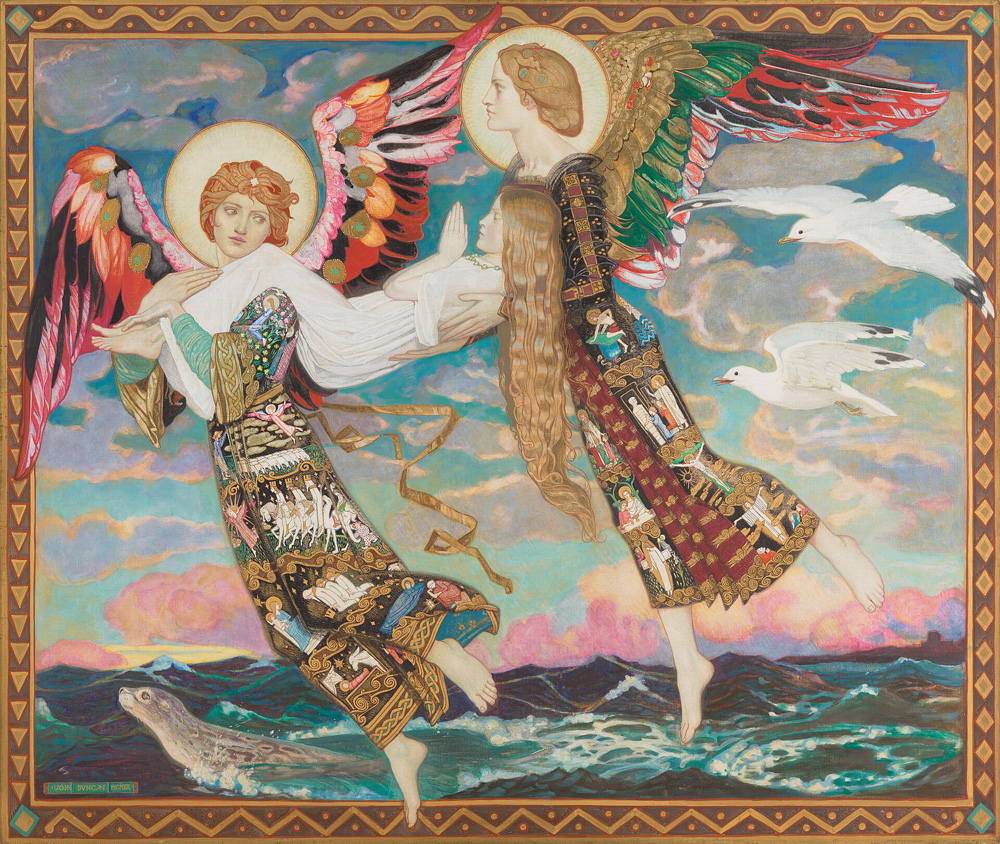
St. Brigid: Reproductive Justice and the Realms of the Miraculous by Elanur Williams

St Brigid being carried away by angels, in a painting by John
Duncan (1913)

One of my favorite saints is St. Brigid of Kildare, the patroness of poetry, learning, healing and protection. She is frequently called upon during childbirth. Brigid’s hagiographies are noteworthy for her remarkable abilities to heal and perform miracles—including her ability to make pregnancies vanish, for those who ask. In Vita Prima and Vita Brigitae (Life of Saint Brigit) published around 650 C.E. by Cogitosus, an Irish monk from Kildare, it is claimed that “Saint Brigid, by the very powerful strength of her faith, blessed a woman who had fallen [pregnant]…and the conception in the woman’s womb decreased and she restored her to health…without childbirth and its pangs.” The pregnant people in Brigid’s tales turned to Brigid to help them reclaim and restore their dignity. Consequently, their abortions served as catalysts for change. “Abortion miracles” have narrative and theological functions: they expose constructs of sexuality, chastity, purity, and sin. In addition, they test our understandings of healing—physical and spiritual—by revealing the intersectionality between medicine, pregnant people, power, and personal agency. Scholars have theorized the presence of “abortion miracles” in hagiographies, and whether they are to be read as a kind of defiance towards early Christian morality, or as a demonstration of chastity’s role and value in early medieval Irish Christianity. Some Irish penitentials view medieval abortions as malefic acts or as a kind of malevolent magic; however, according to Arica Roberts (2020), it can be argued the abortion miracles found in Irish hagiography can instead be read as “medicines of penance” and as contributing to healing.

Continue reading “St. Brigid: Reproductive Justice and the Realms of the Miraculous by Elanur Williams”

From the Archives: Painting Herstory: Our Lady of Silver Lake by Angela Yarber

This was originally posted August 8, 2015

It has become my new routine during the first phase of my queer little family’s year-long journey. After completing my chores, I run along the trails surrounding Silver Lake and once I’m thoroughly drenched in sweat, I grab a book and push our enormous 15-foot canoe into the frigid waters of the little lake we’re calling home for three months. With a smile that has yet to wipe off my face, I paddle fiercely. I’m typically the only person on the lake.

It’s a steep mile hike from the trailhead, and we’re the only ones “living” here for the summer, so my giant green canoe ripples the silvery waters in solitude. Once I find the right spot, I stuff my life vest behind my head and cozy down into the belly of the canoe, book in hand, goofy grin still spread across my flushed face. In the warmth of the sun, I read. In the belly of the canoe, I drift into the history of the lake, the unwritten annals lapping alongside my rocking boat, the portions on record filling the book in my sun-warmed hands.

Continue reading “From the Archives: Painting Herstory: Our Lady of Silver Lake by Angela Yarber”

From the Archives: I Sing Asherah Exalted! by Janet Maika’i Rudolph

This was originally posted Dec. 16th, 2021

With this season of the festivals of light upon us (Hanukkah, Christmas, Solstice, Kwanzaa), I wanted to focus on the more joyful aspects of our lives. For that, I have been diving into passages about joy and singing in the bible.

Sometimes when I write these posts, they take me in directions I never thought to go. This post is one of them. The surprise direction I found is in the Psalm below:

Sing unto him, sing psalms unto him: talk ye of all his wondrous works.
Glory ye in his holy name: let the heart of them rejoice that seek the LORD.
Psalm 105:2-3 KJV

Continue reading “From the Archives: I Sing Asherah Exalted! by Janet Maika’i Rudolph”

“Now I Will Have Respect”; “Now I Will Be Looked Up To” – Women Assert Their Worth in the Christmas Story by Liz Cooledge Jenkins

“The Giver of Breath has looked upon me with kindness and has taken away my shame. Now I will have respect in the eyes of my people.” -Elizabeth (Luke 1:25, First Nations Version [FNV])

“From deep in my heart I dance with joy to honor the Great Spirit. Even though I am small and weak, he noticed me. Now I will be looked up to by all. The Mighty One has lifted me up!” -Mary (Luke 1:46-49a, FNV)

Two women, one older, one younger. Both unexpectedly pregnant. Both key players in the Christian Advent story. Both living in a world, not unlike ours today, where women were not fully acknowledged as complete human beings, with all the strength and agency this entails. And both, for this reason, starving for the respect of their loved ones and communities.

Continue reading ““Now I Will Have Respect”; “Now I Will Be Looked Up To” – Women Assert Their Worth in the Christmas Story by Liz Cooledge Jenkins”

Gardens Bloom Between our Wombs by Chaz J.

For years, I have dedicated my life to empowering and uplifting all women in all ways. I have loved women as mothers, aunties, sisters, friends, cousins, teachers, mentors, daughters, God, and most recently myself. The depth of sweetness and emotion for women runs as deep as my life’s work. My life’s work centers and finds a deep well of inspiration in women and women’s lived experiences. My feelings concerning women were confusing for a long time and for a long time I have loved women in every way, except two: sexually and romantically. Giving myself permission to love women in every way has been one of the most liberating personal experiences of my life. It is one of my most radical revolutions. It is self-acceptance and self love in totality. 

The object of my desires is fluid and delicate. She is intuitive  and evasive. She is real and ethereal. She is Wombman. She created and is the fundamental elements that constantly gives birth to the world around us. She has given birth to all of us. She is fire and fury. She is Mother Gaia. She is the winds of change. She is water’s depth and grace. She is the sunlight after a storm. She IS the storm purging impurities. She is a creator and she is destruction. She simply IS…

Continue reading “Gardens Bloom Between our Wombs by Chaz J.”

You Lied to Me About God, a memoir by Jamie Marich, PHD, book review by Janet Maika’i Rudolph

This was a hard book for me to review. Perhaps because she writes about such difficult issues and yet she does so in a compelling and at times even humous manner.  I feel a responsibility and yet find it hard to capture how she manages a breezy manner while discussing heavy material. Perhaps, even though our backgrounds are vastly different, I was also relating to so much of what she said. Jamie also covers so much ground; it is hard to pick out individual aspects to discuss.

As a child Jamie Marich was caught in the web of different religious systems, Catholicism from her mother and Evangelical from her father. They were at soul-hurting odds with each other (both parents and religions). Each one proclaimed they were the one true path so there was the ever-present threat of choosing the wrong one and facing a parent’s wrath along with that of eternal damnation. She labels this spiritual trauma. It cuts to the soul of a person being trapped into a no-win situation. It’s a conflict-driven, shame-filled, guilt-ridden way to grow up.

Continue reading “You Lied to Me About God, a memoir by Jamie Marich, PHD, book review by Janet Maika’i Rudolph”

The Wisdom of the Beguines: The Forgotten Story of a Medieval Women’s Movement by Laura Swan, part 2 by Theresa C. Dintino 

Part 1 was posted yesterday

Praying people out of purgatory

Beguines excelled at this. By the Middle Ages, the belief in many Christian circles was that one did not go directly to heaven but to a sort of “holding place” after death to be cleansed of their sins before being allowed into heaven. Eventually “the medieval church also taught that people could pray for the souls in purgatory and that their prayers would effectively aid those souls in their transition from purgatory to heaven”(108).

It’s important to note that these women were esteemed by the communities they lived in as spiritually gifted, able to intercede with God on their own without permission from the church, clergy or men. This is radical for the time.

“Beguines, as we have seen, were understood to have extraordinary spiritual powers. People believed that having a beguine intercede before God on their behalf was an assurance that their petition was heard by God—and perhaps in no instance more than for “those poor souls in purgatory.” And beguines believed that they did indeed exercise the authority to release countless souls from purgatory. Many of the stories included in the vitae of beguines grapple with the fate of the deceased in purgatory (or hell)”(109).

Continue reading “The Wisdom of the Beguines: The Forgotten Story of a Medieval Women’s Movement by Laura Swan, part 2 by Theresa C. Dintino “

The Wisdom of the Beguines: The Forgotten Story of a Medieval Women’s Movement by Laura Swan, part 1 by Theresa C. Dintino 

Moderator’s Note: This piece is in co-operation with The Nasty Women Writers Project, a site dedicated to highlighting and amplifying the voices and visions of powerful women. The site was founded by sisters Theresa and Maria Dintino. To quote Theresa, “by doing this work we are expanding our own writer’s web for nourishment and support.” This was originally posted on their site on July 5, 2022. You can see more of their posts here. 

Around 1200 AD in Europe, communities of women often called beguines began to form. These women were not nuns, they were devout and devoted to the tenets of Christianity but did not belong to any church. They were independent communities of women who often created their own industry, trade or other means to produce income. They were self-sufficient and generally concerned with helping the poor, especially women. They lived in convents. This was the origin of that word.

“These women were essentially self-defined, in opposition to the many attempts to control and define them. They lived by themselves or together in so-called beguinages, which could be single houses for as few as a handful of beguines or, as in Brugge, walled-in rows of houses enclosing a central court with a chapel where over a thousand beguines might live—a village of women within a medieval town or city”(2).

Continue reading “The Wisdom of the Beguines: The Forgotten Story of a Medieval Women’s Movement by Laura Swan, part 1 by Theresa C. Dintino “

REMEMBERING THE MAGIC OF MAMA DONNA HENES: 1945-2024 by Diane Saarinen

For those who don’t know who Donna Henes was, her official bio:

Donna Henes is an internationally renowned urban shaman, spiritual teacher, award-winning author, popular speaker and workshop leader whose joyful celebrations of celestial events have introduced ancient traditional rituals and contemporary ceremonies to millions since 1972. More at her Wikipedia page here.

Donna, known affectionately to many as Mama Donna, was so in tune with the seasons (even putting out a quarterly publication for a time called Always in Season), that when her time came to leave this sparkling, stunning incarnation of hers, she left on Autumn Equinox Eve 2024, just two days after her 79th birthday.

Sad news to those she left behind and sad news to the planet. But as we approach Samhain, Halloween and Day of the Dead, what wonderful memories my friend Donna Henes left me with! And “what is remembered, lives.”  So live on, Mama Donna!

                                                                                      *******

Continue reading “REMEMBERING THE MAGIC OF MAMA DONNA HENES: 1945-2024 by Diane Saarinen”