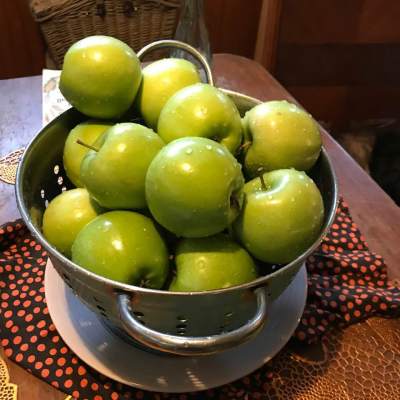
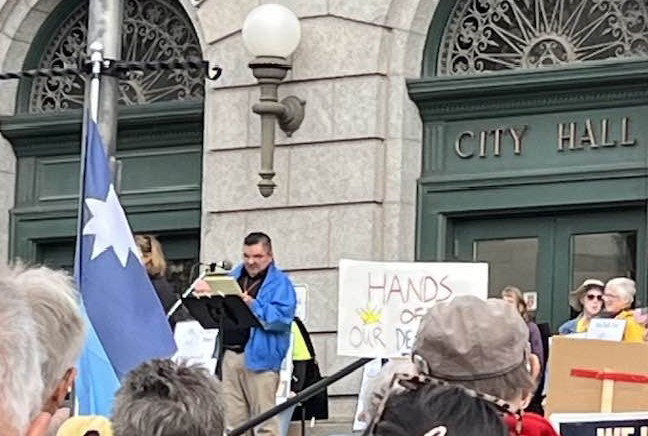
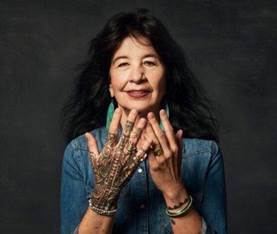
There is something very special about ‘the cutting away and gathering in’ … my very wild gardens are flattened, my wildflower field has just been mowed, trees are turning, and I am possessed by joy.
Near and Far Mountains
It’s at this time of year that the sky opens into a field of dreams. I walk down through the pines to watch the stars appear at dusk – the open field widens my vision. The Great Bear circumnavigates the sky and as other constellations crystalize, I can imagine that it’s possible to re- imagine, to re- weave the threads around the cross-cultural web that is broken. Ordinary perception fails.
I am also reminded that everything changes, and that the seasonal round is the foundation of life.
In this same field during daylight hours birds feast on thousands of scattered seeds that have been baked in summer heat.
This post was originally published on March 17th, 2014.
As I think about the incarceration of young black men for relatively minor drug crimes, and the murders of Trayvon Martin and Jordan Davis, I cannot help but compare the astonishing progress that Americans have made in overcoming prejudice against gays and lesbians to the astounding lack of progress we have made in overcoming prejudice against black Americans.
It is often repeated that the reason for changes in attitudes about gays and lesbians is the process of coming out—most people in America now know a lesbian or gay family member, friend, or co-worker. On the other hand, I would dare to speculate that many—perhaps most—Americans who are not African-American do not know a boy like Trayon Martin or Jordan Davis. If you do—count yourself lucky! Our society remains divided by race and class divisions (many of them a legacy of racism) that prevent many non-black Americans from knowing a single young black man. Continue reading “Legacy of Carol P. Christ: Segregation”
“He looked at me without judgment. With him, I didn’t feel the need to perform.” Both her future husband (first year medical resident) and she (now studying applied linguistics) disliked fundamentalism’s legalism, but they were still committed to Christianity. Both were “devoted to [sexual] abstinence.” Sex did not even happen on their wedding night, but when it did, it hurt. For years, the pain continued. Vaginismus. “I didn’t know there was a name for it. I didn’t know that…it was twice as common for those who had grown up in religiously conservative households.” It took years to get through the pain. “It’s not until we can believe that our bodies are inherently good and worthy of pleasure and joy that we can begin to heal.”
A new pastor arrived at Rollins’ church armed with Christian nationalist ideas and fervor. It didn’t set right with her. She was moving toward progressive positions beginning with “my body, my choice.” She adds, “If there’s anything someone who’s struggled with an eating disorder understands, it’s the concept of bodily autonomy.” She began to research the Reformers beginning with Martin Luther who said this about women: “If women become tired, even die, it does not matter. Let them die in childbirth. That’s what they are there for.” Rollins’ husband pushes back, though, quoting Scripture—“there is no male or female…we are all unified in Christ.” Why then, Rollins wonders, does sexism run rampant in the church?
In her Preface, Rollins writes, “Hypercontrolling my food and using exercise compulsively had always been how I coped with life, stress, expectations, and fear.” Many people (usually women) use this coping technique in their day-to-day lives. Controlling your body’s needs and desires allows you to feel powerful. I know. I am one of those people.
Powerful or being in control was not something the author felt able to achieve in any “normal” way given her upbringing “in an Appalachian [West Virginia] church that fully embraced purity culture [sexual abstinence before marriage] and rigid gender roles.” Rollins continues, “…I’d bought into the scripts offered to me by both diet culture [controlling food intake to achieve a better-looking body] and purity culture [controlling your sex drive] … [knowing] that if I controlled my appetites, I could control my world. That if I made myself smaller, I would be better, safer.”
Rollins interviewed scholars, psychologists, and an array of women while writing FAMISHED. She states, “When women worked to heal from body shame, their relationship to religion was intricately involved.”
The author divides her work into three sections: Girlhood, Marriage, and Motherhood.
Choosing How We Show Up with The Inner Compass of Mind, Eye and Heart
What does it mean, to set an intention? In this piece, I explore the Taoist concept of Yi, the integration of mind, eye and heart as a practice of coming into alignment with life.
This essay invites a nuanced relationship with intention, away from the modern hype around manifestation, and instead rooted in choice, care and conscious participation in life.
Klara Kulikova, Unsplash
A common concern around the word ‘intention’, especially in spiritual or self-help contexts, is its suggestion that thinking the right thoughts or holding the right mindset, will miraculously give you what you want.*) When it doesn’t, the implied message is that you somehow fell short: you weren’t positive enough, not aligned, or evolved enough for it to work. In short, the burden of failing is placed on you, without recognising the complexity of life. Rest assured, that’s not the kind of intention I’m writing about here.
Living as I do in the midst of both Finnish immigrant and Anishinaabe cultures, and where the two merge in the many here who identify as “Findians,” I was intrigued by the description of Kaarina Kailo’s book, Sauna, Culture, Sweat and Spirituality, as a comparative exploration of Indigenous sweat lodges — madoodiswan in Anishinaabemowin — and Finnish saunas.[i] As an outsider to both cultures, I have no ancestral or traditional knowledge of either saunas or sweat lodges and I wanted to learn more about both. Kailo’s book did not disappoint. What I hadn’t expected and was delighted to discover was that Kailo connects both with ancient goddess religions, contemporary feminist spiritualities, and ecofeminism.
Kailo’s book is a widely and deeply researched cross-cultural comparative study of the elements, practices, intentions, and spiritualities of sweat cultures ranging far beyond various Native American sweat lodge practices – Delaware Great Houses, Anishinaabe sweat lodges, Pueblo kivas – and the Finnish sauna,to Iberian/Galician saunas, Irish sweathouses, and Old Europe. As Kailo herself says, the value of such cross-cultural studies is the way they help to expand our thinking, enabling us to see things we might not have otherwise. She repeatedly says that she is looking for the “affinities” among these various sweat cultures, rather than focusing on their differences, and she finds many. In the process, she reveals the role of sweat lodges, sweat houses, and saunas as sacred spaces of healing, restorative balance, connection with the spirits, rebirth and regeneration, women-centered spirituality, and Great Bear religions. Infiltrated throughout are her reflections on how reviving the widespread use of sweat cultures and saunas, and the woman and life-centered spiritualities at their heart, would provide an antidote to the current economic, ecological, and political threats to the world.
Feminism’s critical principle is the affirmation and promotion of the full humanity of women; an assertion that must be made in light of a world that diminishes women’s dignity and autonomy thereby authorizing their subjugation. Sexism is the word we use to name the attitudes, prejudices, and actions that work to diminish women’s dignity and autonomy for their subjugation. Patriarchy is the resultant ossified system of those attitudes, prejudices, and actions as they become the norm.
This post was originally published on March 10th, 2014.
In recent years monotheism has been attacked as a “totalizing discourse” that justifies the domination of others in the name of a universal truth. In addition, from the Bible to the present day some have used their own definitions of “exclusive monotheism” to disparage the religions of others. Moreover, feminists have come to recognize that monotheism as we know it has been a “male monotheism” that for the most part excludes female symbols and metaphors for God. With all of this going against monotheism, who would want to affirm it?
In response to some or all of the above critiques, many modern pagans define themselves as polytheists, affirming at minimum, the Goddess and the God, and at maximum a vast pantheon of individual deities, both female and male, from a single culture or from many, including divinities with animal characteristics. Other pagans define themselves as animists, affirming a plurality of spirits in the natural world. A group of Christian feminists have argued that the Christian Trinity, the notion of God Three-in-One, provides a multiple and relational understanding of divinity.
While also rejecting exclusive monotheism and male monotheism, Jewish poet, ritualist, and theologian Marcia Falk provided a definition of inclusive monotheism that I find compelling.
A few years ago, I took a pilgrimage to Crete with the hope of meeting the Great Goddess. I was yearning from something undeniable, proof that would allow me to be a card-carrying believer. Although our group was led to powerful ancient sites where we enacted sincere rituals and dances, each time I failed to feel greeted by Her universal power.
Except once. And I almost missed it.
The great cavern, Skotino (Photo by Helen Marie Traglia)
One day, a small but determined group of women took it upon us to co-lead a ritual at Skotino cave, an ancient site used for sacred purposes from the Bronze Age through the Roman era. The collaborative approach to facilitating a ritual was new to us, so we all felt especially ignited and giddy. Before we descended into the depths of the cave, I sang, (something I NEVER do). I had been provided lyrics, but I made up my own melody, which my fellow initiates sang back to me, as a call and response.