“The beauty of the planet from 100,000 miles should be a goal for all of us, to help in our struggle to make it as it appears to be.” Astronaut Michael Collins said these words reflecting on seeing the Earth from space. To me, he is expressing the truth that the Earth is our community that we share with all other beings on the planet, our home base. But what does this really mean in its most profound perspective?
Over the years, I have heard people express over and over how they desire “community,” whether that means a neighborhood café or an ongoing circle to share our deepest lives over decades, or any of many other expressions. The emotional and physical impact of isolation and divisiveness over the past months of the pandemic has shown how essential “community” is to our well being, and how we need to think of it as more than just a sense of being part of a group. True community provides us with a sense of belonging and relationship, of being part of a vibrant, interdependent web, of assuming everyone will act in the best interests of all.
Sometimes the best rituals are those we cannot plan, requiring only pine needles and wind, open eyes and a long, slow-sinking sun settling gently into shadows. Sometimes the best magic of all is made with what is exactly right now, bluestem grass and gray feathers, raccoon footsteps between the trees, laughter and joined hands, a faith in the cycles of retreat and renewal. This is what we are here for, days like these.
One crow behind the house greeted me on a frosty solstice morning. Five more slid across the road in front of me as I reluctantly left home to go to the dentist. A red-shouldered hawk glided across the road next and I spotted a kestrel perched on a wire. I drove and sang, memories of our bright candles and solstice spiral the night before behind my eyes, sun bread left rising golden on the counter at home. The dentist has devised a pulley system to hang bird feeders by each of his second story windows and I watch house finches collect sunflower seeds as I lie in the chair. I spot a vulture circling in the distance slow and graceful above the trees. The sky is blue. When I leave the office, I hear a crow’s voice call from across the street and as I drive back home to my family and our winter holiday celebrations, another red-shouldered hawk swoops in front of me, while a red-tailed hawk sits solemnly in a tree by the field, watching the ground. I’m amazed how birds, so unbound, tether me so reliably to the magic of place, to being present with the ensouled and singing world as I move within it and I am grateful.
In the late afternoon on the solstice, my family and I carry the sun bread we have made out to the field by our studio. We join hands and sing and then toss small bits of our golden bread to the sun, calling out our wishes for the year to come and offering our thanks to the spinning world we walk on, beneath this burning sun.
The kids go inside and my husband, Mark, and I walk down the road to finish watching the sun set. It sinks low and slow behind the bare oak trees, growing larger and redder as it goes. It seems to be one of the most drawn out sunsets of this year and we sit down in the frost-crisped dittany by the side of the road, our backs against the oak trees, watching. I turn to look at Mark smiling and say: this is what I am here for, days like these.
I decided to take social media break as 2021 drew to a close, something I’ve wanted to do for a long time, something I’ve needed to do for a long time, and yet, something I’ve always talked myself out of. I need this for our business, I think. It is part of my work. How else will I reach people? I will just post a few more things. While, inside, the hunger to really listen, to de-fragment my mind and re-collect my soul continued to build to a peak of fervency and desire. The blessing and the curse of social media is that everything is in one place. Convenient, yes. Holds you hostage, also yes. Exposes you to more information than you can reasonably hold and process, also yes. The first day of my break, I was amazed how often I was tempted to cheat, how many ways I came up with to sneak around the limit and to just do one little thing anyway. I was also surprised to discover how much extra space there is in my mind and how liberating it is to step away from the clamor of so many other voices. As Cal Newport explains, we all need time each day when we are outside of the influence of other minds. And, I was surprised by how invisible I felt, how unseen and unheard. As the days passed, I felt it though, my scattered pieces coming home. I knew that social media was affecting my focus and my brain functioning, could feel it fragmenting my thoughts, and making my focus and attention jumpy and scattered. In these days of silence, something began to heal inside. I feel a bit invisible, yes, but I also feel whole. I feel like I am coming back online, to my own life.
What was intended only as a ten day break over the winter solstice, extended through the first month of new year and while I’m not saying I’m never going back, I find I am in no rush to re-engage, certainly not in the way I had before.
In the reclaimed attentional space within, I discovered the soulsong of a new book walking up to me, hands extended and eyes wide.
We walk again under long wings of twilight, last vestiges of day sinking purple and mauve into the horizon. Somehow we end up talking about cryptocurrency and NFTs.
Give me dirt and give me stars, I say, as our feet crunch across the brown gravel, our shoulders hunched slightly against the wind. Give me life, right here, where it is.
As we come back up our driveway, we spot a doe at the compost pile, she watches us silently as we turn to make one more lap down the dusky gravel road.
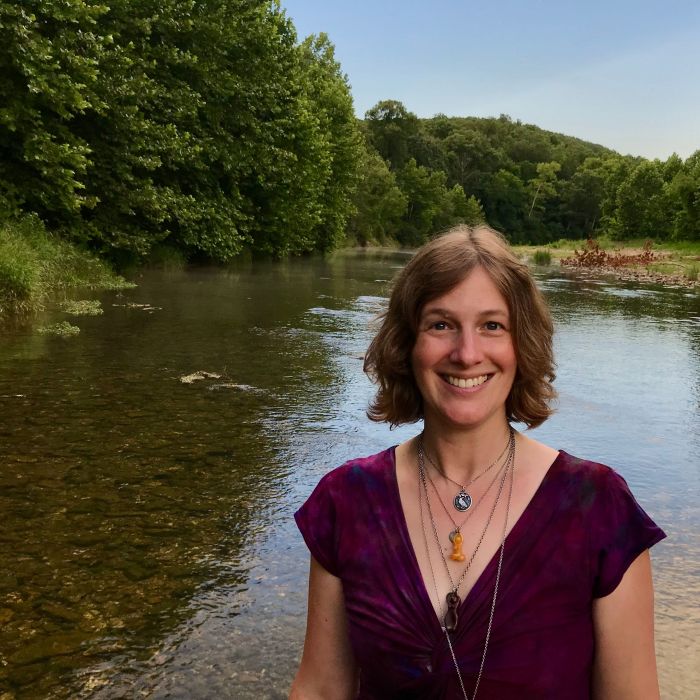
Molly Remer, MSW, D.Min, is a priestess facilitating women’s circles,seasonal rituals, and family ceremonies in central Missouri. Molly and her husband Mark co-create Story Goddesses at Brigid’s Grove. Molly is the author of nine books, including Walking with Persephone, Whole and Holy, Womanrunes, and the Goddess Devotional. She is the creator of the devotional experience #30DaysofGoddess and she loves savoring small magic and everyday enchantment.

Note: this essay is excerpted in part from a book in progress, tentatively titled Walking with the Goddess.
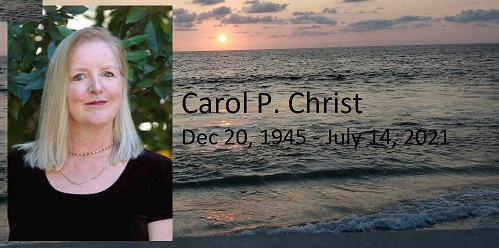
Moderator’s Note: We here at FAR have been so fortunate to work along side Carol Christ for many years. She died from cancer in July, 2021. Her work continues through her non-profit foundation, the Ariadne Institute for the Study of Myth and Ritual and the Goddess Pilgrimage to Crete. To honor her legacy, as well as allow as many people as possible to read her thought-provoking and important blogs, we are pleased to offer this new column to highlight her work. We will be picking out special blogs for reposting. This blog was originally posted March 23, 2013. You can read it long with its original comments here. Carol provides links to the three posts of hers that we have reposted recently.
There are many reasons for women, slaves, and the poor to rebel against domination and unjust authorities in patriarchal societies. But we should not assume that there are any reasons to rebel against domination where no domination exists or to rebel against unjust authority in societies where there are no unjust authorities.
In response to my recent series of blogs on patriarchy as a system of male dominance created at the intersection of the control of female sexuality, private property, and war (Part 1, Part 2, Part 3), I was asked if there is an injustice inherent in matriarchal societies that caused men to rebel and create patriarchy.
Moderator’s note: This marvelous FAR site has been running for 10 years and has had more than 3,600 posts in that time. There are so many treasures that have been posted in this decade that they tend to get lost in the archives. We have created this column so that we can all revisit some of these gems. Today’s blogpost was originally posted July 1, 2018. You can visit the original post here to see the comments.
I bet almost no one knows this secret: the United States is being watched over by two goddesses! One of them stands on top of the Capitol dome in Washington, D.C. The other stands on an island in New York harbor.
The goddess standing above our congressional building is named Libertas, or Freedom. She’s a Roman civic goddess whose sisters are Concordia and Pax. Although the Romans hardly ever experienced freedom, civic harmony, or peace, they always kept their eyes on the possibilities. Libertas was sometimes merged with Jupiter, sometimes with Feronia, who was originally an Etruscan or Sabine goddess of agriculture or fire. In Rome, Feronia became the goddess of freed slaves. Libertas is shown on Roman coins as a matron in flowing dress and wearing either a wreath of laurel leaves or a tall pilleus, which is called a “liberty cap” and looks like a witch hat without the brim. And there’s also a bird—is it a raven?? She holds either a liberty pole (vindicta) or a spear, and in some paintings of her (she was a popular subject in the 19th century) there is a cat at her feet.
Because the late 18th century is sometimes referred to as the Augustan Age (for classicism in architecture, literature, and art and named after the first Roman emperor, Caesar Augustus), the Roman Libertas became Lady Liberty during the American Revolution. To celebrate the repeal of the Stamp Act in 1766, Paul Revere created an obelisk with an image of Lady Liberty on it, and a short time later, Tom Paine addressed her in his poem, “The Liberty Tree.” An enormous bronze statue of Lady Liberty was commissioned in 1855 for the top of the Capitol building, and she was hoisted up there in 1863, where she stands, hardly visible, to this day.
Here’s my idea. This FAR community has lots of power. We—and at least two thirds of the U.S. population—are very unhappy with the antics of the Lyin’ King and his court…excuse me, the executive and legislative branches of our national government. So let’s visualize Libertas coming to life. Watch her stomp her heavy bronze feet so hard she breaks a hole in the top of the dome. Watch her fly down into the main lobby of the Capitol. Now she turns in one direction and stalks into the Senate. “Gentlemen and Ladies,” she begins, “you were sent here to do a job. You’re not doing your jobs. Work together! Learn to compromise. Stop talking so much. Get to work!” And then she marches into the House. “Why are you here?” she asks. “And why are you here only three or four days a week, and why aren’t you working for the benefit of all the citizens of the United States?” I suspect that Libertas, who is 19 feet 6 inches tall and weighs approximately 15,000 pounds, could indeed put a scare into Congress, not to mention all the lobbyists. Remember, she also carries that spear. And she no doubt knows how to use it.
Our second national goddess? “Liberty Enlightening the World,” whom we call the Statue of Liberty, was a gift from France to the U.S. circa 1886 on the occasion of our centennial. Designed by Frederic-Auguste Bartoldi and Alexandre Eiffel (who also built a famous tower in Paris), Lady Liberty holds a tabula ansata (a tablet evoking the law) in one arm and with her other hand raises a torch, a common symbol of truth and purification through illumination. She wears a crown of solar rays similar to the crown worn by the Colossus of Rhodes, one of the seven wonders of the ancient world.
For almost a century and a half, Liberty has welcomed immigrants to our Atlantic shore. Those immigrants were the grandparents and great grandparents of nearly all of us. Now let’s visualize Liberty taking action. Goddesses can perform magic; let’s visualize Liberty multiplying herself into 10,000 Liberties, and then let them travel to Texas, New Mexico, Arizona, and California and—you guessed it—let them stand facing south. Let these 10,000 goddesses with torches of purification replace the Xenophobe-in-Chief’s wall/fence/border army. Let’s ask Liberty to welcome people into the U.S. Because she’s smart (and the flames of that torch can reveal a lot) and there are indeed drug smugglers traveling in addition to men, women, and children who are coming for sanctuary or safety or work, let her use her torch to reveal the small proportion of criminals trying to sneak in. And let her welcome and protect everyone else and keep families together. (Maybe she could send all the ICE agents off hunting coyotes, who are no doubt smarter and more humane than they are.)
Here is the full text of “The New Colossus” the poem by Emma Lazarus that Lady Liberty proclaims to the world. Maybe our senators and representatives should read it—for the first time, I bet. They should pay attention to what it says and obey the words and principles of this goddess.
Not like the brazen giant of Greek fame, With conquering limbs astride from land to land; Here at our sea-washed, sunset gates shall stand A mighty woman with a torch, whose flame Is the imprisoned lightning, and her name Mother of Exiles. From her beacon-hand Glows world-wide welcome; her mild eyes command The air-bridged harbor that twin cities frame. “Keep, ancient lands, your storied pomp!” cries she With silent lips. “Give me your tired, your poor, Your huddled masses yearning to breathe free, The wretched refuse of your teeming shore. Send these, the homeless, tempest-tost to me, I lift my lamp beside the golden door!”
Let us visualize both of these American goddesses doing their work and protecting the hard-won rights of everyone who lives in the United States.
BIO:BIO:Barbara Ardinger, Ph.D. (barbaraardinger.com), is the author of Secret Lives, a novel about crones and other magical folks, Pagan Every Day, a unique daybook of daily meditations, and other books. She really enjoys writing her monthly blogs for FAR. Her work has also been published in devotionals to Isis, Athena, and Brigid. Barbara’s day job is freelance editing for people who have good ideas but don’t want to embarrass themselves in print. To date, she has edited more than 400 books, both fiction and nonfiction, on a wide range of topics. She lives in Long Beach, California, with her rescued calico cat, Schroedinger.
Moderator’s note: This marvelous FAR site has been running for 10 years and has had more than 3,600 posts in that time. There are so many treasures that have been posted in this decade that they tend to get lost in the archives. We are beginning this column so that we can all revisit some of these gems. Today’s blogpost was originally postedMay 20, 2019. You can click here to see the original comments.
Trigger Alert: The bible on its face is quite violent to women.
Amidst the ugliness that is American politics in general and abortion politics specifically, I began to look for guidance to understand what is happening. I ended up pulling out two books that I read long ago. The first is Woe to the Women-The Bible Tells Me So by Annie Laurie Gaylor. Gaylor, in turn, was inspired by the work of Elizabeth Cady Stanton in her The Women’s Bible which was originally published in two parts (1895 and 1898).
I had forgotten how inspired I have been by both books. Together, they motivated me to begin looking at how the bible is a foundational paradigm of our culture. I started researching how translations have been altered from original meanings. I have already written a few blogs about how the representations of Eve have been changed to strip Her of the roots of Her original power. Take a look here and here.
As a society, we are not good at grief. Three days max, then we are expected to be back to work, keep the economy humming – shop, go to the movies and the mall, “put on a happy face.” Required to wear a cheery countenance, we deny our suffering and the suffering of others. However, loss unacknowledged compounds its effects. Grief will unleash itself somewhere, whether manifesting in excessive consumption – of food, alcohol, Netflix, stuff; or in unquelled anger, violence, hatred, enemy-making, and scapegoating — all of which have been erupting onto our world in devastating ways; or in the unmetabolized pain we pass on to the next generations. It is essential to our individual and collective well-being that we welcome grief, and tend it.
Strains of “In the Bleak Midwinter” have been accompanying me on my wintertime walks. Yet “bleak” is the last word I would use to describe these glorious winter days. The sparkling snow, dazzling sunshine, and deep blue of the sky against white birch branches offer solace to my soul. Still, the carol rings true, for in this midwinter, bleakness – a sense of desolation, loss, and despair — shrouds the land. Many dear to me have suffered tragic losses – of brothers, mothers, sisters, children, friends, partners and spouses – to cancer, suicide, alcohol, a hit-and-run driver, injury from a fall, dementia, sudden death, and sheer despair. An aggrieved world spins out tendrils of affiliated losses — of community and country, safety and security, watersheds and wild places, touch and tenderness and trust; family and faith — whether in god or humanity or the future. Thousands have lost the tangibles of jobs, shelter, savings, and physical capacity, and millions more the intangibles of dreams deferred, hopes for a nation, and belief in the basic decency of our fellow humans. And then there are the ordinary, everyday losses. As a friend recently posted, “I am grieving. I miss Sunday breakfasts at the cafe. Live music. Dinner parties. I miss seeing people smile in the grocery aisle.”[i] We are all suffering utter and ongoing loss.
I have always had a relationship with plants. All the women in my family were gardeners and I had my first garden when I was about four year old. But it wasn’t until mid-life that I began to sense that this woman-plant relationship might be more complicated than I realized. Blurred boundaries. Intimacy. Weavings underground. My dreams were full of vines that hugged the earth and spiraled like serpents sliding on bellies through deep green forests. I could grow plants that others could not. Was it the attention I gave plants? Love? I saw them as friends, as equals. I loved touching and caring for them.
When I saw my first passionflower blossom at a neighbor’s house I practically swooned. I fell in love with the flower and its scent. Not the generous type, I had to beg for a cutting for two whole years before this woman finally relented. Thrilled, I brought the cutting home. It was spring. I put it in water. To my joy it rooted in a few weeks warmed by the April sun, and within three months I was able to pot the cutting.
Moderator’s note: This marvelous FAR site has been running for 10 years and has had more than 3,600 posts in that time. There are so many treasures that have been posted in this decade that they tend to get lost in the archives. We are beginning this column so that we can all revisit some of these gems. Today’s blogpost was originally posted February 1, 2014. You can visit it here to see the original comments.
Brigid, Goddess of the Fire, greets us on Brigid’s Day, February 1. She is a Celtic sun goddess whose light burns brightly, illuminating the darkness of the land, of a heavy heart, and the dark night of our soul. With her shining light to guide us, we are lifted out of the Underworld darkness where we tend to descend in Winter, to the light of the World above, teeming with life as Spring begins to unfold her wet wings.
Brigid is a beloved goddess throughout the British Isles, particularly Ireland, where she is seen as the Mother of the Land and Her people. As a feminine archetype, she activates our solar, active nature. Much like the sun rising from below the Earth’s horizon, she urges us to come out of hiding and shine our light on the world. This may be done in a quiet manner, such as sitting by the hearthfire and doing needlework, finding inspiration by a walk in nature and writing a poem, moving about the kitchen making soup, getting busy with an art or craft project, or in big ways by taking on new roles as healers, artists, and leaders and calling others to join us.