Someone told me the other day that Death Doulas are one of the fastest growing career fields out there right now. As a (currently not practicing) Birth Doula, this does not surprise me. The term Doula came into its modern – predominately American – usage in the early 1970s, in reference to a woman who provided non-medical care for a birthing woman. The word is Greek in origin and depending on who you ask, means “with woman” or “servant woman.”
While I suspect the earlier “servant woman” version is the correct etymology, the romantic in me appreciates the “with woman” version, even in its technical inaccuracy. This is because at its core, the role of the Birth/Postpartum Doula is the formalized return of what I believe in my bones to be an ancient cultural practice of women being with each other as a woman passes through an intense life transition.
Whereas before, when a woman gave birth, the older, multiparous women of the local culture would gather around her to see her through her passage from expectant to postpartum motherhood; now some of us approaching that same rite of passage use the Internet to reach out into the culture to hire a Doula to do that very same thing. How we bring it about has changed, but what we desire has not. We desire to be supported, cared for, & loved by someone who has gone through what we are about to — we desire to be with women.
The number of Birth Doulas in the U.S. and abroad, at this point, has increased dramatically over the last ten years and now it would seem that the Conscious Birth movement has birthed a Conscious Death movement, complete with Death Doulas. Again, how we secure the care we want at birth or at death has changed, but what we desire in those powerful moments of passage has not.
The fundamental physical, emotional, and spiritual craving to be with women at life’s major rites of passage runs incredibly deep within us. It is also something denied to us by the patriarchal structures of most major religious systems, but over the last sixty years or so, we’ve worked hard at taking that back. Continue reading “With Women by Kay Bee”


 While trying to find a topic for today’s blog, I came across a facebook post from July 10 by former Orthodox priest Christoforos Schuff in which he announced:
 Introduction by Maeve: Elizabeth’s July post usually features an excerpt from my Chronicles in honor of my feast day, July 22. This year the excerpt comes from the novel that opened the way for my story. Ever since a playdough figure took shape spontaneously in her hands, Esther, a minister’s wife, has been on a quest to find out Who She Is! Here she encounters the Lady as the Virgin Mary. (For my take on the BVM, aka Ma, the scene stealer, see The Passion of Mary Magdalen and Bright Dark Madonna.)
 Recently I need to take a deep breath every time I glance at the news headlines. There are terror attacks and military conflicts. People kill each other and cause each other immense suffering. The worst thing is that so many of these conflicts are between people who have lived side by side for centuries: between related ethnic groups or neighbouring people.

 Doing a recent talk on pioneering woman writers, I like to do the Before Jane Austen test with my audience. Who can name a single woman writer in the English language before Jane Austen? Alas, because woman have been written out of history to such a large extent, most people come up blank. Then we talk about pioneering Renaissance authors, such as Aemilia Bassano Lanier, the subject of my recent novel,
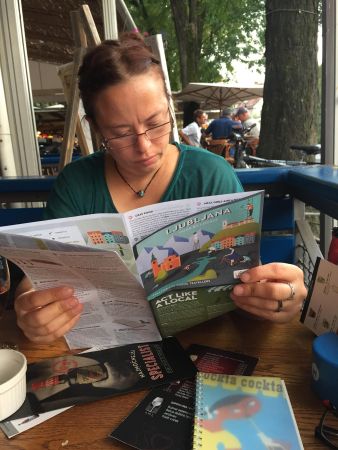 My partner and I are getting married in a little over a month. She, a lawyer, and I, a professor, live in the Czech Republic. Technically, we aren’t getting married because the Czech Republic doesn’t have marriage equality. Our relationship will not be recognized in the U.S. For that, we need to be married in a state or nation that has marriage equality. Germany might soon. Other options would be a number of EU countries or the United States, but that doesn’t affect our status in the Czech Republic. Finally, our marriage will also not be recognized by some in Jewish circles as well since the
