

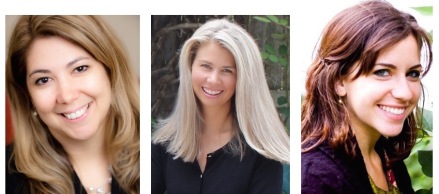
 It seems like every few weeks another young, female celebrity proudly and publicly declares she is not a feminist: Shailene Woodley. Katy Perry. Kelly Clarkson. Kendall Jenner. These women often justify their refusal to claim feminism by explaining they do not hate men—speaking to the most intractable and yawn-worthy of the mischaracterizations of feminism—or by insisting they do not personally face inequality.
Nevermind that compelling movie roles for women dry up decades before those for men, or that recently 37-year-old Maggie Gyllenhaal was deemed “too old” to play the love interest of a 55-year-old man. (Thank you, Amy Schumer, for the Last F**kable Day Skit!). Even if we accept these young stars’ claims that they don’t face any discrimination, feminists wonder where the concern is for other, less privileged women.
This question is both frustrating and justifiable. On the one hand, who cares what a reality television star thinks of feminism? On the other, these women tremendous power to influence young women. For them to dismissively say, “I have rights, so who needs feminism,” both dishonors the sacrifices of our foremothers and ignores the reality that women’s rights are still in play.
They are still in play for women seeking equal pay for equal work, for those who want paid maternity leave, and for those who seek access to reproductive health. They are still in play for women of color and for LGBT women.
And they are still in play for women of faith.
Gender continues to be a serious issue in patriarchal religious traditions, and women continue to be denied particular roles because of their genitalia and/or gender expression. However, while mainstream feminists practically beg young celebrities to adopt the “feminist” label, women of faith are mocked for actually claiming a feminist identity and working within our traditions to combat sexism. While mainstream feminism seems desperate to have in its fold a 19-year-old reality television star who is famous in no small part because her older sister’s sex tape went viral, mainstream feminism rejects empowered women of faith.
So why have we become second-class feminists?
We understand the appearance of a disconnect between our faith and our feminism. We acknowledge that our religious traditions suffer from sexist interpretations. We understand why some feminists leave our faiths, and we have been tempted to do the same. But even if every Jewish, Christian and Muslim feminist abandoned her tradition, there would still be many women who stay, women for whom that decision has religious jurisprudential consequences. They will still be subject to Halakhah, Canon law and fatwas. They will still face exclusion from leadership roles. They will still endure pressure from community members who accept women’s lesser status based on the teachings of unenlightened rabbis, priests, and imams.
We acknowledge and concern ourselves with these real world impacts of our faiths. But we also recognize our faiths’ foundational messages for what they are and the ways they’ve been misconstrued. In other words, we refuse to let our traditions be defined by sexist interpretations.
This refusal takes many forms. Jewish, Christian, and Muslim feminist scholars are working within the framework of existing translations of the Torah, Bible, and Qur’an, producing new translations of those texts, and, in some cases, questioning the authenticity and divinity of verses that appear irredeemably sexist. At the same time, female activists are committing radical acts of worship that address longstanding sexism. Anat Hoffman was arrested and strip searched for her activism seeking legal recognition for Jewish women to pray out loud with traditionally male religious garb at the Western Wall in Jerusalem. Kate Kelly was excommunicated after founding the movement Ordain Women and calling for women to take on leadership roles within the Mormon Church. Amina Wadud endured international condemnations and threats of violence when she became the first woman to lead a mixed-gender Muslim prayer in the U.S.
These are dedicated, tenacious women who refuse to abdicate their religions to sexist interpretations. This is what courage looks like. This is what feminism looks like.
And yet, while mainstream feminists pine for young stars to pay lip service to feminism, women of faith who are actually doing brave and difficult work are routinely told they cannot be “true” feminists.
We recognize that many people think it is only a feminist act to leave patriarchal traditions. We contend that it can also be a feminist act to stay, and we look forward to the day when doing so puts neither our faith nor our feminism in question.
___
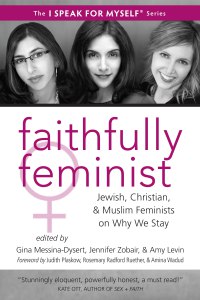 This piece was co-authored by Jennifer Zobair, Gina-Messina-Dysert, and Amy Levin, the co-editors of Faithfully Feminist: Jewish, Christian, and Muslim Feminists on Why We Stay.
 Driving around my town in North Carolina, I have come across a handful of houses that had decorated their yards with an empty manger staged in front of an empty cross. This juxtaposition of Christian symbols struck me as peculiar, so I began asking some of my friends if they had ever come across a display like this.
 In early December 2016 I visited central Williamsburg in Brooklyn, New York, where my 2x great-grandparents
  Winter Solstice in the Northern Hemisphere is the day of the least daylight and the longest night. Long before Christmas our Northern European ancestors celebrated the Winter Solstice, the moment that heralds the return of the sun and with it the promise of new life in spring. Without the comforts offered by modern technology, this time of year must have raised fears in the hearts of our ancestors; fear that the sun would not return to its summer glory, fear that there would not be enough food for the winter, fears that surface most easily in the dark. A celebration of light would have been most welcome and needed.
 The sense of separate personal identity is elusive. It is difficult to observe, find and bring to the surface of consciousness where, according to Buddhist beliefs, it dissipates naturally, like a bubble of foam popping. In the same way patriarchy is entrenched in so many different ways and on so many different levels in society that it is as difficult to reach out to it and weed it.
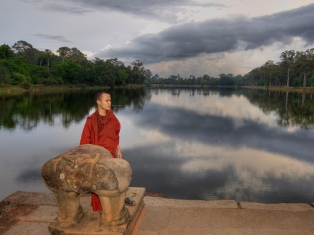 There is a Sutta in Theravadin Canon called “
 takes place over a few days in the life of the Church of the Regeneration as the women prepare for their annual rummage sale. Charlotte Crowley, an over bearing kleptomaniac who wraps men around her little finger while antagonizing most of the women, has always led the effort. But with only a few days to go before the sale begins, Charlotte is found dead in the basement, smothered by a plastic dry cleaning bag full of coats.
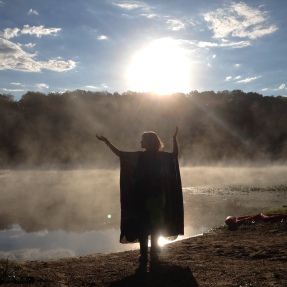 living with your feelings, touching the earth, and embracing the fullness of your humanity.”
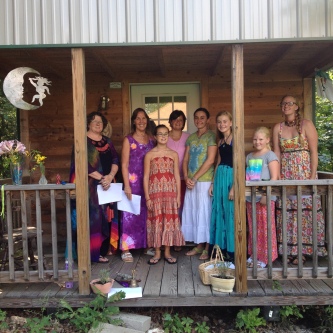
 In this building I write, work, create, and hold small rituals with a circle of friends. I call it my Tiny Temple and it is the proverbial, “room of one’s own” described by Virginia Woolf in 1929. Having a dedicated work and ceremony space in the midst of a home-based life, which includes a home business shared with my husband, and four homeschooled children, has changed my life profoundly. In the tiny temple, I feel most wholly myself: connected, powerful, free, authentic, and completely alive.
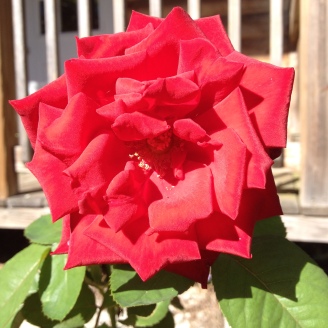 “We may need to be cured by flowers.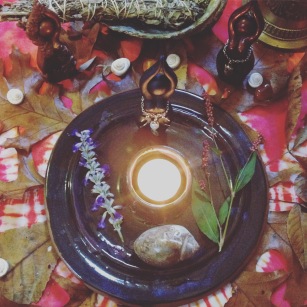
 Like many others, I too have been thinking of this election the past month or so. A lot has been said about the repercussions a Trump presidency will have on immigrants, women, the LGBTQ community, non-Whites…the list is endless. But in this post, I would like to talk about personal matters, and what it meant for a first-time voter like me to vote in the US elections. I have been living in the United States for over seventeen years, but only recently – in April this year – did I apply for citizenship.
 The Refugee Crisis: Through the Eyes of the Children by Robert and Robin Jones. Santa Barbara, CA: Blue Point Books, 2016. $19.95. Website:
