 As discussed in earlier blogs, the sources tend to paint pious women as recluses for any number of reasons. No matter the intention, the message transmitted over time–in so many ways–is that pious women should restrict their social lives, especially their public social lives, even if that means restricting spiritual or scholarly engagement. But what I have been arguing over this series of blogs is that pious and Sufi women lives were not restricted in the way they are portrayed. Thus I argue that despite the messaging that silence is the mark of our purity, there is little historical ground for it. If we are to take the Prophet’s wives and pious and Sufi women such as Hafsa bint Sirin seriously as models for women’s piety, then there is no “sunna” of silence or social disengagement to be a good woman.
The portrayal of the tender relationship between Hafsa and her son is out of character in the literature concerning early pious and Sufi women. When children are mentioned in these sources, it is almost always in bare sketches depicting their service to their mothers, transmitting their mother’s wisdom, or, less often, distracting their mothers from their worship. For all the idealization of mothers in Islam from the early period onward, it is surprising to find this aspect of women’s experience missing from biographies devoted to articulating their piety. Even in those very few accounts in which a loving relationship is depicted between mother and child, like Hafsa and al-Hudhayl, the stories seem to be used mainly to portray the mother as an idealized solitary worshipper, not an idealized mother.
After al-Hudhayl died, Hafsa became close with her student Hisham who seems to have become something of an adopted son to her. She shared stories about al-Hudhayl with him which he transmits and are recorded in the sources. But these stories are not transmitted in order to demonstrate the tenderness of their relationship. Consider that Hafsa’s intent may have been to share stories with Hisham about her close relationship with her son, but the transmitter’s intent was first and foremost to show that she stayed awake all night in solitary prayer and that she fasted everyday.
Playing down the presence of children in these women’s lives seems to have less to do with de-emphasizing the women’s identity as mothers or grandmothers as it does with de-emphasizing women as embodied social beings of which motherhood is a part. Women raised their children as part of a community of other women, members of their extended families, and neighbors in which the shared experience of the cycles of life create ineluctable social bonds. Just because these relationships are not documented in the texts, does not mean we cannot logically infer the possibility of them given all the other evidence to hand.
Given the structure of homes at the time in Basra and the common practice of extended families living in related quarters, Hafsa, her son, and his family probably lived in a grouping of rooms with a shared courtyard and an area set aside for his camel. Her son visited with her regularly. Given the social roles of family members during that time, it is likely that her daughter-in-law helped out with cleaning and cooking. After al-Hudhayl died, his wife probably returned to her own family. Hafsa is reported to have purchased an enslaved girl to do the household chores after he died. This girl, about whom we have no other information, was asked about her and transmits a story about her habit in prayer. She was Hafsa’s unwilling companion. Her sister is said to have visited her often, and although we only have the story of the lamp from her, I find it hard to believe that they never spent time with one another as sisters do. Likewise, there are no stories of her and her sister Karima visiting each other or worshipping together, even though Karima was also known for being a devoted worshipper.
Her brother Muhammad’s wife is said to have been almost continuously pregnant and to have lost nearly all her children. These were hard times in Basra and Muhammad had little interest in business. His work as an itinerant cloth salesman seems to have been more of an opportunity for him to sit with other scholars and pious folk. His wife and children seem to have lived in dire poverty. Given Hafsa’s close relationship with her brother and love of her own child for whom she would grieve so deeply, it is hard for me to imagine that she never came to the aid of her sister-in-law. No doubt her sister-in-law’s own family would be there for her, but in this cultural context it would be expected that all the members of extended families would care for one another.
Perhaps more telling for the silence in the texts, we never hear of any grandchildren or her siblings’ children visiting her. She had twenty-two full or half brothers and sisters. A number of her siblings were also scholars and pious worshippers. It seems impossible that any of their children, not to mention Ibn Sirin’s surviving son who would become a scholar himself, never sat with her to learn Qur’an and Hadith as a child. Ibn Sirin sent his own companions to study with his sister, but not his son who would himself become a pietist and transmitter of hadith? Just because these relationships are not documented in the texts, does not mean we cannot logically infer the possibility of them given all the other evidence to hand.
So despite almost no mention of these social relations in the reports concerning her, I feel comfortable assuming that Hafsa would have spent a good amount of time with her sisters, sister-in-law, daughter-in-law, their children, not to mention her enslaved servant.
If my understanding of her life as filled with family, friends, and her students is correct, then it is impossible, as the sources report, that she only left her place of prayer long enough to relieve herself and get some sun. This claim becomes even more implausible when we consider that the very reports attesting to her extraordinary solitude are transmitted by people who so often spent time in her company: the young men who studied Qur’an with her on a regular basis. In particular, Hisham visited with her socially in her old age, learning from her, taking advice from this wise old woman, and listening to her as she shared stories about her relationship with her son.
Most likely, then, Hafsa stayed awake in worship from the evening prayer to the morning prayer, slept until the midday prayer, then received visitors, students, or visited others during the afternoon hours, performing the afternoon and sunset prayers at their appointed times. This schedule would leave her ample time to take part in the social life of her home as well as teach her classes on the Qur’an and Hadith. We know too that she traveled for Hajj several times in the company of others and visited the homes of elites in Basra. Finally, consider that at least on cold nights, her son, and then her slave, kept her company through the night feeding the fire while she prayed.
All of which begs the question, when was this recluse ever alone?
This entry marks the completion of the Hafsa blogs.
(Accounts are taken from Ibn Saʿd’s Tabaqat al-kubra, her transmissions of hadith, and Ibn al-Jawzi’s Sifat al-safwa).
The featured photo is of the Senegalese Sufi leader Sayyida Zeynabou Mbathie and disciples at a Friday ḥaḍra (gathering) and sikkar (zikr, dhikr). For more on the many female Sufi leaders of Senegal see Hill’s linked article or his forthcoming book Wrapping Authority.
Laury Silvers is a North American Muslim novelist, retired academic and activist. She is a visiting research fellow at the University of Toronto for the Department for the Study of Religion. Her historical mystery, The Lover: A Sufi Mystery, is available on Amazon (and Ingram for bookstores). Her non-fiction work centres on Sufism in Early Islam, as well as women’s religious authority and theological concerns in North American Islam. See her website for more on her fiction and non-fiction work.


 Autumn of 1977. The faculty wives have come together in the modest University Heights home of a physics professor. Their Aquanet hair is sprayed to the heavens and at significant risk of igniting from lipstick-stained cigarettes that are resting precariously in the cradle a heavy crystal ashtray. Their business is serious. They are putting together a cookbook. The Faculty Wives Cookbook of 1977, to be precise. It is a noble task. They will cook from it for their young families, for their husbands, that is, the faculty. Even more, they will use each other’s recipes. Martha will cook Mary’s chili; Margaret will lose weight on Donna’s diet cabbage stew. It is an achievement that will be smugly displayed on bookshelves for decades. It will yellow, and the black plastic spiral binding will wear and crack. The Kinko’s heavy card stock cover will be ringed with coffee marks. And, one day, daughters-in-law will decide whether to keep it or to pitch it out.
 Last month, I took a dear friend on a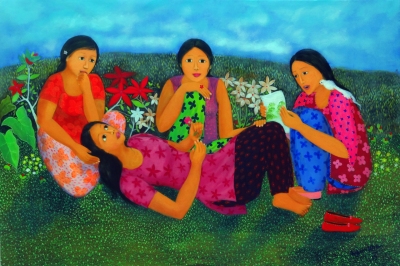
 History offers few instances of women helping create scripture. Hinduism’s sacred Rigveda may have been partly composed by women, and scholars believe the biblical Book of Ruth was possibly written by a woman, but the evidence for each is wanting. And while Muhammad’s widow was entrusted with the manuscript that would become the Quran, its scribe was a man named Zayd ibn Thabit. The only clear exception to this is the Book of Mormon, which Joseph Smith partially dictated to his wife Emma. The central role of Mormon women in the church was therefore fixed from the start.
 Recently FAR contributor
  I’ve been married for most of my life. Marriage, along with all our institutions, is influenced by and therefore takes shape from the culture/society in which it exists. When I got married, I had certain expectations that I’d absorbed from my environment. Attaining “marital bliss” by achieving an indistinguishable oneness with my spouse was part and parcel of it all. Popular thought tells us that marriage (especially heterosexual marriage) brings about the completion of two individuals. How often do we hear about people searching for, and sometimes finding, a person they label as their soulmate? People seem to long for that one human being they think will make them happy.
 Working alongside my dad on the family farm, I grew up learning how to operate and maintain machinery: tractors, balers, and a double-shift 10-wheeler. We worked outdoors in weather with temperatures ranging from minus 10 to plus 110 degrees Fahrenheit. You could say, I developed a thick skin. Snide comments about me being a girl, doing a man’s job, rolled off.
 Boann, Celtic Goddess of Poetry, Fertility, Inspiration, Knowledge and Creativity was one of the Tuatha De Danann (People of Danu). She was associated with the 70 mile long river Boyne in Northeast Ireland and its source, the Well of Segais. Some bards say that long, long ago when the world was young and wild places were everywhere, Boann initiated that spring by walking counter-clockwise around stones found there, causing the water from under the earth to spring forth with great strength and rush down to the sea. The pool formed by the spring was encircled by nine sacred hazelnut trees, whose nuts could impart knowledge when eaten. The salmon of wisdom swam in the waters of this hidden pool from which the river Boyne flows.
