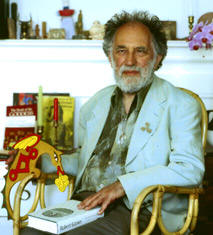
“If You Allow Gay Marriage…” by John Erickson

“We need to start examining the underlying questions of counter-cultural relationships that view one man marrying many women to be hip because we begin to see that although a polygamist idea of marriage may be sexy from a popular culture standpoint, the thought of legally recognized gay marriage always then gets likened to bestiality.”

… you have to allow polygamy, bestiality, and everything else!” The title for my post this week is a quote from an individual I used to associate with.  This individual, haling from a conservative evangelical background, tried to explain to several others and myself the reasons why gay marriage would eventually lead to the repeal of anti-polygamy and bestiality laws across the United States.

The problems that I have with this particular argument are conflating gay marriage with religious freedom.  Activists and scholars can draw comparisons to anti-polygamy cases such as the 1878 U.S. Supreme Court case Reynolds v United States and the 1882 Edmunds Act and 1887 Edmunds-Tucker Act that disfranchised and led to the imprisonment of Mormon polygamists. But in the end, gay marriage is not about religious freedom but rather human rights.

I often feel that there is this need both within and outside religious communities to promulgate the idea that LGBTQ individuals want to get married within the sanctified walls of “the church” just as much as heterosexual couples do.  Although I do not want to disqualify those who desire to see LGBTQ equality within their faith based communities, buying into a heternormative ideal of what traditional marriage should look like needs to result in LGBTQ individuals asking why marriage should be performed in sacred spaces in the first place The normative traditions that have often defined marriage have also served as shackles keeping LGBTQ couples in the mindset that to achieve fully marriage equality with their heterosexual counterparts is to fully immerse themselves within the same traditions and practices. Continue reading ““If You Allow Gay Marriage…” by John Erickson”

The Naming of Our Mother-Lines by Cynthia Garrity-Bond

I am Cynthia, daughter of Pauline, daughter of Ellen, daughter of Mary. I first spoke this litany of names at a retreat given by Carol Christ.  As we entered the chapel, each woman was given a rose to place in the center of the circle after she recited her own mother line.  Simple but incredibly powerful, a beautiful reminder of our matriarchal inheritance.

The reflection of this ritual is all the more rich because today is my birthday. Especially since my mother’s death in 1990, March 9 is a day of reflection on our complicated mother-daughter relationship with all its highs and lows that marked our lives.  But what I really miss from her are the stories told around the kitchen table, starting with the uniqueness of each of our births.  With each one, the hope and expectation of both parents was for a daughter.  Not until the fourth birth did their plea to St. Jude, patron saint of lost causes (and our family’s most depended on saint), bring forth their highly anticipated girl. Continue reading “The Naming of Our Mother-Lines by Cynthia Garrity-Bond”

Preying on Victims: Radical Christianity and Exploitation of Tragedy in the Name of God By Michele Stopera Freyhauf

It is our moral responsibility, whether we identify as Christians or not, to pray for not prey on the victims of tragedies.

Over the last month, dare I say years, society has witnessed or been subjected to an all out war from radical Christians across America deploying the wrath of God and reveling in the tragedy of others to perpetuate their apocalyptic message of rhetoric and terror.   As I hear the news over the last few months, an old Billy Joel song starts to play in my head “We didn’t start the fire.”  Whether we started the fire or not, we should not feed the flames of hatred but figure out a way to extinguish it.

Here is a brief synopsis of current events that reflect this hatred and radicalism perpetuated in the name of God – examples of Christianity terrorizing or preying on victims through their actions.

The Westboro Southern Baptist Church: Preying on Victims at Funerals and Thanking God for their Tragic Deaths

Original Picture found at http://www.newsnet5.com

Their web address says it all: www.godhatesfags.com.  This group, which one cannot call Christian but rather “hate-mongers,” threatened to burn the Qur’an, was banned from Facebook for spreading hatred against homosexuals, and recently had the audacity to picket funerals of Americans killed in natural disasters, most recently, a teen-age shooting victim, Daniel Parmertor (age 16), from Chardon, Ohio.  Thankfully, volunteers across Ohio and a local group of bikers formed a human barricade to keep these people away from the funeral and grieving family and community.

This group preys on tragedy.  They “praise God for sending a shooter to a High School in Ohio.”  They “praise God for killing a coast guard member.’  They praise God for killing UK Singer Davy Jones.”  They also picketed the funerals of the Arizona shooting victims where Congresswomen Gabrielle Giffords was shot and six others, including federal Judge John M. Roll was killed stating, “God sent the shooter to shoot you!  And He’s sitting in Heaven laughing at you!”  The article goes on into quite graphic detail, which you can read for yourself  but concludes with the statement “Thank God for his Righteous Judgments!”  This group picketed over 47,500 funerals and events to date. One has to wonder what bible they are reading and what God they are praying to. Continue reading “Preying on Victims: Radical Christianity and Exploitation of Tragedy in the Name of God By Michele Stopera Freyhauf”

Pink Smoke Over the Vatican: A Review by Kate Conmy

Review: Pink Smoke Over the Vatican (2010)

Award-Winning Independent Documentary Film

Directed by Jules Hart

By Kate Conmy, MA.

Membership Coordinator of the Women’s Ordination Conference.

Last weekend I had the honor of joining over eighty Women’s Ordination Conference members and supporters in Claremont, California for a screening of “Pink Smoke Over the Vatican” followed by a distinguished panel discussion.  WOC board member Miriam Todoroff of Pilgrim Place hosted the event, along with Rev. Kathleen Jess, ECC, with local support from Theresa Yugar. “Pink Smoke Over the Vatican” has recently been made available for purchase, but for the past couple of years the film has starred in women’s ordination movement circles, drawing hundreds to cinemas, churches, universities, and homes for a peek at the controversial and moving film.

Fr. Roy Bourgeois has taken the show on the road, touring and speaking throughout the world (from Rhode Island to Rome) on women’s ordination and the important stories in the film. Fr. Roy’s involvement with women’s ordination is well documented, however, notably, “Pink Smoke Over the Vatican” is specifically mentioned in his First Canonical Warning from his Order, the Maryknoll Fathers and Brothers, insisting that his public support and promotion of the movie was a Holy Offense. More than just good press, this is a testament to the power contained within this film. Continue reading “Pink Smoke Over the Vatican: A Review by Kate Conmy”

The “Curse of Eve”—Is Pain Our Punishment? Part 2 by Stacia Guzzo

In the first part, I posed the question about whether or not the so-called “Curse of Eve” could be interpreted alternatively from the traditional understanding of Genesis 3:16a (the result of Eve’s disobedience being the punishment of painful childbirth for all generations of women). I considered an alternate interpretation of “sorrow” rather than “pain” for the verse, a lens through which the punishment could then be seen as impacting the God-human relationship rather than as a condemnation of pain.

I would like to further examine the consequences of this consideration. What if we were bold enough to interpret both the punishments of Adam and Eve (toiling over the land and pain in childbirth, respectively) as symbolic for all of humankind—and, furthermore, as speaking specifically of the God-human relationship? After all, men certainly aren’t the only ones who have toiled in the fields to bring forth food (I say this specifically thinking of a female farmer who lives down the road from me, and remembering her 10-14 hour days laboring over her harvests). Nor are all women subject to painful childbirth; in fact, the documentary Orgasmic Birth specifically devotes its study to women who find the experience of birth both sensual and ecstatic.  If interpreting the Scriptural “curses” as literal and final, these not-so-exceptional exceptions would seem to contradict God’s decree.  Yet when interpreting the punishments as indicative of a schism in relationship between God and humankind, the implications can be more clearly understood. Continue reading “The “Curse of Eve”—Is Pain Our Punishment? Part 2 by Stacia Guzzo”

FORGIVENESS or TRUTH: WHICH IS THE BEST REMEDY? by Carol P. Christ

What happened to you really was bad. This should not happen to any child. It should not have happened to you.

In our culture there is often a rush to forgiveness that precedes acknowledging the harm that has been done. When I was a child and my father yelled at me or withheld love, I was told by mother, “He really does love you. He just does not know how to show it.” She sometimes added, “Even though he will never say he is sorry, you should forgive your father, because he did not really mean what he said.”

As a child I “learned my lesson well.” I came to the conclusion that women must “read between the lines” of the behavior and words of men, because men cannot and do not express their true feelings. This “lesson” did not serve me well in my life. Quite the opposite. When I loved a man and he did not treat me well, I remembered my mother’s words. “He does love me,” I told myself, “he just doesn’t know how to show it.” My mother passed on a very good recipe for accepting abuse.

“Hold on,” I can hear you thinking, “Your mother was only trying to protect you.” Of course she was, but her words had exactly the opposite effect. Instead of helping me to deal with life, my mother’s words confused me. My mother taught me that where men are concerned the word “love” does not have its ordinary meaning, the one I learned from her love for me. Where men are concerned “love” is complicated and mysterious: what does not look or feel like love really is love. Sorry Mom, but that was bullshit! I know you wanted me to find love and happiness and were often puzzled when I didn’t. You wondered if it was anything you did. Despite your best intentions, it was something you did. Continue reading “FORGIVENESS or TRUTH: WHICH IS THE BEST REMEDY? by Carol P. Christ”

No One Is Safe from the Parodist (Part 2) by Barbara Ardinger

I suppose I should be ashamed to admit this, but I once worked as a freelance copywriter for a multi-level marketing company.

I suppose I should be ashamed to admit this, but I once worked as a freelance copywriter for a multi-level marketing company. (Okay—I needed the money. It was a job.) I wrote the following piece one day when I was supposed to be writing real advertising copy. They were not amused. A few years later, when I was writing Finding New Goddesses (ECW Press, 2003), I pulled it out of my three-ring binder, renamed it Dr. Lucre’s Whoopee Pack, and Found (i.e., made up) Panglossolalia, the Found Goddess of Infomercials. Today, if we want to be politically correct, we recycle and reuse, so here we go again. I’ve changed the names in this infomercial and brought it up to date. When November comes, be sure to vote for the candidate of your choice.

Dr. Mittens’s Whoopee Pack

Good evening, friends, and welcome to my secret garden. I’m your friendly political commentator. I’m so glad you could visit me tonight as we take a short break from biased documentaries and endless negative commercials. Friends, tonight’s movie, Attack of the Jobless Economist, will begin in a minute. But first, this.  Continue reading “No One Is Safe from the Parodist (Part 2) by Barbara Ardinger”

The Sovereignty of the Soul by Elizabeth Mott

As a teenager, I had very little self-confidence, and I was—and still am—an idealist. My mother, who suffered from diabetes and heart disease, never worked outside the home. She raised four children—one with disabilities—and found a great deal of happiness doing that when we were young. She died at the age of 49, when I was 21. By that point in my life, I had serious questions about my worth as a female member of society. How much of this was due to my family, how much was due to my religion, and how much was due to my middle-class American background? That is hard to answer. But I would probably say that my 21-year-old angst had more to do with witnessing my mother’s health challenges than anything else.

I never pictured my future looking any different than my mother’s and my aunts’, and until the reality began to stare me in the face, I thought I was OK with that. Raised in the Mormon diaspora of the American Mid-West, they all received bachelor’s degrees, married men with advanced degrees, and then settled down into the male-breadwinner model of marriage. Continue reading “The Sovereignty of the Soul by Elizabeth Mott”

A FEMINIST TAOIST VOICE PART 2: MY DIALOGUE WITH ELISA FON, ACUPUNCTURIST, TAOIST, FEMINIST AND FRIEND by Sara Frykenberg

Taoism is a philosophy that, for me, has been around so long because it is meant to move and change with society…

Acupuncturist, healer and friend, Elisa Fon and I began a discussion of Taoism and feminism in Part 1 of this interview.  Elisa defined her vision of feminism and Taoism, explained Taoism’s relational and yet, individual emphasis on what is particular in each of our experiences and considered the basic relationship of yang and yin.  Part 2 picks up where she and I left off, returning to the discussion of yin, yang and supposed dualisms.

Sara: I was wondering if you could talk a little about the complementarity of yin and yang?

Elisa:  In Taoism any type of imbalance should be adjusted.  So any major abundance or deficiency of yin or yang would be considered unhealthy. Yin and yang are interrelated: without one aspect of this relationship the other couldn’t exist. Day comes and it brings certain dynamic energy with it: the light is transformed to energy for plants.  But night is equally valuable, the nurturing yin, where things fall asleep, heal themselves and prepare to go forward again in the morning.  They are considered mutually interchangeable too.  If you had an over excess of yin at some point it would actually become yang.  It’s a fluid cycle.  Like we see in the yin/yang Taiji symbol, there is yin found within yang and yang within yin at all times. Continue reading “A FEMINIST TAOIST VOICE PART 2: MY DIALOGUE WITH ELISA FON, ACUPUNCTURIST, TAOIST, FEMINIST AND FRIEND by Sara Frykenberg”

Get Your Laws off my Body! by Elise Edwards

After considering Virginia’s Transvaginal Utrasound Bill in light of the womanist critique, I wonder if religiously-motivated lawmakers considered that they alone do not have access to God’s intentions, but that the divine spirit is operative in a pregnant woman as well, would they be so willing to negate her moral agency?

On Tuesday, the senate in Virginia approved a law that would require women to get an external ultrasound before an abortion.  This is a scaled-back version of an original bill that mandated transvaginal ultrasounds prior to abortions. According to this Washington Post article, opponents like Sen. Janet D. Howell describe the measure as “state rape,” since it is the state, not the woman and her doctor who decides that she must undergo this procedure  requiring the insertion of a probe into the vagina.  Although proponents of the bill say that it is designed to give women more information about a fetus’ gestational age and development, most would agree that it is ultimately intended to discourage the women from having an abortion.  This is why bloggers like Kendra Hamilton believe that religion is the moti­va­tion behind this and the other 5 abortion-related bills introduced in the Virginia General Assembly connected to issues of women’s sovereignty over their bodies.  Yet, as I heard about these bills, another religious response came to mind – one that expresses horror and condemnation of coercive practices regarding women’s childbearing. Continue reading “Get Your Laws off my Body! by Elise Edwards”