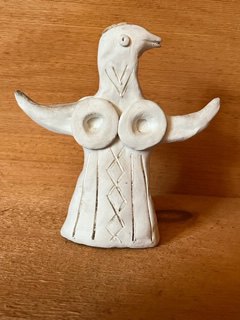
Inanna’s Sisters, by Molly M. Remer

Sometimes I feel like my own Ninshubur. 
I set up a lamentation in the street. 
I call my own name,
beat the drum 
to lead myself back home,
prepare the temple
for my own arrival. 
I will not give up on myself,
will not abandon my own wholeness,
I refuse to sacrifice my Self. 
I will not stay in the underworld forever. 
We all need people in our lives who will say:
No, this will not do. 
I’m coming after you. 
I will help you to crawl back up, 
back out, back through. 
I will reach out to you. 
I will boost you up.
I will rise with you into becoming. 
You will not stay behind defeated 
and alone so long as I,
your Ninshubur,
draw breath.
I will beat the drum for you. 
I will call your name. 
You are not alone. 
Come back to me.
I see your power 
and your strength. 
I hear your longing. 
Return, 
return,
return.

I first met Inanna in the firelit darkness of a midwifery retreat in central Missouri. Toddler son at my breast, I watched, spellbound, as the charismatic, dark-haired midwife recounted the tale of Inanna’s descent into the underworld, through the seven gates we traveled, to the seat of our own wounding and our own medicine.

Continue reading “Inanna’s Sisters, by Molly M. Remer”

The Flood by Sara Wright

Bee on butterfly weed

It is just four days from the Turning. The season of abundance is supposed to be upon us as the goddess turns the wheel towards the dark of the year. We have already lost a half an hour of light. The leaves of fruit trees are yellow, many drifting like butterflies to the ground, prematurely. The ground is sodden, like walking on sponge. Cicadas coax down the sun on the few days we have seen it since the beginning of June. A few crickets have joined the chorus. In the fields the goldenrod is painting a golden haze over emerald and lime. The quality of that green belies the changing season. No wheat- colored grasses. Flowers bloom on with a determination that reveals nature’s intention to survive. Torrential rains pour down silver sheets from the sky obliterating the possibility of peering out to see the hummingbirds dip and soar, sip bee balm nectar. Fog is a constant companion on my  pre-dawn walks – the only time I can listen to birds when the air quality is clean. That three – mile walk is my sanity and sometimes my only exercise. By 8 AM some mornings the air is already reaching the poisoning stage. Most days the windows stay shut. ‘Moderate’ is wishful thinking. If a morning sun burns through the clouds the invisible killer starts burning my eyes if I step out the door to sit on the porch. Inside, the humidity is so high that I am chilled; never below 75.

Continue reading “The Flood by Sara Wright”

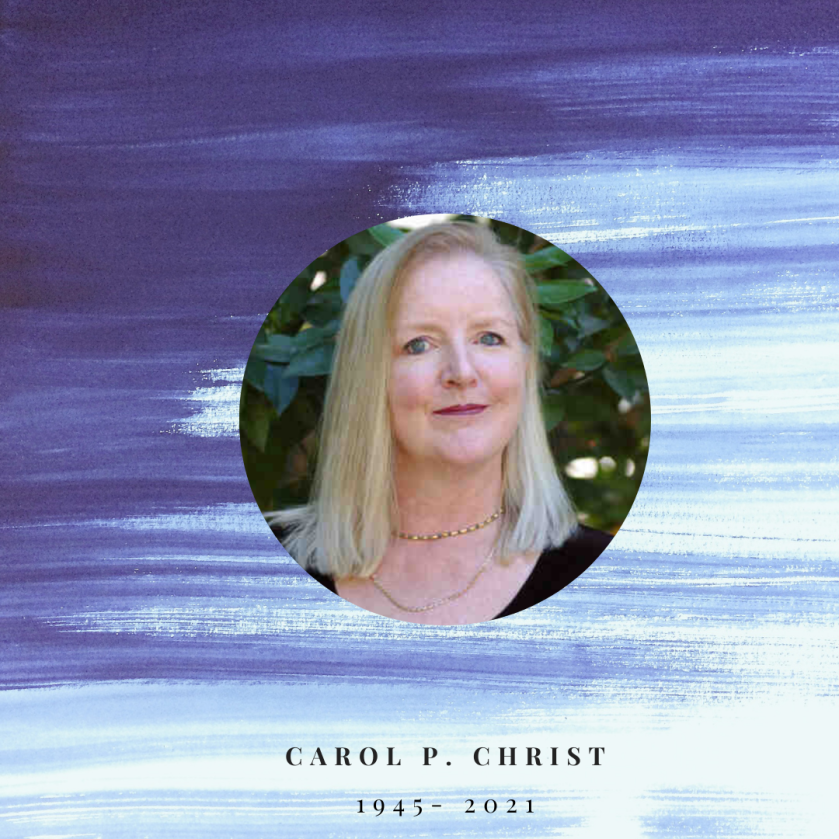
Legacy of Carol P. Christ: The Flourishing of Life and Feminist Theology

This was originally posted on July 28, 2014

I first encountered the image and concept of “flourishing” in Grace M. Jatzen’s feminist philosophy of religion, Becoming Divine. For Jantzen “flourishing” is a symbol of a theology of “natality” or birth and life, which she contrasts to the focus on death and life after death in traditional Christian theologies.

Jantzen argues that the focus on death and life after death is a rejection of birth. Birth is rejected because birth through a body into a body implies finitude. Birth ends in death.  Jantzen argues that embracing natality means embracing finitude and death.

Continue reading “Legacy of Carol P. Christ: The Flourishing of Life and Feminist Theology”

Image and Likeness by Dale Allen

I attended a beautiful women’s circle to celebrate my dear friend Gloria’s birthday recently.  Each woman was invited to bring a sharing for Gloria – a poem, reflection, oracle card, song or dance – whatever felt right.  Each sharing that day was not only a gift to Gloria, but to each of us.

I had met Gloria during the period of my life when I had written a play titled, “Dancers of the Dawn,” with a cast of seven women of different ages, shapes, sizes and colors. The play featured original music, drummers, myth, history, dance, even comedy for a sumptuous experience of the sacred feminine emerging in modern women.  Gloria was a part of the women’s sacred circles that we co-created during that time – circles that continued for a decade and still retain heart-connections today. 

Continue reading “Image and Likeness by Dale Allen”

Ancient Her-Story by Annelinde Metzner

Lately I’ve been rereading and refreshing myself with important books of the Great Goddess.  Three books at a time! I would switch off, chapter by chapter, among  When God Was a Woman by Merlin Stone, When the Drummers Were Women by Layne Redmond, and one that had remained overlooked on my shelf, Sanctuaries of the Goddess, The Sacred Landscapes and Objects, by Peg Streep (1994.)  I’ve been immersed in the knowledge of 30,000 years of honoring and worship of women’s bodies and the Great Goddess. When I got to Chapter 7 of Peg Streep’s well-researched book, “The Goddess at the Peak: Crete,” I was blown away with the evidence we still have, in art, architecture, religion and culture, of a highly advanced society, full of life and joy, where women were central to all life. With my mind, my heart, my intuition and my sense of past lives, I’ve attempted to place myself there, before any influence of patriarchy.

Continue reading “Ancient Her-Story by Annelinde Metzner”

From the Archives: Oakness as a Metaphor for the Wild Soul: the Dance Between Life Force, Personality and Original Nature by Eline Kieft

This was originally posted June 16, 2022

The process of fitting in and learning what is required to participate in society teaches us many useful skills such as math and language. All too often, this happens at the expense of developing expressive and intuitive abilities and trust in our unique contributions and points of view, or what I call the ‘Wild Soul’. This represents our original blueprint or essential spark that makes us into who we are.

Continue reading “From the Archives: Oakness as a Metaphor for the Wild Soul: the Dance Between Life Force, Personality and Original Nature by Eline Kieft”

Abundant Life Is for Women, Too by Liz Cooledge Jenkins

I lived in East Palo Alto, CA, for two years in my mid-twenties. During the first year, a man was killed down the street from my apartment building, in the parking lot of the building where my friends lived. I walked through that parking lot often, as a shortcut back to my own place from wherever I could find street parking. I didn’t know the man, but I knew people who knew him. His death was both disturbing and tragic. The neighborhood mourned. My friends and I got together and wrote a prayer for our community. The murder changed my experience of living there.

Continue reading “Abundant Life Is for Women, Too by Liz Cooledge Jenkins”

The World Needs More Feminist Books…And Why You Should Write One of Them by Dr. Angela Yarber

I believe more women—and particularly queer and/or BIPOC women—deserve to publish books. Let me explain why.

It was my first year of seminary. After majoring in religion in undergrad, I had a decent handle on feminist theology, but I hadn’t yet reconciled my strong, feminist upbringing with the faith tradition that held my ordination in their patriarchal hands. A seminary friend recommended I read Sue Monk Kidd’s Dance of the Dissident Daughter and everything changed.

This was twenty years ago. That one book helped me internalize the intersectional feminist theory that had always dwelled outside of me. Decades later, I find myself teaching in my own seminary classrooms and mentoring DMin students, requiring that same text, along with one of my own books, Queering the American Dream, and Christena Cleveland’s God is a Black Woman when discussing the power of feminist memoir in religious leadership.

Continue reading “The World Needs More Feminist Books…And Why You Should Write One of Them by Dr. Angela Yarber”

Breaking the Silence by Sara Wright

 I believe that The Fourth of July is the most despicable cultural celebration Americans engage in. This year I met the weekend head on. On July 1st I publicly posted the following words knowing that locally, at least, there would be fallout:

Before the colonizers took over this land from Indigenous Peoples no one considered being “independent” because the People knew there was no such thing… Like it or not we all belong to the earth and are dependent upon this planet for our survival.

 What we really celebrate on the 4th of July is the Colonizers’ takeover of what was once a pristine continent ripe with lush forests, plants, wildlife, and peaceful people who had relationships with all their non-human relatives. These Native people also understood they belonged to the powers of each place they called ‘home’.

Continue reading “Breaking the Silence by Sara Wright”

From the Archives: The Found Goddesses of Good Eats by Barbara Ardinger

This was originally posted on August 1, 2013. We usually do Carol Christ’s legacy posts on Mondays. Given the closeness of Lughnasadh, it felt appropriate to share the work of one of our other long-time writers today. Carol’s legacy posts will be back next week.

Lughnasadh (pronounced LOON-us-uh) or Lammas—is the first of the three traditional harvest festivals of the traditional Celtic calendar that most pagans follow today. And what naturally follows harvest? Feasting, fairs, and festivals. To help us celebrate the season, here are two Found Goddesses of good eating. The term “found goddesses” was created in 1987 by Morgan Grey and Julia Penelope, authors of a hilarious book titled Found Goddesses. After reading this book and having never met a pun I didn’t instantly love and being of a naturally satirical state of mind, I started Finding—i.e., inventing—my own goddesses shortly before the turn of the century. After I found a hundred of them, they were published in 2003 in my book, Finding New Goddesses.

Continue reading “From the Archives: The Found Goddesses of Good Eats by Barbara Ardinger”