Ancient Mothers, I Hear You Calling Me to Crete by Carol P. Christ

On a cold and rainy morning in Lesbos, I ponder the advice of my intuitive friend Cristina to reflect on the spiritual dimensions of my decision to move to Crete. When asked why I am moving from Lesbos to Crete, I tend focus on the negative: I am lonely in my small village; and I am disheartened by my neighbors’ lack of compassion for the refugees who come to our island from Syria, Iraq, Iran, and Afghanistan.
As I begin to think again, I recall the many wonderful things I have experienced in Lesbos. This is the island where Sappho sang, and I too have been inspired by the muses who arise from the land. It is here that I first felt Greece calling me to leave my home. It is here that I learned to speak Greek. It is here that I listened to the stories of the old people who remembered a time when everyone lived closer to each other and the land. It is here that I learned to dance the traditional dances of Greece. It is here that I learned to identify over 300 species of birds that visit the wetlands on spring migration or are year-around or summer and winter residents. It is here that I dedicated a decade of my life to the effort to protect the wetland home of the birds I came to love. It is here that I was asked to run for regional and national office by the Green Party Greece. It is here that I met green friends I will always hold in my heart. It is here that I became an amateur geologist, learning the volcanic history of an island that has been declared a UNESCO Geopark. It is here that I imagined the time before 1922 when Turks, Armenians, and Greeks lived together in my village. It is here that I renovated a small Turkish house in a neighborhood that once had a mosque and later, a Neoclassical “mansion” (not particularly large by American standards) built by a Greek shipowner who transported goods brought by camels along the silk road from China. It is here that I learned to drink retsina and to relish food drenched in olive oil. I will carry all of this with me, for it is in my blood and in my bones.

But now, Crete is calling me. Continue reading “Ancient Mothers, I Hear You Calling Me to Crete by Carol P. Christ”

Birth, Death, and Regeneration: Why I Am Only a Kind of a Buddhist by Carol P. Christ

In a recent blog describing conversations with my friend Rita Gross, I said that I think of myself as a “kind of a Buddhist” because I have given up a great deal of the ego(tism) described by Buddhists. I also remarked that “I must be a Buddhist after all” because I accept my finitude and do not fear death. At the same time, I said that the idea of a relational world coheres with my experience and is more satisfying to me than the Buddhist theory of nondualism. When I speak of a relational world, I am referring to the worldview of process philosophy.

One of the central insights of Buddhism is the concept of “dependent origination.” This means that “no thing” exists in and of itself:  “all things” are related to and dependent upon “other things.” One of the key assumptions of western philosophy is that “things” exist in and of themselves: all things have an single, unchangeable “essence” or “nature.” Buddhism considers this assumption to be false: if all things are dependent on other things, then they cannot finally be separated from the web of dependence in which they exist. Buddhism insists, moreover, that the interdependent world is in flux. This means that what a thing-in-relationship is in one moment changes in the next.

Process philosophers, including Whitehead and Hartshorne, recognized that Buddhism affirms a central truth that western philosophy has denied: the truth that life is in flux and that no individual exists apart from or independent of others. Continue reading “Birth, Death, and Regeneration: Why I Am Only a Kind of a Buddhist by Carol P. Christ”

Dance of the Bees: Reading the Language of the Goddess by Carol P. Christ

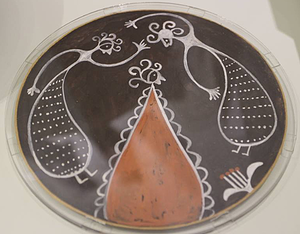
bee women dancing croppedThe image from an ancient Cretan bowl (c.1700 BCE) from the Sacred Center of Phaistos pictured here has often been interpreted as an early depiction of Persephone’s descent or rising. But are clues from later Greek mythology pointing in the right direction in this case?

Recently, my colleague Mika Scott posted the Phaistos bowl image on our Goddess Pilgrimage Facebook site in conjunction with the bee pendant from Mallia. This juxtaposition led me to think again about the importance of bees and pollination in agricultural societies and to offer an alternative reading of the symbolism on the bowl. Continue reading “Dance of the Bees: Reading the Language of the Goddess by Carol P. Christ”

Has the Phaistos Disk Been Cracked? by Carol P. Christ

Carol Christ in LesbosRecent headlines in the international press announced that the enigmatic language of the ancient Cretan “Phaistos Disk” has been translated—in part—by the Welch-Cretan scholar Gareth Owens. Owens states that the Phaistos Disk records an ancient hymn to a Mother Goddess. More specifically he claims that one side is dedicated to a Pregnant Goddess and the other to a Birth-Giving Goddess.

All of this is very exciting, but is he right? Continue reading “Has the Phaistos Disk Been Cracked? by Carol P. Christ”

The Ancestors Live in Us by Carol P. Christ

Carol Christ in LesbosOn the recent Goddess Pilgrimage to Crete women had the option of riding up a winding road on a mountainside in the back of a farm truck singing “She’ll Be Comin’ ‘Round the Mountain” or could choose to go with the guard in his closed automobile.

That evening one of the older women who had chosen to ride in the car said, “I saw how much fun you were all having, but I have done that before. This time I was happy to let the rest of you do it.”

“That’s exactly how I feel about death,” I responded. “Some people want to live on after death, but I don’t. I am happy to let others do it. The only thing that would upset me would be if life did not go on after me.” Continue reading “The Ancestors Live in Us by Carol P. Christ”

Was Ariadne the Most Graceful Bull-leaper of All? Deconstructing and Re-visioning Greek Mythology by Carol P. Christ

carol-christSometimes we think of Greek myth as a pre-patriarchal or less patriarchal alternative to the stories of the Bible. After all, Goddesses appear in Greek myths while they are nearly absent from the Bible. Right?

So far so good, but when we look more closely we can see that Greek myth enshrines patriarchal ideology just as surely as the Bible does.  We are so dazzled by the stories told by the Greeks that we designate them “the origin” of culture. We also have been taught that Greek myths contain “eternal archetypes” of the psyche. I hope the brief “deconstruction” of the myth of Ariadne which follows will begin to “deconstruct” these views as well.

bull leaping ring before 2000 bc phourniAriadne is a pre-Greek word. The “ne” ending is not found in Greek. As the name is attributed to a princess in Greek myth, we might speculate that Ariadne could have been one of the names of the Goddess in ancient Crete. But in Greek myth Ariadne is cast in a drama in which she is a decidedly unattractive heroine.

In the story told by the Greeks, Ariadne falls in love with Theseus, a handsome young man who was sent with 11 other Greek young people to be fed to a monster (who is half man, half bull) known as the Minotuar. The Minotuar is Ariadne’s half brother (see below). Because of her “love” for Theseus, Ariadne helps him to murder her brother.  She then flees with Theseus on his boat.

However, this “love story” does not have a “happy ending” as Theseus abandons Ariadne on a nearby island–long before he arrives home in Athens. Theseus is ever after celebrated as a hero who killed a monster, while Ariadne is just another cast-off female.  Whose story is this? Continue reading “Was Ariadne the Most Graceful Bull-leaper of All? Deconstructing and Re-visioning Greek Mythology by Carol P. Christ”

Of Birds, Angels, and Tidings of Great Joy by Carol P. Christ

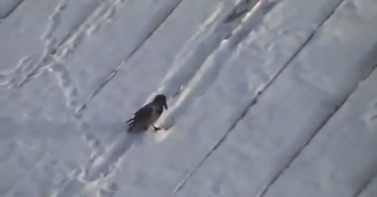
carol p. christ 2002 colorA link to a video of a European Hooded Crow sliding down a snow-covered rooftop on a mayonnaise-lid sled appeared on my Facebook timeline a few days ago. For me this crow expresses the “spirit of the season” as aptly as anything I can think of.  She brings a smile to my face on a grey and cold morning.  She makes me want to climb up on the rooftop and slide down with her.  She reminds me that we humans are not alone–we share the world with a vast multitude of other intelligent creatures.  She tells me that there is nothing more sacred than the joy of life.

crow

The ancient Cretans believed that the capacity to enjoy life was not limited to human beings–they believed that animals  enjoy life as much as we do, and they expressed this sensibility in their art.  They also celebrated birds because their  arrival in spring announces the beginning of the growing season. This early pot in the shape of a bird or duck opening its mouth to–as we kids used to say–“drink the rain” cannot help but evoke a smile. Continue reading “Of Birds, Angels, and Tidings of Great Joy by Carol P. Christ”

A New Glossary for Crete: The Power of Naming and the Study of History by Carol P. Christ

carol-christThe words we use affect our thinking. In the case of ancient Crete the repetition of the terms “Palace,” “Palace of Knossos,” “King Minos,” “Minoan,” “Priest-King,” and “Prince of the Lilies” shape the way we understand history–even when we ourselves know these terms are incorrect. We must engage in “new naming.”

Ariadne. May have been a name of the Goddess of pre-patriarchal Crete. The ending “ne” signifies that Ariadne is not of Greek or Indo-European origin and thus predates the later Greek myths.

Ariadnian. The name I have given to the Old European pre-patriarchal culture of Crete, from arrival of the Neolithic settlers from Anatolia c.7000 BCE to the Mycenaean invasion c.1450 BCE. Arthur Evans named the Bronze Age (c.3000-1450 BCE) culture of Crete “Minoan” after King Minos of Greek mythology, son of Zeus and Europa, husband of Pasiphae, father of Ariadne, whose gift of the secret of the labyrinth to Theseus led to the downfall of her culture. Evans assumed that Minoan Crete was ruled by a King.

This image I call “Ariadne Dancing” could become the new “icon” of Ariadnian Crete.

minoan woman dancing

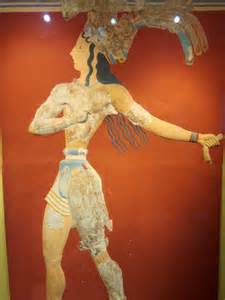
It could and should replace the “icon” of  the “Priest-King” Arthur Evans’ “imaginatively” reconstructed and named the “Prince of the Lilies.”

 prince of the lilies

Once we remove the crown which probably belonged to a Sphinx, the figure’s white color and athletic body suggests it was intended to portray a young female bull-leaper leading a bull. Continue reading “A New Glossary for Crete: The Power of Naming and the Study of History by Carol P. Christ”

Earth Connection & Healing the Bees by Jassy Watson

Jassy_Agora1-150x150

I’m an avid gardener. I must, need, long to have my hands in the soil. The sweet smell and feel of the earth connects me to something greater, to a sense of ‘other’; a source divine. I am interwoven, connected, at one and in reverence of a greater mystery.  When I think about my connection to the earth and its origins, I find it is a connection I have had my entire life. As a young girl I spent many hours, days, in fact years, exploring the Australian bush – it was my backyard. Some of my most prominent memories are the smell of Eucalypt and the crescendo of cicada song that would permeate my entire surroundings throughout summer. As a teen, time and time again, I bushwalked our families property that backed onto mountainous National forest. I often sensed the indigenous ancestral spirits of our land watching attentively.

It is this deep connection that I have to the earth that not only leaves me feeling exultant, it leaves me troubled. I am troubled by the continuing problems caused to the environment. I admit to feeling quite disturbed recently when I read a number of reports about the persisting problems with the Fukushima Nuclear plant – radiated water still leaking into the ocean. Birdlife and ocean animals found suffering from radiation burns. Should we even be eating fish from the pacific? I can’t begin to fathom the enormity of the repercussions from this disaster that will be seen for many generations to come. My inner activist wants to be out there on the frontline, riding the waves on the Rainbow Warrior, tied to an ancient tree in protest of lopping; but I know my place is here, nurturing my little ones. So what can I do with these troubled feelings, with the frustration and with the love I have for Mother earth and all her beings? Action starts from home. So I let it fuel my fire and I get creative. I paint, I write, I garden; with intention. My intention is to play a role, no matter how small, that aids in the healing of the planet. I hold hope that it inspires other to do the same. Continue reading “Earth Connection & Healing the Bees by Jassy Watson”