The Need for Roots: Mutual Aid by Beth Bartlett

In those first few days after the holidays, when the togetherness, warmth, and happy times with family and friends came to an abrupt end, a song my son used to sing as a small child kept running through my mind:

Keep Christmas with you all through the year.
When Christmas is over, save some Christmas cheer.
These precious moments, hold them very dear
And keep Christmas with you all through the year..

The simple glee of my 21-month-old grandson finding ways to scoot and slide down the small icy slope in our backyard was enough to keep the grief over the loss of my sister and my recent loss of my dearest friend at bay.  But in the days after their departure, as I spent time with my friend’s family planning her memorial gathering and visited another dear friend who has chosen to enter hospice in her final days of a terminal illness, coupled with the hooded ogre of the approaching Project 2025, saving Christmas cheer has had its challenges.

But my son found a way.  He and his wife decided they didn’t want the precious times to end, and within a week had decided to pull up stakes from their home 150 miles away, found and signed on to buy a house just five minutes from our home so that the precious moments could continue.

Continue reading “The Need for Roots: Mutual Aid by Beth Bartlett”

Into the Light by Beth Bartlett

I looked for my friend, Pamela’s email the morning after she died. Every morning I have looked forward to her email from the day before — the last one sent at 4:37 on the Tuesday afternoon before Thanksgiving. Did she ever see my response sent at 6 AM the next morning – my wish for her to know joy this Thanksgiving, my sending much love? The bulk of it was full of mundanities. How differently might I have written it had I known it would be the last she would see?  Our ongoing call and response email conversation — now without response, forever without response. 

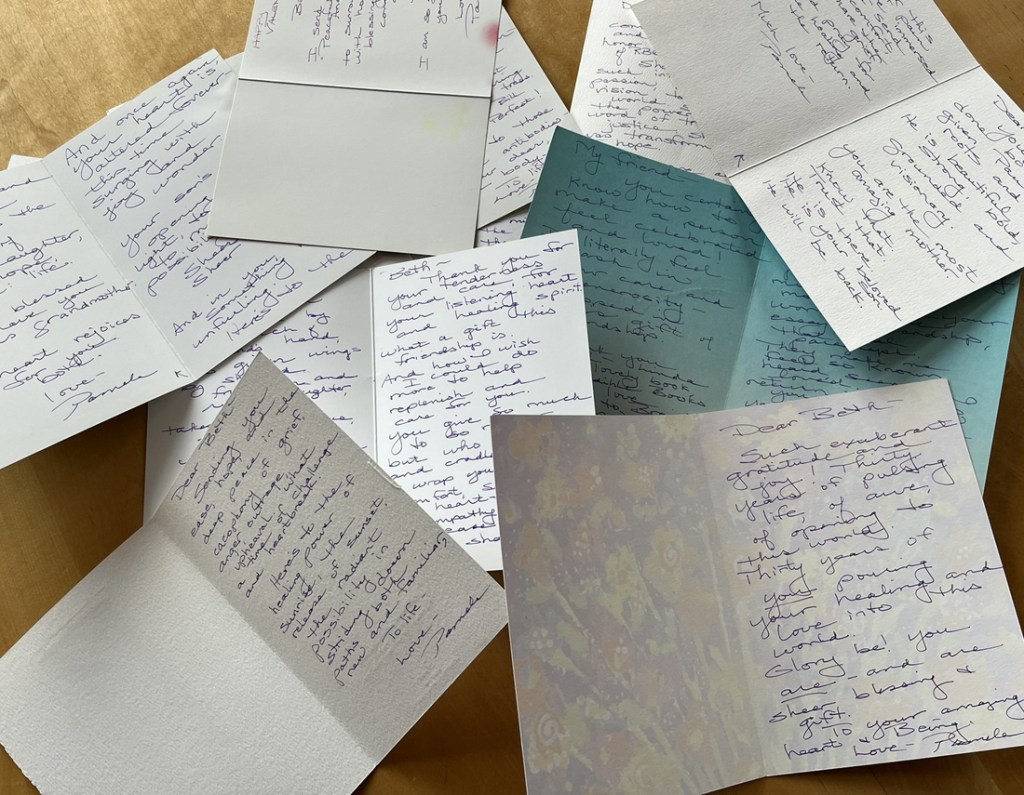
Ours was a friendship of words — words in the cards she has given me over the years, in her detailed responses to my blog posts, in the thousands of emails passed between us over several years. I’ve saved them all.  They were too precious ever to delete. How we both loved words — their poetry, their capacity to communicate, convey, confound, console, comfort. I eagerly anticipated her words every day. For years I have entrusted my daily thoughts, worries, joys, activities, hopes, and the occasional dream to her tender care, always knowing her response would be a mirror, reflecting me back to myself, she reflecting on all I had written – giving witness and testimony, always with the deepest of care and affirmation. As Adrienne Rich wrote in the poem we both loved — “Phantasia for Elvira Shatayev” – I have never seen/my own forces so taken up and shared/and given back.   Yes, this – the immensity, the intensity, the profound reciprocity of our sharing.

Continue reading “Into the Light by Beth Bartlett”

Thanksgiving by Beth Bartlett

When I offered to write the FAR post for Thanksgiving a month ago, I had no idea how difficult I would find that task to be. I suppose I had a different vision of what these days would be like.  I had no idea how heartsick and wordless I would become in the wake of a second and even more bizarre and dangerous Trump presidency.  It hardly feels like a time for celebrating a national holiday. 

Thanksgiving in the United States and the colonies before has gone through several iterations – from the mythologized feast of the Puritan colonists in Plymouth, Massachusetts with the indigenous Wampanoag following the successful corn harvest – corn the Wampanoag had taught the Puritans how to plant after half of them had starved to death the previous winter; to George Washington’s Thanksgiving proclamation giving thanks for the successful ratification of the US Constitution; to Abraham Lincoln in 1863 acceding to Sarah Josepha Hale’s 36-year quest to establish Thanksgiving  as a national holiday — “to heal the wounds of the nation.” Goddess knows we could use that now, but it seems farther out of reach than ever.

Lesser known is the proclamation of a day of thanksgiving by the Massachusetts Bay Company to celebrate their defeat of the Pequot nation following the Pequot Wars of 1636-1638 in which most of the Pequot peoples were killed or enslaved, giving rise to many indigenous peoples observing Thanksgiving as a National Day of Mourning.

Continue reading “Thanksgiving by Beth Bartlett”

Mourning by Beth Bartlett

Grief is the experiencing . . . Mourning is the process,
when we take the grief we have on the inside and express it outside ourselves –
writing, planting, burying, burning, rising up
ceremony, ritual, community[i]

A glimpse of our cottage as I drove away.

“As long as I stayed there, I could keep you with me. . . .” Those words kept repeating in my mind throughout my long drive home from my sister, Jeannie’s, “Celebration of Life” service. I’d stopped midway on my thousand-mile journey at the cabin our family has shared for sixty years.  There I could still feel her presence — on the hillside where we so often sat with our morning cups of tea, or watching the sunset, or chatting away the afternoon; on the dock where we’d lie in the sun or sit late at night and watch the stars come out, or cuddle up in blankets on windy, fall days; in the circle of couches and chairs where we played telephone Pictionary, charades, and CatchPhrase; in the kitchen where we’d cooked and eaten and played card games together; in the bedroom we often shared with a dog between our beds; the road where we’d go for family walks – eight, ten, twelve of us all together, and always two, three, or four dogs; even the driveway where we’d greet and hold each other with great gladness after months of separation, and where we’d hug and say goodbye, and then hug once more because in the back of our minds we’d be wondering if this was the last time.  . . .

Continue reading “Mourning by Beth Bartlett”

The Purpose of Women by Beth Bartlett

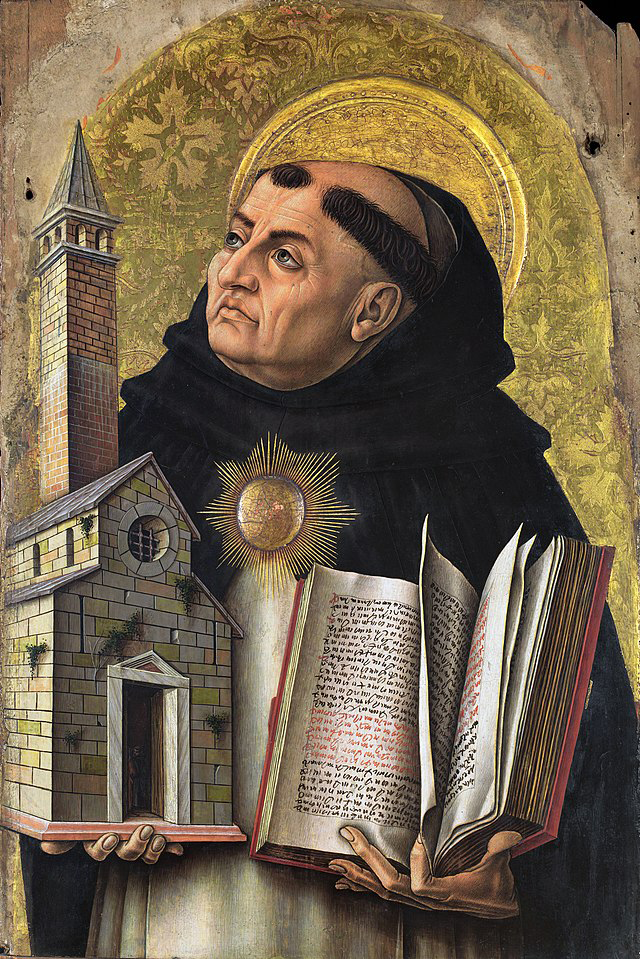
Thomas Aquinas, Wikimedia Commons

12th century theologian Thomas Aquinas didn’t think much of women.  He’d known less than a handful during his lifetime – his mother, who sent him off to a Benedictine monastery when he was five, as was the custom at the time, and later abducted and imprisoned him, with the help of her other sons, seeking to “rescue” him from his choice of becoming a Dominican priest; his two sisters who were sent to him while imprisoned to dissuade him from his choice; and the prostitute his brothers sent into his prison cell to try to tempt him to sin and break his vows – unsuccessfully. So perhaps it is no wonder that Question 92 of his Summa Theologica asks, “Should woman have been made in the original creation?” Though more likely his question was prompted by the milieu of misogyny in which he was raised and lived, having been educated in the theological tradition of Augustine who believed women to be the “lesser” sex and necessarily subject to men, and highly schooled in and known for reviving the thought of Aristotle, who said of women, “a woman is a misbegotten man.”[i]

Continue reading “The Purpose of Women by Beth Bartlett”

And Then Everything Changed: Part Two: Joy by Beth Bartlett

(part one was posted yesterday)

Author’s Note: I wrote this post shortly after Pres. Biden stepped down as the Democratic candidate for the presidency and endorsed Kamala Harris, long before the Kamala-Harris ticket adopted “joy” as their watchword. The reference to the “joy” of this campaign has now become so ubiquitous that I fear it will become trivialized and merely a slogan. I hope instead that they meaningfully embrace a politics of joy and the capacity of joy to heal divides, not just in this country, but throughout the world. 

* * *

. . . and then everything changed. 

What is this feeling that has been filling me of late? Ah, yes, I remember — hope, enthusiasm, excitement, optimism!  It’s been so long since I’ve felt this — on the political scene, for our country, for the world. But lately I’ve felt buoyant – something I haven’t felt at least since 2016. Rather than avoiding the news, now I am eager for it, seek it out. 

The energy, vitality, and yes, laughter that Kamala Harris has brought to the presidential campaign has infused myself and many others I know with a sense of joy, a welcome contrast from the doom and gloom that has been surrounding the campaign for so long. Her ability to laugh, to smile, to find the positives in people, in life, that has brought new life to this campaign. Yet for some reason, the opposing side has chosen to focus on Harris’s easy laughter as a target for derision. 

Continue reading “And Then Everything Changed: Part Two: Joy by Beth Bartlett”

And Then Everything Changed: Part One: Mourning by Beth Bartlett

At the end of June, in clear contradiction to the Founders’ intent,[i] the Supreme Court ruled, 6-3, that the President has “absolute immunity from criminal prosecution for  . . . all his official acts.”[ii] In other words, the President is above the law, or, as Justice Sotomayor said in her impassioned dissent: “The relationship between the President and the people he serves has shifted irrevocably. In every use of official power, the President is now a king above the law.” 

The ruling left many outraged. The people at large do not want a presidency unchecked by law. The ruling becomes even more chilling given the real possibility of Trump – a self-proclaimed admirer of autocrats — returning to the office of the President, and the specter of Project 2025, the blueprint by the Heritage Foundation that lays out the sweeping changes Trump and a faction of conservatives have planned to put in place if Trump is elected.

Continue reading “And Then Everything Changed: Part One: Mourning by Beth Bartlett”

Sojourner Truth, the photos by Beth Bartlett

Moderator’s Note: We inadvertently left out the photos from Beth’s posts on Sojourner Truth. The photos, all by themselves, pack an emotional punch and so we want to be sure they can be seen. These are Beth’s photos from Sojourner Truth Legacy Plaza in Akron, Ohio

You can see Beth’s posts here. Part 1 and Part 2

close- up of statue

Sojourner Truth: Part Two: The Speech and the Sojourner Truth Legacy Plaza by Beth Bartlett

Part one was posted yesterday.

Most of us are quite familiar with Sojourner Truth’s “Ain’t I a Woman?” speech as recorded by Frances Gage several years later, with its powerful “ain’t I a woman” refrain.  However, the actual speech as transcribed at the time by Marius Robinson, while similar in content, does not contain the refrain. Rather, Truth simply states that she is “a woman’s rights” woman.[i]  It is unlikely that she spoke in the southern dialect Gage used in her transcription, since Truth grew up knowing only Dutch, eventually learning English as spoken in New York, and probably spoke with a Dutch accent. Much of the content in the Gage version was fabricated – such as the statement that she bore thirteen children, when she only had five children, though she did cry out in a mother’s grief when she learned that her only son, Peter, had been illegally sold south to Alabama.[ii]

Continue reading “Sojourner Truth: Part Two: The Speech and the Sojourner Truth Legacy Plaza by Beth Bartlett”

Sojourner Truth: Part One: Her Life by Beth Bartlett

On May 29th, 1851, a striking, 6’ tall, African American woman rose to speak at the Women’s Rights Convention being held in Akron, Ohio. There Sojourner Truth gave her famous “Ain’t I a Woman Speech.” 

Originally named Isabella, and known as “Bell,” Truth was born into slavery in 1797, the second youngest of James (“Bomefree” – Dutch for “tree”) and Elizabeth (“Mau-mau Bett”) who were enslaved by a wealthy Dutch man, Johannes Hardenbergh, Jr., who had a large estate in Ulster County, New York, which was inherited by his son, Charles, when Truth was just an infant. Upon the death of Charles, at the young age of nine, she was sold at auction to John Nealy, where she “suffered ‘terribly-terribly’ with the cold”[i] and beatings. In her own words, “He whipped her till the flesh was deeply lacerated, and the blood streamed from her wounds – and the scars remain to the present day.”[ii] She prayed for deliverance, and soon after was sold to a fisherman and tavern owner, Martinus Schriver, where she led “a wild, out-of-door kind of life,” carrying fish, hoeing corn, foraging roots and herbs for beer.  Only a year later she was sold again to John J. Dumont, where she lived out the remainder of her enslavement until her emancipation by the State of New York in 1828. She described her life there as “a long series of trials” which she did not detail “from motives of delicacy,  . . . or because the relation of them might inflict undeserved pain on some now living”[iii] whom she regarded with esteem. Knowing the conditions of enslaved women, we can deduce what those trials entailed. Despite her affections for a man on a neighboring estate, who was beaten to death for visiting her when she was sick, she was forced to marry a much older man, Thomas, also enslaved by Dumont, with whom she bore five children. Because Dumont reneged on his promise to free her, she walked away with her infant daughter in 1827 and was taken in by the Van Wegener family where she lived for the next year. 

Continue reading “Sojourner Truth: Part One: Her Life by Beth Bartlett”