The Importance of Rituals (Part 2) by Elise M. Edwards

elise-edwards

In my previous post, I wrote about the importance of rituals. The rituals of the Easter season helped me process some difficult emotions. The way that rituals mark time and demonstrate consistency has been a comfort for me when facing new challenges and settings. But I am quite aware that rituals can become empty.   In one of the comments to that post, a woman named Barbara responded, “There came a time for me when familiar and meaningful ritual no longer made sense. I had changed in understanding of what the ritual symbolized and celebrated. And haven’t found new rituals that make sense for me now…or at least I’m not aware of any.” Barbara’s remarks capture not only the loss from no longer being able to relate to existing rituals after life changes, but also the difficulty in finding or creating new rituals to take their place. I thanked Barbara for her honesty and decided that this post would continue the discussion, focusing more on discovery and creation of new rituals.

As I was preparing that post, I watched an episode of Call the Midwife that prompted me to reflect on the need to create rituals when existing ones just don’t work. Call the Midwife is a BBC-PBS show about nurses and midwives living in a convent in London’s East End at the end of the 1950s and early 1960s. The show is based on the memoirs of Jennifer Worth, and it does a better job than most primetime dramas of showing female characters’ experiences the joys and challenges of their professional lives and personal lives. As it is set in a convent with several characters who are both nuns and midwives, the show also explores the theme of vocation. What does it mean to be called to the religious life? Called to nursing? What does motherhood demand? Continue reading “The Importance of Rituals (Part 2) by Elise M. Edwards”

The Importance of Rituals by Elise M. Edwards

elise-edwardsMy sister once said about me, “One thing you have to understand about Elise—she takes the ritual of whole thing very seriously.” My sister was right and her words helped me see this quality about myself. What ritual was she talking about me taking so seriously? Happy hour on Fridays.

It was a different season of my life when she said this. I don’t have Friday happy hours regularly anymore, although I did gather with my friends nearly every week for food and drinks for many years throughout my 20s and 30s. It was often on Fridays, but at one point it was Wednesdays and then, for about a year, it was Thursday nights after a late shift at work.

More recently, I would meet a friend for crepes at the farmers’ market on Saturday mornings. Although the day and the time and specifics of these gatherings would vary, the act of setting aside a weekly time to connect with people dear to me and relax as we indulged in good food or drink was a ritual to me.

Continue reading “The Importance of Rituals by Elise M. Edwards”

Resurrection Garden, Resurrection Feast by Elizabeth Cunningham

Elizabeth Cunningham headshot jpegIn John’s account of the Resurrection, Mary Magdalen mistakes Jesus for the gardener.  Or perhaps it is not a mistake or not just a mistake but also a poetic truth. In any event, John’s Gospel makes clear:  the Resurrection takes place in a garden!

(For the feminist significance of horticulture, I refer you to Carol Christ’s recent post on this site: Women and Weeding, the first 10,000 years .)

Many  prominent (male) theologians, historians, anthropologists, and psychoanalysts among them James Frazer, Jung, and C.S. Lewis made the case for and/or against (in Lewis’ case) Jesus being another dying rising god of vegetation with Christianity borrowing imagery and ritual from earlier or even contemporary cults. The argument against insists that Jesus’s life, death and resurrection is historical, redemptive, and unique.  From a tour of Bloglandia, the debate pro and con appears to continue unabated.  I say better to pull weeds (if you are lucky enough to have a garden) than pontificate. Continue reading “Resurrection Garden, Resurrection Feast by Elizabeth Cunningham”

A Family Conceived, Lost, and Resurrected by Gina Messina-Dysert

Gina and SarahGood Friday marks the second anniversary of one of the most significant dates in my life – the adoption of my daughter, Baby S – who by the way is no longer a baby (she will be turning 5 this May).  On Easter Sunday, 2012 I wrote about the resurrection of my family.  In the last few years that I have been blogging, this is by far my favorite post and I have been so grateful for the many wonderful responses I have received from it.  With today being Good Friday, it seems an appropriate time to revisit this incredible experience and once again, give thanks for the blessings in my life.  Continue reading “A Family Conceived, Lost, and Resurrected by Gina Messina-Dysert”

Hidden Meanings in the Rituals of the Assumption by Carol P. Christ

carol-christ“[T]he Old European sacred images and symbols were never totally uprooted; these persistent features in human history were too deeply implanted in the psyche.  They could have disappeared only with the total extermination of the female population.” Marija Gimbutas, The Language of the Goddess, 318.

August 15 is known to Greek Christians as the date of the Koimisi, “Falling Asleep” or Dormition of the Panagia, She Who Is All Holy.  December 25 is a minor holiday in the Orthodox tradition, while Easter and August 15 are major festivals.  The mysteries of Easter and August 15 concern the relation of life and death.  In Orthodox theology, both Easter and August 15 teach that death is overcome:  Jesus dies and is resurrected; Mary falls asleep and is assumed into heaven.  These mysteries contain the promise that death is not the final end of human life.  Yet this may not be the meaning of the rituals for many of those who participate in them.

In Christus Victor, Gustaf Aulen argued that Eastern (Orthodox) and Western (Catholic and Protestant) traditions understood salvation differently.  The Western Church focuses on salvation from sin, while the Eastern Church focuses on transcending death.  This contrast is not absolute, as for the Western Church sin is the cause of death and when sin is overcome, immortal life is restored.  While Orthodoxy has strong ascetic and monastic traditions, it does not teach ordinary Christians to focus on sexual purity and impurity as Western traditions have done.  Nor is there a strong emphasis on transforming collective sin in movements for social justice.  Significantly, though Roman Catholics and others consistently refer to the “Virgin Mary,” Orthodox Christians prefer “Panagia,” She Who Is All Holy.

In Greece the ordinary rhythms of life are disrupted at Easter and in August.  During lent, many women (and some men) fast, while in August women named Mary and Panagiota–as well as others who wish to honor or petition the Panagia–wear black for two weeks.

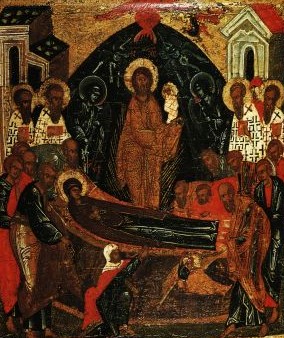
Assumption1Throughout the first 2 weeks of August, Greek Christians focus on the death of the Panagia.  According to theology, her Son appears after her death and “assumes” her into heaven.  The Orthodox icon depicts Mary surrounded by the Apostles, while Jesus holds the assumed body of Mary depicted as an infant wrapped in swadling clothes.

When she first saw this icon, my friend Naomi Goldenberg commented that it is an example of the widespread attempt on the part of men to appropriate the power to give birth.  The icon reverses the symbolism of the nativity where the baby wrapped in swadling clothes is held in the hands of his mother.  Christian baptism described as re-birth through the Father, Son, and Holy Spirit is another version of “male birth.” Continue reading “Hidden Meanings in the Rituals of the Assumption by Carol P. Christ”

SHADOWS OF THE GODDESS IN GREEK ORTHODOX TRADITION: EASTER AND THE DORMITION OF THE VIRGIN by Carol P. Christ

While I would not wish to argue that Greek Orthodoxy is in any way a “feminist” tradition, the shadow of the Goddess falls long over the two great festivals of spring and midsummer.

In Greek Othodox tradition, there are two major spiritual holidays– Easter in the spring and the Dormition/Assumption of the Virgin at midsummer.  The Panagia, She Who is All Holy, also known as Mother of God, Virgin, and Mary, is a central figure in people’s faith–dethroned neither by the Reformation nor by Vatican II.  Indeed when I speak of the need for the “rebirth of the Goddess” in Greece, I am often told, “the Panagia is our Goddess.”  This may not be theological orthodoxy, but it expresses a truth of practice. Continue reading “SHADOWS OF THE GODDESS IN GREEK ORTHODOX TRADITION: EASTER AND THE DORMITION OF THE VIRGIN by Carol P. Christ”