Fannie Lou Hamer’s Commitment to Life by Elise M. Edwards

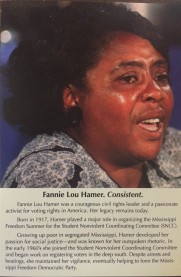
Elise EdwardsA few weeks ago, I came across a postcard that I was given at a conference last year. I got the postcard (advertisement?) because it has a picture of Fannie Lou Hamer on it, and in my home and office, I like to display images and quotes from inspirational women, especially black women. Hamer was a sharecropper from rural Mississippi who became a leader within the civil rights movement in the United States. I was happy to have something with her likeness on it. It was only later that I looked at the text on the front and back of the card, which read in part, ”Often called the ‘spirit of the Civil Rights Movement,” Hamer worked tirelessly on behalf of the rights of others—including the unborn. [She said,] ‘The methods used to take human lives such as abortion, the pill, the ring, etc. amounts to genocide. I believe that abortion is legal murder.’” I realized then that the card was distributed by an organization called Consistent Life, who, in support of a “consistent ethic of life,” is “committed to the protection of life threatened by war, abortion, poverty, racism, capital punishment and euthanasia.”

I was conflicted about the ushamere of Hamer’s image for this organization’s purposes. It is true, Hamer did have those views about abortion and birth control. But I did not know if her image and story was being manipulated for a particular political and religious agenda—one I do not align myself with. I put the card in a box of other images and quotes. I didn’t display it, but I didn’t throw it away, either, which is why I came across it again a couple weeks ago as I was cleaning and decorating my home office. I had the same misgivings about the image as before, and I set it aside again. Continue reading “Fannie Lou Hamer’s Commitment to Life by Elise M. Edwards”

More than Individual Concerns by Elise M. Edwards

Elise EdwardsWell, the fall semester of the school year has begun. I’m teaching undergraduate classes in Christian Ethics and Bioethics this fall. I’ve designed my classes so that they are much more discussion-based than they have been in previous semesters and as a result, I’m noticing the things that challenge and confuse my students fairly early. I have readings from feminist, womanist, and mujerista thinkers in these courses, and unsurprisingly, some of my students don’t know what to do with the arguments feminists make about how we arrive at moral decisions and live them out. I hope that as we work through the essays together, my students and I learn from each other.

I assigned an essay called “Theology’s Role in Public Bioethics” by Lisa Sowle Cahill that was included in the Handbook of Bioethics and Religion edited by David E. Guinn (2006). Cahill, a feminist thinker, asserts that theology can be a conversation partner in public debate about bioethics and also an advocate for just, compassionate, and inclusive health care practices. Citing the work of another feminist, Maura Ryan, Cahill argues that ethical questions about reproductive technologies should be examined not only as individual dilemmas but as issues that exist within a social justice context. In the conclusion of the essay, she states, ”Specifically, one of [theology’s] most important and distinctive contributions to public discourse is a critique of the ways in which modern biomedicine and biotechnology have become luxury items marketed to economically privileged classes, while the world’s poor majority lacks basic health needs.” (55).

I suppose because I’ve been reading feminist thought, theology, and social ethics for years, some of the claims that my students see as radical and new are commonplace and go unquestioned by me. I expected some of my students to disagree with Cahill and Ryan’s particular positions about assisted reproduction. But I was surprised by students’ rejection of the idea that debates about reproductive technologies include MORE than individual considerations.

I’ve blogged on this site about reproductive rights before, and let me be clear that I do not think that the church, state, or any institution should have more governance over a person’s body than that person herself. But while respecting individuals’ rights to make health decisions for themselves, I also acknowledge that these “individual” decisions have broader social implications and meanings. This is one reason second-wave feminists have insisted that “the personal is political.”

Feminists routinely relate individual, “personal” acts and beliefs to larger constructs and the too-often asymmetrical power dynamics at work within them. This is why we are disturbed by video of a man who knocks his fiancée out and drags her unconscious body from an elevator and pop stars who gain commercial success by graphic displays and descriptions of sexuality that is objectifying or exploitative. And, in response to one of my students who wondered if feminist interpreters of religious texts go too far, that is why they point to patriarchy in a story that seems to be about devotion (referring to the Book of Ruth).

I’m grateful to my students for prompting me to explain some of these convictions that feminists hold. Certainly feminism is not monolithic. We feminists disagree on many issues including the scope of individual rights, the role of religion in public debate, and the extent of harm (or lack thereof) in media portrayals of female sexuality. But I believe we tend to agree that our personal decisions as well as our societal issues should be addressed with a consciousness that as humans we are beings-in-relation. Our conviction that we are connected and affected by each other lies behind our motivation to make the world a better place for women and girls and others who suffer from patterns of dominance.

What do you think?

Elise M. Edwards, PhD is a Lecturer in Christian Ethics at Baylor University and a graduate of Claremont Graduate University. She is also a registered architect in the State of Florida. Her interdisciplinary work examines issues of civic engagement and how beliefs and commitments are expressed publicly. As a black feminist, she primarily focuses on cultural expressions by, for, and about women and marginalized communities. Follow her on twitter, google+ or academia.edu.

Sleeping: Thinking about Bodily Practices, Pt. 2 by Elise M. Edwards

Elise EdwardsAs I mentioned in my previous post, I’ve been reflecting on bodily practices–especially those that are not typically associated with feminism and religion. Our lives as embodied persons are so multi-dimensional! There is so much we perceive and experience through our senses, through our movements, and through the places we locate ourselves. So I have decided to use this blog to think through some ideas and learn from you in this community of readers, contributors, and commenters. Over the next few months, I will continue to discuss the ways I am becoming more intentional about connecting habits surrounding the body to feminist and religious concerns. Once again, I’ve glossed on only a few of the many connections we could make about women, religion, and bodily practices. Today I write about sleep. I would love to hear your thoughts in the comments below.

Do feminism and religion have anything to do with sleep?

Sleeping is as vital to human survival as food and water. But lamentably, getting the proper amounts of sleep is not one of those healthy goals that is fiercely defended. It is much more common to hear someone brag about how productive she can be on a few hours of sleep than to boast about her productivity after a full night’s rest. I have to admit, I am always a little suspicious of those people who proudly proclaim they only need 4 or 5 hours of sleep, and I’m a little antagonistic to those who want to recruit the rest of us into their sleepless world: “There is so much else you could be doing with your time than sleeping!” They say, “I’ll sleep when I’m dead!” I have even heard “Sleep kills dreams!” Um, actually, dreams come when you sleep. Sleep breeds dreams, you could say. More on that below.

As you might be able to tell, I am the type of woman who loves sleep. I love climbing into my bed at night. I enjoy the feeling of waking up with a rested body and a renewed spirit and a groggy-but-fresh mind. I especially love naps for that reason. The most enjoyable and perhaps “productive” seasons of my life have been those when I could take a nap after class, after work, or after the gym.

Sleep is vital because it allows the body to rest. In the Christian tradition, we claim that rest is part of the creation of the world. That God marveled at the wonderful world God created, and when the work was done, God rested. This rest inspires the Sabbath. Sabbath is a day set aside for rest, worship, and contemplation of the holy. It is regrettably observed less and less in contemporary American Christianity. Since we have let go of the need for the Sabbath, it certainly no surprise we have also lost sight of the importance of daily rest, too.

Although my thoughts are little uncharitable towards those who preach the gospel of little sleep, I am very sympathetic to those who feel they do not have enough time to sleep. To those who feel like sleep is a luxury they cannot afford. Certainly many women tasked with numerous responsibilities often feel this frustration. They make do with less sleep because they have to complete more tasks in their waking hours. Yet it has been my experience that even those who are overworked and overscheduled appreciate the uncommon times when they can sleep a little longer than usual.

For me, times of sleep are very much connected to gratitude. In the past year or so, I have retrieved the practice of nightly prayer, which sadly got left behind in my childhood years. In all honesty, it was not a renewal of spiritual piety that led me to resume these bedtime prayers. It was insomnia. As much as I love sleep, I am often kept from it by anxieties and thoughts of the coming day. I started using bedtime prayers as a way of turning my cares over to God. These silent prayers become conversations about what is important to me and what concerns me. I talk to God about what I am grateful for. I talk to God about my family and my friends, about their lives and concerns that weigh on me. And then I let it go–at least for the night–and trust my soul to the divine power who cares for me while I sleep.

These nightly prayers have not only promoted peaceful sleep (for most nights, at least) but also the experience of vivid dreams. Dreams, like other visions, are honored in many religions as a place where the divine communicates with humanity. But this too, seems absent from contemporary American Christianity. Perhaps it is because dreams are associated with the intuitive senses, and therefore the feminine, that they are overlooked. Dreams are less clear and presumably more open to speculative interpretations than the texts we read during the day. I cannot say whether I meet God or whether I meet my deeper self in dreams, but I do know I am connected to powerful ways of being in my sleep, and that this is important for my spiritual life.

My final reflection about sleep is an acknowledgment that we often do not sleep alone. While sleep itself takes us to a solitary place, we often share our beds with lovers, children, and other family members and friends. Like those bedtime prayers, the words we speak under the covers in those moments before sleep connect us to our bed-mates. Whether they are ghost stories or secrets or incoherent ramblings about the day to come, these nighttime words prepare our minds for the sleep that will soon overtake us. Unless, of course, we are next to someone who snores or kicks.

Elise M. Edwards, PhD is a Lecturer in Christian Ethics at Baylor University and a graduate of Claremont Graduate University. She is also a registered architect in the State of Florida. Her interdisciplinary work examines issues of civic engagement and how beliefs and commitments are expressed publicly. As a black feminist, she primarily focuses on cultural expressions by, for, and about women and marginalized communities. Follow her on twitter, google+ or academia.edu.

Eating: Thinking about Bodily Practices, Pt. 1 by Elise M. Edwards

Elise EdwardsI am currently preparing to teach a course on bioethics in the fall. I plan on combining some common, secular materials on biomedical ethics with some theological material and some feminist readings. After all, in a course that centers around practices related to the body, birth, and death, there seems ample opportunity to introduce feminist themes. Some feminist perspective, of course, is typical, like when we will discuss abortion and contraception. (Or at least it is common in my courses where try to present multiple sides of an issue.) Anything related to conception, pregnancy, and birth is easily understood as a “women’s issue” and therefore something that feminists address. I’ve discussed abortion and contraception in previous posts on this forum.

However, I realized in going through readings for this course that I have not focused much on other practices related to the body in my scholarship or personal reflection. Specifically, I have not connected them to theological principles or feminist convictions. Perhaps not everything concerning the body is directly relevant to feminism. But I am sure if I thought about it, I would be able to make the connections. We are physical creatures and the feminist movement generally affirms recognizing our embodiment.

Continue reading “Eating: Thinking about Bodily Practices, Pt. 1 by Elise M. Edwards”

Songs for the Soul by Elise M. Edwards

Elise EdwardsDuring the Christian season of Lent, many Christians focus on spiritual practices or disciplines that bring them closer to God. This year, I did not really engage in this type of reflection until the end of Lent. I have been wrapping up my first year teaching college students full-time, I’ve been focused on several writing projects, and I’ve been traveling. I did not intentionally think about spiritual practices until I participated in a silent retreat before Holy Week and traveled first to spend the holiday with my family and then again to mourn and remember the life of my aunt.  I reflected on them when I most needed them.

Continue reading “Songs for the Soul by Elise M. Edwards”

Women’s Christian Heritage by Elise M. Edwards

elise-edwardsIt is difficult to carve out time in a course that covers Christianity from the past 2000 years to address material beyond the standard textbooks.  But yet, I must because the visual and material culture, the worship practices, and the daily activities of women and men who have called themselves Christians or followers of Christ throughout history also comprise the story of the Christian heritage.

Over the past several weeks, I have been developing material for a historical and theological survey course called “The Christian Heritage.” In the multiple sections of this course taught at my university, and I imagine similarly at schools across the country, students are assigned a course reader.  The reader we use is a collection of texts that have shaped the Christian faith from the first century to the 21st.  It is a good collection, and I have no objection to using it.  However, for the way I would like to teach the course, I will need to supplement the reader with other material.  I have two interrelated concerns: the reliance on texts as a way of determining theological history and the absence of women in that history before the medieval period (and even then the number of women included is small). Continue reading “Women’s Christian Heritage by Elise M. Edwards”

Exposure by Elise M. Edwards

Before I feared too much disclosure, but now I seek to channel revelations of personal experiences into exercises that inform the moral and intellectual agency of everyone in the classroom, including me.

I have always been a bit nervous when people share personal experiences in non-intimate settings.  For the past several years, I’ve been in an academic environment where people routinely discuss and reflect upon significant life events.  There were times that I was very uncomfortable listening to classmates discuss abortions, first sexual experiences, and encounters with racism.  Even though they did not use graphic or disturbing language, I questioned the appropriateness of sharing intimate details of one’s life in a classroom.

So when I was preparing to teach my own course on Christian Ethics, I was careful to define a course policy that related to sharing and participation.  In part, it reads: “While students are encouraged to use the course material to reflect on their own experiences and develop their own theological-ethical perspectives, sharing intensely personal reflections is not required  – in fact, it is discouraged to maintain the professional atmosphere of the classroom.“  In class, we discuss conceptions of God and religious faith as they are applied to complex issues like sexuality, racial reconciliation, war, and medicine.  The potential for conflict and personal attack is always present in the classroom because we often have deep commitments and personal beliefs on these issues, so I wanted to curb the amount of personal reflection that occurs in the corporate setting.

Over the course of the semester, though, my perceptions have changed due to well-written memoirs and personal statements I have read recently, the profound statements my students have shared, and the teaching philosophy I am developing.  Whereas before, I feared too much disclosure, now I seek to channel revelations of personal experiences into exercises that inform the moral and intellectual agency of everyone in the classroom, including me. Continue reading “Exposure by Elise M. Edwards”

Working to Bring about the End by Elise M. Edwards

I was reminded that the idea of eschatological reversal can be a powerful image in the promotion of justice if we believe that we already are, or that we should be moving towards the ultimate end that remedies current injustices.

I started teaching a course in Introduction to Christian Ethics a couple weeks ago for a class of graduate students who are pursuing their M.Div. and other Masters in religion degrees.  We are spending some time talking about the use of Scripture in ethics, so I reviewed Richard Hays’ 1996 text The Moral Vision of the New Testament: A Contemporary Introduction to New Testament Ethics.  It got me thinking a lot about the role of eschatology in ethics. (Eschatology is the area of theology concerned with “last things,” like the end of the world, heaven, hell, death and eternal judgment.)

Continue reading “Working to Bring about the End by Elise M. Edwards”