
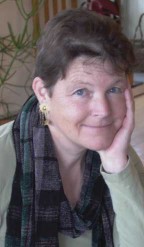
My Immortal Mother-in-Law by Elizabeth Cunningham

Elizabeth Cunningham headshot jpegBefore Olga Eunice Quintero Smyth died on December 4, 2014 at age 101 and 10 months, I was tempted to believe she was immortal, literally. I knew Olga for forty-five years (from age 16 to 61). For thirty-five of those years she was my mother-in-law. Our history began when I was kicked out of high school and went to work at her free-wheeling school, her utter lack of any interest in reforming me a blast of fresh air. It ended with me sitting beside her as she was dying, softly singing “Row, Row, Row Your Boat.”

Olga was named for a Russian princess her mother encountered when she was a babe in her arms en route to Trinidad from her native Venezuela. Olga took for granted her descent from Incan royalty as well. Her mother moved the family to New York when she was eleven. A few years later, she won a scholarship to Mount Holyoke College. She married a classmate’s brother, Julian Smyth, great grandson to Nathaniel Hawthorne. If that weren’t enough, Olga claimed for Julian’s line direct descent from the first century Celtic Queen Boadicea. As long as she could speak, she spun tales. “Where in Africa was she born?” one of her nurses asked me. “What kind of a dancer was she?” Continue reading “My Immortal Mother-in-Law by Elizabeth Cunningham”
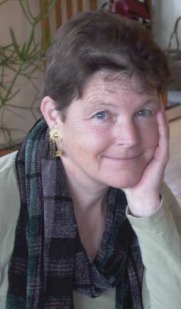
In Memory of Margot Adler (1946-2014) Priestess, Journalist, Skeptic, Mystic by Elizabeth Cunningham

Elizabeth Cunningham headshot jpeg“Ritual has the power to end our alienation from the earth and from each other. It allows us to enter a world where we are at home with the trees and the stars and other beings, and even with the carefully hidden and protected parts of ourselves that we sometime contact in dreams or in art.” –Margot Adler

Margot Adler died of cancer on July 28, 2014. A Pagan priestess, she asked for memorial events to be held in the season of Samhain, also known as Halloween.  At this time of year, the rituals of many religious traditions remind us that we are all connected, the living, the dead, and those to come, one continuous communion.  In this spirit, I offer a tribute to the late Margot Adler.

Though I must have heard her distinctive voice on National Public Radio where she served as an innovative and eclectic journalist for thirty years, I encountered Margot Adler’s work more intimately by accident—or synchronicity—as countless others have.  I had recently found myself face to face with the goddess.  As if in answer to my question: “Who are you and what do you want from my life?” a hefty book literally fell off a shelf in a small-town bookstore: Margot Adler’s ovarian work Drawing Down the Moon: Witches, Druids, Goddess-Worshippers, and other Pagans. Writing as both observer and participant, Margot brought into fruitful union the spiritual seeker and the fact-finding reporter, the social activist and the ecstatic celebrant.  I had found a trustworthy guide for my own explorations. Continue reading “In Memory of Margot Adler (1946-2014) Priestess, Journalist, Skeptic, Mystic by Elizabeth Cunningham”

Almighty Isis by Elizabeth Cunningham

Elizabeth Cunningham headshot jpegWhen the press began using I.S.I.S. as a perhaps inaccurate and now obsolete acronym for the Islamic State of Iraq and Syria, diverse groups made a connection with the Egyptian goddess who was once worshiped all over the Greco- Roman empire. A pagan organization protested the appropriation of the goddess’s name. Others took it as a sign that the self-declared Islamic State represented the anti-Christ or confirmed a conspiracy by the Illuminati. (Divinity of any kind seems to attract human projection.)

When I was doing research for my novel, The Passion of Mary Magdalen, Isis found a special place in my heart. A lover and mother goddess, later associated with both Mary Magdalen and the Virgin Mary, Isis appealed to people from all classes and cultures, especially to women, respectable Roman matrons and prostitutes alike. Continue reading “Almighty Isis by Elizabeth Cunningham”

Resurrection Garden, Resurrection Feast by Elizabeth Cunningham

Elizabeth Cunningham headshot jpegIn John’s account of the Resurrection, Mary Magdalen mistakes Jesus for the gardener.  Or perhaps it is not a mistake or not just a mistake but also a poetic truth. In any event, John’s Gospel makes clear:  the Resurrection takes place in a garden!

(For the feminist significance of horticulture, I refer you to Carol Christ’s recent post on this site: Women and Weeding, the first 10,000 years .)

Many  prominent (male) theologians, historians, anthropologists, and psychoanalysts among them James Frazer, Jung, and C.S. Lewis made the case for and/or against (in Lewis’ case) Jesus being another dying rising god of vegetation with Christianity borrowing imagery and ritual from earlier or even contemporary cults. The argument against insists that Jesus’s life, death and resurrection is historical, redemptive, and unique.  From a tour of Bloglandia, the debate pro and con appears to continue unabated.  I say better to pull weeds (if you are lucky enough to have a garden) than pontificate. Continue reading “Resurrection Garden, Resurrection Feast by Elizabeth Cunningham”

Beyond Clenched Teeth: Reflections on Forgiveness by Elizabeth Cunningham

Elizabeth Cunningham headshot jpeg“I forgive you.”

These words make my teeth buzz like the sound of chalk squeaking on a blackboard. I can vividly recall my sister and myself, as children, saying these words through clenched teeth.  Not only were we Christians, we were the minister’s daughters.  We had no choice. The only other words I hated as much: “I’m sorry,” also forced through clenched teeth.

Oddly enough I cannot recall my older brother being told to ask my forgiveness when he and his friend pummeled me. That fell into the category of: “you egged them on.” My mother did used to say of my brother, mournfully and anxiously: “he doesn’t know his own strength.” Which meant: it isn’t his fault that he hurt you.  But my sister and I were supposed to be nice to each other. Continue reading “Beyond Clenched Teeth: Reflections on Forgiveness by Elizabeth Cunningham”

Longing for Hermitage by Elizabeth Cunningham

Elizabeth Cunningham headshot jpegAt least since the days of the Desert Mothers in the 4th and 5th centuries CE, there have been women in the Christian tradition (and doubtless other traditions) who have lived lives in religious solitude, whether by choice or circumstance.  In Medieval Europe many churches had anchorholds, small enclosures inhabited by men or women dedicated to a life of solitude and prayer. The word anchorhold implies that the presence of the anchoress or anchorite grounded the church community, but the word derives from the ancient Greek verb (pronounced anachōreō) for to retire or withdraw.  Anchoress Julian of Norwich is still revered as the author Revelations of Divine Love, possibly the earliest surviving book written by a woman in the English language.  Six centuries after her death, her vision of Jesus our Mother continues to challenge, comfort, and inspire.

I grew up in an Episcopal rectory, daughter of a secretly agnostic mother who loathed being a minister’s wife (living in a fishbowl, she said) and a father who preached and practiced the social gospel as had his father before him. If you weren’t directly feeding, clothing, visiting “the least of these my brethren,” your pieties (as my father dismissed them) were worthless. At every meal we prayed, “make us always mindful of the needs of others.”  Selfishness and individualism were synonymous. The pronoun “I” was frowned upon.  The only route to salvation was social and/or political activism. My father walked his talk, literally, taking part in the 1965 march from Selma to Montgomery.

Continue reading “Longing for Hermitage by Elizabeth Cunningham”

Martha, Mary—and Maeve by Elizabeth Cunningham

Today is the eve of Mary Magdalen’s Feast Day, July 22. I like to celebrate with Maeve, my BIFF (best imaginary friend forever) the Celtic Mary Magdalen and narrator of The Maeve Chronicles. Below is an excerpt (edited for brevity) from The Passion of Mary Magdalen. Maeve (who against her better judgment is married to Jesus) is camped out with her beloved and his growing entourage at the house of the Bethany family, Mary, Martha, and Lazarus. The huge crowd of motley guests is enough to give a good hostess hives. The scene opens as Maeve returns from an outing with her mother-in-law aka the BVM.

When we walked into the courtyard of Martha’s house, the air was as charged as the moment before a thunderclap when the wind has stilled and everything holds its breath. Martha stood, confronting Jesus in the center of a seated crowd. Her chest was heaving, and she was clearly struggling to control herself. On the ground in front of her was a platter she must have dropped (or hurled?). Bread, olive paste, cheese, and grapes lay scattered among bits of broken crockery. Mary B, sitting nearest Jesus, (yes, you could say at his feet) was the first to unfreeze. She got on her knees and started gathering up the shards, but Martha paid no attention. Continue reading “Martha, Mary—and Maeve by Elizabeth Cunningham”

Coming Out as a Shaman at Your Presbyterian Memorial Service by Elizabeth Cunningham

One morning my husband comes to my office to give me an important phone message. “Jo wants you to come and talk to her about her funeral.”

Johanne RenbeckMy friend Jo, an artist and poet, is dying of an aggressive form of cancer that is infiltrating her brain. At home in hospice care, she has already lost the use of her left side and has been told she may lose her mind and speech soon.  So I go right over to her house where she is enthroned (a tall, regal woman) in her hospital bed in the middle of her living room. All her visitors have the pleasure of being surrounded by her paintings, magical and alive, like all her work from sculpture to book arts (have you ever worn a book? Jo has!) to poetry–some of her most powerful work was composed in the hospital. Continue reading “Coming Out as a Shaman at Your Presbyterian Memorial Service by Elizabeth Cunningham”

Brigit and Patricia: Comrade-Women by Elizabeth Cunningham

Brigit is my comrade-woman
Brigit is my maker of song
Brigit is my helping-woman
My choicest of women, my guide

Brigit, celebrated by pagans and Christians alike on February 1, is a goddess who knows how to incarnate. When Christianity came to Ireland, she became a saint without missing a beat and without giving up any of her reputation for healing, poetry, or smith crafting, for being the keeper of the sacred flames and wells. The verse above is one of my favorites from “The Blessing of Brigit,” several versions of which are recorded in Alexander Carmichael’s Carmina Gadelica, Hymns and Incantations Collected in the Highlands and Islands of Scotland in the Last Century (which is to say the nineteenth!)

I adapted the verse and sang it in memory of author, educator, priestess, and visionary activist Patricia Monaghan who died November 11, 2012. Dawn Work-Makinne offered a beautiful tribute to Patricia’s life and work. Today I want to reflect on Patricia in relation to Brigit, a goddess Patricia researched and celebrated (look for the forthcoming anthology she edited with her husband, Michael McDermott  Brigit: Sun of Womanhood)—and whose spirit she embodied as vigorously as the legendary Saint Brigit of Kildare. Continue reading “Brigit and Patricia: Comrade-Women by Elizabeth Cunningham”

Maeve (aka the Celtic Mary Magdalen) on Elections, transcribed by Elizabeth Cunningham

You are a poet and a seer. Say you are a V.I.P (very important poet; in the first century CE when I lived such a thing was possible). Because of your poetic prowess, your ability to go between the worlds and see into the heart of the matter, it has fallen upon you to seek a vision. Who will be the new leader of the tribe?  Here is no simple matter of primogeniture. Here no ballots to be counted or stolen. No one has had to endure televised political conventions or candidate debates. It goes hardest for the sacrificial bull, who has been slaughtered and must be consumed—by you, sometimes raw, sometimes cooked, depending on local tradition. In either case, you consume the flesh and blood of the sacred bull. Then you are wrapped in its still-bloody hide. You fall into a trance, you dream….

My name is Maeve (rhymes with brave). I came to be known as Mary Magdalen. (How that happened is a long and exciting story, but not the subject of today’s post.) I am taking Elizabeth’s place to make some commentary from my first century perspective as you twenty-first century Americans prepare to elect new leaders. (You hope you will be electing them. I’d trust poets in bloody bull hides over electronic voting machines any day.) The rite described above, called the tarbhfleis or bull-sleep, was used to select the kings of Tara. The Celts counted wealth in cattle, so the bull was revered. The Gallic god Esus (as the druids called Jesus) was associated with the sacrificial bull. The infamous Queen Maeve of Connacht (for whom I am named), that champion of women’s sovereignty, went to war over a bull that defected from her herds to her husband’s. People said that the bull did not want to be ruled by a woman. Those were fighting words for Queen Maeve.  Continue reading “Maeve (aka the Celtic Mary Magdalen) on Elections, transcribed by Elizabeth Cunningham”