Legacy of Carol P. Christ: Life in the Tenements

This was originally posted on January 2, 2017

During my ancestor research, I have seen the word “tenement”—with the implication of poverty, filth, and disease–handwritten onto more than one death certificate. Last month, I visited the Lower East Side where my Irish 2x great-grandmother Annie Corliss lived in the tenements near the docks with her husband the Scottish seaman James Inglis and their nine children.

Though the tenements where they lived in the vicinity of Cherry Street a block from the East River have been torn down to build public housing, my newly discovered third cousin Hattie Murphy still lives in the area. She arranged for me to visit the “Irish Outsiders” house in the Tenement Museum on nearby Orchard Street in order to gain an understanding the conditions of life in the tenements in the middle of the nineteenth century.

Continue reading “Legacy of Carol P. Christ: Life in the Tenements”

Crete as the cradle of a culture of peace – Part Two by Laura Shannon

Part One of this article spoke of our collective yearning for peace, and the difficulty of imagining a peaceful world when we are taught to believe that “patriarchy and with it war and domination are universal and inevitable.” (Carol Christ, 2015)

But this is a myth. The peaceful civilisation of Bronze Age Crete lasted two thousand years with no sign of violence, slavery, or war. Most likely matriarchal, matrifocal, and matrilineal, ancient Crete embodied the final flowering of Old Europe. Art and archaeology reveal a life-loving people who honoured the earth, the Goddess, and nature, particularly mountains, caves, and trees. Key values and symbols of this culture of peace survive today in Cretan women’s dances and folk arts including pottery, textiles, baskets, and bread.

Continue reading “Crete as the cradle of a culture of peace – Part Two by Laura Shannon”

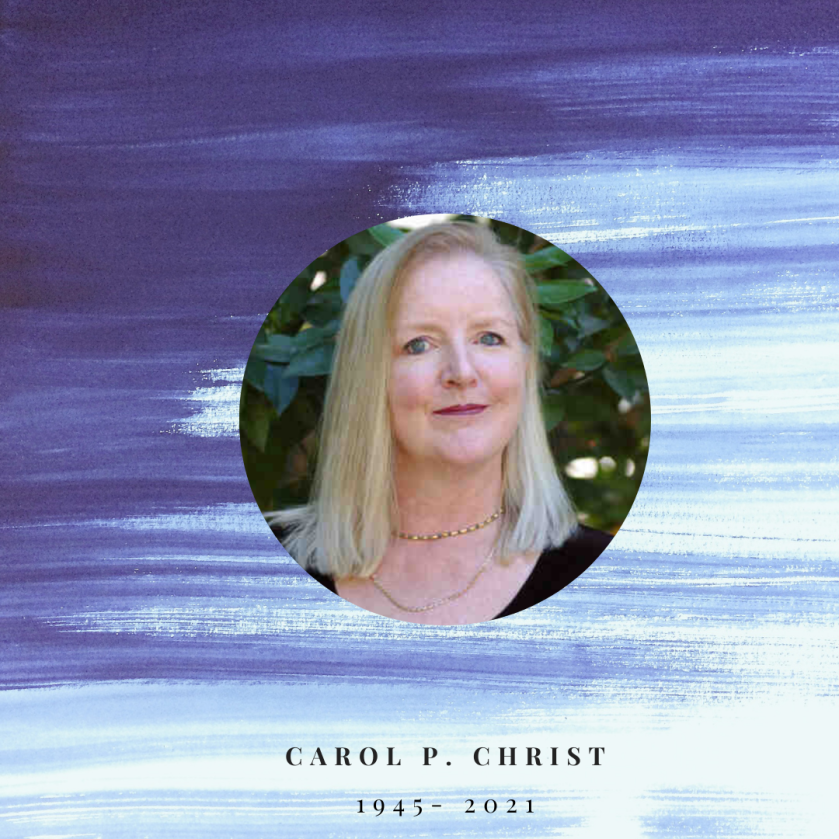
Legacy of Carol P. Christ: “AS WE BLESS THE SOURCE OF LIFE, SO WE ARE BLESSED”

This was originally post May 7, 2012

Blessing the Source of Life harks back to the time when shrines were built near springs, the very literal sources of life for plants, animals, and humans.

The prayer “As we bless the Source of Life, so we are blessed,” based on a Hebrew metaphor which refers to a water source and set to music in a Jewish feminist context by Faith Rogow, has become one of the bedrocks of my Goddess practice.

In Minoan Crete, seeds were blessed on the altars of the Goddess and the first fruits of every crop were returned to Her. The ancient Minoans piled their altars high with barley, fruits, nuts, and beans, and poured libations of milk and honey, water and wine, over the offerings they placed on altars. Evidence of these actions is found in the large number of pouring vessels stored near altars.

Continue reading “Legacy of Carol P. Christ: “AS WE BLESS THE SOURCE OF LIFE, SO WE ARE BLESSED””

Legacy of Carol P. Christ: Is It Essentialist To Speak Of Earth As Our Mother?

This was originally posted on November 25, 2013

The charge of “essentialism” has become equivalent to the “kiss of death” in recent feminist discussions. In this context it is taboo to speak of Mother Earth.  Yet, I would argue there are good reasons for speaking of Mother Earth that do not add up to essentialism. What if the values associated with motherhood are viewed as the highest values? What if the image of Mother Earth encourages all of us to recognize the gift of life and to share the gifts we have been given with others?

For those not familiar with the “essentialism” debate in feminist theory, it might be useful to define “essentialism.”  In philosophy, essentialism is the idea that every “thing” has an “essence” which defines it.  In its pure form, essentialism is a by-product of Platonic “idealism” which states, for example, that the “idea” of table is prior to every actual table and that every actual table is an embodiment of the idea of table.

Continue reading “Legacy of Carol P. Christ: Is It Essentialist To Speak Of Earth As Our Mother?”

I Am Kaleidoscope by Janet Maika’i Rudolph

Art work designed by Jaysen Waller – http://www.jaysenwaller.com/

FAR was founded in June 2011 by four women, Xochitl Alvizo, Cynthia Garrity-Bond, Caroline Kline, and Gina Messina.  They are and have been revolutionary thinkers in the world of feminism. Below is a portion of what they write on our “About” page

There is no single definition of feminism and this is a place of many voices. Important work in women’s studies in religion continues as more attention is paid to the intersection between gender, race, culture, and sexual identity, within feminism and religion.” They go on to say: “We establish this blog in the hope that feminist scholars of religion — and all who are interested in these issues — will use this forum to share their ideas, insights, and experiences, so that this community of thinkers will be nurtured as we explore diverse and new directions.”

Continue reading “I Am Kaleidoscope by Janet Maika’i Rudolph”

Legacy of Carol P. Christ: Hidden Meanings in the Rituals of the Assumption

“[T]he Old European sacred images and symbols were never totally uprooted; these persistent features in human history were too deeply implanted in the psyche.  They could have disappeared only with the total extermination of the female population.” Marija Gimbutas, The Language of the Goddess, 318.

August 15 is known to Greek Christians as the date of the Koimisi, “Falling Asleep” or Dormition of the Panagia, She Who Is All Holy.  December 25 is a minor holiday in the Orthodox tradition, while Easter and August 15 are major festivals.  The mysteries of Easter and August 15 concern the relation of life and death.  In Orthodox theology, both Easter and August 15 teach that death is overcome:  Jesus dies and is resurrected; Mary falls asleep and is assumed into heaven.  These mysteries contain the promise that death is not the final end of human life.  Yet this may not be the meaning of the rituals for many of those who participate in them.

Continue reading “Legacy of Carol P. Christ: Hidden Meanings in the Rituals of the Assumption”

The Queen of Heaven Cakes: Asherah and Ishtar by Michelle Cameron

When one nation conquered another in antiquity, vanquished peoples typically switched allegiances to that country’s gods, since those deities were clearly stronger than their own. In my novel, Babylon: A Novel of Jewish Captivity, the prophet Daniel warns against this tendency, so the Judean exiles would remain faithful despite their captivity:

“You may be tempted to slip away from your Hebrew roots. Many of us struggle to remain steadfast to our faith. We are seduced by the lure of the gods of Ishtar and Marduk, Sin, Damkina, and Ea. Their temples overflow with riches and their ways are strange and compelling.

Continue reading “The Queen of Heaven Cakes: Asherah and Ishtar by Michelle Cameron”

Legacy of Carol P. Christ: Has the Vatican Discovered that Women Should Be Running the World?

This was originally posted on February 9, 2015

So it is a [female] generativity that .. is … giving life to social, cultural and economic structures that are inspired by values, ideas, principles and practices oriented to the common good …

carol p. christ photo michael bakas

The above statement from the Pontifical Council’s document on “Women’s Cultures: Equality and Difference” is a response to Pope Francis’s call for a discussion of “feminine genius” and its role in the Church. If in fact women are  “oriented to the common good,” then this is the best reason I can think of to elect a woman pope. And if a women are in fact hard-wired to think about the good of all, wouldn’t a woman pope’s first act be to dissolve the hierarchy that elected her? Is this why the Vatican is so afraid of the power of women?

Continue reading “Legacy of Carol P. Christ: Has the Vatican Discovered that Women Should Be Running the World?”

Legacy of Carol P. Christ: “THE DIVINE MYSTERY”?

This was originally posted on November 11, 2013

christina's love

“The mystery of God in feminist theological discourse” is the subtitle of Elizabeth Johnson’s widely read She Who Is. The notion that God is “a mystery” is rarely questioned in feminist theologies. But maybe it should be.

Although it is true that the finite cannot encompass the infinite, and that all knowledge is rooted in particular standpoints, I do not agree that the first and last thing to be said about the divine power is that it is “a mystery.” Indeed as I will argue here, speaking about God as “a mystery” obscures more than it “reveals.”

Continue reading “Legacy of Carol P. Christ: “THE DIVINE MYSTERY”?”

Legacy of Carol P. Christ: Essentialism Reconsidered

This was originally posted on September 15, 2014

In my Ecofeminism class we have been discussing essentialism because some feminists have alleged that other feminists, particularly ecofeminists and Goddess feminists, are “essentialists.” They argue that essentialist views reinforce traditional stereotypes including those that designate men as rational and women as emotional. I too find essentialism problematic, but I do not agree that Goddess feminism and ecofeminism are intrinsically essentialist.

Goddess feminists and ecofeminists criticize classical dualism: the traditions of thinking that value reason over emotion and feeling, male over female, man over nature. We argued that the western rational tradition sowed the seeds of the environmental crisis when it separated “man” from “nature.”

Goddess feminists and ecofeminists affirm the connections between women and nature in an environmental worldview that acknowledges the interconnection of all beings in the web of life.

Continue reading “Legacy of Carol P. Christ: Essentialism Reconsidered”