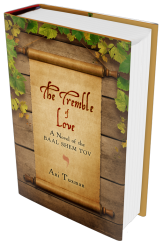
The Tremble of Love: A Novel of the Baal Shem Tov by Ani Tuzman – Reviewed by Joyce Zonana

jz-headshotNever has it been more difficult for me to affirm that “love trumps hate” as during this unprecedented United States election season.  After watching the Republican Convention last July in mute horror, I took to bed for several days, overwhelmed by the presentiment that everyone–blacks, women, Jews, Latinos, Muslims, queers– other than a certain breed of white American males was doomed to shameless malignment and persecution.  The palpable hatred in Donald Trump’s acceptance speech seared me, arousing my ancestral memory of various persecutions of Jews, Muslims, and others–not something I usually think about or choose to foreground.  For several months now, I have been haunted (and almost paralyzed) by fear.

tremble-of-love-cover-3d-for-webHence Ani Tuzman’s The Tremble of Love: A Novel of the Baal Shem Tov has come as an especially welcome, healing antidote, affirming as it does the power of “unshakeable faith even in the presence of inhumanity” (473).  I cannot say that I fully have such faith, but this novel, if anything can, leads me towards it. Page after page is filled with compelling examples of love’s power to disarm hatred and assuage pain.

Early on, a tale is told of a young man fearlessly facing three would-be highwaymen who have stopped the wagon in which he is riding with a rabbi’s wife and her three children, one of whom is disabled:

Continue reading “The Tremble of Love: A Novel of the Baal Shem Tov by Ani Tuzman – Reviewed by Joyce Zonana”

To Every Season by Deanne Quarrie

Deanne QuarrieWe are closing in on the last of the season of abundance. Wherever we look we see Her harvest around us. Purple grapes hang from their vines. Branches hang heavy from the weight of fruit and sweet nuts. All the forces of life have done their work ~ the sun ~ the rain ~ the earth ~ the wind ~ all have added and blessed everything with fruitful abundance.

We have reached the time of the harvest. The shadows of the day are lengthening and our growing season is drawing to a close. We reach out claiming our rich rewards ~ our bountiful harvest. Continue reading “To Every Season by Deanne Quarrie”

The Restorative Act of the Rite-13 Ritual by Katey Zeh

carpeI had never heard of the Rite-13 Ritual until I saw it listed on my worship bulletin a few months ago. My first reaction was to become annoyed when I saw the additional program item and to begin to calculate the additional minutes we were going to be sitting in our pew. Our nearly two-year-old daughter had just had her weekly meltdown over being left in the nursery, and all I wanted was for this liturgical hour to be over so I could scoop her up in my arms and take her home.

Started by an Episcopal Church in the 1980s the Rite-13 Ritual is modeled on the Jewish bar and bat mitzvah and intends to recognize adolescence as a time of transition in a young person’s life. After the opening hymn, six gangly, slightly awkward teenagers and their slightly nervous parents made their way up to the front of the congregation. They began with a reading based on Psalm 139: “God, investigate my life, get all the facts firsthand.” Most of their voices were barely above a mumbled whisper, perhaps due to the sheer discomfort of being center stage at church. In between each passage the youth read, the congregation responded, “Your creation is wonderful, and we know it well!” I’m a strong advocate for participatory worship, but this kind of of responsive reading always feels a little odd to me.

The last portion of the ritual, however, caught me off guard and left me in tears. The youth knelt down as their parents prayed a blessing over them. We couldn’t hear what was said, but watching these parents lovingly speak words of affirmation and encouragement softly into their children’s ears was beautiful. Now that I’m a parent, I couldn’t help but imagine what it might be like to stand in their place one day and pray a blessing over my daughter. But I don’t think that’s what brought on the tears.

I had a flash of a memory of a similar scene. I was also thirteen standing at the front of my church with my mother and a group of other youth and parents. We were not there to receive a blessing or to be affirmed, however, but instead to proclaim our commitment to sexual purity until marriage. It was the late 1990s and the True Love Waits movement was just ramping up. I guess you could say my church was an early adopter.

Instead of reciting Psalm 139, we spoke these words instead: “Believing that true love waits, I make a commitment to God, myself, my family, my friends, my future mate and my future children to be sexually abstinent from this day until the day I enter a biblical marriage relationship.” In this evangelical church of my childhood the only readily available affirmation of me as a teenager was tied to an ill-informed, naïve promise I was pressured to make about sexual abstinence for the foreseeable future and beyond.

It was a perfect example of the contradictory theological messages I got constantly from my faith community: God created you, so you are good. But you are also sinful, so you are bad. I remember a church friend once jokingly said, “You totally suck. But Jesus is great through you.”

Twenty years have passed since that True Love Waits Sunday, but as Madeline L’Engle wrote, “I am still every age that I have been.” Over those two decades, I’ve internalized that message of earned and performative self-worth I got as a teenager. It shifted from worth rooted in sexual purity to one tied to academic achievement, transformed to professional success, and then on to marriage and parenthood and the illusive “balance” of doing all of it simultaneously. I still yearn to hear those words of acceptance that I needed then and need to this day.

As I see it, the heart of the Rite-13 Ritual is a commitment on the part of young people to seek divine wisdom throughout the journey of life and for the community of faith to pledge to be a place of unceasing support, friendship, and care for them. No strings attached. I’ve kept that bulletin insert, formerly a source of annoyance, on a prominent place on my desk. I turn to it on particularly hard days as a constant reminder of the truth of my own sacred worth that can’t be lost or earned. It simply is. “Your creation is wonderful, and we know it well!”

Katey Zeh, M.Div is a thought leader, strategiest, and connector who inspires intentionalKatey Headshot communities to create a more just, compassionate world through building connection, sacred truth telling, and striving for the common good.  She has written for outlets including Huffington Post, Sojourners, Religion Dispatches, Response magazine, the Good Mother Project, the Journal for Feminist Studies in Religion, and the United Methodist News Service. Her book Women Rising will be published by the FAR Press in 2017.  Find her on Twitter at @kateyzeh or on her website kateyzeh.com

“And God Said It Was So”: Donald Trump Is the Spittin’ Image of Bad Theology by Carol P. Christ

Carol P. Christ by Michael Bakas high resoultionI try very hard this election season to avoid reading about, watching, or listening to Donald Trump: the man is a liar, a cheat, a bully, a narcissist, a racist, a sexist, the list goes on. Yet even progressive commentators are talking almost exclusively about him. And now I am joining them–despite my best intentions.

Reflecting on why facts seem to matter so little to Trump, Patricia J. Williams characterizes his campaign as an exercise in one-way communication:

Freedom of expression is reduced to an arbitrary insistence upon one-way communication, a barked order. Making America “great again,” by this measure, is a command, not a hope. . . This assumption—the belief that communication flows in one direction only, that it is the role of some to speak and others only to listen—is a paradox that stifles rather than encourages debate.

Continue reading ““And God Said It Was So”: Donald Trump Is the Spittin’ Image of Bad Theology by Carol P. Christ”

In Search of Ancestral Wisdom by Max Dashu

Max 2011

 What is the preserving shrine? Níansa (not hard).
The preserving shrine is memory and what is preserved in it.
What is the preserving shrine? Níansa.

The preserving shrine is Nature and what is preserved in it.
Senchas Mór, Ireland

In a world in extremity, we are searching for the wellspring, the inexhaustible Source known to all our ancient kindreds. Many of us have been cut off from our deep roots, and especially from the ancient wisdom of women, and female spiritual leadership.

My long quest has been to discover the lost strands of my own roots, the old ethnic cultures of Europe, and to reweave those ripped webs. I have spent decades searching for authentic cultural testimony about women’s spiritual ways before Christianity, before the Roman empire, before men commandeered all positions of religious leadership. My book, Witches and Pagans: Women in European Folk Religion, brings together these ripped strands of the cultural web. Continue reading “In Search of Ancestral Wisdom by Max Dashu”

Digging My Well by Joyce Zonana

James River
The James River

I write this from the heart of a ten-day silent yoga retreat deep in central Virginia.  The peace within and without fills me as I gaze over the James River, meandering through its wide valley, thickly carpeted in green.  The late summer thrum of cicadas rises and falls around me, and in the far distance I hear what sounds like a mower circling a field.  Earlier today, during meditation, I watched a pileated woodpecker pry its meal from the hollow of an ancient oak.  Rather than silently repeating my mantra with eyes closed, I had my eyes open, and I experienced the sacred vibration in the bird’s rhythmic taps.

440px-PileatedWoodpeckerFeedingonTree
Pileated Woodpecker

Now a soft breeze touches my face, bringing with it the sweet scent of wet grass.   “There is a blessing in this gentle breeze,” I remember the opening of William Wordsworth’s Prelude, and I am reminded as well  of Elizabeth Barrett Browning’s heroine Aurora Leigh, celebrating “the body of our body, the green earth.”  Yes.  This earth is my body, and I am blessed to be in it, here, at the ashram of my guru, Swami Satchidananda, silently  practicing hatha yoga, meditating, breathing, simply being.

Continue reading “Digging My Well by Joyce Zonana”

Gender Jihad and Epistemic Justice by Vanessa Rivera de la Fuente

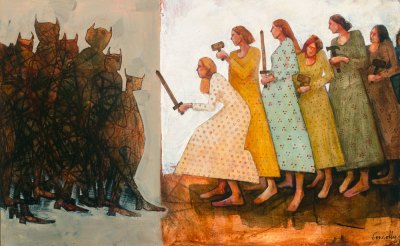
women-fighting-demons_web

In previous articles I have developed my personal perspective on Islamic feminism as a third narrative pathway that responds to the two traditional hegemonic discourses that exist on Muslim women, which I call “idealization of inequality” and “demonization of Islam

The search for gender justice within the framework of Islam has been called Gender Jihad is focused on installing a legal and social equality for Muslim women and groups or identities in the otherness, in line with the equality of divine origin established in the Qur’an. I think this socio-political equality begins with unpacking the epistemic violence prevailing in religious narratives that affects the representations and validation of women and persons in the otherness as equals, ie, like people, like men, the discursive and biopolitics referent of what is “Humankind”.

Islamic feminism is a narrative that provides answers to the epistemic violence represented by the speeches of idealization and demonization. As Gayatri Spiviak said, such epistemic violence is an orchestrated, widespread and heterogeneous project to constitute the colonial subject, as other. Women in religion are colonized subjects. Epistemic violence leads to epistemic injustice that results in unfair practices such as, for example, considering that the testimony of some people is less credible because they belong to certain gender, based on a distorted image of the other, which dehumanizes the individuals who are giving testimony.

The Gender Jihad posed by Islamic Feminisms seeks to establish a declaratory place that is an authentic expression of the agencies women and people in the otherness in relation to a hegemony with a strong colonial bias, represented for the narratives of idealization and demonization. Gender Jihad is the building of an episteme, understanding the right of Muslim women to enunciate and interpret a reality that challenges them, for and by themselves since, as Amina Wadud says “defining religion is to have power over it.”

This discursive possibility is possible thanks to the Tawhidic paradigm developed by Amina Wadud in the early 90s and  in her book “Qur’an and Woman,” a methodology that can decolonize fields of  knowledge, bodies and representational policies of the mainstream narrative about Muslim women and Others.

The merit of her paradigm, among many, is to systematize existing concepts in the Muslim cosmogony, in a way that provides a frame for gender analysis from Islamic theology and promoting the empowerment of women through it. Recognizing, on the one hand, the inherent equality of women as human beings, it gives theological support to a legal equality that for centuries have been at the discretion of Muslim scholars. On the other, it enables women, through rescuing Ijtihad, in our enunciation and narrative capacity as religious subjects. If humans are equal before God, then Women and Others are, by divine right, equally able to read, decipher, interpret and convey their perspective on religious matters.

There cannot be any political transformation, without having an equal right to speak, equal freedom to express thoughts, equal entitlement of movement of the body and ideas, equal agency to occupy material and symbolic spaces, without restrictions.

There can be no Gender Jihad without appropriating the  readings and discourses on gender, religion and jihad.

Gender Jihad begins with the recovery of the right to say and represent, therefore, is a struggle that could have as a prior aim the acquiring of epistemic justice.

This is relevant because “Who can speak” will mark simultaneously “on what terms that person talk.” What concepts and meanings can be used within the framework of the construction of a particular view of reality? What terms become the lens for discerning reality: development, democracy, gender equality, civil society, religion, social agency, etc. Only and exclusively from the enunciation (the power to speak) and from the ability to define the context in which speaking occurs, can one have a voice, that is, be a subject.

This framework for a new reality, based on the epistemic justice, will allow Muslim women to define their own place and have a voice to counteract epistemic injustice. Wadud offers a system of hermeneutic model that enables a “who can speak” and “on what terms” from an interpretation of the Quran from a gender perspective, which recognizes Muslim women agency to define and interpret religion, to build a speech based in empowerment and to rise as “political individuals of faith,” establishing a mapping for the construction of a reality in which they position themselves as people, beyond stereotypes and myths.

Image: Women Fighting Demons – Caitlin Conolly

Vanessa Rivera de la Fuente is a social communicator, writer, mentor in digital activism and community educator in gender and capacity development. She has led initiatives for grass roots female leaders’s empowerment in Latin America and Africa. She is an intersectional feminist interested in the crossroads between Religion, Power and Sexuality. Her academic work adresses Feminist Hermeneutics in Islam, Muslim Women Representations, Queer Identities and Movement Building. Vanessa is the founder of Mezquita de Mujeres (A Mosque for Women), a social media and educational project based in ICT that aims to explore the links between feminism, knowledge and activism and highlights the voices and perspectives of women from the global south as change makers in their communities.

Taking Risks to Heal Ourselves and Our World by Katey Zeh

Screenshot 2016-08-10 10.36.51

I was in New York having tea with a colleague whose prominence in our field has risen significantly over the last several years. I confessed half-jokingly that had we not known each other before this happened, we probably would not have been sitting there catching up in a coffee shop because I would’ve turned down the invitation. For as long as I can remember I’ve had an aversion to being in close proximity with even moderately well-known people, even if they are known only within our shared professional circles. Continue reading “Taking Risks to Heal Ourselves and Our World by Katey Zeh”

Thinking about Goddess and God by Judith Plaskow and Carol P. Christ

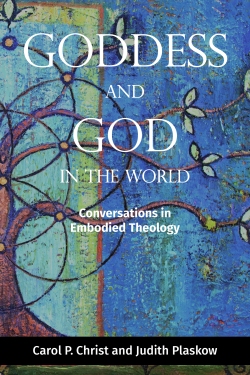
Goddess and God in the World final cover design

Talking about our deepest beliefs and feelings can be surprisingly intimate. In our new book Goddess and God in the World, we discuss our different theologies and challenge each other’s views. In the conclusion, we consider whether there is any way to judge between our positions. While we believe that theologies are rooted in experience, we also insist that they must make sense of the world we share and provide the orientation we need as we face the social, political, and environmental crises of our time.

Theologically, we disagree on two fundamental issues: whether divinity is personal or impersonal; and whether divinity is good or inclusive of good and evil. Does one of our views meet our criteria for adequacy more fully than other?

Does the notion of a personal or impersonal deity make more sense of our experience of the world? Carol argues that if consciousness and intelligence is a fundamental aspect of human existence and is found in varying degrees throughout the web of life, then it makes sense to think of divinity as also having consciousness and intelligence. Judith responds that the notion of a personal deity seems to her a holdover from the biblical picture of God and that she can find no evidence in her experience or reflection that a divine individual who is conscious and intelligent exists. We seem to be at a standoff here. There is some consolation in recognizing that this is a fundamental divide in the history of religions, but this insight does not resolve our disagreement.

Does one or the other of our views offer better guidance in making moral decisions? Judith argues that her view places moral responsibility firmly in human hands, which is where it belongs. Carol agrees with Judith that humans and other individuals are the ones whose decisions will determine the fate of the world, and she finds recognition of the interdependence in the web of life sufficient grounds for moral decision-making. But she would add that the love and understanding of a divine individual inspires her to love and understand the world and to promote its flourishing. Judith believes that the idea of one divine presence that enlivens and unites the universe is a sufficient basis for ethical action.

Our other major theological difference concerns whether divinity is good or inclusive of good and evil. Judith argues that if divinity is inclusive of the world, it must be inclusive of both good and evil. Carol counters that if divinity is reflective of what is best in ourselves and in other individuals in the world, then divinity must be good, not evil.

Does one of our views provide better moral guidance? Carol argues that a divinity who is good inspires us to try to make the world better. Judith replies that the notion that divinity is good leads us to idealize ourselves and to forget or deny our capacity to do evil. Carol feels that a clear focus on the world is sufficient to remind us of our capacity for evil.

Does one of our views offer a more adequate account of the existence of evil in the world? Judith asserts that the idea that divinity is the ground of both good and evil provides a better answer to the problem of evil: the potential for both good and evil are inherent in the creative process that is the foundation of life. Carol believes that the world is created by a multiplicity of individuals, including the divinity. The capacity for good and evil is inherent in the creative process that structures the world. The divinity is good but not omnipotent. What we call evil is created by individuals other than the divinity. Judith replies that this view does not adequately account for the origin of evil.

Is there any way to choose between our different positions? Each of us is firmly convinced that her view is clear, consistent, coherent, and comprehensive, that it takes full account of the complexity of human experience, and that it provides the moral orientation we seek….Each of us has tried without success to win the other over to her perspective. In the process, we have gained a deeper appreciation of each other’s views and clarified our own. This is as far as we have been able to go. We acknowledge that, in the end, we cannot know which, if either, of our theologies expresses the nature of ultimate reality or provides the crucial ethical guidance we need. Our views have been shaped by our standpoints, including personal, communal, cultural, and historical factors, and this means that they are relative and partial. Because we cannot see into the future, we cannot know the long-term effects of either of our theological worldviews.

At the same time, we are unwilling to throw up our hands and declare that all theological perspectives are of equal value. We firmly reject the fundamentalist insistence that particular texts, traditions, or truths are universally and eternally valid. This position denies that people create and interpret traditions, and it has repeatedly led to intolerance and violence. We continue to insist that the views of divinity we have articulated make more sense of the world as we know it and provide better orientation as we face the problems of our time than the traditional views we have criticized. On the one hand, all theologies—and all worldviews—are relative to experience and limited by human finitude. On the other hand, they can be examined, evaluated, and debated in relation to their understanding of the world and the kind of life they make possible for both the self and others.

Excerpted from Goddess and God in the World: Conversations in Embodied Theology–order now. Ask for a review copy (for blog or print) or exam or desk copy. Post a review on Amazon.  Share with your friends on social media using the links below.

carol p. christ photo michael bakas

Carol P. Christ and Judith Plaskow are co-authors of Goddess and God in the World and co-editors of Womanspirit Rising and Weaving the Visions. Judith wrote the first Jewish feminist theology, Standing Again at Sinai, while Carol wrote the first Goddess feminist theology, Rebirth of the Goddess. Judith is co-founder of the Journal of Feminist Studies in Religion. Carol leads the Goddess Pilgrimage to Crete. Space available on the fall tour!

Maiden, Mother, Crone: Ancient Tradition or New Creative Synthesis? by Carol P. Christ

Carol P. Christ by Michael Bakas high resoultionThe image of the Goddess as Maiden, Mother, Crone is widespread in contemporary Goddess Spirituality. The Triple Goddess honors three ages of women, in contrast to the wider culture that: affirms young women as sex objects while shaming them as sluts; celebrates mothers on Mother’s Day, while providing few legal and economic protections for mothers; and ignores older women.

Though Goddess feminists have created rituals for menstruation and birth, I suspect that a greater number of rituals have celebrated “croning.” The reasons for this are twofold. One is that women have time and space to reflect on the meaning of life in middle age. The other is that aging women are not honored and respected in the wider culture–creating a need for rituals that do just that. Many women I know have spoken of the empowerment they felt in their croning rituals.

On the other hand, many women I know have not been particularly interested in a croning ritual. Continue reading “Maiden, Mother, Crone: Ancient Tradition or New Creative Synthesis? by Carol P. Christ”