As Luke’s Gospel tells it, at the beginning of Jesus’ public ministry, the devil comes to him in the wilderness and tempts him.[1] First, the devil latches onto Jesus’ hunger after forty days of fasting: “If you are the Son of God, tell this stone to become bread.”[2] Then, he shows Jesus “all the kingdoms of the world.” He says, “I will give you all their authority and splendor; it has been given to me, and I can give it to anyone I want to.If you worship me, it will all be yours.”[3]
I’ve been thinking about this second temptation: all the authority and splendor of the kingdoms of the world. All can be yours. You just have to worship me. Did Jesus find this appealing? Personally, I find it a little hard to relate to. I have zero interest in ruling the kingdoms of the world, however splendid they might be. The whole proposition sounds like too much limelight and far too much stress. Thank you, devil, but I’m good.
This blog was originally posted on November 6. 2017. You can read the original comments here.
Trigger warning: this post describes sexual abuse
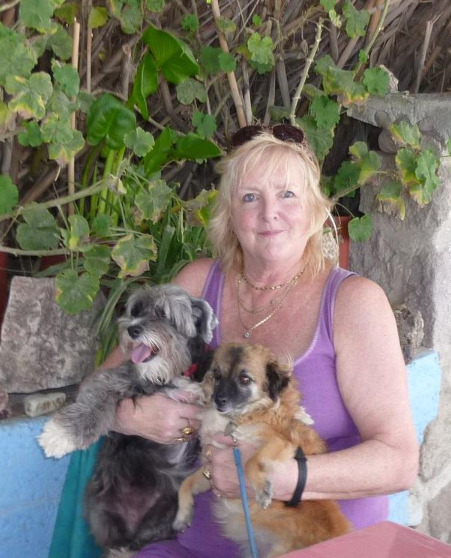
Last week while responding to a comment on my blog, I suddenly remembered a series of incidents in which men I did not know exposed themselves to me in public places. The first time occurred at a park around dusk during an outing with a group of girls. I was about 11, I may have wandered away from the group, or I may have been with others. What I remember is seeing a man with his pants down sitting on a park bench, possibly the first time I ever saw an adult man’s penis. I told or we told, but the man was not reported by the adults. Fast forward to the beautiful gardens of the Palace Schoenbrunn in Vienna where I was confronted by a penis while lost in thought when I was 19. I ran, but said nothing. In my 20s at the early showing of movies in New York City men would sit next to me and jerk off into paper bags. I learned to move whenever a man was near me in the theater, but I never told the ticket seller. A few years later, I crossed paths with a man who had his penis out on my favorite walk in the hills of Alum Rock Park in San Jose. I never walked carefree in that park again. When I was looking for the cave of the Furies on the Acropolis Hill in Athens, a man followed me waving his penis. I told the guard, but when the police came, he was gone. I arrived home in distress. My boyfriend said I was over-reacting. I learned to stay clear of men in cars on the streets of Athens at night after seeing things I did not want to see more than once in their hands. I coded this behavior as part of the background of my life. There was a man who from the basement apartment a few doors up from the Cycladic Museum pressed his erect penis against the window. I told the guard at the museum who said, “We have called the police more than once, but he always cries, and they let him go.” On a trail I had walked many times with my dogs near Lafionas in Lesbos, coming around a bend, I encountered a young farmer, who as soon as he saw me, pulled out his penis and urinated against a fence. That was the last time I walked the trail. We are supposed to learn to consider this behavior as well, if not normal, anyway, not such a big deal. After all, I wasn’t hurt, or was I?
For the first several weeks of my walking pilgrimage, I debated whether to visit the famous Black Madonna of Orcival. It wasn’t the walking distance that deterred me; She lived in a gorgeous Romanesque cathedral nestled in a charming medieval mountain town only fifteen miles away. Rather, I was hesitant to visit Her because I knew that, after a thousand years of being Black, She had undergone a mid-twentieth-century “renovation and restoration” process that whitened Her skin. I knew from photos that Her once gorgeous melanated skin was now a ghastly beige-ish pink. The incredible Black Madonna of Orcival now appears to be a white woman.
Despite the distances involved, throughout my adulthood, I regularly visited my parents. As their home was small, I often found myself seated at the kitchen table with my mother while my father watched TV in the adjacent living room. During those visits, it was not unusual for my mother to come and stand behind me and begin working her fingers into my thick dark hair.
I knew why she did this—she was looking for my scars, hidden under the abundance of my hair but still visible to those with patience. Two scars are hidden by my hair. When I was three, I received a glancing blow from a horse’s hoof which cut my scalp causing it to bleed profusely. When I was six, I fell out of a tree in our back yard and cut my scalp again. Maternal fingers remembered where those scars should be, and Mom would weave her fingers through my hair until she found each scar. Then she would lovingly stroke each spot several times and return to her seat. Even at the time it seemed like she was offering a blessings to my wounds.
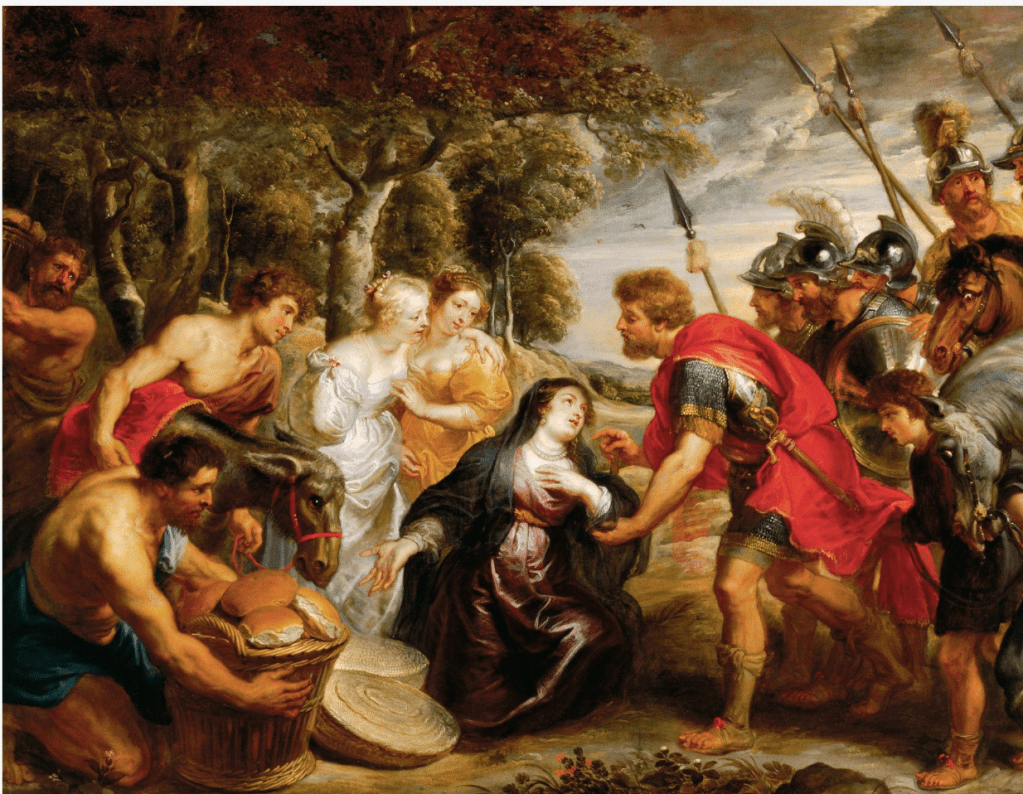
The meeting of David and Abigail by Peter Paul Rubens circa 1630
In these days when so many are afraid and aching for the people of Ukraine, and concerned about the lasting impacts of this war around the world, I cannot help thinking of the wise women of ancient Israel. These wise women, unafraid of confronting dangerous men, used their intelligence and storytelling skill to defuse violent situations between powerful adversaries and restore peace. May their wisdom be felt in the world now.
The institution of “wise woman” appears several times in the Bible. In the Book of Samuel, a wise woman (chachamah in Hebrew, from chochmah, wisdom) steps in when there is a war, or political conflict, to promote peace. In II Samuel 14, after King David’s son Amnon rapes David’s daughter, Tamar, the king does nothing. Tamar’s full brother Absalom takes matters into his own hands and kills Amnon, then flees to another country. David grieves for Absalom but won’t send for him. The wise woman of Tekoa appears before King David, pretending to be a woman whose sons fought, and one killed the other. The story she tells helps to reconcile King David with his son Absalom, at least temporarily.
In recent days I have been pondering the fact that some people and some feminists seem to see the issues of religious faith and belonging to be rooted in birth, family, and community, while for others the question of belonging to a religious community hinges on belief and judgments about the power exerted by religious institutions. What accounts for this difference in the way we view religious belonging?
Recently I watched The Secret History of Sex, Choice and Catholics, a film featuring Roman Catholic feminists and ethicists who dissent from the Roman Catholic hierarchy’s views on contraception, abortion, and homosexuality. At the beginning of the film those interviewed state almost univocally that for them being Catholic stems from having been born Catholic. These Catholic dissidents continue as Catholics, even though they disagree with major portions of Roman Catholic teaching. It may have been because they were not asked, but most of them did not name reasons of belief for remaining Catholic.
The internet and social media has been eagerly anticipating the release of Hulu’s fictional/non-fictional docuseries based around events in the lives of Pamela Anderson and Tommy Lee. For many of us who lived through the 1990s, the scandals surrounding the love and fall out of Baywatch actress Pamela Anderson and rockstar Tommy Lee was a huge turning point in conversations of how media is never truly private nor is it ever truly gone.
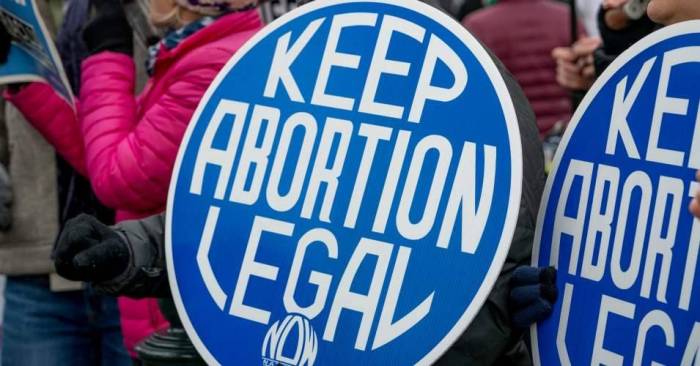
Slowly, yet systematically, women, men, and everybody else along the gender continuum, are losing access to a timely, legal, and safe abortion. This is not breaking news. Pushback in the United States against abortion “rights” has been happening in various state legislatures for decades. These days we find ourselves more and more constricted as laws across the country reflect a tightening of accessibility to what some people refer to as a “scourge” in the land.
My first-ever blog post on FAR (March 2014) wrestled with the subject of abortion. In that essay (one that’s still relevant), I suggest we broaden our thinking about a subject that has polarized Americans. Is abortion (a) right? Is it wrong? The two sides have become entrenched.
Moderator’s note: This marvelous FAR site has been running for 10 years and has had more than 3,600 posts in that time. There are so many treasures that have been posted in this decade that they tend to get lost in the archives. We are beginning this column so that we can all revisit some of these gems. Today’s blogpost was originally postedMay 20, 2019. You can click here to see the original comments.
Trigger Alert: The bible on its face is quite violent to women.
Amidst the ugliness that is American politics in general and abortion politics specifically, I began to look for guidance to understand what is happening. I ended up pulling out two books that I read long ago. The first is Woe to the Women-The Bible Tells Me So by Annie Laurie Gaylor. Gaylor, in turn, was inspired by the work of Elizabeth Cady Stanton in her The Women’s Bible which was originally published in two parts (1895 and 1898).
I had forgotten how inspired I have been by both books. Together, they motivated me to begin looking at how the bible is a foundational paradigm of our culture. I started researching how translations have been altered from original meanings. I have already written a few blogs about how the representations of Eve have been changed to strip Her of the roots of Her original power. Take a look here and here.
I started writing this post a day after news broke that beloved activist, poet, feminist, and academic, bell hooks had passed away. This news comes months after our FAR community lost Carol Christ; another academic, feminist, writer, and maker of history. This post was finished as almost three weeks into a new year has gone by. The advent of 2022 is filled with the last two years’ heavy, unbelievable, heartbreaking, and extraordinary experiences and events.