Part 1 was posted yesterday. You can read it here. The Norns were explaining the mess they had made when they got drunk at a Valhalla party.
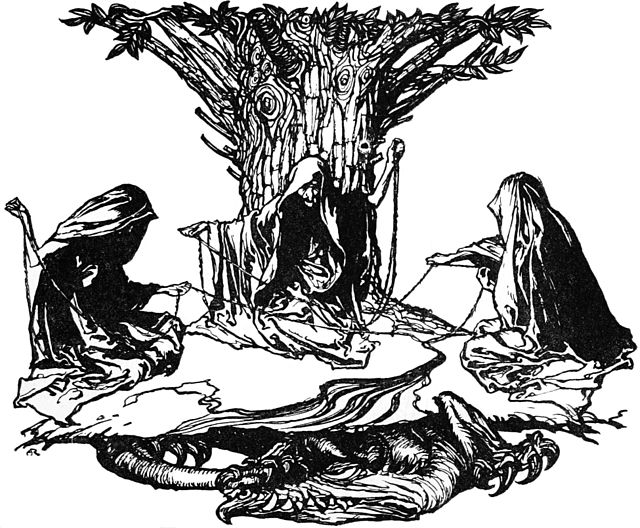
The Norns looked at me with sadness. “We knocked over one of our looms/templates/arrangements”
Their tone changed, they looked at each other and I thought I could see emotion churning. They were arguing and then they stopped. They turned toward me and looked sheepish, that is if divinities can look sheepish. “It was a disaster/calamity/debacle.”
“Tell me then,” I was growing impatient.
Verdandi: “Well you see the loom we knocked over was . . .”
“What?” I almost shouted at them.
Urd: “It was the loom holding the pattern from Salim/Jerusalem.”
In 2020, I began writing my biography because some weird things were happening in my life including some which were time-bending. To help make sense of it, I wrote up “conversations” with the mythical characters of Persephone, Inanna and the Norns of the Norse. Throughout my bio, I speak to the Norns as an out loud meditation on the nature of time, fate and energy.
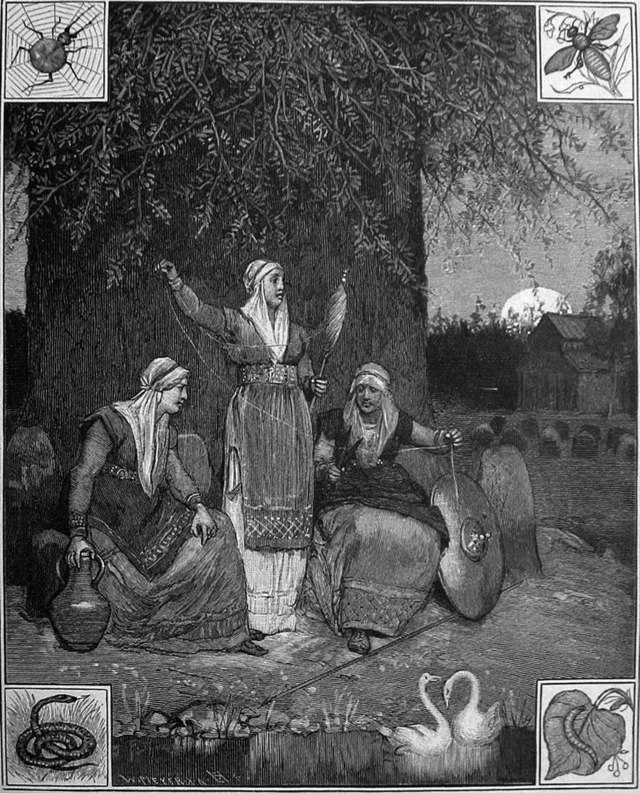
The three Norn sisters are Urd, Verdandi and Skuld. Their names come from Old Norse which is not a spoken language. The actual translation of their names is open to speculation. In general, here are their common meanings.
Urd – past
Verdandi – happening or present
Skuld – future or debt.
By mythological tradition, they show up at a child’s birth and then weave their “fateful” decisions about that child’s life into a tapestry. They are considered more powerful and fearsome than the gods because even the gods are ruled by the hands of fate (or Norns in this case). They were also treated as oracles where kings and warriors went to consult them much as was done in Delphi Greece.[1]
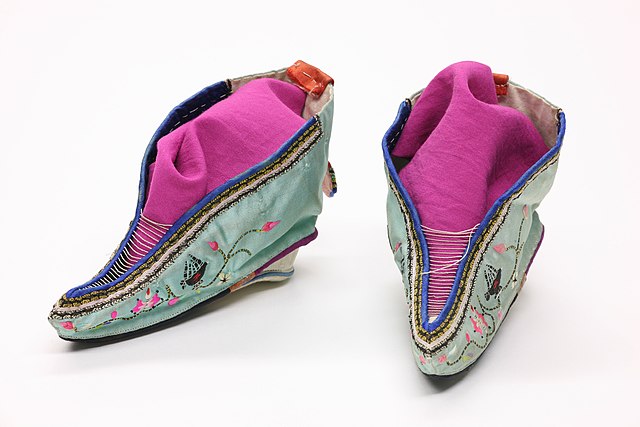
My husband, Marty, is a retired podiatrist. He worked in pockets of New York City that were poor and largely immigrant. When he first started his practice, he treated women from China whose feet had been bound. Despite being officially outlawed 1912, footbinding was still being practiced well into modern times. He saw these patients in the 1970s and 80s.
For those who don’t know what it is, young girls, as young as 3-5 would have the bones in their feet broken and then the feet bound with cloth strips. Every few years, the feet would be broken again until the desired result was created. To create that affect, the toes would be flattened against the bottom of the foot and arch would be so broken and damaged that the heel would curl back to the front of the foot. At each of the breakings the girl would need to learn to walk again. One can only imagine that pain of walking on foot bones that had been repeatedly broken. And here is an especially chilling part. The mothers would do it to their own daughters. I won’t go into further gruesome details because they can be easily looked up on the internet. It left the girls crippled for life.
Moses is an interesting character is in the pantheon of religious leaders. He is such a major personage, considered the founder of Judaism and yet there are no extra-biblical accounts of his life and his deeds. He only exists in the bible. You’d have thought that such a major event as leading a whole class of people away from Egyptian slavers, would have shown up on the radar of other written or mythical accounts from the time. Nothing!
Even his name is interesting. When the Egyptian princess gathered Moses out of the waters she said:
She named him Moses, explaining,
“I drew him out of the water.”
Exodus 2:10
This is one meaning of his name. But there are others. In Egypt, the land where he was born and raised, the M-SH (variations: m-s or m-ss) root simply means “son.” Or it can mean “child” in a non-patriarchal sense. We see this in other Egyptian names Ramses is the child of the sun god Ra. Tutmose is the child of Tut.
Editor’s Note: A more formal memorial to Catholic Feminist Theologian Rosemary Radford Ruether was posted here at Feminism and Religion at the time of her passing. Now we are delighted to share these memories of her by two scholars, Theresa A Yugar and Janice L. Poss, who knew her well, especially in her last months. Therese’s reflection is below and Janice’s will appear tomorrow. As Janice notes in her post, “More than any deep theological concept, doctrinal exegesis, or other hyper-scholarly thought, she taught me simply by being who she was – a woman – and she gave me the ultimate gift, the gift of herself.” Through these posts, Theresa and Janice pass on some of Rosemary’s wise and caring gifts to our FAR readers.Part 1 was posted yesterday.You can read it here.
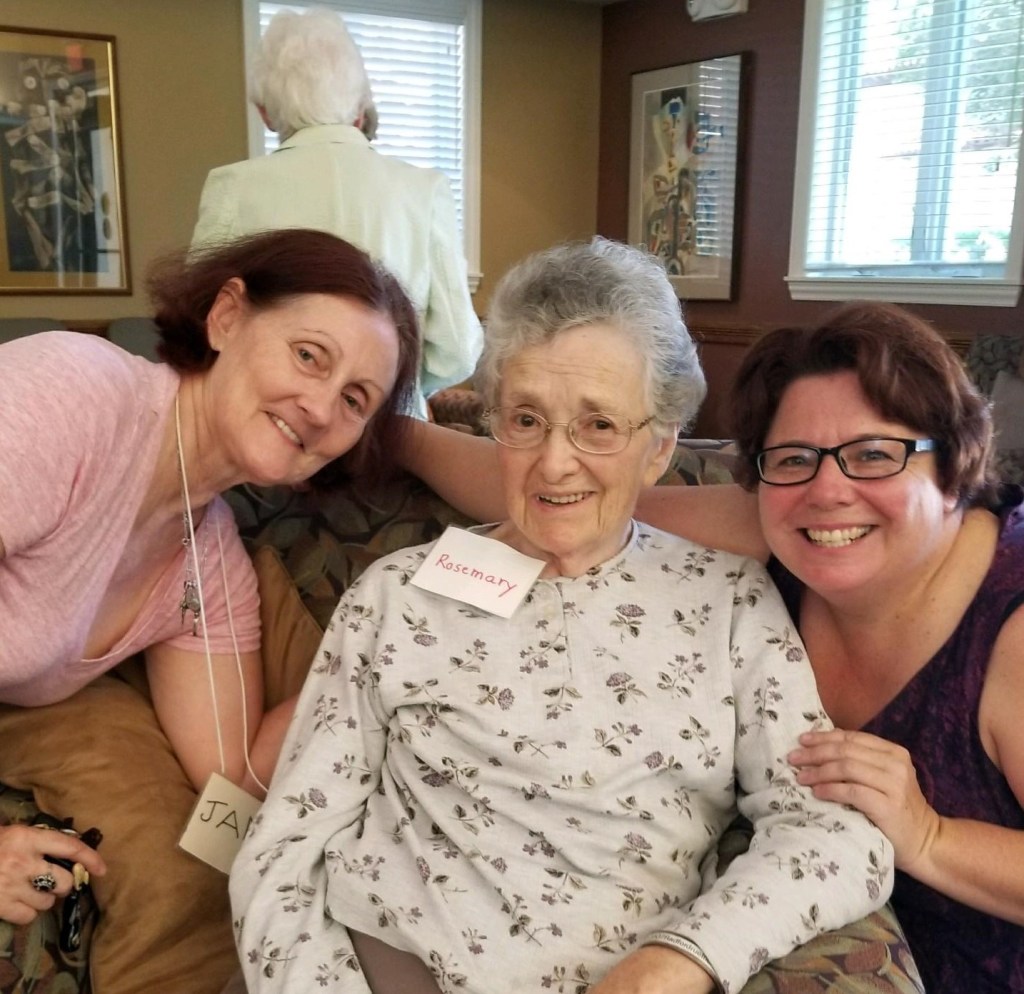
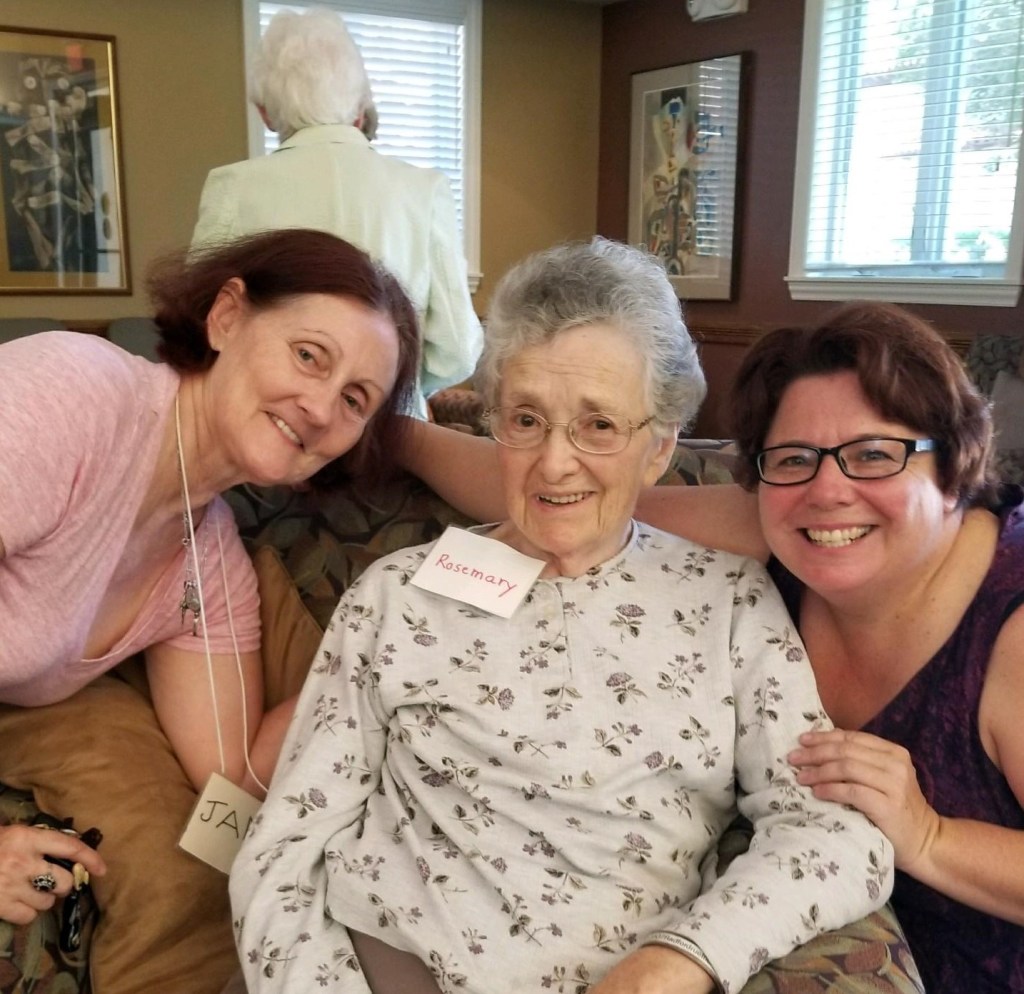
Janice, Theresa with Rosemary
Almost five years ago, Rosemary Radford Ruether suffered a devastating stroke that left her partially paralyzed and no longer able to speak or write, activities that were integral to her life as a writer, teacher, activist, and scholar. During her difficult last years Janice and I learned new ways of engaging her that were academically stimulating and fulfilling for her. We became advocates for her during her disability as she had been an advocate for us. Thus, out of pain grew blessings.
Janice and I dedicate and share with you these two short reflections that reflect our struggle to find our way without her. We know there will be many more reflections composed and shared by others whom she mentored, influenced and touched. Now—in the midst of our grief and sadness at her loss—we offer our personal memories of how she enriched our lives every day until she passed from our midst at 2pm, on Saturday, May 21, 2022.
Editor’s Note: A more formal memorial to Catholic Feminist Theologian Rosemary Radford Ruether was posted here at Feminism and Religion at the time of her passing. Now we are delighted to share these memories of her by two scholars, Theresa A Yugar and Janice L. Poss, who knew her well, especially in her last months. Therese’s reflection was posted yesterday and Janice’s is below. As Janice notes in her post, “More than any deep theological concept, doctrinal exegesis, or other hyper-scholarly thought, she taught me simply by being who she was – a woman – and she gave me the ultimate gift, the gift of herself.” Through these posts, Theresa and Janice pass on some of Rosemary’s wise and caring gifts to our FAR readers.
Janice L. Poss, Rosemary and Theresa A. Yuger
She’s gone, but not forgotten. She is there, presence felt. The Spirit, as they say, works in mysterious ways. I knew about Rosemary for several years after attending two presentations on feminist topics that she gave at Loyola Marymount University in 2005 and 2008. In 2006, I also recall hearing about her while organizing the first Roman Catholic Women Priests (RCWP) Mass in Los Angeles. Once I entered Claremont Graduate University as a Ph.D. student I heard quite a bit about her because my colleague and friend, Theresa Yugar, mentored me through orientation until she graduated. Occasionally I would see Theresa and Rosemary at Pilgrim Place when I attended Women Church Services. Although Rosemary was still teaching one class a semester, I could never attend because I was working full-time.
Labyrinths are magical. I’ve always been drawn to them. About two years ago, a local Episcopalian Church rebuilt their beautiful outdoor labyrinth and opened it to the public. In concert with them, I have been delighted and honored to offer guided walks there. Doing these walks, both in leading them and in walking myself, have given me the opportunity to reflect deeply on what they mean from many perspectives: historical, personal, spiritual, philosophical, experiential.
When I walk a labyrinth, it feels like I am mirroring the universe while expanding my internal journey. Teresa of Avila agrees with me (or, more accurately, I with her). She wrote, “If we learn to love the earth, we will find labyrinths, gardens, fountains and precious jewels! A whole new world will open itself to us. We will discover what it means to be truly alive.”
Along with the words of Justices Sotomayer, Breyer and Kagan.
The Supreme Court ruling overturning Roe was expected, but there was nothing that could prepare me (nor likely anyone else) for the devastation of the actual decision. My gut is reeling. I thought it would be useful to survey the landscape through the lens of patriarchy. Thanks to Carol Christ for having always written insightful comments about the roles of patriarchy. This is inspired by her work.
The dissenting judges were quite eloquent, so I will work off their words.
“Whatever the exact scope of the coming laws, one result of today’s decision is certain: the curtailment of women’s rights, and of their status as free and equal citizens.”
“After today, young women will come of age with fewer rights than their mothers and grandmothers had. The majority accomplishes that result without so much as considering how women have relied on the right to choose or what it means to take that right away. The majority’s refusal even to consider the life-altering consequences of reversing Roe and Casey is a stunning indictment of its decision.”
My Commentary: Through the eyes of patriarchy here is no need to consider life-altering consequences because it only recognizes two roles for women: madonna or whore. We are never seen as full humans with civil and independent rights. Patriarchy doesn’t just hate the sexual freedom of women, it has spent millennia trying to quash it, make it into something dirty, control it. It’s a love/hate relationship with sex. Rape is really OK (look how hard it is to prosecute). Pedophilia OK too (look at the church). But a woman making her own sexual, reproductive choices . . . a bridge too far. Patriarchy will always force us to pay a price for having sex, for being alluring, for being female.
Yet another of my great feminist and spiritual teachers has died. Rosemary Radford Ruether, ecofeminist Catholic theologian, died on May 21st. Her work challenged my thinking and gave me new understandings and perspectives. She was a prolific writer, authoring hundreds of articles and 36 books, and was the quintessential scholar and historian of world religions and ecofeminist thought and theologies. A scholar of the scholastics, she examined the three strains of Western thought: the Hebraic tradition; Platonic-Gnostic; and Pauline-Augustinian in all their complexities to develop an understanding of the nature of Western thought and its implications for the domination of women, nature, and colonized others. As she described her own approach, she drew out the contradictions and complexities in these theologies, careful “to see both negative and positive aspects . . . and to be skeptical of exclusivist views on either side.”[i] Her thought and writing was ever-expanding, and always striving “to see the dominant system of patriarchy, including its racism, classism, and colonialism, in critical perspective,” and to put herself “in places where in solidarity with its victims, I can see it from its underside.”[ii]To this end, she brought together the ecofeminist theologies of women from around the globe, particularly the global south.[iii] Her thought also grew to include critiques of militarism and corporate globalization. Needless to say, I cannot begin to encompass all of her contributions here. So I will focus on the ways her thought has most deeply influenced and inspired my own, as well as my students’.
This was originally posted on March 12, 2014. It was Esther’s first FAR post.
Recently, I got involved in a conversation about abortion. It happened on Facebook when a relative posted that her heart hurts when she considers her “sweet baby girl” and how the law (Roe v. Wade, 1973) in the United States gave her the choice as to “whether [or not] I would have her killed.” She’s sincere. Many of her friends “liked” her post and, with few exceptions, commented in agreement. I was one of the exceptions.
March celebrates Women’s History Month–a month to remember the accomplishments of our foremothers, noting their work helping to secure for us (their progeny) certain rights, most notably the right to vote (Elizabeth Cady Stanton, 1815-1902) and reproductive rights (Margaret Sanger, 1879-1966). Support for abortion nowadays almost always falls under the rubric of “women’s reproductive rights.” So when we hear, “It’s my body and I’ll decide what I’ll do with my own body,” the speaker is giving voice to what many consider to be a fundamental right–the right to be autonomous and exercise free agency over one’s own person.