Please Keep It in Your Pants by Carol P. Christ

Trigger warning: this post describes sexual abuse

Last week while responding to a comment on my blog, I suddenly remembered a series of incidents in which men I did not know exposed themselves to me in public places. The first time occurred at a park around dusk during an outing with a group of girls. I was about 11, I may have wandered away from the group, or I may have been with others. What I remember is seeing a man with his pants down sitting on a park bench, possibly the first time I ever saw an adult man’s penis. I told or we told, but the man was not reported by the adults. Fast forward to the beautiful gardens of the Palace Schoenbrunn in Vienna where I was confronted by a penis while lost in thought when I was 19. I ran, but said nothing. In my 20s at the early showing of movies in New York City men would sit next to me and jerk off into paper bags. Continue reading “Please Keep It in Your Pants by Carol P. Christ”

Rest and Renewal: Gifts of Women’s Ritual Dance by Laura Shannon

 Samhain is past, and we in the northern hemisphere are once again entering the final outbreath of the solar year. At the winter solstice, light will be reborn. Until then, it is important to embrace the time of rest and renewal which is the great gift of this season. Like the falling leaves and the drying seeds, we too can relax and release old burdens. This is the best way, perhaps the only way, to draw new strength for the next active phase in the ever-changing cycles of our lives.
Many of us no longer follow the rhythms of the year and consequently subsist in an ongoing state of near-exhaustion. But rather than letting our energies get too depleted, we can learn to thrive within the limits of our available resources. As well as vastly improving the quality of our lives, this may lead to solutions for sustainable living in the long term – perhaps the most important skill humanity needs to develop now.  Continue reading “Rest and Renewal: Gifts of Women’s Ritual Dance by Laura Shannon”

Women and the Ethics of Conflict by Vanessa Rivera de la Fuente

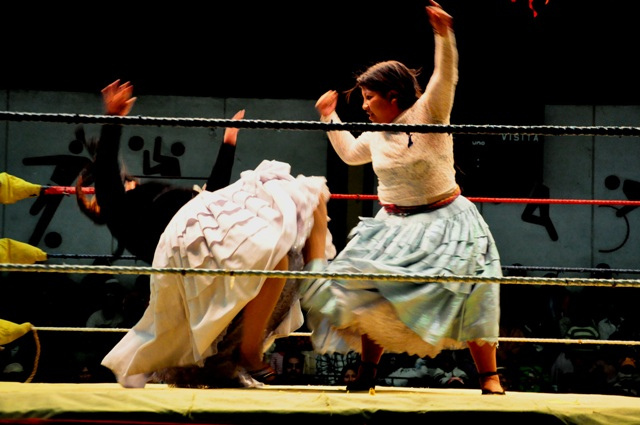
Cholitas wrestling

Some time ago, trans-activist F.  was the target of bullying and harassment via social networks that lasted months and included defamation on Twitter and Facebook, articles in feminist blogs and web sites, and letters to women’s organizations and public institutions to request they ban the presence of F. from feminists spaces. Who did this? Feminists who had been F. friends. Why? For a disagreement with F.

In fact, F. was obliterated from women’s movements and even lost job opportunities. The most serious, perhaps, was the deep depression that affected her and the loneliness in which she had to live this experience.

Cases like these are examples of a behavior that is not strange, but instead is pitiful and very harmful — the destructive socialization of females to please patriarchy and to reproduce patriarchy and oppression at the expense of our integrity as women.

Women fight with the guns of patriarchy

We have been domesticated, trained to obtain the approval of a man and of the patriarchal system at any cost, to do whatever it takes to have a place at his side. We are the result of centuries of pedagogy that creates mistrust between women, and the validation and reproduction of our oppression and conditioning towards mutual competition. This is the root of our inability to deal with conflicts between us in a constructive and non-dehumanizing way. We can only give of what we have and as long as we have an identity as objects instead of individual people, women will be expert agents of misogyny.

Being a feminist, an scholar in gender studies doesn’t excuse or free anyone from this, at all. Continue reading “Women and the Ethics of Conflict by Vanessa Rivera de la Fuente”

Reflections on Marriage by Ivy Helman

studyMy partner and I are getting married in a little over a month.  She, a lawyer, and I, a professor, live in the Czech Republic.  Technically, we aren’t getting married because the Czech Republic doesn’t have marriage equality.  Our relationship will not be recognized in the U.S.  For that, we need to be married in a state or nation that has marriage equality.  Germany might soon.  Other options would be a number of EU countries or the United States, but that doesn’t affect our status in the Czech Republic.  Finally, our marriage will also not be recognized by some in Jewish circles as well since the ketubah, the Jewish marriage document which possesses legal status in Jewish courts, is between two women.

There is nothing legal about our Jewish wedding except one could argue its Jewishness. So, the day after our wedding our relationship will have the same recognition as it had the day before and the day before that.   This would not be the case if we were a heterosexual couple.  It reminds me of the countless commitment ceremonies that took place before marriage equality in the United States.  They were not prohibited (like the marriages that slaves had because slaves weren’t considered people under the law or eligible to enter into legal contracts while in bondage (see pages 301-302).  Yet, similar to the “contubernal relationships” of slaves performed by their masters or other slaves (page 302), they weren’t particularly legal either.  Despite the ceremony, there was no change in status of the couple within society.  Yet, recognition was and still is an important component of both struggles for rights.  In fact, according to Darlene Goring in “The History of Slave Marriage in the United States,” (345-346), the process of gaining legal recognition was very similar for both ex-slaves and the marriage equality community in the United States. Continue reading “Reflections on Marriage by Ivy Helman”

Sometimes I Think I Am a Voice Crying in the Wilderness … by Carol P. Christ

Just last week I was dumbfounded when an acquaintance told me that his philosopher partner calls a woman leading a workshop on labyrinths “a tree hugger.” “What,” I wanted to say, “is wrong with being a tree hugger? Are we not all interdependent in the web of life? Why should we imagine that trees or the cells of trees have no feelings at all?” But the tone of contempt and dismissal in the man’s voice told me that I would only be creating another “fuss,” the kind that can make me persona non grata among the ex-pats in my village.

Moreover, I could not have made my point simply. I would have had to discuss Plato’s assertion that the mind of man is destined to rise above the body and nature and modern science’s conclusion that nature is mere matter for man to use as he chooses. I might have needed to cite Susan Griffin or indigenous worldviews. This could have been a very long discussion indeed. Continue reading “Sometimes I Think I Am a Voice Crying in the Wilderness … by Carol P. Christ”

Breaking Down the Concept of Arranged Marriages by Vibha Shetiya

13327613_10208448645447348_6913754683590458893_nOne of the first things my American friends and family ask me when they learn I used to be married to an Indian man is: was it an arranged marriage? I understand the intrigue, the bewilderment and even horror that the phrase “arranged marriage” can conjure up in unfamiliar Western minds. Images of forcing women to marry strangers encountered upon the street or child betrothals or women being dragged to the wedding site to be married off to mustachioed men are likely to flash before one’s eyes. While such incidents may have occurred from time to time, and in the past, as with child marriages, the long-established concept of “arranged marriage” is very different and not as frightening as may seem.

Traditionally speaking, proposals materialized through word-of-mouth – family and friends recommended a good alliance, or a parent would approach someone directly or indirectly to ask for a daughter or son’s hand in marriage. Even then, personal histories were well researched into, before both parties decided to “see” each other. Marriages in India continue to be alliances between families, and so it is important to check into family background – what are the parents’ and siblings’ occupations? How much does the prospective groom earn? After all, he may be the sole earning member of his family and may not be able to provide for his own family once he starts one. Is there a history of crime or mental illness? This investigation makes perfect sense in a society that is community and family-oriented, and wherein joint family situations are still the norm, especially in smaller towns and villages. It is thus imperative that everyone try and get along. “Arranged marriage” is certainly not synonymous with an “Oh-let’s-just-get-rid-of-our-daughter” arrangement.

Continue reading “Breaking Down the Concept of Arranged Marriages by Vibha Shetiya”

Recalling the Courage of Shamima Shaikh by Vanessa Rivera de la Fuente

If this be Madness

Shamima Shaikh’s name may be unfamiliar for you and many who are not deeply informed about Islam and gender issues in South Africa or who tend to identify Muslim women and/or activism for women’s rights in Islam with the Arab region. Why should you know about her? Because Shamima Shaikh was one of the most notable Muslim anti-apartheid activists and advocates for the rights of Muslim women in her country—a prominent feminist, journalist, radio producer, movement builder, trailblazer, and fearless activist.

This year—2017—marks the 20th anniversary of her death, and I think it’s a special occasion to recall her brave legacy, not only because twenty is a special number. In the context of violence against women in South Africa and worldwide—in particular the violence against and exclusion of Muslim women in Syria, Palestine, Yemen, and Saudi Arabia—as well as the gendered Islamophobia that targets our sisters in Europe, claiming the courage and spirit of resistance of Shamima Shaikh as part of our ethos as women living in a patriarchal world that hates us is absolutely necessary. Continue reading “Recalling the Courage of Shamima Shaikh by Vanessa Rivera de la Fuente”

Earth Dreaming, Water Dreaming: How Elemental Dreams Offer Healing for the Earth and Us by Jill Hammer

I once dreamed I was giving a lecture on a spiritual philosophy called magmatheism.  The literal meaning, I thought when I awoke, would be something like “belief in the divinity of molten rock.”  I had the sense this dream was trying to tell me something about what I had come to believe and know.  When I asked my friends what they thought magmatheism was, they gave answers that delighted and intrigued me.

One said: “the belief that God/Goddess dwells below the ground and every once in a while erupts out gloriously.”

Another said: “By studying the ways in which rock is liquid, we can understand the oneness of all things… Our separation is an illusion.  We are part of the whole.”

A third said: “Honoring the magnetic pull to earth.”

A fourth said: “The unmanifest that creates the foundation of all life.”

The dream told me something real about the power of dreaming. It let me know that a life physically and spiritually connected to the earth—the life I was trying to live and to encourage others to live—did not only occur when I was awake, but when I was asleep.  The dream told me that the earth was speaking to me in my dreams.  As dream tender Stephen Aizenstat writes, “Dream images are not representations of our personal nature only, but are also informed by the subjective inner natures of the things and creatures out there in the world. (Aizenstat, S. Dream Tending: Awakening to the Healing Power of Dreams. New Orleans, LA: Spring Journal, Inc. (2011), pp. 149-150).

Continue reading “Earth Dreaming, Water Dreaming: How Elemental Dreams Offer Healing for the Earth and Us by Jill Hammer”

Shakespeare’s Sister Revisited: A Circle of Female Lineage by Mary Sharratt

Vanessa Bell’s painting of her sister, Virginia Woolf

What do groundbreaking 17th century poet, Aemilia Bassano Lanier, and 20th century feminist icon, Virginia Woolf, have in common? A lot actually.

In her 1929 essay, “A Room of One’s Own,” Woolf imagines the tragedy of Shakespeare’s brilliant sister, Judith, barred from the grammar school because of her sex and forced to hide her writing from her family. To escape a forced marriage to a man she hates, she runs away to London to seek her fortune in the theatre, only to end up pregnant, abandoned, and destitute. Out of despair, she kills herself. Continue reading “Shakespeare’s Sister Revisited: A Circle of Female Lineage by Mary Sharratt”

“He Owes Us Nothing”: A Very Bad and Very Sad Theology by Carol P. Christ

While waiting to get off a plane last week,  I overheard a serious young woman explaining a recent theological insight to her half-asleep and equally young husband. “You see,” she began, “what I just learned is that though He owes us nothing and does not reward us for our good deeds, nonetheless, He takes pleasure in them.”

As the flight was from Mytilene, Lesbos to Athens, I guessed that the young couple had come from the United States to my island to assist the refugees. I imagined that the young woman wanted to do good deeds, to help others, and to please her God.  At the same time, she seemed to be struggling with Lutheran, Calvinist, or Anabaptist doctrines of justification by faith alone and predestination. I suspected that she had been told she must accept the teachings of church authorities on faith as the correct interpretation of the word of God. Her new insight was attributed to someone else. Continue reading ““He Owes Us Nothing”: A Very Bad and Very Sad Theology by Carol P. Christ”