Religion, Race, and Feminism in an Era of Elusive Enlightenment by Salaam Green

The warrior spirit is not only the coherent ability to resist circumstances outside of one’s making; but the ability to fight the war within all of us thus managing discomfort and chaos with the force of authenticity.

Recently an enlightened friend on social media reminded me of the importance of not only portraying an awakened consciousness in the fight towards enlightened morays in an age of fascist’s dictatorships but actually waking up to unresolved veracities.

Hurriedly, I searched for a working definition of enlightenment consistent with my Christian beliefs. I finally found several however, none exactly measured up to the values that are interlaced within scriptures and thus are founding principles of Christianity and religious fundamentals.

Continue reading “Religion, Race, and Feminism in an Era of Elusive Enlightenment by Salaam Green”

Reflections on Trauma, Part II: YOLOCAUST by Stephanie N. Arel

stephanie-arelIn light of the recent attacks on Jewish cemeteries —the desecration of Mount Carmel Jewish Cemetery in Philadelphia and the toppling of more than 150 gravestones at Chesed Shel Emeth Cemetery in Missouri — along with my reminiscing that a year ago today (March 1 as I am writing) I was en route to Jerusalem to work with a group of scholars for the Intercontinental Academia on Human Dignity, I wanted to once again confront trauma (building on Part I of this topic). In this case, I consider trauma as an affront to the dignity of ALL bodies and their memories, while simultaneously questioning how those who have not experienced trauma develop respect for its proximity – in individual lives, in sacred spaces, and in memorials.

The desecration of memory alive in the space of the cemetery presses me to repeat what I have said before: that the violation of bodies lies at the heart of traumas caused by human design — even if those bodies are inhumed. Continue reading “Reflections on Trauma, Part II: YOLOCAUST by Stephanie N. Arel”

We the People by Joyce Zonana

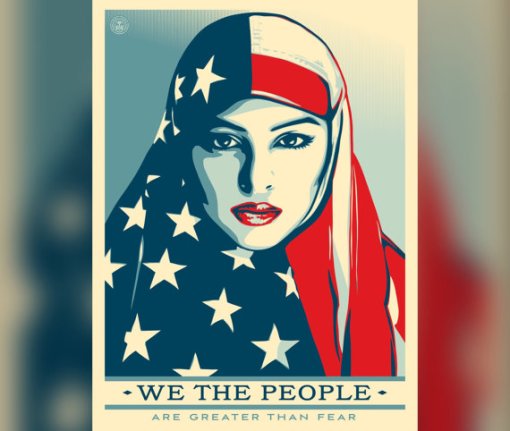
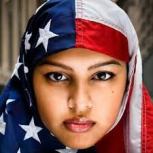
jz-headshotDuring the January 21st Women’s March in New York City, I was inspired and delighted by so many of the signs women and men had crafted to express their opposition to the current disastrous regime in the United States: “Grab America Back,” “Support Your Mom,” “Sad!,” “Miss Uterus Strikes Back.”  But one image stood out, mesmerizing me:  that of a woman proudly wearing an American flag as hijab, with a message below—“We The People Are Greater Than Fear.”  For several blocks as we made our way up Fifth Avenue, I walked beside a woman carrying that sign, and it became, for me, the most powerful symbol of the resistance we must all wage during the dark time ahead.
il_570xn-1174082361_2sxw
Poster by Shepard Fairey
images-1
Munira Ahmed photo by Ridwan Adhami

The image, based on a photograph of Munira Ahmed by Ridwan Adhami, was created for the Women’s March by graphic artist Shepard Fairey (who also designed the iconic image of Barack Obama, “Hope”).  It offers a striking visual challenge to a long-held orthodoxy, now brought to the fore by Donald Trump and his gang:  that Western-style liberal democracy (epitomized by the United States) is incompatible with Islam.  And, perhaps even more specifically, that Islam is incompatible with feminism.

Many Western women—including feminists—are still bound by the Orientalist worldview that encumbered our liberal feminist foremothers.   Continue reading “We the People by Joyce Zonana”

“Girl . . . You’re Gonna Make It” by Carol P. Christ

https://vimeo.com/82884853

Why did this song,* this program, this woman mean so much to Oprah and  Michelle, to you, to me?

Because Mary Tyler Moore was one of our first role models of cheerful independent womanhood.

Why does this song still bring tears to my eyes?

Because I had never learned that a girl could make it on her own.

Because I feared that I couldn’t and hoped that I would.

And guess what, I did.

Lots of us did.

With help from our friends.

Mary showed us that too.

The Mary Tyler Moore Show was broadcast on Saturday nights.

Many of us were home alone, watching faithfully.

We do not forget.

*The above version of the song is from the first season, the words “you’re gonna make it after all” were changed to “you’re gonna make it on your own” in season two.

***

a-serpentine-path-amazon-coverGoddess and God in the World final cover designBe among the first to order A Serpentine Path, Carol P. Christ’s moving memoir of transformation. Carol’s other new book written with Judith Plaskow is Goddess and God in the World: Conversations in Embodied Theology.

Carol is a leading feminist theologian and historian of religion who wrote the first Goddess feminist theology, Rebirth of the Goddess as with Judith Plaskow co-edited the path-breaking Womanspirit Rising and Weaving the Visions.

Join Carol on a Goddess Pilgrimage to Crete in 2017. Save $200.


The Women’s March on Washington: I’ll Be There in Spirit by Carol P. Christ

womens-march-logoThe Women’s March on Washington has released its statement of vision and principles, and what a stunning testimony to intersectional feminism and collaboration it is! The statement is woman-centered, while at the same time addressing a multitude of issues that affect women’s lives: from access to abortion for all, to an equal rights amendment to the constitution, to the rights of  women as domestic and farm workers, to police reform, and so much more.

I was thrilled to read the list of women honored as foremothers to the march:

Bella Abzug*Corazon Aquino*Ella Baker*Grace Lee Boggs*Berta Caceres*Rachel Carson*Shirley Chisholm*Angela Davis*Miss Major Griffin Gracy*LaDonna Harris*Dorothy I. Height *bell hooks*Dolores Huerta*Marsha P. Johnson*Barbara Jordan*Yuri Kochiyama*Winona LaDuke*Audre Lorde*Wilma Mankiller*Diane Nash*Sylvia Rivera*Barbara Smith*Gloria Steinem*Hannah G. Solomon*Harriet Tubman*Edith Windsor*Malala Yousafza

Many of these women have inspired me, particularly (but not only): Bella Abzug, Rachel Carson, Shirley Chisholm, Malala Yousafza. I have taught books by or about many of them, including: Rachel Carson, bell hooks, Audre Lorde, Harriet Tubman, Barbara Smith.

I hope these names will be read at the beginning of the ceremonies, followed by an invitation to all present to speak, shout, or whisper—all at the same time–the names of all the women, known and unknown, who have inspired their own activism for women’s rights. In this way, no one’s name is left out. We have a similar ritual on the Goddess Pilgrimage to Crete, and it is incredibly powerful.

I first heard the Women’s March on Washington discussed at the meeting of the Feminist Liberation Theology Network held in conjunction with the meetings American Academy of Religion and Society of Biblical Literature ten days after the (so-called) election of Donald Trump. At that time a number of women asked if this march would be a white women’s march. Would women of color feel called or able to come? In the interim, women of color have become leaders of the Women’s March on Washington and it is definitely not “for white women only.” It was suggested that women of color might feel safer at local marches. These have been organized as well: learn about Sister Marches here. At the time of this writing 370 Sister Marches had been organized—in all 50 states and in more than 40 countries.

If, like me, you are feeling weary and despondent these days, the statement of the Women’s March on Washington may help to re-inspire your commitment to all women’s rights:

The Women’s March on Washington is a women-led movement bringing together people of all genders, ages, races, cultures, political affiliations and backgrounds in our nation’s capital on January 21, 2017, to affirm our shared humanity and pronounce our bold message of resistance and self-determination

Recognizing that women have intersecting identities and are therefore impacted by a multitude of social justice and human rights issues, we have outlined a representative vision for a government that is based on the principles of liberty and justice for all. As Dr. King said, “We cannot walk alone. And as we walk, we must make the pledge that we shall always march ahead. We cannot turn back.”

Our liberation is bound in each other’s. The Women’s March on Washington includes leaders of organizations and communities that have been building the foundation for social progress for generations. We welcome vibrant collaboration and honor the legacy of the movements before us – the suffragists and abolitionists, the Civil Rights Movement, the feminist movement, the American Indian Movement, Occupy Wall Street, Marriage Equality, Black Lives Matter, and more – by employing a decentralized, leader-full structure and focusing on an ambitious, fundamental and comprehensive agenda. Read more.

Learn more about the march. Readers of FAR might want to participate in the march with WATER (Women’s Alliance for Theology, Ethics, and Ritual). I’ll be there in spirit from Molivos, Lesbos, Greece.

***

a-serpentine-path-amazon-coverBe among the first to order A Serpentine Path, Carol P. Christ’s moving memoir of transformation. Carol’s other new book written with Judith Plaskow is Goddess and God in the World: Conversations in Embodied Theology. Carol also wrote the first Goddess feminist theology, Rebirth of the Goddess.

Join Carol on a Goddess Pilgrimage to Crete in 2017. Save $200.

Read two of the chapters in the book: Mysteries and Dionysian Rites.

Thanks to Judith Shaw for the cover art “Downward Serpent.”


The Importance of Religion for Eco-Feminism by Ivy Helman

untitled.png“Why is religion important to ecofeminism?”  A student, in the Master’s course I teach at Charles University, asked this as we began the class session dedicated to the topic.  Given the overwhelming presence of atheism in the Czech Republic, I wasn’t too surprised by the inquiry.  Nonetheless, the idea has been at the back of my mind ever since: what does religion have to do with ending patriarchy and bolstering the health of the planet?  While I may take the connection as obvious, it is clearly not for many feminists out there.  Here is how I understand it.

First, it is true: many of our inherited religious traditions have been and still are considerably patriarchal.  Because of that, some feminists outright reject religion.  In fact, some feminists even consider religion dangerous and threatening, as it is often utilized to contradict many feminist aims.  Yet, there are many, many feminists who find, within their given or chosen tradition, non-patriarchal elements that can be recovered, remembered and/or (re)created.   Religious feminists work tirelessly to transform religions in life-sustaining and post-patriarchal ways not just for themselves but also for those women and men who belong to the same communities.   Continue reading “The Importance of Religion for Eco-Feminism by Ivy Helman”

Don’t Treat Religious Women Like Second Class Feminists by Gina Messina, Jennifer Zobair, and Amy Levin

ff-editors-001It seems like every few weeks another young, female celebrity proudly and publicly declares she is not a feminist: Shailene Woodley. Katy Perry. Kelly Clarkson. Kendall Jenner. These women often justify their refusal to claim feminism by explaining they do not hate men—speaking to the most intractable and yawn-worthy of the mischaracterizations of feminism—or by insisting they do not personally face inequality.

Nevermind that compelling movie roles for women dry up decades before those for men, or that recently 37-year-old Maggie Gyllenhaal was deemed “too old” to play the love interest of a 55-year-old man. (Thank you, Amy Schumer, for the Last F**kable Day Skit!). Even if we accept these young stars’ claims that they don’t face any discrimination, feminists wonder where the concern is for other, less privileged women.

This question is both frustrating and justifiable. On the one hand, who cares what a reality television star thinks of feminism? On the other, these women tremendous power to influence young women. For them to dismissively say, “I have rights, so who needs feminism,” both dishonors the sacrifices of our foremothers and ignores the reality that women’s rights are still in play.

They are still in play for women seeking equal pay for equal work, for those who want paid maternity leave, and for those who seek access to reproductive health. They are still in play for women of color and for LGBT women.

And they are still in play for women of faith.

Gender continues to be a serious issue in patriarchal religious traditions, and women continue to be denied particular roles because of their genitalia and/or gender expression. However, while mainstream feminists practically beg young celebrities to adopt the “feminist” label, women of faith are mocked for actually claiming a feminist identity and working within our traditions to combat sexism. While mainstream feminism seems desperate to have in its fold a 19-year-old reality television star who is famous in no small part because her older sister’s sex tape went viral, mainstream feminism rejects empowered women of faith.

So why have we become second-class feminists?

We understand the appearance of a disconnect between our faith and our feminism. We acknowledge that our religious traditions suffer from sexist interpretations. We understand why some feminists leave our faiths, and we have been tempted to do the same. But even if every Jewish, Christian and Muslim feminist abandoned her tradition, there would still be many women who stay, women for whom that decision has religious jurisprudential consequences. They will still be subject to Halakhah, Canon law and fatwas. They will still face exclusion from leadership roles. They will still endure pressure from community members who accept women’s lesser status based on the teachings of unenlightened rabbis, priests, and imams.

We acknowledge and concern ourselves with these real world impacts of our faiths. But we also recognize our faiths’ foundational messages for what they are and the ways they’ve been misconstrued. In other words, we refuse to let our traditions be defined by sexist interpretations.

This refusal takes many forms. Jewish, Christian, and Muslim feminist scholars are working within the framework of existing translations of the Torah, Bible, and Qur’an, producing new translations of those texts, and, in some cases, questioning the authenticity and divinity of verses that appear irredeemably sexist. At the same time, female activists are committing radical acts of worship that address longstanding sexism. Anat Hoffman was arrested and strip searched for her activism seeking legal recognition for Jewish women to pray out loud with traditionally male religious garb at the Western Wall in Jerusalem. Kate Kelly was excommunicated after founding the movement Ordain Women and calling for women to take on leadership roles within the Mormon Church. Amina Wadud endured international condemnations and threats of violence when she became the first woman to lead a mixed-gender Muslim prayer in the U.S.

These are dedicated, tenacious women who refuse to abdicate their religions to sexist interpretations. This is what courage looks like. This is what feminism looks like.

And yet, while mainstream feminists pine for young stars to pay lip service to feminism, women of faith who are actually doing brave and difficult work are routinely told they cannot be “true” feminists.

We recognize that many people think it is only a feminist act to leave patriarchal traditions. We contend that it can also be a feminist act to stay, and we look forward to the day when doing so puts neither our faith nor our feminism in question.
___

final-cover-faithfully-feministThis piece was co-authored by Jennifer Zobair, Gina-Messina-Dysert, and Amy Levin, the co-editors of Faithfully Feminist: Jewish, Christian, and Muslim Feminists on Why We Stay.

Supporting Embodiment: Societal and Jewish Views on Body Modification by Ivy Helman

me-hugging-treeEmbodiment is a feminist principle which has, as its basis, two fundamental criteria.  First, humans require their bodies to live.  We must acknowledge that our existence is tied to our bodies.  This fact grounds us in this world.  Here, and not in some other-worldly place, we live out our lives.  We are dependent on our bodies and what the world provides for our survival.  In other words, humans are inseparable and interconnected to this world.  Humans are not above nature as the Western hierarchical dualist mindset would suggest.

Second, embodiment challenges the hierarchical dualistic notion that the mind and body are separable by connecting the mind to the body.  Humans do not exist because they think, as Descartes once said.  Rather, humans exist because of a complex system of interactions between body and mind. Without the body, the mind fails and vice versa.  The link between the mind and the body has led many feminist theorists to reject any sort of existence beyond this physical life.  That is a topic for another time. Continue reading “Supporting Embodiment: Societal and Jewish Views on Body Modification by Ivy Helman”

Women, Theology and Identity as Believer by Vanessa Rivera de la Fuente

eve

Like all my reflections, this is not intended to be conclusive, but rather, to share some impressions about theology and the way in which women are created or given an identity as believers.

In the androcentric and misogynist narratives of religious traditions lies the root of much violence against women. This is not new, since the same diagnosis has already been raised by the theologian José Luis Tamayo when he says that although women are the majority presence of religious communities and those most involved in the transmission and practice of traditions “they are the biggest losers” for all the exclusion and violence exercised against them in the name of religion.

The influence of religion on the lives of women goes beyond the realm of religion itself. From theology comes the gender discourses that impact our lives as political subjects. In all the most obvious (sociological, historical, economics) causes of the weak status of women, we can find theological roots or argument religion-based. These  roots are discursive. What is said about women from religions, as well as from the social and exact sciences, institutions and the media, are stories, narratives that are the product of the interaction of mechanisms of power, enunciation authority and historical accumulation of performative actions. Continue reading “Women, Theology and Identity as Believer by Vanessa Rivera de la Fuente”

Atonement, Forgiveness, and Feminism by Debra Guckenheimer

Photo by Michael Stepansky

As Rosh Hashana and Yom Kippur approach, I am in the midst of my annual process of asking forgiveness to everyone I have knowingly wronged in the last year. During this time, Jews atone for our wrong-doings. We are tasked with not only asking for forgiveness, but making things right with those we have wronged.

This year, I’m realizing that I have been missing out on so many aspects of forgiving. What about the forgiveness I am not aware I need? I need to learn to forgive us and to invite others to call me out on the ways I have inflicted harm on them. Continue reading “Atonement, Forgiveness, and Feminism by Debra Guckenheimer”