(Not Yet) Elder Reflections by Chris Ash

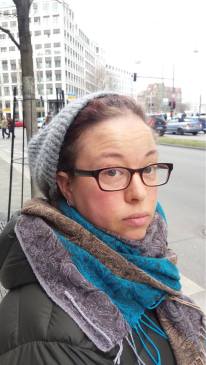
Four years ago, as I went to touch up my roots with a shade of red I’d been dying my hair since I was 18, I noticed that what had started as a few random strands of gray amidst my natural reddish brown had become streaks of brilliant silver. I began dying my hair red as a style choice, long before I’d ever even thought of going gray. I loved the way my natural hair reddened in the summers, with copper highlights flashing under the beach sunsets. There was never an intention to hide gray or look younger, but there was a time in my thirties when the first few strands of gray seemed to make my darker roots look muddy, like they were dirty instead of graying.

But brilliant streaks of silver? This, I could do. I switched from my usual permanent henna dye to a temporary red to keep my roots touched up while the henna’d hair grew out, and waited. Three years later, all the permanently red hair had grown out, and I was ready to have fun. I went to the stylist, had him bleach out the parts I’d been dying red, and had him color it all with a wild ombre of colors that would look good with silver. My hair was a darkened nebula, silver roots reaching down into four different shades of purples of blues. After each new dye – a brilliant nebula, each time fading over a few months into a soft mix of gray-blues and silver. Even at the end of the fade-out, people still ask me if I just had my hair colored. Every week, the color seems a new shade.

Currently, I’m at the end of a fade out. Honestly, I probably would have colored it a few weeks ago if I weren’t so busy, but at this point my hair is mostly gray with some slight bluish highlights.

And twice in the last week – TWICE! – I’ve been offered the senior discount by well-meaning cashiers.

At 42. Continue reading “(Not Yet) Elder Reflections by Chris Ash”

Creating Women’s Circles that Heal and Enrich Our Lives by Anne Yeomans and the Women’s Well

From 1994 until 2012, the Women’s Well, based in Concord, Massachusetts, offered thousands of women the opportunity to participate in women’s circles of all kinds. In the first and second parts of this series, Anne Yeomans, a co-founder of the Women’s Well, and others who co-created the Women’s Well, shared about their experiences with the power and wisdom of the circle and the use of altars and ritual. (Part I and Part II).  This third part, explains the guidelines that the Women’s Well developed for their circles. This post is adapted from the Women’s Well website at www.womenswell.org.

We often used the guidelines in our circles. Sometimes the facilitator or holder of the circle would speak of them and then place them around the circle on printed cards, to remind us of the quality of listening and speaking that we were trying to invite in.

These guidelines were originally drawn from the work of Tom Yeomans who developed a way of working in groups, called the Corona Process. It was an approach to group dialogue that came to him in a dream the night after attending a meeting with the great physicist David Bohn, who at the end of his life became interested in dialogue and world peace. Continue reading “Creating Women’s Circles that Heal and Enrich Our Lives by Anne Yeomans and the Women’s Well”

Meet the Bible Bitches: Interview with Rev. Laura Barclay and Sara Hof

What do you get when you have two ladies, one a Baptist Minister living in KY and one an agnostic living in LA, making jokes and talking about the Bible?  Don’t know?  You get the new and exciting podcast Bible Bitches! 

BB-Banner-white

What do you get when you have two ladies, one a Baptist Minister living in KY and one an agnostic living in LA, making jokes and talking about the Bible?  Don’t know?  You get the new and exciting podcast Bible Bitches!  We hope that you’ll take a moment to check out this new and exciting podcast that explores the F-word in Religion (among many other topics) and read the Q&A below with the creators Rev. Laura Barclay and Sara Hof!  Click here to listen to the podcast (now on episode 5)!

Continue reading “Meet the Bible Bitches: Interview with Rev. Laura Barclay and Sara Hof”

Feminazi as Archetype by Vanessa Rivera de la Fuente


Feminazi.jpg

Feminazi is an image and narrative created by patriarchy to control the liberation and recognition of women as autonomous political subjects, and to serve as a warning to thwart these processes.

It is a label used for male supremacy to name the fearless woman. Fear is a control mechanism used to keep us living in terror of: expressing opinions, gaining weight, walking on the street, being raped, ridiculed, or lonely, not being married, being rejected, or dismissed, having too much cellulite, going to hell, traveling alone, being beaten, believing in ourselves, etc.

Feminazi is a modern myth designed to make us believe that there are good and bad feminists, and that it is possible to exclude and ignore all feminists through labels and stereotypes. A woman’s transition toward liberation can be seen as threatening to others when it is assumed that “someone else” outside the woman herself, has the privilege to define which feminisms are acceptable, or which processes of liberation and searching for autonomy are legitimate, or not.

Continue reading “Feminazi as Archetype by Vanessa Rivera de la Fuente”

Why Are You So Angry? by Vanessa Rivera de la Fuente

32809382544_f804118009_b

Please be warned, this post details violence against women.

A new March 8.
Another year protesting
Another evening taking the streets of our cities around the world
In Rome, in Lima and Santander
A new slogan, a new banner, for the same rage

A decent man, one of those who define himself as a good citizen and father stands in front of me asking: “Why are you so angry? …. Why are feminists so angry? I am asking you: Why are you so fucking angry?”

Why are you angry?
Because my friend went to the police to put a complaint that her husband beat her and they did not take the complaint. When she returned home, her husband hit her again.

Why are you angry?
Because I am 16 years old and every day after school, older men shout sexual things to me in the street, they even follow me and when I get upset and tell them not to do it they say that I am being rude … I am afraid to walk in the street. Continue reading “Why Are You So Angry? by Vanessa Rivera de la Fuente”

A Feminist Retelling of Cain and Abel by Trelawney Grenfell-Muir

Eve and Adam had many children. Two of them, the sisters Cain and Abel, were best friends. When they grew up, Cain became a farmer, and Abel became a shepherd. In their community, people shared what they had with each other. They shared this way in order to help the community be strong, and to practice gratitude. They shared with each other in sacred, holy ceremonies, in which they put their communal offerings onto an altar for Sister God/ess, to be blessed. One day, both Cain and Abel brought an offering to their community. Cain brought some food she had grown, and Abel brought a sheep. The community gathered for the ceremony. They prayed prayers of gratitude and blessing, and thanked the Earth for its abundance. They each laid hands on the sheep and thanked her for her life, blessed her spirit that it might journey peacefully and joyfully to reunite with Sister God/ess, and praised her for giving her body to feed the community.  Then they killed the sheep, as quickly and carefully as they could, and set the meat in the sacred fire to cook. Abel was glad that she could help her community be fed and healthy with the sheep she had given.

Continue reading “A Feminist Retelling of Cain and Abel by Trelawney Grenfell-Muir”

The Feminist-O-Meter by Vanessa Rivera de la Fuente


Not my way to see Feminism_ then that's NOT Feminism_

Have you heard about, applied or received the Feminist-O-Meter lately?

The Feminist-O-Meter is a tool that often appears in feminisms and women rights activisms, fostering power struggles, cliques, jealousies and -if that is not enough – encouraging the reproduction of mainstream socialization that fosters competition and alienation among women.

It can be summed in the expression:

“Not my way to see Feminism? Then, that’s NOT Feminism”

I see feminisms as revolutions of subjectivities based on the radical idea that women are people … and it turns out that people are diverse, we are the result of our experience and the way we interpret them.

So, I do not understand why there is so much drama, judgment, outrage and social punishment in feminist spaces when those involved are undertaking the process of discovery, of claiming back our personhood by legitimizing our different ways of thinking, our understandings of liberation, and our acknowledgment of what makes us happy and makes us feel feminist.

Continue reading “The Feminist-O-Meter by Vanessa Rivera de la Fuente”

Breaking the Silence by Chris Ash

Christy CroftYesterday, Time Magazine announced that its “Person of the Year” for 2017 would be “The Silence Breakers” – the name it has given to those women who helped launch and made headlines in the #metoo movement. This movement was started by activist Tarana Burke in 2006 to highlight the sexual abuse of women of color and was sent viral by actor Alyssa Milano in 2017. It speaks volumes that this designation falls exactly one year after Time awarded this honor to Donald Trump for the political shift heralded by his defeat of Hillary Clinton.

This defeat that was fueled, at least in part, by the way Trump’s own normalization of sexism, harassment, and assault played on the fears and bitterness of misogynist voters hell-bent on preserving what racial, gender, and economic privilege they could continue to hoard for themselves and those like them. This defeat, and the ensuing glorification of a sexual predator and rampant misogynist, in turn fueled a movement of people, mostly women, tired of being scared into silence to protect the powerful who abuse. Continue reading “Breaking the Silence by Chris Ash”

Kintsugi for the Soul – Part I – by Vanessa Rivera de la Fuente

Kintsugi2

Kintsugi is a Japanese art technique that consists of repairing broken porcelain or pottery with resin varnish dusted or mixed with gold, silver or platinum powder. It is the art of fixing what has been broken with a precious metal that gives a greater value than that which the piece originally had. Kintsugi makes objects become a testimony of a particular journey.

In September 2015, in Cape Town, my fiance and I went to have lunch and listen to a concert at the Waterfront. Walking through the artisan market, we were struck by a stand where simple mugs of clay and pottery were displayed. Each one of them had been made by a woman survivor of some type of violence or trauma, which put her name and the imprint of her hands. Mugs had no handle, the way to take it was to put your hands in the hands of the woman. So, she connected with you and became part of your daily journey. Moved by the deep transcendence of the initiative, we got a pair. Mine was made by Heather, 54 years old. Continue reading “Kintsugi for the Soul – Part I – by Vanessa Rivera de la Fuente”

Asking for Help by Carol P. Christ

I climbed trees and rode my bike and roller skated on sidewalks for hours on end when I was a child. As an adult, I have always been physically strong without having to work at it. Nor have I had to think much about my health. I have been able to trust my body to do pretty much everything I wanted it to do. I am also fiercely independent. And I don’t always like to be touched because my body is extremely sensitive to other people’s energies.

On the Goddess Pilgrimage to Crete I was always the first one in and out of the caves and usually the first or one of the first up and down the mountains too. This changed when I injured my knee a few years ago in one of the caves and then six months later re-injured it in a fall on my front steps. I was told not to stress my knee by the pharmacist, and as a consequence stopped walking and doing yoga. I began to lose my physical strength. Continue reading “Asking for Help by Carol P. Christ”