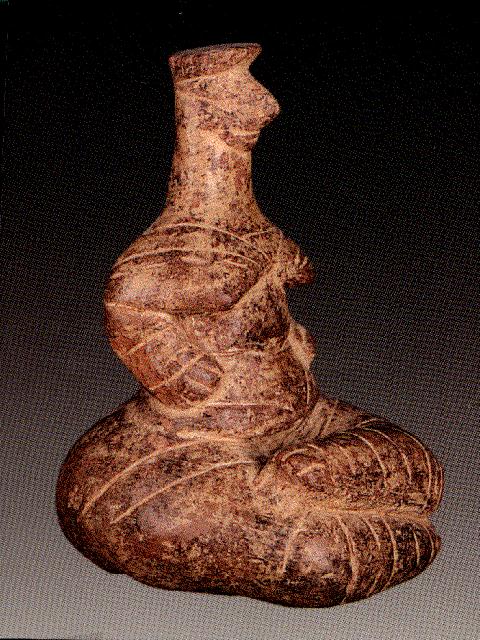
“The Language of the Goddess” In Minoan Crete by Carol P. Christ

While the “war against Marija Gimbutas,” rooted in what my friend Mara Keller calls “theaphobia,” is being waged in the academy, her theories continue to unlock the meaning of hundreds of thousands of artifacts from the culture she named “Old Europe.”

According to Gimbutas, the Neolithic and Chalcolithic cultures of Old Europe c. 6500-3500 BCE were peaceful, sedentary, agricultural, matrifocal and probably matrilineal, egalitarian, and worshipped the Goddess as the power of birth, death, and regeneration in human and all forms of life.  The cultures of the Old Europe contrasted with the Bronze Age cultures of the Indo-Europeans who brought the Indo-European languages and value systems to Europe and India and to all of the European colonies.  The Indo-European cultures were patriarchal, patrilineal, nomadic, horse-riding, and warlike, and worshipped the shining Gods of the sky. 

“The language of the Goddess” includes a series of signs and symbols that the people of Old Europe could “read” as surely as you and I know that a cross on top of a building marks it as Christian or that a woman wearing a star of David pendant is Jewish.  Gimbutas identified the meaning of these symbols through a painstaking process that involved comparison of artifacts, attention to where they were found, and clues from the recurrence of similar symbols in later cultures.  In twenty years of leading Goddess Pilgrimages to Crete, I have found Gimbutas’ theories an indispensible “hermeneutical principle” which unlocks the meanings of the artifacts we encounter.

  Continue reading ““The Language of the Goddess” In Minoan Crete by Carol P. Christ”

Goddess as Love: From Experience To Thealogy by Carol P. Christ

If theology is rooted in experience, how do we move from experience to theology? In my life there have been a number of key moments of “revelation” that have shaped my thealogy. One of these was the moment of my mother’s death.

In 1991 my mother was diagnosed with cancer. While she was being treated, I realized that I had never loved anyone as much as I loved her. When I wrote that to her, she responded that “this was the nicest letter” she “had ever received” in her life and she invited me to come home to be with her and my Dad.

My mother died only a few weeks after I arrived, in her own bed as she wished. She was on an oxygen machine, and I heard her call out in the dark of early morning. When my Dad got to the room, he tried to turn up the oxygen, but it didn’t help. Then he called the doctor who reminded him that my mother did not want to go to the hospital under any circumstances.

My Dad then sat by my mother’s bed and held her hand.  As my mother died, I felt that the room was” filled with love.” I sensed that my mother was “going to love.” Continue reading “Goddess as Love: From Experience To Thealogy by Carol P. Christ”

Are Most of Us Abused Children? And is Child Abuse the Root of Evil? by Carol P. Christ

Child abuse does not have to be physical or sexual. The most widespread forms of child abuse are psychological, and therefore harder to see, acknowledge, and eradicate. As abused children, we unconsciously pass on patterns of abuse visited on us to children, and to others we have power over including students, employees, and even friends and lovers.

The recent visit of a friend who is suffering greatly in a “battle” with her own “demons” reminded me of the important work of Alice Miller. My friend’s “demons” take the form of a persistent self-criticism laced with the feeling that “if only” she did or didn’t do certain things, her world would fall into place. My “demons” generally take a different form, telling me that I am helpless and that there is nothing I can do to ease my suffering.

Such “demons” were not implanted in my friend and me by the devil. They took root in interactions with our own parents, who were not themselves any different from most of the parents of their time and place. Recognizing that our parents were not “bad” people should not blind us to the great harm they did to us. However, when abused children speak of their abuse, the statement that their parents did not intend to harm them usually functions to deflect attention away from child abuse that really did occur. Continue reading “Are Most of Us Abused Children? And is Child Abuse the Root of Evil? by Carol P. Christ”

WHY DON’T FEMINISTS EXPRESS ANGER AT GOD? by Carol P. Christ

 My relationship to God changed when I accused “Him” of everything I thought “He” had done or let be done to women—from allowing us to be beaten and raped and sold into slavery, to not sending us female prophets and saviors, to allowing “Himself” to be portrayed as a “man of war.”

In the silence that followed my outpouring of anger, I heard a still small voice within me say: In God is a woman like yourself. She too has been silenced and had her history stolen from her. Until that moment God had been an “Other” to me. “He” sometimes appeared as a dominating and judgmental Other, and at other times as a loving and supportive Other, but “He” was always an “Other.” I as a woman in my female mind-body definitely was not in “His” image. 

After I expressed my anger to God, God transformed from an Other into what Whitehead once described as “a fellow [or should I say female] sufferer who understands.”  Although I had already been searching for a “God in my image” or “in whose image I could be,” I had yet to find Her. In the quiet after the storm, I came to believe that I would.   Continue reading “WHY DON’T FEMINISTS EXPRESS ANGER AT GOD? by Carol P. Christ”

On Winning and Not Winning in the “Fight” for “Justice” in the Web of Life by Carol P. Christ

The reason for hope is not the rational calculation that we will be able to save the world. The reason for hope is that it is important for us to try.

A few days ago, the United States Supreme Court upheld the deeply flawed heath care law passed by Congress. (I will not call it “Obamacare” as I do not believe Obama “owns” the concept of universal health care any more than Lyndon Baines Johnson or even Martin Luther King “owned” the concept of civil rights.) As a progressive I view universal health care as the only truly just health care system.  Still, I consider the Supreme Court decision a “victory.”

The same day the Supreme Court decided, I received a copy of a letter from the Greek government accessing 81,950 Euros in fines against the road-building company that violated the highly protected Natura wetlands while constructing the 36th National Road in Lesbos. Another “victory.”

Two weeks ago the cause of “justice,” as I see it, was not served when the center-right party New Democracy Party gained the majority in the Greek elections and became the central player in a coalition government. With New Democracy in coalition with the center-left Pasok, it is unlikely that corrupt politicians and tax evaders will be made to repay the money they have stolen from the Greek people. At the same time, it is likely that the Greek people in the middle and lower classes will be made to pay even more than they already have for the failure of a corrupt system of government.  The Green Party missed gaining 8 seats in Parliament in the first election by 4000 votes. In the second election we lost ground, while the fascist Neo-Nazi party that calls itself The Golden Dawn, garnered 18 seats. Continue reading “On Winning and Not Winning in the “Fight” for “Justice” in the Web of Life by Carol P. Christ”

GOD AND WOMAN AT YALE* by Carol P. Christ

As a graduate student, I was told in every way possible that I could not be a woman and a theologian.

When I was studying for my Ph.D. at Yale in theology in the late 1960s and early 1970s, my skirts were short as was the fashion of the day.  The male faculty and students and their wives dressed in ways that would not call attention to themselves or their sexuality.  I was also over 6’ tall.  When I walked into a room, I was consciously and unconsciously perceived as a threat to a world which these men had simply assumed was “theirs.”  Their response was to categorize me as a sexual being (I was once introduced as “our department bunny”) and to erase my mind.  I was to discover that the male graduate students were making bets in the dining hall about “where she will sit today.”  One of my friends frequently fell down and feigned to “worship” me when I passed him in the hallways.  I had never received so much attention from men before and it was flattering.

At the same time, I was being told by these men that of course “no one expected me to finish my degree because I would marry and have children” and that “all of the jobs should go to men who have families to support.”  The “generic male,” as in “when a man finishes his PhD,” was the common language of both faculty and students.  If I protested, I was reminded that I probably would not finish my degree anyway.  I dated two of the other students in my first year, fell in love with one of them and lost my virginity to the other.  They both dumped me.  I was being told in every way possible that I could not be a woman and a theologian.  There was such a disconnect between the way I was perceived and the way I perceived myself that I came close to suffering a mental breakdown. Continue reading “GOD AND WOMAN AT YALE* by Carol P. Christ”

LOVING LIFE* by Carol P. Christ

My religious views have changed over time, but the spirituality I learned from my grandmothers has remained constant. I have been Protestant, Catholic, a lover of Judaism, an admirer of Christian Science, and a Goddess feminist.  I have always loved life.

I was born in Huntington Hospital just before Christmas in 1945 and brought to my grandmother’s home on Old Ranch Road in Arcadia, California.  Peacocks from the adjacent Los Angeles County Arboretum screeched on the roof. There was another baby in the house, my cousin Dee, born a few months earlier.  My mother and her sister were living with their mother. The war was over, and they were anticipating the return of their husbands from the Pacific Front.  My earliest memory, recovered during healing energy work, is visual and visceral. I am lying crossways in a crib next to the other baby. There is a soft breeze. The other baby is kicking its legs, and I am trying to do the same.  I look up and see three faces looking down at us.  Although the faces are blurry in the vision I see, I feel them as female and loving.  I got off to a good start. Continue reading “LOVING LIFE* by Carol P. Christ”

SHE WHO CHANGES* by Carol P. Christ

She changes everything She touches and everything She touches changes. The world is Her body. The world is in Her and She is in the world. She surrounds us like the air we breathe. She is as close to us as our own breath. She is energy, movement, life, and change. She is the ground of freedom, creativity, sympathy, understanding, and love. In Her we live, and move, and co-create our being. She is always there for each and every one of us, particles of atoms, cells, animals, and human animals. We are precious in Her sight. She understands and remembers us with unending sympathy. She inspires us to live creatively, joyfully, and in harmony with others in the web of life. Yet choice is ours. The world that is Her body is co-created. The choices of every individual particle of an atom, every individual cell, every individual animal, every individual human animal play a part. The adventure of life on planet earth and in the universe as a whole will be enhanced or diminished by the choices we make. She hears the cries of the world, sharing our sorrows with infinite compassion. In a still, small voice, She whispers the desire of Her heart: Life is meant to be enjoyed. She sets before us life and death. We can choose life. Change is. Touch is. Everything we touch can change. Continue reading “SHE WHO CHANGES* by Carol P. Christ”

To a Friend, on the Loss of her Daughter by Carol P. Christ

One test of a thealogy is whether it can help us “make sense” of our lives—even the senseless parts of them.

Recently a friend told me that the teen-aged daughter of a friend of hers had committed suicide. “What would your thealogy say to that?” she asked me. Here is what I might say to a friend who lost her daughter:

I am so sorry for your loss. This never should have happened.

I remember times when I wanted to commit suicide. My pain was intense and my mind was stuck. All I could think was: this hurts too much to go on, and it will never change, so I might as well die. I am so sorry if your daughter felt that way, because I know it is a horrible way to feel. I am sorry she was not able to understand that it could have–and probably would have–changed. Don’t blame her. Sometimes pain is so overwhelming you really cannot see beyond it. Don’t blame yourself either. I am certain you did everything you could think of to help her. I know that if you could have prevented her, you would have. It really was not your fault. I don’t blame you, and no one else should either.

I also want to tell you that what happened to your daughter was not the will of God. Goddess, like you, felt you daughter’s suffering and reached out to try to help her. Like you, She did not have a magic wand. All She could offer was love and understanding. Right now Goddess is feeling your feelings of anger and sorrow that Her love and compassion and yours were not enough to comfort your daughter. Please do not torture yourself further by asking how this could have been the will of God. It was not. It really was not. Continue reading “To a Friend, on the Loss of her Daughter by Carol P. Christ”

EASTER OF THE GODDESS: A VIEW FROM GREECE by Carol P. Christ

On Good Friday, Easter Saturday, Easter Sunday, and Easter Monday the blogs on feminismandreligion.com celebrated mothers and God the Mother.*

 This is my body, given for you.

This is my blood, given for you.

While these words are the center of a Christian liturgy celebrating the sacrifice of Jesus as the Christ, they are more appropriately spoken of our own mothers. Your mother and my mother and all mothers, human and other than human, mammalian, avian, and reptilian, give their bodies and blood so their offspring might have life. True, mothers do not always make conscious choices to get pregnant, but almost all mothers affirm life in their willingness to nurture the young who emerge from their bodies and from their nests. Had mothers—human and other than human–not been giving their bodies and their blood from time immemorial, you and I would not be here.

The Easter liturgy fails to acknowledge that the original offering of body and blood is the mother’s offering. Christianity “stole” the imagery associated with birth and attributed it to a male savior. If that was all Christians had done, it would have been bad enough. In most countries today there are laws against theft. Christian theologians and liturgists should also be given an “F” for plagiarism–defined as presenting the ideas of others as if they are one’s own. Z Budapest was right when she famously famously opined, “Christianity didn’t have any original ideas.

Continue reading “EASTER OF THE GODDESS: A VIEW FROM GREECE by Carol P. Christ”