Announcing A Serpentine Path: Mysteries of the Goddess by Carol P. Christ

carol p. christ photo michael bakas“The serpentine path is the path of life, a snakelike, meandering path, winding in and out, up and down, with no beginning and no end, into the darkness and into the light.”

As the year draws to a close, I am putting the finishing touches on A Serpentine Path: Mysteries of the Goddess. In the spring of 2016 it will be published by the Far Press, founded by Gina Messina-Dysert.  A Serpentine Path is the original title of the memoir of my journey from despair to the joy of life on the first Goddess Pilgrimage to Crete. It was published in 1995 as Odyssey with the Goddess, a title chosen by the publisher.

A Serpentine Path marked a turning point in my life and in my career as a writer. During the time described in my memoir I had fallen into a deep despair, sparked by the end of a marriage, the end of a love affair, and disappointment in my career. Hoping to make a fresh start, I moved to Greece. Not surprisingly, my despair followed me there. Nonetheless, as I would learn, I made the right decision, for as my Greek therapist was to tell me, I needed to learn to live in my body, not my head, and Greece was the place to learn that.

I was at a crossroads in my spiritual quest. I left Christianity for Goddess feminism, yet I felt the Goddess had abandoned me. I had a contract to write the first Goddess thealogy, but as I said in a speech at I gave at Harvard Divinity School just before I made the decision to move to Greece, I was not sure of the meaning of the symbol of the Goddess. Is Goddess a personal being who cares about the world? Or the name we give to the cycles of birth, death, and regeneration in nature? My inability to answer this question led my editors to return draft of my Goddess thealogy with the comment that something was missing. Continue reading “Announcing A Serpentine Path: Mysteries of the Goddess by Carol P. Christ”

Artio, Celtic Goddess of Wild Life, Transformation and Abundance by Judith Shaw

judith Shaw photoArtio, Celtic Goddess of Wild Life, Transformation, and Abundance, is one of the more obscure goddesses in the Celtic pantheon.  She is often shown with baskets of plenty and surrounded by animals.  Artio is frequently depicted as a bear. Her name comes from the old Celtic word for bear, arth(e), which the Romans Latinized to artos.

Continue reading “Artio, Celtic Goddess of Wild Life, Transformation and Abundance by Judith Shaw”

The Dog Days of Summer by Carol P. Christ

Sirius in the Sky


Sirius rises late in the dark, liquid sky
On summer nights, star of stars,
Orion’s Dog they call it, brightest
Of all, but an evil portent, bringing heat
And fevers to suffering humanity. –Homer, The Iliad


The dog days of summer are associated with the reappearance of the brightest star in the sky, the “dog star,” also known as Sirius, just before dawn from July 23 until August 23. This star heralds the days of the most intense summer heat. Though this is the time of the summer harvest in Mediterranean cultures, it a time of death. Energy wanes. The grasses have dried out on the hillsides, plants in gardens will die too unless they are watered. The healthy “sit out” the heat of the day with closed shutters, while those who are old or very ill often give up the ghost. They say that this is also a time when babies are conceived during long and languid afternoon naps.

The Greater Mysteries of Demeter and Persephone were celebrated at the end of this period, and the Greek Orthodox festival of the Dormition (Death) and Assumption (Rebirth) of the Panagia (the Virgin Mary) echoes an ancient rhythm.

This year I have spent most of the dog days in air-conditioned rooms, feeling little inclination to brave the heat of the day even for a refreshing swim in the sea. During this time, Judith Plaskow and I completed the final draft of the manuscript of Goddess and God in the World and submitted it to our publisher: a midsummer harvest!

To be truthful, I also spent many of the dog days days glued to my computer watching reruns of D.C. Banks and Blue Murder. These days of rest were good for the knee I had injured earlier in the summer, which now is almost healed. They must have been good for my spirit as well, for a friend who had not seen me since late spring told me that I looked refreshed and renewed.

In nature, the death days of late summer are followed by rebirth. At the very time when the sun is at its most intense, the days become shorter—first imperceptibly, and then quickly. While sun “stands still” for several months, setting at more or less the same time before and after the Summer Solstice, all of a sudden (or so it seems), the sun sets half an hour earlier. From then on, it sets several minutes earlier each day: a clear indication that fall is on its way. Before long, the rains come and the hillsides become green again.
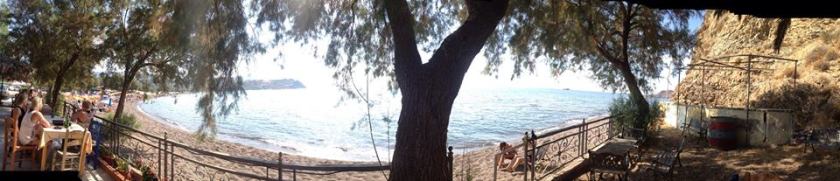
beachttime in anaxos by Andrea Saris

For me, August 14, celebrated in Greece as the day of the Dormition of the Panagia, marks the beginning of the end of the intense heat of midsummer. Yesterday, on this day, with some trepidation, I packed my dogs into a hot car and headed for the sea. Our favorite tavern was empty and a light breeze coming from the sea tempered the heat. A friend arrived unexpectedly, and—joined by my intrepid miniature schnauzer—we enjoyed a swim so refreshing we didn’t come out of the water until our fingers became wrinkled. Just before sunset my friend and I met again to ascend the stairs to the shrine Church of the Panagia on the Rock to light candles for Rebirth and Renewal, ending our day with dinner by the sea.

As I write the next morning, I feel poised on the edge of rebirth and regeneration. I don’t yet have new ideas in my mind, nor do I have the fullness of energy I know will continue to return as the heat wanes. I look forward to the coming of fall and await new green shoots of inspiration in my life and my work.

carol mitzi sarah

Carol P. Christ leads the life-transforming Goddess Pilgrimage to Crete (facebook and twitter).  Carol’s books include She Who Changes and and Rebirth of the Goddess; with Judith Plaskow, the widely-used anthologies Womanspirit Rising and Weaving the Visions and forthcoming in 2016 from Fortress Press, Goddess and God in the World: Conversations in Embodied Theology. Explore Carol’s writing. Photo of Carol by Shanti Jones. Photos of beach at Anaxos by Andrea Sarris.

Kali Ma by Jassy Watson

IMG_3813The creative ‘Wisdom of the Goddess’ Journey Within Program I am facilitating has moved into its’ second trimester, ‘Transformation’. It is winter here in the South; a time to release what no longer serves us and look at the shadow aspects of ourselves. I decided that the goddess Kali Ma, often referred to as the “Dark Mother” was most suitable to explore at this stage. Kali Ma is the Hindu goddess of creation, preservation, and destruction and is better known for her destroyer aspect. She serves as the archetypal image of the birth-and-death Mother, simultaneously the womb and tomb, the giver of life as well as the taker. She is the primordial female principle of manifestation and embodies shakti – feminine energy, creativity and fertility.

Kali is a warrior and is usually depicted with her tongue protruding, brandishing a sword in one hand a decapitated head of a demon in the other. She wears a necklace and belt of skulls, and she drips with blood. The demons she slays however, are the demons of the ego and the attributes of ignorance. Kali is the enlightening force that dismantles preconceived notions, frees you from conditioned beliefs, false personal identities, and anything else that keeps you from recognizing your true identity. In other words, part of what Kali represents is the power to release that which is true in you. Even in destruction, She reminds us that good really can come of bad situations. If you find your hopes and dreams have been crushed, Kali can change the cycle and produce life out of nothingness. Where there is sorrow, She dances to bring joy. Where there is fear, She dances in courage. Continue reading “Kali Ma by Jassy Watson”

Restored in Beauty by Carol P. Christ

Carol Christ in LesbosThe path leading to the Klapados Waterfall begins at the edge of an open meadow in the pine and oak woodlands of a mountain in the island of Lesbos. After driving several miles on a very rutted dirt track, we parked under an oak tree, crossed the meadow and scrambled down a winding path. After about 20 minutes, it ended at a stream surrounded by plane trees. From there, we climbed over rocks to reach a pool created by the seasonal waterfall.

waterfall at klapados 1On the day we visited it, the waterfall was only a trickle of cascading drops that moistened its moss-covered path to the pool. The roots of a plane tree growing at the top of cliff followed the path of the water, weaving a web over the rockface all the way down to the pool.

Sitting on a rock at the edge of the pool I realized that the cliffs that embraced it on three sides were the remains of a crater formed twenty million (or so) years ago when a finger of molten lava pushed its way through the earth, exploding in clouds of dust and projectile rocks.

In Lesbos the volcanic activity came not from a single source–for example, from the highest mountain. Rather, like the plane trees in whose shade we rested, the volcano’s trunk with roots in the molten lava of the earth’s core, had many branches from which it erupted at different times. Huge boulders thrown out in the explosions can be seen in the meadows, while the trees in the forest curve their roots around them to reach the soil. The mountain was also shaped by the settling of volcanic dust that crumbles again into tiny fragments when exposed.

As I was thinking of all of this my friend Cristina climbed over the roots of the plane trees that surrounded the pool, removed her clothes, and slipped into the water. Soon I followed her. We sensed that we were in a sacred place, and as we have done rituals together many times before, our ritual emerged spontaneously: it almost seemed as if our minds and bodies were moving as one.

We renewed ourselves in beauty, submerging our bodies under the water three times, while floating in the embrace of the pool, gazing up at the rock formations, admiring trees that looked like dancing women, moss that looked like pubic hair, and blue black damselflies that all together had created a most beautiful place that called to something deep within us on that day.

Later we would sing the English version of the song of the Navajo Beautyway:

klapados waterfall 056


I walk with beauty before me.
I walk with beauty behind me.
I walk with beauty all around me.
As I walk the beauty way.
I walk with beauty above me.
I walk with beauty below me.
I walk with beauty inside me.
As I walk the beauty way.

We are the creative process of life.

We are restored in beauty.

Blessed be!


Carol leads the life-transforming Goddess Pilgrimage to Crete (facebook and twitter).  Carol’s books include She Who Changes and and Rebirth of the Goddess; with Judith Plaskow, the widely-used anthologies Womanspirit Rising and Weaving the Visions and forthcoming next year, Goddess and God in the World: Conversations in Embodied Theology. Explore Carol’s writing.

Reciprocity, Empathy, and Reconciliation: The Roots of Human Morality in Our Primate Ancestors by Carol P. Christ

carol mitzi sarahA link to a talk called “Moral Behavior in Animals” by Franz de Waal recently found its way into my email inbox. I am a big fan of Franz de Waal because his findings confirm what I always believed—that animals are intelligent. I followed the link and other suggested links and spent most of the evening listening to de Waal.

De Waal began his studies of animal behavior at a time when instinctual behaviorism was academic orthodoxy: the idea that animals can think and feel was “poo-pooed” by “scientists.” As de Waal observed ironically, everyone who has a pet knows better than that. But academic researchers continued down this path, expressing contempt for ordinary people who thought their pets were intelligent and the likes of de Waal who suggested that scientists might be colossally wrong.

De Waal’s discovery that chimps almost always “reconcile” after fights by touching hands, hugging each other, grooming, and even kissing, led him down “the garden path” to his discovery that what he calls the “two pillars of morality”—“reciprocity and empathy”– are found in primate social systems and in those of other higher mammals including dolphins and elephants . Continue reading “Reciprocity, Empathy, and Reconciliation: The Roots of Human Morality in Our Primate Ancestors by Carol P. Christ”

In the Face of Despair, Choose Life by Carol P. Christ

carol mitzi sarahYesterday I had a delightful swim with a friend in the cool Aegean Sea. In in the evening I met two dear friends at an open air restaurant for a delicious meal and good conversation. Last night a beautiful moon rose over the sea and a soft breeze caressed my skin. All of this made me very happy. However, the state of the world does not.

Michael Brown. Trayvon Martin. The Ferguson police. Hold your ground laws. Bombing in Gaza. War in Ukraine. War in Iraq. War in Afghanistan. War in Syria. Wars that are not on my radar. Rape as a part of war. Joe Biden threatening to chase ISIL “to the gates of hell.” Citizens United. A rash of laws restricting voting rights. A rash of laws restricting abortion rights. Police brutality. Police brutality that is racially motivated. Young men being sentenced to prision for minor drug offenses. The brutality of the prison system. A woman with children being paid $8.50 an hour working at McDonalds and not even knowing when she will be called in to work. Open carry laws allowing Americans to walk the streets with loaded weapons. And that’s just off the top of my head this morning.

When I was young and protesting poverty, racism, and the War in Vietnam, I thought that it would be a relatively simple matter to change the world. It turned out that I was not only wrong: I was very wrong. The world has changed all right, but not for the most part for the better. In fact, despite the diligent efforts of social justice activists, in many respects the world has changed for the worse. Continue reading “In the Face of Despair, Choose Life by Carol P. Christ”

TWO MEANINGS OF ANTHROPOMORPHISM by Carol P. Christ

carol christ“The error of anthropomorphism” is defined as the fallacy of attributing human or human-like qualities to divinity. Recent conversations with friends have provoked me to ask in what sense anthropomorphism is an error.

The Greek philosophers may have been the first to name anthropomorphism as a philosophical error in thinking about God. Embarrassed by stories of the exploits of Zeus and other Gods and Goddesses, they drew a distinction between myth, which they considered to be fanciful and false, and the true understanding of divinity provided by rational contemplation or philosophical thought. For Plato “God” was the self-sufficient transcendent One who had no body and was not constituted by relationship to anything. For Aristotle, God was the unmoved mover.

Jewish and Christian theologians adopted the distinction between mythical and philosophical thinking in order to explain or explain away the contradictions they perceived between the portrayal of God in the Bible and their own philosophical understandings of divine power. While some philosophers would have preferred to abolish myth, Jewish and Christian thinkers could not do away with the Bible nor did they wish to prohibit its use in liturgy. Continue reading “TWO MEANINGS OF ANTHROPOMORPHISM by Carol P. Christ”

THE DIVINE DRAMA AND THE UNIVERSALITY OF DEATH by Carol P. Christ

carol christIn Greece the liturgies of lent and especially of the week before Easter are known as the “divine drama,” in Greek theodrama.  This may refer to the “drama” of the capture, crucifixion, and resurrection of Jesus and to the suffering of God the Father and Mary.

However, it is important to recall that the drama in ancient Greece referred to both the tragedies and comedies, most specifically, those that were performed in the theater of Dionysios in Athens.  While we have been taught that the Greek tragedies celebrated “downfall of the hero” due to his “tragic flaw,” it is important to remember that Dionysios was the original protagonist of the Greek tragedy: it was his death and rebirth that was first celebrated.

Some have argued that the Greek tragedies should never be “read” alone, for they were always “performed” in tandem with the comedies, which were followed by the bawdy phallic humor of the satyr plays.  The tragedies end in death and irreparable loss.  But if the comedies and satyr plays are considered an integral part of the cycle, death is followed by the resurgence of life. Continue reading “THE DIVINE DRAMA AND THE UNIVERSALITY OF DEATH by Carol P. Christ”

Curiosity About Everything and the Language of the Goddess by Carol P. Christ

carol christMy recent discovery of Marija Gimbutas on Youtube rekindled my admiration for her work. In her slide-lecture “The World of the Goddess” Marija Gimbutas allows us to follow the line of reasoning she used to decipher the “language of the Goddess” in Old Europe.

Careful attention to her lecture shows that Gimbutas did not close her eyes, dream, and then attach her own ideas and intuitions to the artifacts she later discussed. Rather, she catalogued groups of images with similar symbolism and used her knowledge of nature (what does a water bird or an owl look like?) and folklore (she collected thousands of songs connected to the agricultural and life cycles in her native Lithuania in the 1930s) to unlock the meaning of ancient symbols.

I suspect that most of the critics of Gimbutas lack the knowledge she gained through her wide curiosity about life. Do other archeologists as a group know what specific species of water birds or owls really look like? Do they have the same kind of knowledge of folklore and folk traditions that Gimbutas had?   Continue reading “Curiosity About Everything and the Language of the Goddess by Carol P. Christ”