In egalitarian matriarchal cultures gift-giving is not something reserved for birthdays and holidays. It is a way of life rooted in the primary understanding that life is a gift that is meant to be shared.
Our lives are a gift from our mothers. Our individual lives have are not something we create or created for ourselves. We all emerged from the body of a mother. We were all given the gift of care and feeding by a mother or others. Our mothers did not create themselves. They emerged from the bodies of mothers and were cared for and fed by mothers or others. And so on back to the original mother of the human race, known as the African Eve.
“Let the beauty we love Be what we do
There are hundreds of ways to kneel and kiss the Earth.”
–Rumi
Introductory note: At the end of 2016, my parents purchased a piece of land about one mile from where I already live (they live one mile further away than that). In addition to woodland and meadow, this land has two springs, three creeks, a cave, and ¼ mile of river access. While I have been deeply connected to the land of my birth, the Missouri Ozarks, for a long time, and have written about that connection in multiple past posts for FAR, this new-to-us land has offered a new opportunity: the chance to get to know another section of land “from scratch,” deeply, wildly and well, and to become wise stewards of it for the time in which it is in our care. It is also the first time I have been able to so closely and intimately observe the origin source of a body of water. Previously not giving it much thought, I now have the daily privilege of observing the source of the flow as I watch water emerge directly from the ground. First, there is simply none and then, suddenly, a deep blue pool constantly bubbling as water rises to the surface and flows away on its long, long journey to the sea. This essay is a series of three vignettes as I spend this year immersing myself in relationship with this land.
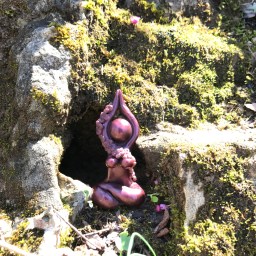
We walk along the nearly vertical hillside hanging onto small trees for support. Finally, though we almost miss it, we spy the opening to the cave nestled behind several mossy stones. The sun is still on the rise above the tree line and the rays filter through the trees so one ray is pointing directly at the cave entrance. We crawl inside, bumping our heads and scraping our backs as we wiggle into this womb in the earth. Once inside, the chamber enlarges so we can stand up. Unlike other caves we have experienced in this area, the only human signs we find are a single bottle cap, a glass bottle, and two sets of initials carved into a rock. In the dark silence we hear the sound of water dripping steadily. I make my way further into the cave, acutely aware that this is living cave and being careful not to step on the fresh, wet, cervix-shaped beginnings of new stalagmites on the floor. At the back of the cave, I find her. A Madonna-like stone column, glistening with water. In the silence of the cave, I quietly sing Ancient Mother to her, as tears well in my own eyes.
I am of this earth for this earth and by this earth.
We skirt carefully along the bank of the creek, making our way to the largest spring. Over three million gallons of water a day flow effortlessly from this small, deep pool nestled quietly in the middle of the woods. I am stunned by the magnitude of this flow as I stand there with my husband, my head resting on his shoulder, hawks wheeling overhead, redbud trees in full bloom. It has never seemed more clear to me how very “small” we are, but a blink of an eye to this spring and its countless years and countless gallons of water, not caring whether it is witnessed in its work or not, but simply, continually, creating and producing. I try to explain this feeling aloud, but words fail me. It is a humbling sensation, not a depressing one. The actual emergence of the water at this origin point of the river is nearly invisible, the continuous gentle, small popping of bubbles on its surface, the only sign that something significant is happening here that distinguishes this body of water from a pond or pool. Yet, those never-ending bubbles rapidly expand to a wide, swift-moving creek, which joins the river and another smaller spring-fed creek to continue to make their way southward across the state. We smell something sharp and see a dead armadillo by the roots of a giant sycamore. We hear a shrill cry and look up to see two bald eagles riding the currents of air high above us. We are so small. So many thousands of years of water have passed, but we are here right now.
Unfathomable eons
Glacier time
I am just a blink of an eye
But I can sit, and watch, and wonder.
We scramble along the uneven terrain on the rocky and wooded hillside, slipping, laughing, and looking. I am exhilarated by the simple thrill of exploring the world right here in front of me. We find tiny flowers. I kneel by the roots of fallen trees. We stop to admire moss on stones. We find gigantic black snake napping in the sun. A complete turtle shell. A shed antler. Each moment feels like a new opportunity to “kiss the earth.” I sing Reclaiming’s song-version of the Rumi quote over and over and as I kneel in each spot to see what it has to show me, in each, I kiss my fingers and press them to the earth. I see all the kissing going on around me…the sun filtering through branches, the fiddlehead ferns kneeling to kiss the earth, the roots wound through rocks, the trillium and bloodroot blooms pushing up between leaves, the water seeping out of the ground and flowing down the hill, the dogwood blossoms opening to the sun, the moss covering stones, the fallen trees stretched along the slope.
“And that is just the point…how the world, moist and beautiful, calls to each of us to make a new and serious response. That’s the big question, the one the world throws at you every morning. ‘Here you are, alive. Would you like to make a comment?’”
–Mary Oliver
We emerge from our walk to find morels growing alongside the path (morels are wild, edible mushrooms found for about two weeks in Missouri each spring and considered a delicacy by many). The afternoon suddenly becomes even more rewarding and we stoop and peer through fallen oak, sycamore, and elm leaves looking for the telltale conical form of these forest treats. We quickly discover that we must tune in and “listen” for the mushrooms, so to speak, or we’ll walk right by them, none the wiser. The moment I start thinking about anything else, I stop finding any. Once I settle into my body and the moment and really look at the world again, there another morel will be.
“I think this is how we’re supposed to be in the world … present and in awe.”
–Anne Lamott, Bird by Bird: Some Instructions on Writing and Life
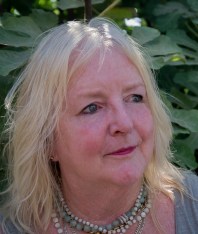
Molly has been “gathering the women” to circle, sing, celebrate, and share since 2008. She plans and facilitates women’s circles, seasonal retreats and rituals, mother-daughter circles, family ceremonies, and red tent circles in rural Missouri and teaches online courses in Red Tent facilitation and Practical Priestessing. She is a priestess who holds MSW, M.Div, and D.Min degrees and finished her dissertation about contemporary priestessing in the U.S. Molly and her husband Mark co-create Story Goddesses, original goddess sculptures, ceremony kits, and jewelry at Brigid’s Grove. Molly is the author of Womanrunes, Earthprayer, and The Red Tent Resource Kit and she writes about thealogy, nature, practical priestessing, and the goddess at Brigid’s Grove.
We are all experiencing troubled times.Many are moaning and groaning, crying and screaming out.Both sides are bringing such huge negative energy to our world.
For just an hour – a day – if you can sustain it – practice gratitude and appreciation. If we can all turn our emotions to the good in our lives, to the love in our lives and take all that energy and place it there – well, no telling what can come of that!
We have had out Thanksgiving meals and are well into the leftovers – the turkey sandwiches and if you are lucky, you still have some dressing and gravy. That’s my favorite part!
Here is an exercise I do whenever I feel troubled by negativity around me.Take of some paper and pencil – or open a new document in your computer (which is what do). Begin to make a list of all the things you are grateful for.It shouldn’t be hard. Most of us did some of this a couple of days ago.As you think of things, they will prompt you to think of other things. Soon a good memory will come up followed by more. Feelings of loving appreciation will begin to flow toward those who participated in the good times with you. You may even find some forgiveness welling up for yourself and others for the bad times. Keep writing until you have it all out there in front of you.Most of us could easily have fifty things on that list.As you are writing these things out, if you are like me, you will feel your heart lighten and brighten with good feelings – loving feelings.This is gratitude. This swelling up of feeling inside us – this is our awareness of feeling blessed. This gratefulness feels lovely.
However, we need to do more. Appreciation.Appreciation is gratitude expressed!Look over your list.Where in that list is an opportunity to express appreciation?Are there events that included others – others who are still present in your life?Can you tell them how much they mean to you?What about family members, friends, co-workers, even your boss at work – are there feelings of gratitude there that can be expressed? Continue reading “Gratitude Expressed by Deanne Quarrie”
Once upon a time there lived a youngish woman and her husband on a tiny farm outside the capital city. Their life was satisfactory. But when el presidente declared war on another country, the husband was press-ganged into the army, leaving his wife alone on the farm. Well, alone with a milk cow, a sow, a rooster, a dozen hens, and, on one side of the house, seven tiny graves holding stillborn babies.
The woman was devastated. “What am I going to do?” she asked herself over and over again. “The land here is poor and infertile. I’m poor and infertile.” She was so unhappy, all she could do was mope around. The animals went untended and soon began foraging for food. The seven tiny graves went unweeded. Their one good field went unplowed. The woman stopped taking care of herself.
The war went on and on. She could still hear explosions in the capital city, and now there were people traveling along the road at the edge of her field. Telling herself the explosions and the refugees from the city were none of her business, she just sat inside, feeling sorry for herself.
Time went by, and one morning when the youngish woman happened to look in the mirror (which was cracked), she was both surprised and not surprised by what she saw. Her hair was gray and ragged and dirty. Her face was wrinkled and dirty. Her clothes were wrinkled and dirty.
“My goodness!” she said. “I look like an old wicked witch!” She gave this some thought. “Well,” she finally said, “why not? I’m alone and friendless. I have barely enough to eat. I remember hearing about other old women who lived alone. People thought they were wicked witches. Hunh! I guess that’s what I’ll do now. Go into the wicked witch business.” She thought some more. “Well, maybe semi-wicked. My grandmother taught me stuff her grandmother taught her—how to mix potions to heal or kill. How to read the cards. All I need to do is remember those lessons. Then I can go into the wicked witch business.” Continue reading “A “Wicked Witch” Discovers Gratitude by Barbara Ardinger”
I’ve been in the midst of moving for almost a year, yet am still not finished with that onerous task. My youngest son and family recently moved into the place I’ve called home since 1980. I bought a small house in the vicinity and have just settled in after spending four months painting, cleaning, and hauling box after box to my new dwelling. At the same time, I’ve been traveling back and forth to New Mexico busy with painting, cleaning, and remodeling my “retirement house.”
I’m tired. Am also experiencing emotions that I thought I was impervious to. I never perceived myself as somebody having an attachment to place, but a month or so before moving out of my old home, I began to feel nostalgic. There was so much I didn’t want to leave behind–the woods, birds nesting in bushes around the property as well as on top of the front porch light, the wildlife (deer, opossum, rabbits), and neighbors far enough away so I didn’t have to hang curtains at the windows.
Just days before the agreed-upon date to turn the old home over to my son and family, I became emotionally distraught. A friend suggested I read Oliver Sacks’ book, Gratitude. Oliver Sacks (1933-2015) was a British neurologist who spent his professional life in the United States caring for people with brain “disorders” such as aphasia, Tourette Syndrome, amnesia, autism, and a host of other neurological diagnoses.
Gratitude is a slim volume featuring four essays written during the last few months of Dr. Sacks’ life. In the second essay, “My Own Life,” he writes: “I cannot pretend I am without fear. But my predominant feeling is one of gratitude. I have loved and been loved; I have been given much and I have given something in return; I have read and traveled and thought and written. I have had an intercourse with the world, the special intercourse of writers and readers.”
I wanted to know more about Dr. Sacks’ life and promptly procured his memoir, On The Move A Life, published just before he died in 2015. I was struck by the apparent comfort he felt in his own skin as he went about living in the world. He came from a fairly Orthodox Jewish family and realized during his teen years that he was gay. When his mother discovered his homosexuality, she said, “You are an abomination. I wish you had never been born.” He writes that she undoubtedly was referring to a text in Leviticus (Hebrew Bible) and although she never mentioned the incident again,” …her harsh words made me hate religion’s capacity for bigotry and cruelty.”
His mother’s view regarding his homosexuality didn’t seem to affect Dr. Sacks’ ability to get on with his adventures living on, what he calls, “this beautiful planet.” He focused on his passions–medicine, literature, traveling, observing the natural world, swimming, lifting weights, and riding his motorcycle. Along the way he met a wide variety of people (patients, colleagues, authors, and characters in books). He squeezed gallons of nectar from those meaningful encounters. Yet, I think his mother’s disgust regarding his sexual orientation must have cut him to the quick. He included the incident in his last book, Gratitude. Continue reading “Gratitude by Esther Nelson”
Last week I went out to eat with a group of insightful scholars at the American Academy Religion 2015 Conference held in Atlanta, Georgia. We had just participated on a remarkable panel which was an “Author Meets Critic” session with Bernadette Barton, author of the book Pray the Gay Away: The Extraordinary Lives of Bible Belt Gays. One of our panelists was in Georgia after years of estrangement, not only from his biological family, but also from the geography of his birth because of the biological familial estrangement. He was experiencing the geography of his hometown for the first time in many years. He spoke eloquently in the panel about how much being in the geography itself again was triggering, but also how somatically it was necessary for his own healing. He needed to revisit and be embodied on the actual land—which was very different than re-remembering the hurt from a geographical distance. Also, in order to fully participate in the life of a scholar, which he was now choosing, he had to reconcile being able to revisit this geography in order to attend this particular conference. And frankly, to be able to participate on the panel which was so close to his heart—being a person who was from the Bible Belt and had literally been “prayed” over so that his “gay would go away.”
I have moderated many panels, but this is the first one where I wrote “Congratulations!” on a piece of paper to one of the panelists and passed it to him after his reading.Overall it was a great session of papers and as mentioned we all adjourned for drinks and conviviality. And to celebrate that our gay had not been prayed away.
We began to discuss holiday plans. I said to the young man who had presented his paper so courageously that I was very proud of him not only for his work, but for his ability to return to the geography in which he had experienced so much harm. I said that I was from a very abusive biological home in New England and I had not been north of New York since leaving at age 30 (I am now 59); that for me, putting my embodied self into the actual geography where I had experienced so much harm had not been possible, except for attending my mother’s funeral- its own extreme event.
Some folks at the table expressed surprise and much sadness—how could those of us without biological ties to family handle the holidays? I realized that for me it has been almost thirty years since I began creating “alternatives” to the family I was born in—my biological family- and that I have successfully created chosen family and chosen traditions instead. One of the ways I first learned to deal with holidays which had expected traditions and attendance at biological family functions was to create alternate plans well before the expected day (Thanksgiving, Christmas, etc.) and stick to that plan. I learned that once that day was “here,” I would be triggered and would not be able to create spur of the moment alternatives in the midst of those feelings.
One tradition I created 20 years ago was the tradition of “Pie Day” with a good friend of mine. We realized this year that we have been doing that for 20 years! Now that is my “tradition” and that is my “family.” We bake an inordinate amount of pies on Pie Day—a very specific recipe—green apple with golden raisin reduction— and people and friends come over. We celebrate. We eat pie with cheese (a New England tradition) and salad- I call it “a French meal” after my Canadian heritage. Whoever bakes or drops by, eats. Some folks walk away with a pie. We freeze a bunch and have “pie nights” throughout the year. Various girlfriends, friends and friends of friends have helped throughout the year make our estimated 15-20 pies per year, complete with hand rolled, all butter crusts every year.
Life – a precious gift I so often take for granted. Events of recent weeks have turned that blatant disregard into profound gratitude.
I began keeping bees about three years ago. My first two years were unsuccessful. But last year, bees I obtained from my bee mentor, Mike, were strong and vibrant. They provided me with my first honey harvest, wintered well, and come spring were out and about pollinating the neighborhood.
I am taking this space, this month to share two very wonderful pieces of news. And I will make the caveat opening here: this is a blog about the benefits of gratitude and I am reaping them here—with a bit of shameless self-promotion. I am advocating here again for my work, my “book child”, as I did in my birth announcement blog!
As we move into spring, I want to step back and take stock of what I have planted that is coming into bloom. And with this, I hope to suggest to you all, dear readers, that you do the same. I (I’ll speak for myself here) tend to rush so much and feel I have so much to do that sometimes when something amazing happens that I have worked so hard for—it just passes me by, and I am on to the next thing before I get a chance to really acknowledge even what that amazing thing was. Continue reading “Taking Time to Smell Your Roses: What Are You Grateful for This Spring? by Marie Cartier”
As Valentine’s Day approaches, it seems normal to think of love, perhaps with cynicism or hope or a mix of conflicted emotions. Last year, I wrote a post on this site about Valentine’s Day, and I’m happy to contribute this year around the same time. But this year I’ve been doing a different kind of reflection. Maybe it’s because I just took my artificial Christmas tree down this past weekend, but I’ve been a little slow to get in the Valentine’s spirit, more specifically to reflect on the idea of a holiday dedicated to love.
It’s not that I haven’t been talking about love and relationships—I’ve been doing a lot of that lately. I’m teaching a class that is currently in the middle of a unit on Christian sexual ethics, I’ve been conversing with friends about their upcoming weddings and future plans, and I have spent a lot of time on the phone navigating the terrain of a long-distance relationship. But all this talk hasn’t left me too much time to reflect. It wasn’t until last night, as the church choir rehearsal I was attending was ending, that my thoughts of devouring chocolate hearts were interrupted by a litany prepared by two choir members in honor of Valentine’s Day. Continue reading “Love and Happiness by Elise M. Edwards”
At the time I thought this was a rather bold suggestion.
Had I been asked why I thought the images were made by women, I might have said that people have understood caves to be the womb of the Great Mother, the Source of All Life, from time immemorial. I might have added that those who performed rituals in the caves cannot have been performing simple “hunting magic,” but must also have been thanking the Source of Life for making life possible for them and for the great beasts they hunted. Still I am not certain that I imagined women as the artists in the Paleolithic caves.
In recent days the news wires have been carrying a story titled “First Cave Artists May Have Been Women, New Study Suggests.” According to retired anthropological archaeologist Dean Snow, the handprints made by Paleolithic ancestors 40,000-20,000 years ago may have been made primarily by women. Snow spent a decade gathering and analyzing photographs of the handprints left in caves. The scientific fact that women’s first and ring fingers are generally of the same length, while men’s ring fingers are generally longer their index fingers, led him to the conclusion that ¾ of the handprints in the caves were made by women! If women were painting their hands on the caves in larger numbers than men, then isn’t likely that they were also painting the images of the great beasts on the walls of the caves? Continue reading “WOMEN ARTISTS AND RITUALISTS IN THE GREAT CAVES: THE BEGINNING OF THE END OF INDOLENT ASSUMPTIONS by Carol P. Christ”


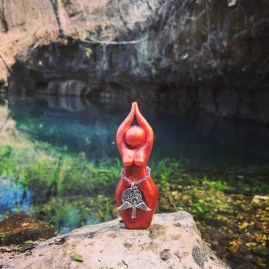 live (they live one mile further away than that). In addition to woodland and meadow, this land has two springs, three creeks, a cave, and ¼ mile of river access. While I have been deeply connected to the land of my birth, the Missouri Ozarks, for a long time, and have written about that connection in multiple
 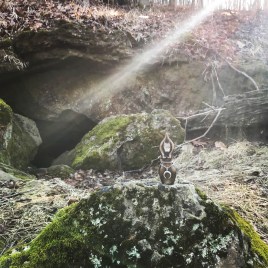 spy the opening to the cave nestled behind several mossy stones. The sun is still on the rise above the tree line and the rays filter through the trees so one ray is pointing directly at the cave entrance. We crawl inside, bumping our heads and scraping our backs as we wiggle into this womb in the earth. Once inside, the chamber enlarges so we can stand up. Unlike other caves we have experienced in this area, the only human signs we find are a single bottle cap, a glass bottle, and two sets of initials carved into a rock. In the dark silence we hear the sound of water dripping steadily. I make my way further into the cave, acutely aware that this is living cave and being careful not to step on the fresh, wet, cervix-shaped beginnings of new stalagmites on the floor. At the back of the cave, I find her. A Madonna-like stone column, glistening with water. In the silence of the cave, I quietly sing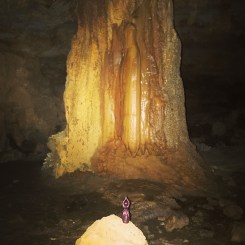
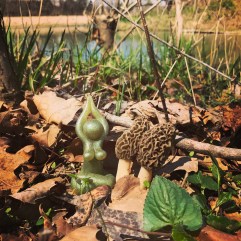 about two weeks in Missouri each spring and considered a delicacy by many). The afternoon suddenly becomes even more rewarding and we stoop and peer through fallen oak, sycamore, and elm leaves looking for the telltale conical form of these forest treats. We quickly discover that we must tune in and “listen” for the mushrooms, so to speak, or we’ll walk right by them, none the wiser. The moment I start thinking about anything else, I stop finding any. Once I settle into my body and the moment and really look at the world again, there another morel will be.
 Molly has been “gathering the women” to circle, sing, celebrate, and share since 2008. She plans and facilitates women’s circles, seasonal retreats and rituals, mother-daughter circles, family ceremonies, and red tent circles in rural Missouri and teaches online courses in
  We are all experiencing troubled times.
 “My goodness!” she said. “I look like an old wicked witch!” She gave this some thought. “Well,” she finally said, “why not? I’m alone and friendless. I have barely enough to eat. I remember hearing about other old women who lived alone. People thought they were wicked witches. Hunh! I guess that’s what I’ll do now. Go into the wicked witch business.” She thought some more. “Well, maybe semi-wicked. My grandmother taught me stuff her grandmother taught her—how to mix potions to heal or kill. How to read the cards. All I need to do is remember those lessons. Then I can go into the wicked witch business.”
  I’ve been in the midst of moving for almost a year, yet am still not finished with that onerous task. My youngest son and family recently moved into the place I’ve called home since 1980. I bought a small house in the vicinity and have just settled in after spending four months painting, cleaning, and hauling box after box to my new dwelling. At the same time, I’ve been traveling back and forth to New Mexico busy with painting, cleaning, and remodeling my “retirement house.”
  Last week I went out to eat with a group of insightful scholars at the American Academy Religion 2015 Conference
 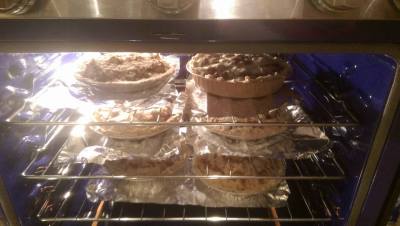 One tradition I created 20 years ago was the tradition of “Pie Day” with a good friend of mine. We realized this year that we have been doing that for 20 years! Now that is my “tradition” and that is my “family.” We bake an inordinate amount of pies on Pie Day—a very specific recipe—green apple with golden raisin reduction— and people and friends come over. We celebrate. We eat pie with cheese (a New England tradition) and salad- I call it “a French meal”


 Feminism and Religion